Seed Round Valuation Benchmarks by Sector in 2025
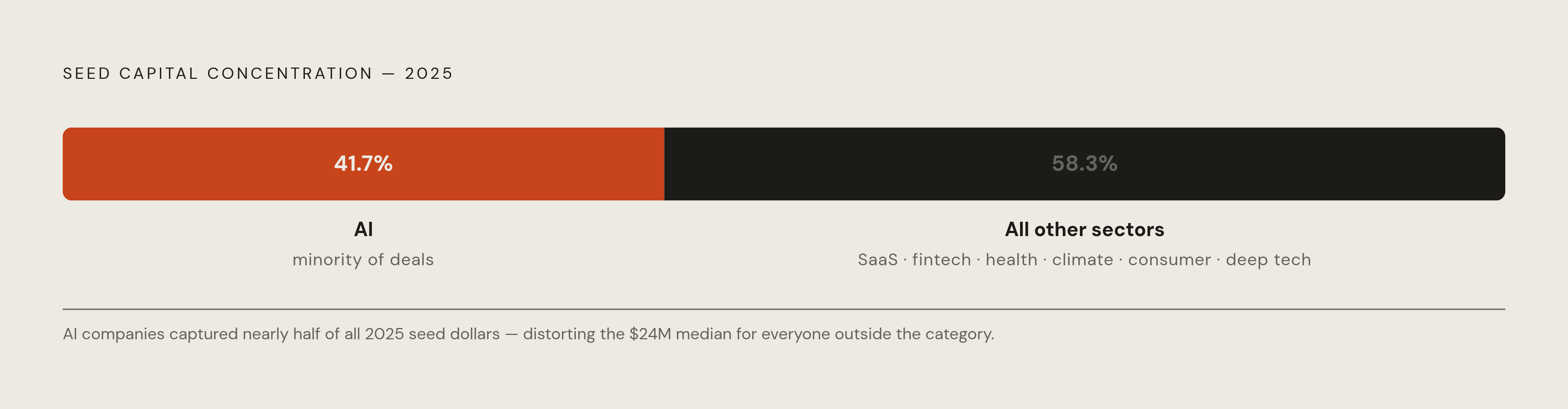
AI companies are capturing outsized capital despite being a small slice of seed deals.

Median seed post-money valuation hit a record high in the fourth quarter of 2025, up from a lower figure a year earlier and lower still two years before that. Round size barely moved, sitting near the same level the whole time, and that gap between price and cash raised comes down to one sector pulling the number up while everyone else gets priced by an older, quieter logic. Build in consumer, healthcare, or plain B2B software and anchor on $24 million, and you're probably mispricing your own round. Either you ask for more than buyers will pay, or you leave money on the table that your sector would gladly hand you.
Two instruments run seed deals right now. Priced rounds are more common at higher raise amounts, while SAFEs remain the dominant structure at the pre-seed level. A post-money SAFE with a valuation cap and no discount is the default pre-seed structure these days, and founders still confuse the cap with an actual valuation. It's a common mistake, especially among first-time founders who quote their cap in a pitch deck as though it were a term sheet. It isn't. The cap is a ceiling, and it only turns into real ownership math once a priced round happens.
Priced seed rounds work differently. The lead investor usually gets a board seat, ownership gets spelled out on day one, and the diligence bar climbs. Rounds have grown, and the market has shifted as both sides increasingly seek clearer ownership terms earlier in the process.
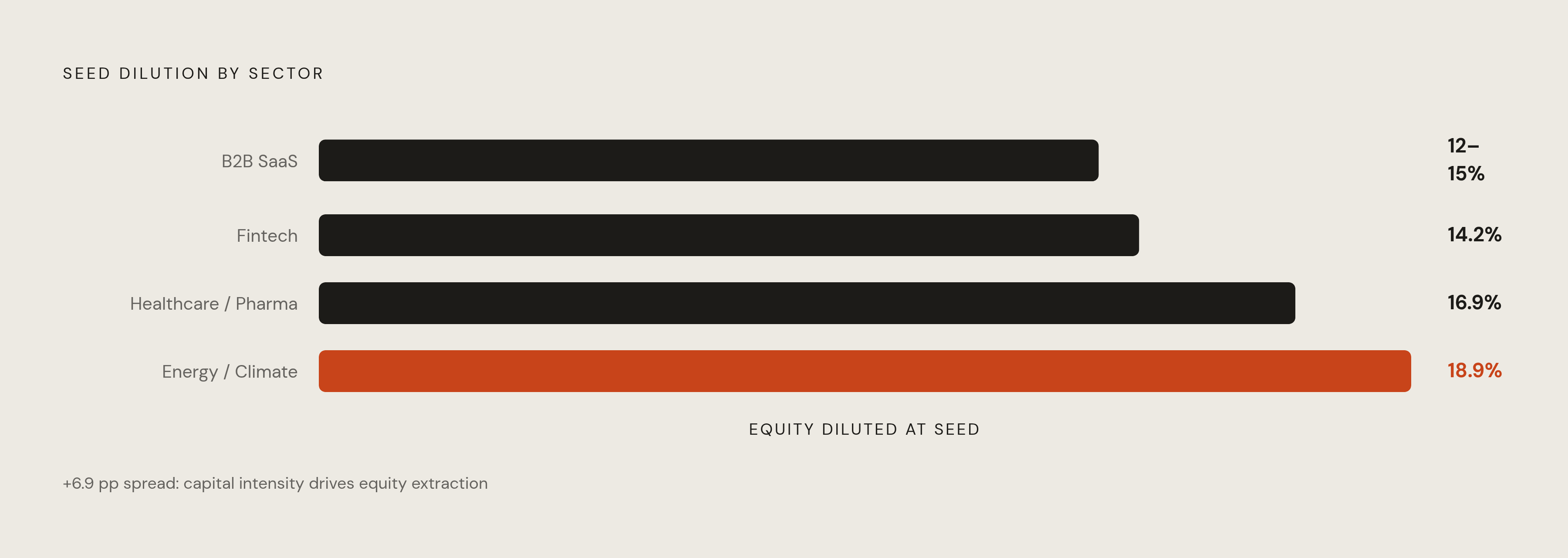
Typical dilution at seed runs around 20% for a priced round, though B2B SaaS tends to run lighter, closer to 12 to 15%. That spread trips people up constantly. A $20 million post-money valuation means one thing if you raised $3 million (15% dilution) and something meaningfully different if you raised $4 million (20% dilution). Two founders can quote the same post-money figure over drinks and walk away having given up very different chunks of their company. When you check yourself against sector benchmarks, compare pre-money figures, not post-money ones, since post-money bakes in your round size, and round size swings enough by sector to muddy the whole comparison.
AI and infrastructure: the sector pulling the entire market's median upward
AI and infrastructure sit well above every other seed category, and this is a structural shift, not a mood swing. AI seed rounds command roughly a 1.3x premium on round size over comparable non-AI deals, and the premium doesn't stop at seed. It compounds hard into Series A, where foundational-model companies raise at medians near $300 million against roughly $55 million for non-AI Series A deals. Wide enough that these start to look like different asset classes wearing the same paperwork.
The dollar concentration is the real story here. AI companies captured 41.7% of all seed capital in 2025, and that's 41.7% of the dollars, not just of the deals. A small number of large checks, going to a small number of companies, is dragging the whole market's median in one direction.
The premium exists because investors are competing hard for a category everyone believes runs winner-take-most. The best teams move from seed to Series A on unusually short timelines, and funds are afraid of missing the round that matters. None of that is irrational. But the $24 million headline says less about the average founder building outside AI and more about how hard investors are fighting over a narrow set of companies. If you're not one of them, use the non-AI median instead. And if you are building in AI, know the premium carries its own price: investors want sharper proof of technical differentiation and faster milestones before they sign.
B2B SaaS seed valuations: a market split into two distinct pricing tracks
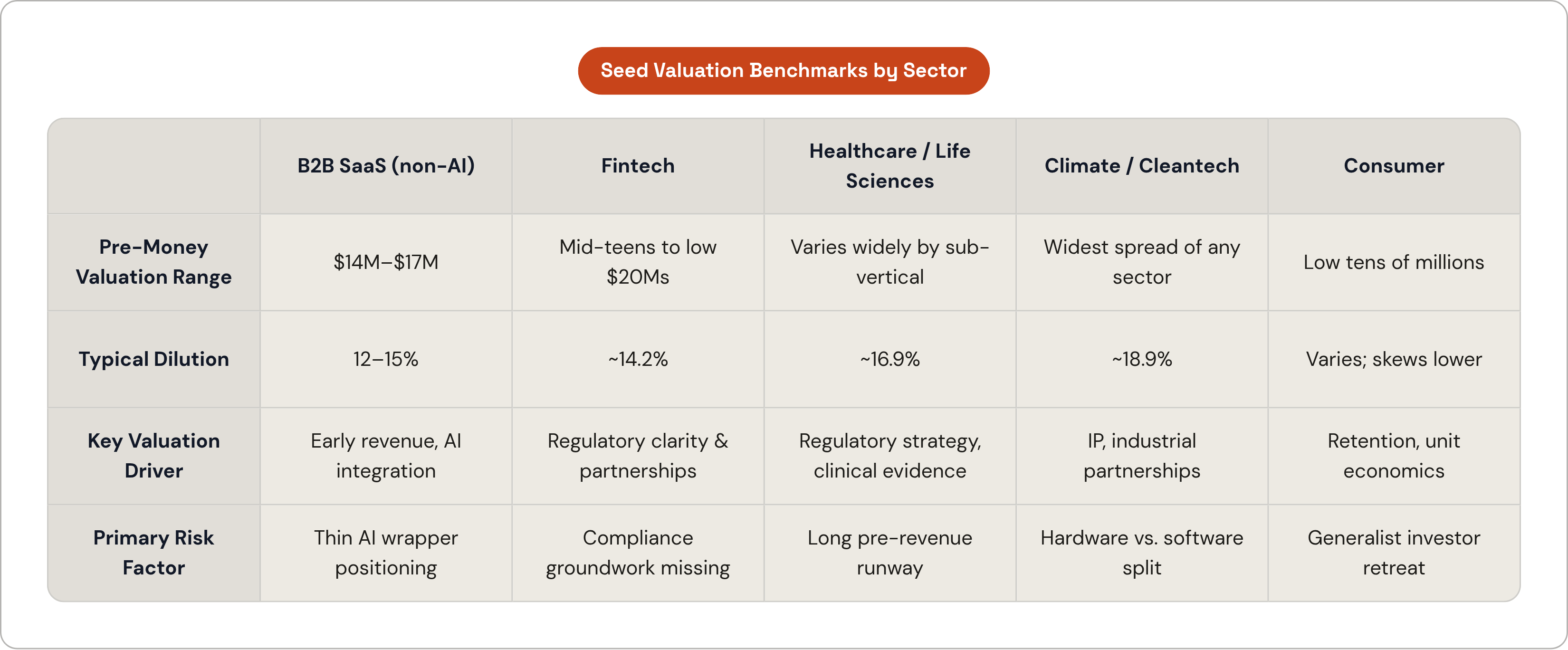
Non-AI B2B SaaS has settled into a narrow band: pre-money seed valuations of $14 to $17 million, round sizes typically a few million dollars, dilution running 12 to 15%. This is the software market most people picture when they hear "seed round," and it's held up against the volatility everywhere else better than almost anything in this piece.
AI-enabled SaaS runs on a different track entirely, closer to the AI premiums above. Series A data shows SaaS has effectively split into two categories with distinct median valuations, and that split is filtering down into seed now too.
Early revenue, a strong growth curve, and AI integration you can actually point to in the product push a founder toward the top of the $14 to $17 million range, even when the thing underneath is still a workflow tool wearing a new label. Pre-revenue founders, or ones without a clear edge against incumbents, land at the bottom or below it, and so does anything that reads as a thin wrapper around someone else's model. The distinction has become a visible, practical consideration in how investors evaluate deals.
The label "AI-enabled" does real work in pitch rooms this year. The answer changes which comps are relevant on the other side of the table. Know which track you're on before you walk in, because the investor across from you has usually already decided.
Fintech seed benchmarks: higher ceilings, but regulatory complexity changes the calculus
Fintech seed rounds typically land in the low millions, with pre-money valuations spanning a wide range from the mid-teens to the low twenties of millions, a noticeably wider band than SaaS. That width reflects real differences in confidence across fintech's sub-verticals. Sub-vertical positioning within fintech affects where a founder lands in that range, with regulatory clarity playing a significant role.
Recent pre-seed data puts finance ahead of every other sector in average pre-money valuation, at roughly €9.1 million, with moderate dilution around 14.2%. Investors are still showing up, just disciplined about how much of the company they'll take for it.
Fintech carries a specific tension. Regulatory complexity is a real moat, and investors like moats, but that same complexity slows diligence and compresses valuations for founders who haven't done the compliance groundwork before they start pitching. Existing bank partnerships, a regulatory pathway already tested, a founding team with real compliance experience rather than just good intentions: that's what pushes a fintech founder toward the top of that range instead of the bottom. Expect scrutiny on licensing strategy that a software founder elsewhere never faces, and expect it before anyone even asks about traction.
Healthcare and life sciences: the most capital-intensive seed category by round size
Healthcare startups averaged several million dollars in seed funding in recent batch analysis, the highest average raise of any sector, well above the lower amounts typical for AI and software companies. Bigger checks don't automatically mean bigger post-money numbers, though: dilution in healthcare and pharma runs around 16.9%, meaning investors write larger checks and take a bigger slice in return.
The capital intensity here is structural. FDA pathways, clinical validation, hardware certification, regulatory clearance: all of it needs cash long before revenue shows up. Investors price for the runway required to survive that gauntlet, not for near-term sales.
The sub-vertical split matters enormously. Digital health software, telehealth platforms, and care coordination tools get priced much closer to ordinary SaaS, while medical devices and therapeutics get priced as long-horizon, capital-intensive bets, closer to biotech logic than software logic. A clear regulatory strategy, a real clinical evidence plan, and ideally a strategic partner or a pilot with an actual health system substitute for the revenue traction a SaaS investor would otherwise demand. AI applied to healthcare is starting to draw its own separate premium too, and founders genuinely working at that intersection should say so plainly instead of burying it inside a broader healthcare pitch.
Climate and cleantech: the widest valuation spread of any seed sector
Climate and cleantech might be the hardest sector to benchmark cleanly, mostly because it spans several distinct business models under one label. Software-centric plays, carbon accounting tools, ESG reporting platforms, and grid optimization software raise and get valued much like B2B SaaS. Hardware-intensive ventures, fuel cells, battery chemistry, hydrogen production, raise significantly more capital and carry dilution closer to healthcare and pharma norms.
Energy and climate carry the highest average dilution of any sector, around 18.9%, since investors will fund long development cycles but want a bigger stake up front for the trouble.
Because the sector splits this cleanly down the middle, the benchmark question gets asked twice: what sector am I actually in, and is my business model software, hardware, or some hybrid of the two? European climate investment has picked up lately, with several new climate-focused funds launching in the second half of 2025. Founders with real exposure to European markets, or a mandate that lines up with European policy priorities, may find friendlier terms there than from funds that default to thinking US-first. Real IP, a strategic partnership with an established industrial player, and a credible path through hardware development and certification tend to earn the strongest seed valuations here. Investors don't expect revenue at this stage, but they do expect a believable roadmap for de-risking the core technical bet, and they'll read the absence of one as a red flag.
Consumer: the sector where the median is least useful as a benchmark
Consumer seed post-money valuations have drifted toward the low tens of millions, well below the aggregate $24 million figure, unless a company shows exceptional early traction. This is the one sector where quoting "the median" risks actively misleading someone.
Consumer funding split into two camps over the past couple of years. AI-hybrid apps and profitable direct-to-consumer brands with clean unit economics kept closing rounds, while nearly everything else hit a genuinely brutal market. Generalist investors who used to write consumer checks without much fuss have largely repositioned toward AI and infrastructure, leaving behind a smaller, more specialized pool of consumer-focused funds.
That contraction creates a selection effect in the data. The consumer deals that still close skew toward the strongest companies, which pulls the visible median up and makes the sector look healthier than it actually is underneath. Founders here are better served benchmarking against companies with a similar business model (subscription against transactional, direct-to-consumer against marketplace) at a similar traction level, rather than against a sector-wide number that flatters almost nobody. The one real exception: consumer AI products with proven retention and engagement now get judged against AI-style multiples instead of traditional consumer ones.
Deep tech, hardware, and robotics: where mega-rounds are redefining what "seed" means
Average deal sizes at seed and early-stage rose sharply in the fourth quarter of 2025, driven largely by mega-rounds in robotics, AI, semiconductors, and defense tech. Hardware finished the year as the second-largest sector by total pre-seed cash raised, with biotech and pharma close behind in third, both climbing from where they sat in 2024.
One event captures the moment better than any aggregate stat. A small number of outsized rounds drove much of the growth in that total, with a few individual deals accounting for a disproportionate share. That's a record, though a single outlier is doing a lot of the lifting here. Large seed rounds concentrated almost entirely in AI, robotics, and defense tech, not deep tech broadly.
What's emerging looks like a barbell. Small, cheap rounds cluster at one end, and large, expensive rounds with a credible lead cluster at the other. The middle, an ordinary $3 to $4 million seed round in hardware or robotics, is thinning out, and oddly enough, it may now be harder to close than either extreme. Decide early which end of the barbell you're aiming for, because the instruments, the investor base, and the pitch itself all differ substantially depending on the answer.
What the concentration of capital tells founders about where the real competition is
Startups on major cap-table platforms raised close to $120 billion over 2025, up sharply from the year before, and the fourth quarter alone brought in $36.1 billion, the strongest single quarter since the second quarter of 2022. On paper, that looks like a boom.
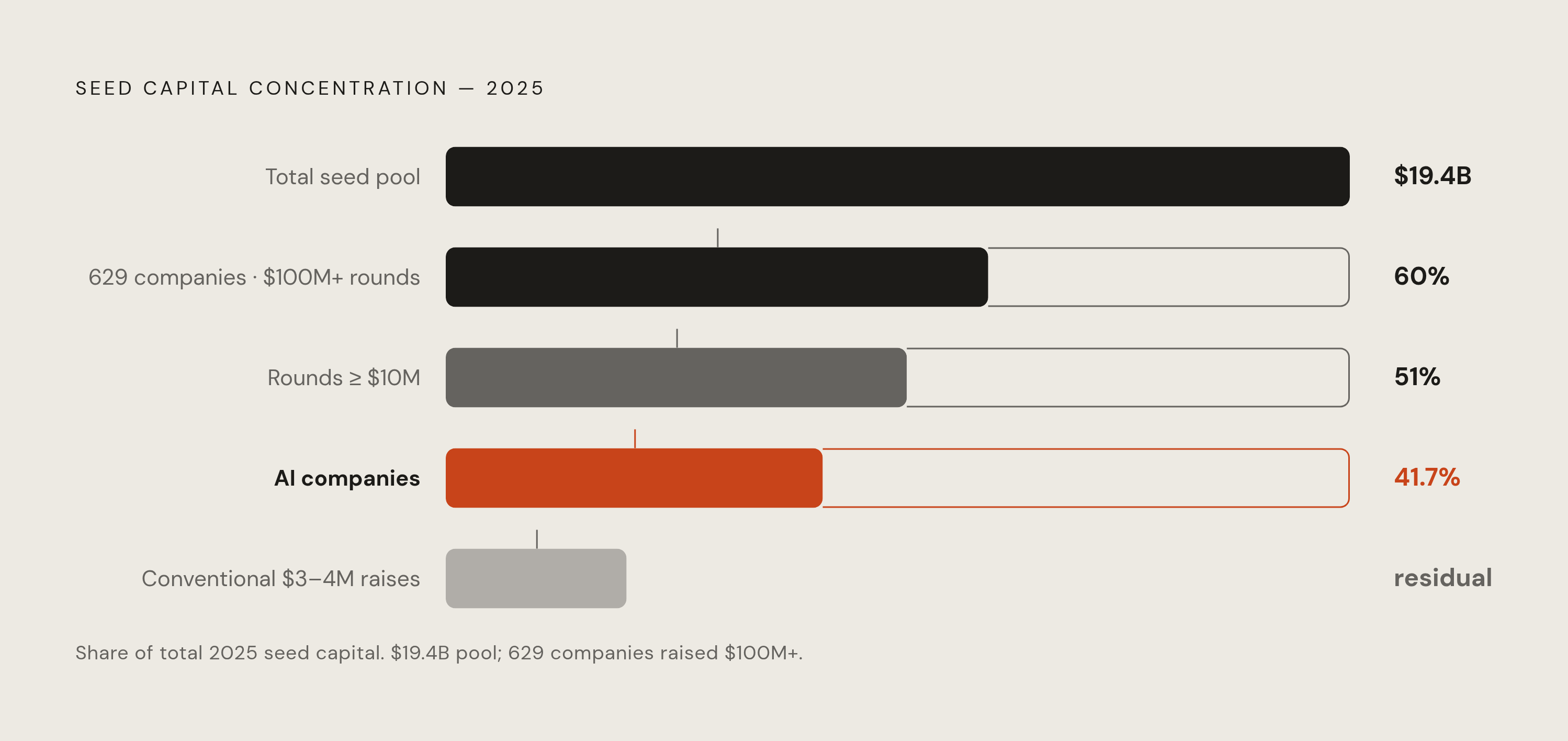
Look closer and the picture changes fast. Roughly 60% of all invested capital went to just 629 companies that each raised $100 million or more, while the vast majority of startups shared a much smaller slice of total capital raised. Seed rounds made up a large share of all new venture deals but a much smaller share of total dollars, which tells you exactly where the money is concentrating, even while deal counts stay high.
Rising medians reflect fewer rounds closing, at higher prices, among a narrower set of companies. They don't reflect any broad easing in the fundraising climate, whatever the headline suggests. Knowing your sector's valuation range only helps if you're pitching investors actually active in that sector, at that stage, right now. Over half of seed dollars in 2025, 51%, went into rounds of $10 million or more, which means a founder raising a conventional $3 to $4 million round is competing for the remaining 49% of roughly a $19.4 billion pool, against a smaller but still meaningfully active group of investors.
How to use sector benchmarks to set a valuation that closes rather than stalls
Every number in this piece is a median or a range, not a price tag. Treat it as a zone of credibility: the window inside which an investor treats your pitch as a serious offer rather than as the opening move in an argument about whether you understand your own market.
Start with your actual comp set, not your industry label. A healthcare founder building pure software should benchmark against SaaS, not against device makers running clinical trials. A SaaS founder with genuine AI integration should say so plainly and expect a different set of comps than a pure workflow tool gets. Vague self-description costs founders real valuation, because investors default to the least generous comp available when you don't hand them the right one yourself.
Match your ask to your round size, not just your sector's post-money headline. Go back to the dilution math from the opening section: the same post-money number implies very different dilution depending on how much you're actually raising. Walk into a meeting quoting a post-money figure without having run that arithmetic yourself, and you'll lose credibility fast with an investor who already ran it before you sat down.
Target investors who are actually writing checks in your sector and at your stage, not generalists chasing the AI premium into every meeting on their calendar. The capital concentration data makes this concrete: a huge share of seed dollars now goes into a small number of large rounds, so the remaining pool of check-writers for a conventional raise is smaller than it looks from outside, and pickier about what they fund. Founders who know exactly where they sit, sector, sub-vertical, business model, round size, walk into that smaller pool with a number that gets signed instead of shelved. Metal, an AI-driven fundraising platform that surfaces investors actively writing checks at a given stage and sector and manages the outreach pipeline around them, is built to close exactly that targeting gap.