Decoding VC Fund Thesis Pages for Real Targeting Signals
Founders who read VC thesis pages as legal documents, not marketing, win funding faster.

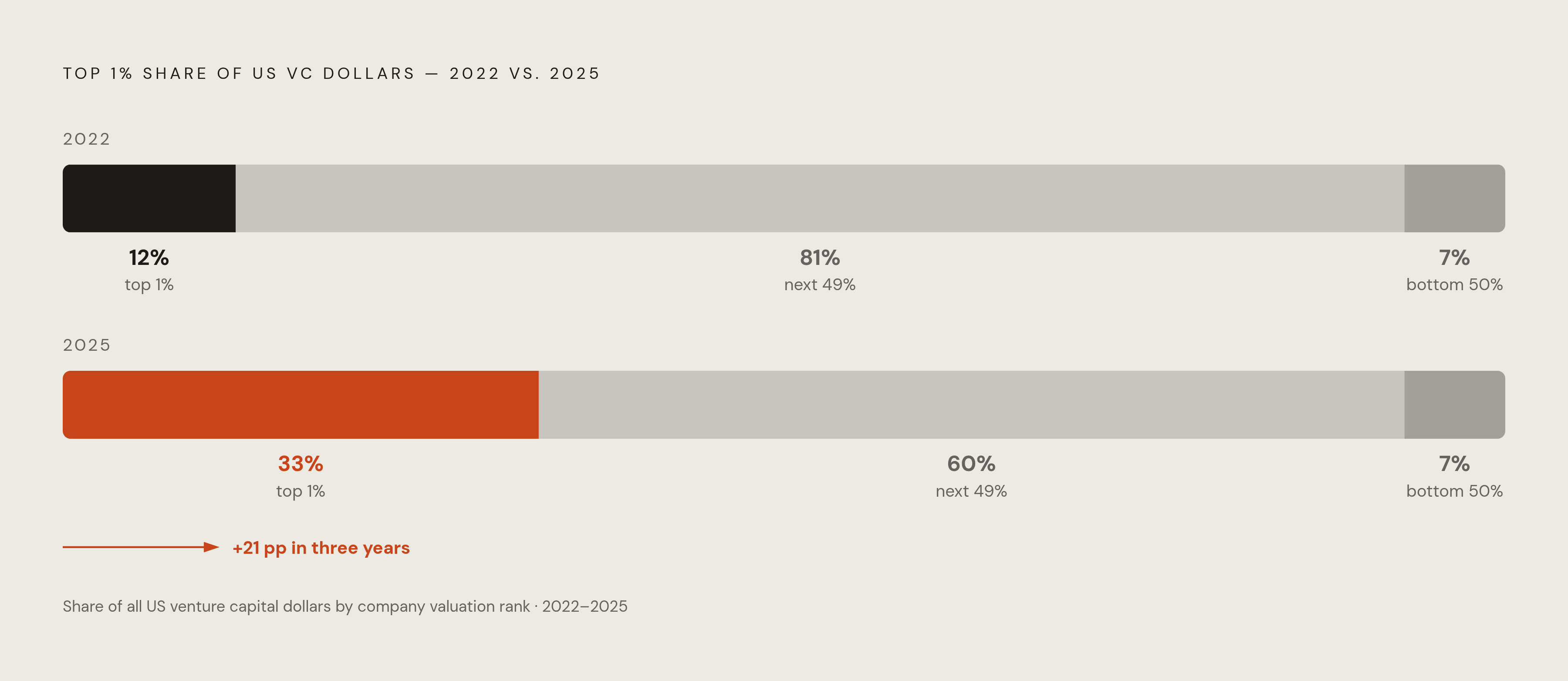
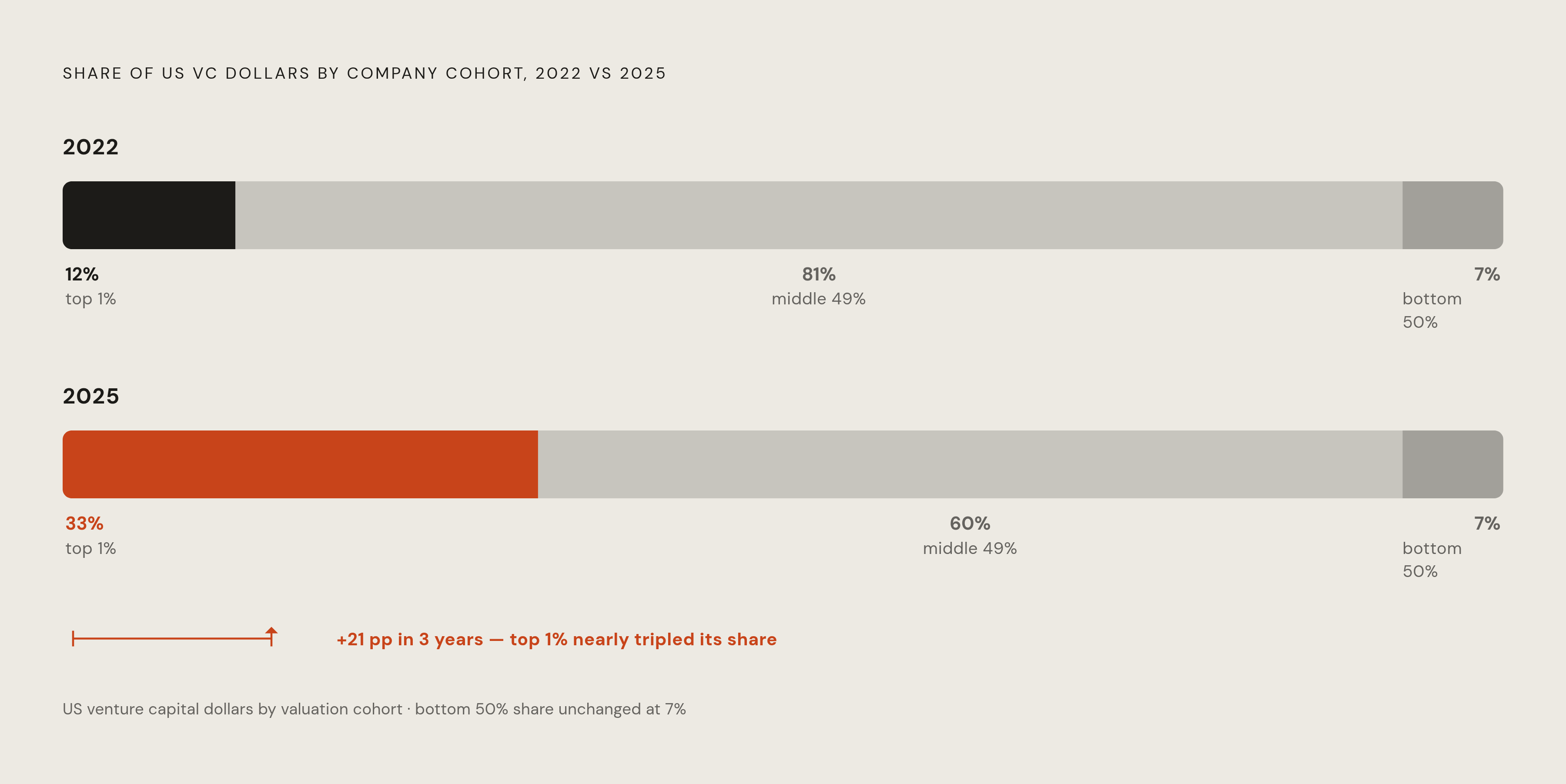
A VC fund's thesis page is not marketing copy. It is a constraint document, written under pressure from limited partners, and founders who read it as a legal filing rather than a pitch deck can filter out the wrong meetings before they cost anyone runway. That distinction matters more now than it did three years ago. The 2025 venture market has bifurcated sharply, with SVB's State of the Markets showing 33% of all US VC dollars going to the top 1% of companies by valuation, up from 12% in 2022, while just 7% of capital reached the bottom half of companies. That is not a soft market. It is a surgical one.
A VC thesis page is written for limited partners, not founders, which means it functions as a constraint document rather than an invitation. Reading it that way requires checking five layers in sequence: sector language (specific phrases repeated across the site, partner posts, and talks carry real conviction; broad category labels do not), stage language cross-referenced against actual portfolio entry points (believe the portfolio when it contradicts the page), check size math against your valuation, geographic scope as a legal limitation rather than an aspiration, and thematic language dated against the fund's most recent closes. In the 2025 market, where 33% of all US VC dollars flow to the top 1% of companies by valuation, a generic pitch fails not because the pitch is bad but because the founder treated a legal-adjacent document as marketing boilerplate. The founders closing rounds are the ones who ran a six-criteria binary filter, sector match, stage match, check size compatibility, geographic scope, deployment timing, and portfolio gap opportunity, before sending a single message.
Seed rounds tell the same story from a different angle. Deal count has declined even as total seed dollars hold roughly flat, which means the rounds that do happen are bigger and the bar to reach one is higher. Median seed pre-money valuation hit $16 million in 2025, up 18% year over year. Getting a seat at that table now requires clearing a sharper filter than founders faced even two years ago, and "spray and pray" outreach, once a wasteful habit, is now a real structural disadvantage. Every fund operates inside a specific thesis and a fairly consistent evaluation process; a generic pitch fails not because the founder pitched badly but because they treated a legal-adjacent document as boilerplate. The founders closing rounds right now are the ones who worked out fit before they ever hit send.
What a VC thesis page is actually built to do — and who it is really written for
A thesis page has two readers, and only one of them is you. Limited partners, the institutions and family offices who commit capital to a fund, read it to decide whether a general partner has disciplined judgment and a defensible edge. Founders read the same page to decide whether to pitch. But the page is written for the first audience, not the second, and once you know that, the language stops looking like marketing and starts looking like evidence.
Data on fund formation shows the median number of LPs in mid-sized funds falling sharply over that period. Fewer LPs means each one holds more leverage over the general partner, and that leverage pushes GPs toward narrower, more defensible thesis language. A fund that has been through that kind of LP scrutiny and still landed on a tight, specific thesis is not posturing. It survived a real filter to get there.
The standard anatomy of a thesis page includes sector and sub-sector focus, stage range, check size band, geographic scope, thematic conviction, and something less obvious: portfolio gap criteria, meaning the kind of company the fund still needs to complete its picture. Each of these is a data point on its own, but together they form a targeting filter founders can run before writing a single word of outreach. One widely cited framework on venture thesis construction makes the point directly: the strongest thesis statements combine a market tailwind argument, a structural moat hypothesis, and a portfolio-fit rationale, all three at once. A founder who knows that structure can hold their own positioning up against it and see immediately where the fit is real and where it is wishful.
Fund vintage matters here too. A fund's second or third vehicle should generally show narrower conviction than its first, fewer sectors, tighter stage focus, because the GP has had time to develop real pattern recognition from the first fund's outcomes. A Fund I with broad, exploratory language is doing what Fund I's do. A Fund III with that same breadth has either not learned anything or is not telling you what it learned.
The five layers of a thesis page and how to read each one for targeting signal
Sector language is the first layer, and the gap between broad and specific tells you almost everything. "Enterprise software" is a category so wide it excludes almost nothing; "AI-native infrastructure for industrial workflows" excludes almost everything except your exact company. Check whether that specific language repeats across the fund's site, partner blog posts, and public talks. Repetition across channels is convergent signal, real conviction rather than a one-off phrase someone wrote for the homepage. BMW i Ventures closed its Fund III in April 2026 at $300 million, bringing total assets under management to $1.1 billion, and the public pivot toward agentic AI, physical AI, and industrial software in that announcement concentrates real targeting opportunity for founders building in those exact categories, and dilutes it for everyone else.
Stage language is the second layer, and it is close to useless on its own. "Early stage" could mean a technical prototype or a company with initial enterprise contracts and proven unit economics; the words alone don't say which. Increasingly, Series A rounds expect meaningful monthly recurring revenue along with a defensible CAC-to-LTV ratio, so a thesis page that says "Series A" while describing "technical breakthrough" or "early exploration" language is describing two different companies. Check the fund's actual portfolio entry points against the stage language on the page. If the portfolio skews later than the stated stage, believe the portfolio.
Check size is the third layer, and it carries hidden math about ownership and reserves. A fund writing smaller checks while leading rounds needs a meaningful ownership percentage to make its model work; if your valuation doesn't leave room for that stake, the check size disqualifies you even when the sector thesis fits perfectly. Watch for language about "long-term partnership" and "follow-on support," because that phrasing usually means the fund reserves capital for pro-rata participation in later rounds. Their initial check is a fraction of the total they intend to commit, which means they're already selecting for companies they expect to back twice.
Geography is the fourth layer and it is a legal constraint, not an aspiration. Fund structure, LP domicile, and regulatory scope often tie a fund to specific geographies in ways that have nothing to do with preference. Some funds list three regions on their site but have board-level bandwidth for one; portfolio concentration will tell you which region actually gets the attention.
Thematic language is the fifth layer, and it decays. "The future of work" or "climate infrastructure" was fresh once; if that phrase is several years old and the fund's recent deals have moved elsewhere, the thesis page is a historical artifact, not a live filter. Some partners update their thinking quarterly through blog posts; if the fund's website thesis reads older than its latest closes, weight the recent deals more heavily than the page.
Reading portfolio composition as the thesis page's honest revision
A fund's actual portfolio is what its thesis looks like after it met reality, and it deserves more trust than the language on the site. Map the sector distribution, the stage at entry, the check size implied by reported ownership stakes, and the time gap between deals in any one category. A cluster of investments in a category the thesis page barely mentions is an underused signal; it usually means real conviction the fund hasn't gotten around to publicizing, or has chosen not to.
Gaps matter as much as clusters. A fund with five infrastructure bets and no application-layer company in the portfolio might be actively hunting for one, or might have a principled reason for staying out of that layer entirely. The way to tell the difference is to check whether a partner has explained the gap somewhere public, a blog post, a podcast, a conference talk. If no explanation exists, treat the gap as opportunity rather than as a wall. Specialist funds in particular lean on deep, narrow sector knowledge to find opportunities generalists miss, so a tight portfolio is frequently a sign of thesis strength rather than a limitation founders should read as caution.
Behavioral divergence is where this gets sharper. If a fund's last eight deals sit in categories its thesis page doesn't mention at all, one of two things is happening: the thesis evolved and nobody updated the website, or the fund is opportunistic rather than conviction-driven. Those two situations call for opposite responses. The first means reference the recent deals directly in outreach, since that's where the real thesis lives now. The second means the fund is a lower priority, because opportunistic capital is harder to predict and slower to commit, which is the kind of distinction Metal, an AI-driven platform that helps founders surface the right investors and manage deal pipelines through proprietary private-market intelligence, is built to surface before a founder wastes outreach on the wrong fund. Qubit Capital Tools to Track Investor Pipeline noted more than 2,300 venture-backed M&A deals globally in 2025, and that kind of dataset gives founders a real audit trail, not for a comprehensive database crawl, but for a targeted read of a fund's last ten to fifteen investments: stage at entry, sector, geography, nothing more elaborate than that.
What thesis pages don't say — and the signals that fill the gap
What a fund refuses to do is often stated more precisely than what it will do. A few funds publish explicit exclusions: no pre-product companies, no regulated industries at seed. Most don't write it down at all, but the same information sits in what's absent from the portfolio. Language like "category-defining" or "long-term compounding" is worth reading as an anti-signal for anything built as a quick flip; that fund's conviction is structural, and a business model built for a fast exit will read as a mismatch even if the sector lines up.
Deployment timing is a separate, live signal that thesis language never states outright. A fund in year one of deploying a new vehicle is actively hunting for new positions to fill the portfolio. A fund in year three or four is mostly reserving capital for follow-ons in companies it already backs, and new outreach competes for a much smaller slice of attention. Thesis pages don't say which situation applies, but close dates, announcement timing, and the observable pace of new deals do. Some tracking platforms now monitor thesis language, check size, and deployment pace across large numbers of active funds simultaneously, and founders who fold that kind of monitoring into their research get timing intelligence no static thesis page will ever hand them.
Content is the clearest early signal of all. A partner who has published three separate pieces on agentic AI infrastructure in six months is telling you where their conviction is building in real time, and that is more useful than a thesis page nobody has touched in two years. Watching where a partner spends attention on social media or podcasts, before a single check gets written in that space, lets a founder spot the inflection point before other founders even notice the fund is moving.
The reserve ratio deserves its own scrutiny, because it is effectively a second thesis operating quietly inside the first. Time between rounds has stretched across the market, and a fund whose language leans on "partnership" and "follow-on support" is telling you that its reserve bucket is doing real work. Watch what happens in a bridge round: insiders participating signals real conviction carrying forward, while a cap table where no existing investor shows up is a signal every new investor in the room will clock immediately.
Turning thesis intelligence into a precision targeting filter before any outreach begins
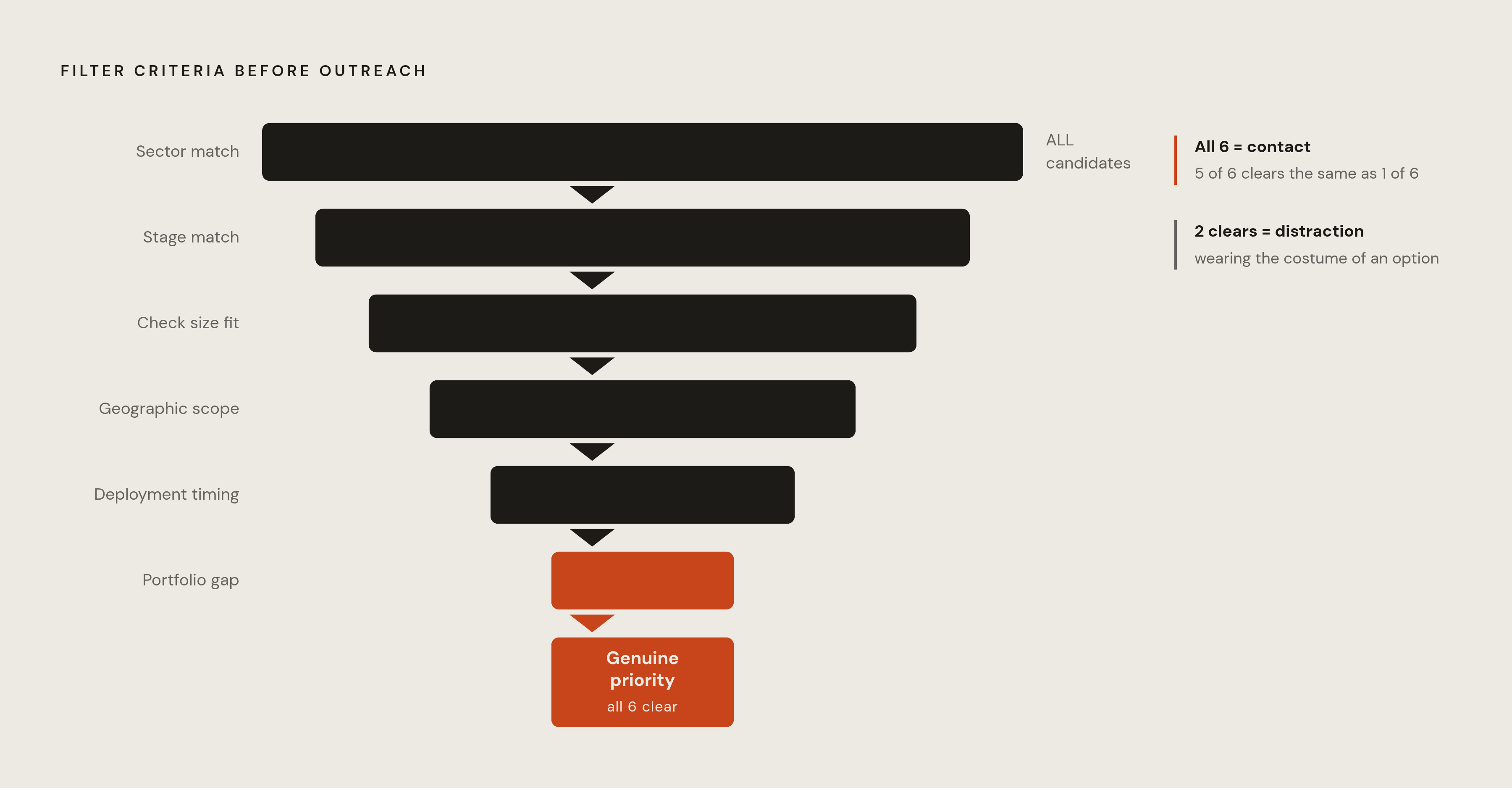
None of this analysis is worth much unless it ends in a binary decision, fit or no fit, made before a single email goes out. Six criteria matter: sector match, stage match, check size compatibility with your valuation, geographic scope, deployment timing, and portfolio gap opportunity. A fund clearing all six is a genuine priority. A fund clearing two is a distraction wearing the costume of an option.
Building this into a repeatable process starts with generating a candidate list through sector and stage screens, using platforms built for exactly that job: Crunchbase for sector tagging, Tracxn, which tracks more than three million companies across sectors, and Harmonic, which indexes over thirty million companies and tracks founder movements, hiring signals, and early traction indicators. From there, run the five-layer thesis read described above against each candidate, written thesis against portfolio pattern against behavioral signal against anti-thesis against deployment timing. Score each fund for portfolio gap opportunity, meaning whether your category is one the fund has been circling or one it has consciously avoided. Then stage the outreach itself by conviction tier: the highest-fit funds get personalized messages that reference specific thesis language or portfolio companies, while mid-tier funds get held back, pursued only through warm introductions rather than cold contact.
Personalization is where all this work actually pays off. Naming a specific portfolio company, quoting the fund's own thesis language, or referencing a partner's recent podcast appearance in an opening message tells the fund you did the homework, and it reframes the pitch as confirmation of a thesis already in motion rather than a cold ask starting from zero. A handful of AI-assisted fundraising tools now help founders draft messages matched to a fund's actual investment record instead of its self-description, which is a meaningful upgrade over guessing at fit from the homepage alone. The discipline underneath all of this mirrors exactly what institutional LPs do when they evaluate whether to back a given GP in the first place; founders who apply that same rigor to picking their investors close faster and burn far fewer relationships chasing funds that were never going to say yes. Fundraising, treated this way, is an operational process: targeting, filtering, sequencing, repeatable steps rather than a series of intuition calls.
What are the most common misreads that send founders to the wrong funds?
Taking stage language at face value is the most common mistake. A fund calling itself "early stage" while its portfolio shows a consistent pattern of entering at Series A revenue levels is not, in practice, a seed fund, no matter what the homepage says. Behavior overrides stated preference every time.
Treating an old thesis page as current is the second. A thesis written three to five years ago and left untouched has almost certainly drifted from what the fund actually does now, especially given how fast AI-driven sectors have moved through 2024 and 2025. When the written thesis and the recent portfolio disagree, trust the portfolio. When partner content disagrees with both, trust the content, since it's the freshest signal of the three.
Confusing thematic interest with an actual investment mandate is the third misread, and it's grown more common as AI conversation has flooded every fund's public output. AI drew more than a quarter of all global VC funding in 2025, up from 15% in 2024, which means nearly every fund on the market is now writing publicly about AI whether or not they're actually writing checks in it. Content signals in that category need portfolio confirmation before they mean anything; a fund's essay on the future of AI agents is a much weaker signal than an actual check written into an AI agent company in the last two quarters.
The fourth misread is treating the fund as a single, uniform mind. A thesis page states the firm's collective position, but individual partners often carry their own thesis tracks inside that broader frame, shaped by their own sector background and deal history. Founders who take the time to identify the right partner within a fund, not just the right fund on paper, are working from a sharper, truer picture of where the actual conviction sits.