SAFE vs. Priced Round Tradeoffs at the Seed Stage
SAFEs dominate pre-seed while priced rounds take larger seed deals.

How each instrument works, stripped of jargon
A SAFE, simple agreement for future equity, is a contract. It isn't equity, and it isn't debt. It grants an investor the right to receive shares at a future priced round, and it carries no interest rate, no maturity date, and no repayment obligation, which is the feature that separates it from a convertible note. Two variables do all the work: the valuation cap, which sets a ceiling on the price at which the SAFE converts, and the discount rate, an optional reduction against whatever price Series A investors pay. Some carry a most-favored-nation clause that lets an investor claim better terms if a later investor gets them. Until conversion, a SAFE holder has no voting rights, no board seat, and no formal information rights. The document runs a few pages, and a founder can close one in the time it takes to get a wire transfer confirmed.
A priced round works differently from the ground up. It sets a specific pre-money valuation, adds the new capital, and calculates a per-share price at signing, so every investor knows their exact ownership percentage the moment the round closes. That precision costs paperwork, requiring at minimum a stock purchase agreement, an investor rights agreement, a voting agreement, and an amended certificate of incorporation. Investors get preferred stock, which usually comes with liquidation preferences, anti-dilution protection, protective provisions, pro rata rights, and often a board seat. CRV's research puts legal fees for a priced seed round at $30,000 to $50,000, with the process routinely stretching past a month.
The detail most founders miss is the 2018 shift Y Combinator made from the pre-money version of the SAFE to the post-money version. Under the old pre-money version, the cap referred to the company's value before the raise, and founders shared dilution from each new SAFE with the SAFE holders who came before them. Under the post-money SAFE, now the market default, each investor's ownership percentage locks in at signing. Every SAFE issued after that dilutes the founder alone, never the earlier holders. That single mechanical change is why SAFE stacking has become the dilution trap it is today, and it is the single most consequential legal-drafting decision in the modern seed market. The post-money capped SAFE is the instrument, full stop, and everything else is a rounding error. It is the instrument, full stop, and everything else is a rounding error.
Where each instrument dominates in the 2025–2026 market data
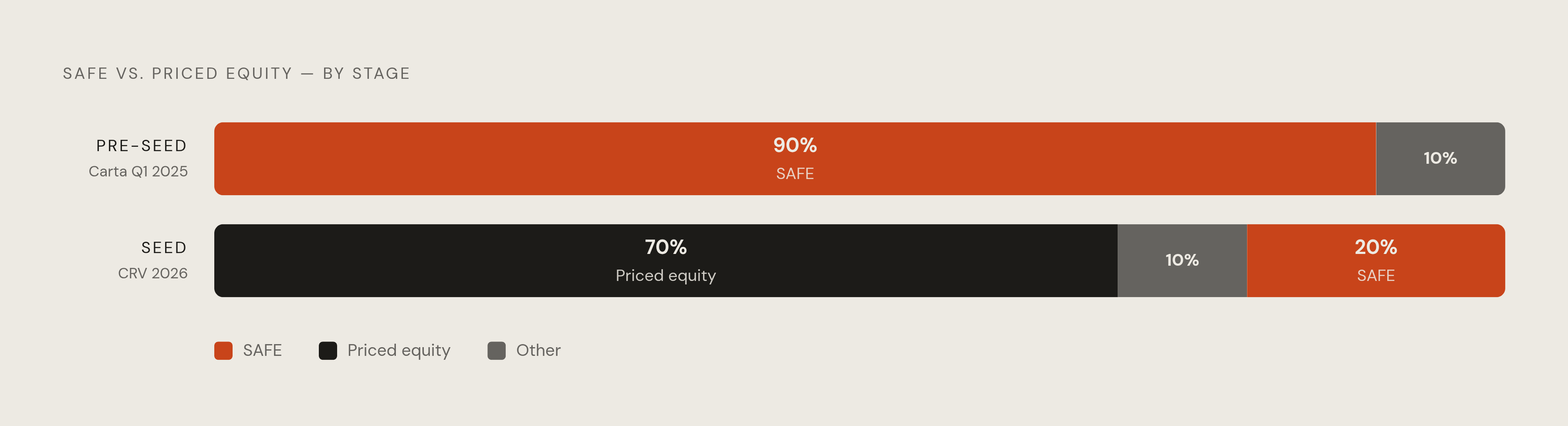
At pre-seed, the SAFE has won the argument. Carta's Q1 2025 data put SAFEs at 90% of pre-seed rounds, a record high, with convertible notes reduced to a small minority and priced equity barely present.
CRV's 2026 analysis found that seed rounds above a few million dollars flip decisively toward priced equity, accounting for about 70% of deals at that size, while SAFEs drop to roughly 20%. Below that... CRV's 2026 analysis found that seed rounds above a few million dollars flip decisively toward priced equity, accounting for about 70% of deals at that size, while SAFEs drop to roughly 20%. Below that threshold, SAFEs dominate. The real decision zone is between a few million dollars and a somewhat higher ceiling, where either instrument is genuinely viable and the cumulative dilution math starts to matter in a way it simply doesn't at smaller raise sizes.
The math behind the market's behavior isn't complicated: legal costs run $1,000 to $3,000 per SAFE close, against $15,000 to $50,000 for a priced round. Funds accept the YC Post-Money SAFE without a fight because it protects their downside well enough, and founders keep reaching for it because it's fast and cheap. That's the whole story of why it became close to universal at seed.
The bifurcation in the market matters here too. An AI-native startup raising a large seed at an elevated cap operates under different pressure than a SaaS company raising a modest pre-seed with thin traction and no obvious defensibility yet. Median seed post-money valuation hit $24 million in Q4 2025, up from $18 million a year earlier, but that number is getting pulled upward by AI mega-rounds at the top of the distribution. Carta data show SAFE caps for sub-$1 million pre-seed rounds held close to $10 million, largely unmoved by the frenzy above them. The headline valuation increase never reached the smallest rounds.
The dilution founders see versus the dilution they signed up for
A priced round settles founders' exact ownership percentage the day it closes. Every investor holds shares, the cap table reflects reality, and a founder knows their exact ownership percentage before the wire even lands. A SAFE defers that same question. The cap table shows no new equity outstanding until the Series A triggers conversion, at which point every outstanding SAFE converts at once, often in a single crowded moment that a founder didn't model going in.
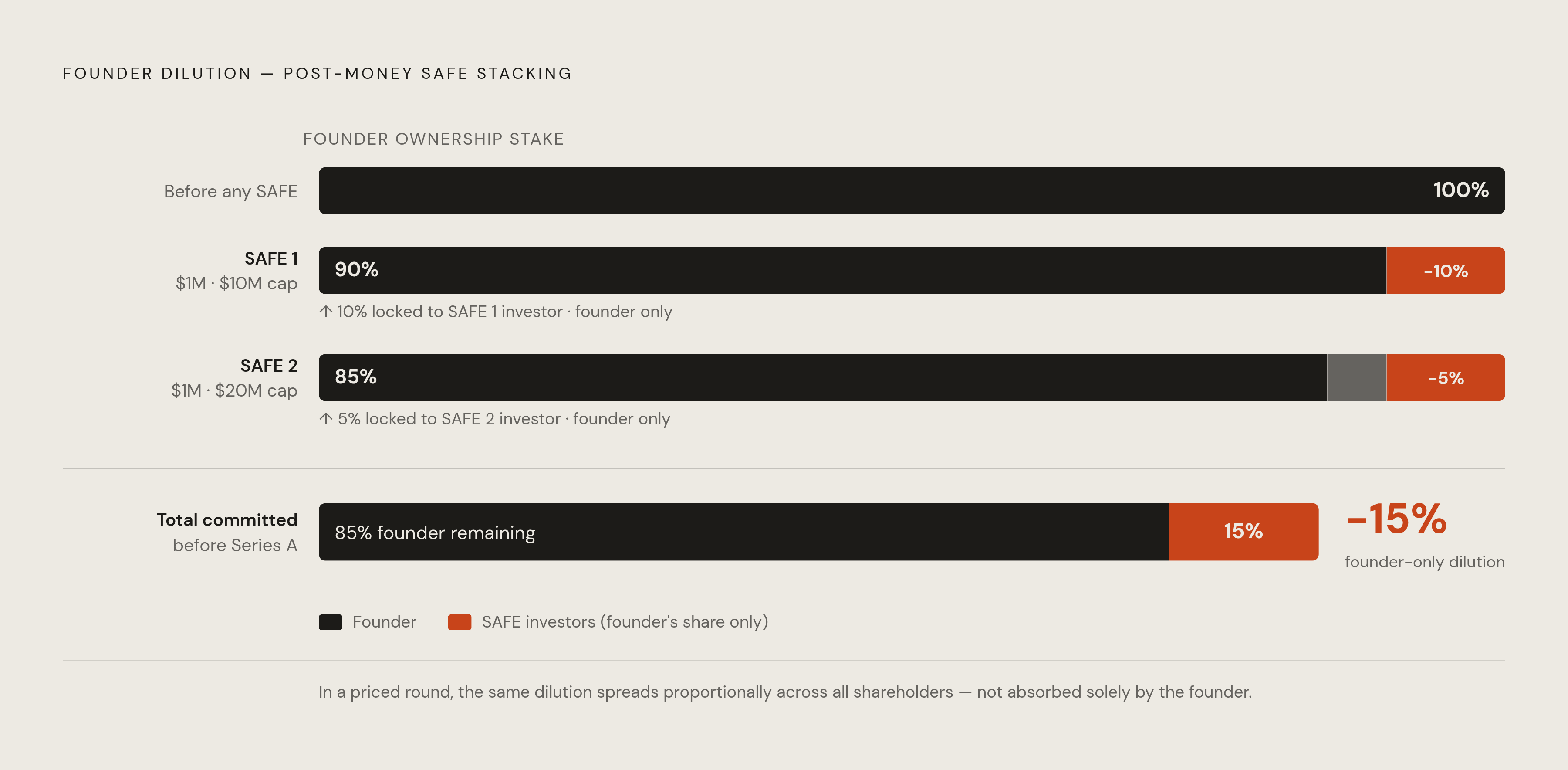
Run the stacking mechanics directly. Raising $1 million on a $10 million post-money cap commits 10% ownership. Raising another $1 million later on a $20 million cap commits another 5%. Total committed dilution before a single Series A investor has written a check: 15%, all of it absorbed by the founder alone. In a priced round, dilution from a new investor spreads proportionally across every existing shareholder. Under the post-money SAFE standard, it doesn't spread anywhere. It lands entirely on the founder's side of the table, every time, and most first-time founders don't understand this until they see it happen on their own cap table.
MFN clauses add another layer of complexity. An MFN clause allows an earlier SAFE holder to claim better terms if a subsequent investor receives them, which can compound dilution across the entire outstanding stack in ways founders rarely model in advance.
Median founder ownership runs around 56% after seed, drops to 36% after Series A, and falls to 23% by Series B. The instrument chosen at seed leaves that compression curve largely unchanged. What it changes is which part of the curve a founder can actually see and negotiate, and which part becomes a surprise. A SAFE doesn't reduce total dilution. It delays the visibility of it, and that delay carries real consequences, because founders make decisions between rounds, hiring plans, option grants, follow-on raises, based on an ownership number that may be far higher than what actually survives conversion.
What a priced round costs founders, and what it buys
Speed and legal cost are the two advantages everyone cites for SAFEs, and the figures back them up: legal costs run $1,000 to $3,000 per SAFE close against $30,000 to $50,000 and a month-plus timeline for a priced round. GoingVC's research found that platforms built for cap table management and fundraise administration have compressed what once took months into weeks, removing a barrier that used to make priced rounds impractical for smaller seed raises.
But a priced round buys something a SAFE structurally cannot deliver. The cap table is clean and settled the day the round closes, with no conversion waterfall to model later and no retroactive math waiting to surprise anyone. Governance terms get negotiated explicitly at the table rather than deferred to some future date when leverage may have shifted against the founder. A priced round also signals to future investors that the company's legal and operational plumbing is in order, which matters when a Series A lead is deciding how much diligence to run. A priced round also gives investors settled share ownership from day one, which can matter for both parties as subsequent financing conversations begin.
That clarity matters for hiring, especially for early hires weighing offer equity against risk.
Governance is where the difference sharpens most. SAFEs and convertible notes largely sidestep formal investor governance, so founders typically hold every board seat through the seed stage. Priced rounds introduce protective provisions, anti-dilution rights, and board dynamics that persist and compound through every subsequent financing, they don't go away once the round closes. A priced round tells the market a company is ready for institutional capital, and that signal matters most precisely when a founder's target Series A leads expect a settled cap table and structured governance on day one of diligence.
The five situational questions that determine which instrument fits
Deal size is the first filter, and the conventions are fairly rigid. Below a few million dollars, the SAFE is close to the only instrument anyone reaches for, since the legal cost of a priced round is disproportionate to the capital raised. Between a few million dollars and a somewhat higher threshold, either instrument works, and the cumulative dilution math becomes the deciding factor rather than convention. Above that threshold, the market has largely decided: 70% of deals that size use priced equity, and investors writing checks that large expect preferred stock, not a contractual promise.
Second, ask how many SAFEs are already outstanding. Each additional post-money SAFE at a new cap adds dilution the founder alone absorbs, and if the cumulative committed percentage from prior SAFEs is climbing toward uncomfortable territory, a priced round can stop the compounding before it gets worse.
Third, ask whether a founder can defend a valuation today with a straight face. A company with a meaningful base of ARR and a clear growth trajectory has a real argument for locking in a valuation now through a priced round, rather than punting that conversation to a moment that might not be friendlier. A pre-revenue company forcing that same conversation risks getting stuck with a cap that undervalues where it's actually headed, and a SAFE lets price discovery wait until the picture clears up. In 2026, AI-native startups with credible teams and a defensible data angle can often support an aggressive SAFE cap or a priced seed valuation that would be unreachable for a consumer or SaaS company still working to prove out its metrics.
Fourth, what a target Series A investor actually expects to find still needs to be addressed. Most institutional Series A funds don't invest through SAFEs. They want preferred stock, and they want a cap table they can underwrite fast. A fragmented SAFE stack, multiple caps, layered MFN clauses, slows that process down and can trigger renegotiation demands before a term sheet even gets issued. Series A leads generally target around 20% ownership, calculated against the fully diluted cap table, so every outstanding SAFE gets counted before the new investor's math even starts. That number moves less than founders hope.
Fifth, how much speed matters right now is a simple question. A SAFE can close in days and get signed investor by investor as commitments trickle in, with no requirement that everyone close at once. A priced round requires simultaneous closing across every investor, can take months to negotiate if terms get complicated, and demands legal bandwidth a lean founding team may not have to spare. When momentum is the asset, an accelerator demo day approaching, a competitor making a move, a customer win that needs announcing, the SAFE's speed advantage is a critical edge. It's often the deciding factor.
The cap table modeling work founders skip
The most common mistake in this kind of financing-instrument-heavy raise is failing to model the full conversion scenario, option pool expansion included, before signing each new one. Founders model the current raise in isolation and skip the exercise of stacking it against everything that came before it. Data on founder ownership trajectories show that more founders are arriving at Series A with fragmented cap tables and unclear dilution pictures, and the instrument decisions made at seed are the primary driver of that outcome.
Before signing any new SAFE, a founder needs the total committed dilution across every outstanding SAFE at that exact moment, run against multiple possible Series A valuations, including outcomes less favorable than the one a founder wants to believe in. That also means accounting for the option pool expansion most Series A leads require, carved out of the pre-money valuation, which dilutes the founder again before the new capital even arrives. Expect something in the range of 18% to 25% total dilution at a typical Series A once that carve-out lands. Any outstanding SAFE with an MFN clause needs checking against every new cap being negotiated, since a lower cap elsewhere can reach back and apply retroactively.
Choosing a priced round carries its own modeling obligations. Board seats, protective provisions, and anti-dilution rights taken on at seed persist and compound through every future round, they don't expire once the ink dries. A valuation set too high at seed, one that doesn't hold up by the time Series A conversations start, creates real down-round risk: down rounds made up roughly 18% of all priced rounds in 2025, well above the historical norm of 8 to 10%. And the legal timeline itself has to weigh against runway, since a month-plus closing process is a real cost when it's eating into a founder's remaining cash cushion.
Tools built for cap table modeling now let founders run these conversion scenarios in real time, work that used to require a CFO or outside counsel to do properly. The founders who keep control of their cap table are the ones who run the model before every single issuance, not just once at the start of the raise. Everyone else finds out what they actually own on the Series A kickoff call, in front of the new lead, which is the worst possible moment to learn it.
Applying the framework: which instrument fits each common seed scenario
A first-time founder, pre-revenue, raising a modest amount from angels and small seed funds, should default to a SAFE, almost certainly the post-money capped version at YC standard terms. There's no traction yet to defend a specific valuation, and the round is too small to justify $30,000 to $50,000 in legal fees. Speed wins at this stage, and there's no argument to the contrary worth entertaining.
A founder with a meaningful base of ARR, raising a mid-sized seed round, sits in the genuine decision zone. If growth is strong enough to defend a specific number with confidence, a priced round locks that valuation in and hands the company a clean, settled cap table heading into Series A conversations. If the metrics are good but not yet undeniable, a SAFE with a cap that reflects real confidence, paired with rigorous modeling of the eventual conversion, keeps the option open without forcing a premature valuation fight.
A founder who has already stacked two or three SAFEs at different caps and is now raising an extension round faces the sharpest version of this choice. Every additional SAFE compounds dilution that lands entirely on the founder's side of the table. At that point, a priced round, even at real legal cost and even at a modest valuation, functions as a circuit breaker: it converts the existing SAFE stack cleanly and stops the asymmetric bleeding before Series A investors show up to negotiate.
An AI-native startup raising a large round at a valuation the market currently supports needs a priced round, and there isn't much of a case otherwise. Deal size alone places it above the tipping point where most of the market has already moved to preferred stock, and investors writing checks at that size won't accept a contractual promise in place of governance rights and a settled cap table.
None of these calls comes down to one instrument being inherently better. Each one matches the specific pressure the company is under, including the size of the check, the strength of the traction story, the state of the existing cap table, and what the next round's investors expect to see when they open the data room.