Leading Indicators That VC Firms Are Actively Deploying Capital
Record VC funding masks which firms still have capital to deploy this year.
Global venture capital hit a record $510 billion in the first half of 2026, closing in on the entire 2021 peak. That number tells founders almost nothing about whether the specific firm on their target list has a check to write this quarter.
Why the macro funding headline misleads founders timing a raise
The headline figure hides a basic fact: deal count has not kept pace with dollar volume, so the surge in capital is a story about concentration, not about broader access to funding. A strikingly high share of seed and Series A dollars in 2026 has gone into mega-rounds, a pattern that would have been rare at these stages for most of startup history. A founder who reads "record VC deployment" and assumes a target firm is actively writing checks is working from incomplete information. Aggregate figures don't tell you whether a specific fund still has capital to deploy, has shifted into harvest mode, or has already committed its remaining reserves to follow-on rounds for companies it backed years ago. A founder needs information at the level of the individual fund, not the market as a whole, and that information is available to anyone willing to look for it.
A fund's vintage and deployment cycle determine whether it can say yes to you
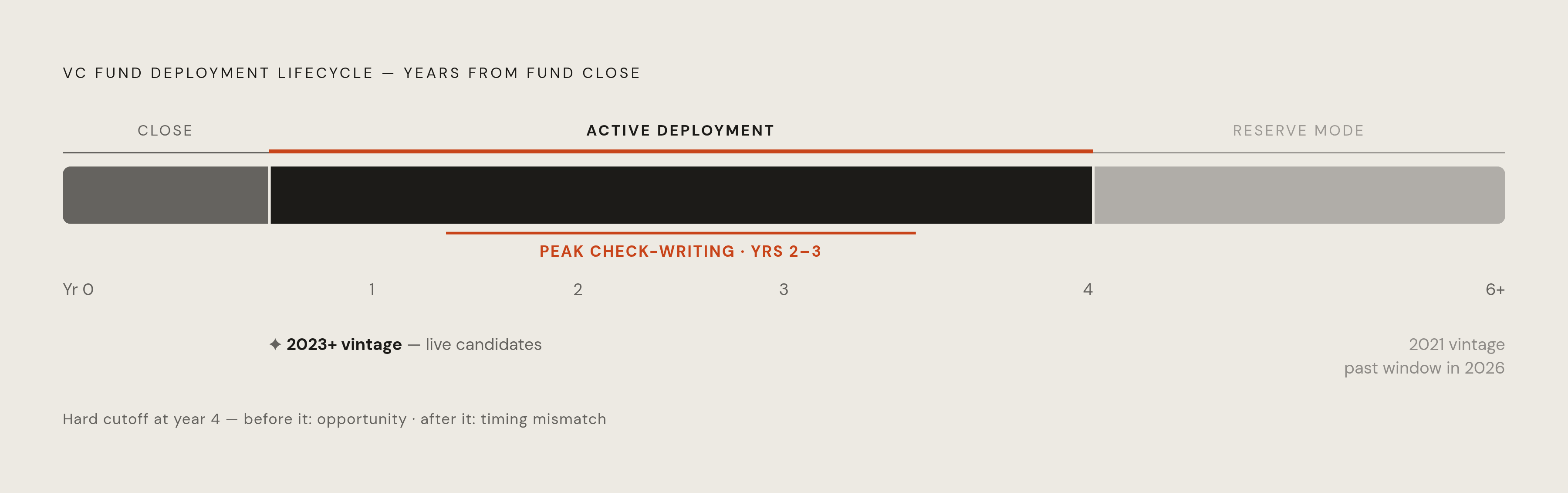
The most reliable predictor of whether a VC fund is actively doing new deals is its vintage year. Funds raise capital from limited partners under a defined deployment window, and that window is a term of the commitment, not a suggestion. Most funds put the bulk of their committed capital to work in the first four years of life, with the heaviest check-writing happening in years two and three. Once a fund has aged past that window, what capital remains tends to sit in reserve, held back for follow-on investments into companies the fund already owns rather than for new entrants. A fund vintage from 2021 or earlier may have committed most of its capital in years two and three, and by 2026, whatever remains is likely earmarked as reserves for existing portfolio companies, not for a founder showing up cold.
This gives founders a simple rule of thumb: treat funds closed in 2023 or later as live candidates for new investment, and treat anything vintage 2021 or earlier as a fund to confirm before engaging rather than one to assume is open. When a firm announces or closes a successor fund, that announcement is itself evidence that the prior vehicle has moved into harvest mode. Firms don't go raise a new fund while the old one still has plenty of room left for new deals, because limited partners would start asking pointed questions about why that capital hasn't been put to work. None of this requires access to a firm's internal reporting. You need to know which year a fund closed and read that date against a four-year deployment clock.
What new fund announcements and closes signal about near-term deal appetite
Fund vintage is a structural concept. Fund closes are the observable events that put that concept into practice, and founders can track them in real time. Once a fund closes, the clock on its commitment to limited partners starts running, so the firm is under deployment pressure from day one. Reaching out to a firm shortly after it closes a new fund sharply increases the odds of a serious, timely response: the capital exists, the mandate to deploy it exists, and the partners involved have every incentive to show LPs early activity.
Several 2026 fund closes illustrate how specific and legible these signals can be. Gradient Ventures closed its fifth fund; Matter Venture Partners raised a new fund dedicated to HardTech; Portage closed its Fund IV around a broad fintech thesis covering wealth management, banking, insurance, and payments, with AI running through it as a core theme. These examples aren't the only funds worth watching, and they aren't ranked by quality. They show how a close event maps onto a founder's own stage and sector.
A particular kind of close deserves separate attention: the 100% re-up, where every dollar in a new fund comes from existing limited partners rather than new ones. Solo GP Zal Bilimoria closed Refactor Capital Fund 5 entirely on returning LP capital, one of the cleanest emerging-manager re-ups of the year, and his track record is strong enough that it commands loyalty, so he doesn't have to go find new backers.
Fund-of-funds closes work on a longer timeline, but they still carry their own value as a forward indicator. Fund-of-funds closes function as an 18–24-month leading indicator: when a fund-of-funds announces a close, it pre-commits capital that will flow out to its underlying portfolio managers over the following years, giving founders forward visibility into where larger pools of capital will actually flow.
Partner-level behavioral signals that a firm is actively sourcing deals
Even inside a fund that is actively deploying, individual partners differ sharply in how they source deals at any given moment, and you can see that difference in the public record without any insider access. The clearest signal is portfolio cadence. A partner who has led one or two new deals in the past six months is actively sourcing. A partner with no new deals, but several board announcements tied to existing portfolio companies, is more likely in support mode than in acquisition mode.
A partner's published writing, conference appearances, and social posts built around a specific thesis appear in the public record before that partner starts actively deploying into that category, and they signal real receptiveness to founders working in that space. Shifts in a firm's average check size across its recent announced deals point to where its attention is moving on the stage spectrum, which matters directly when a founder is deciding whether their round size fits what that partner is actually writing checks for. A partner who announces a new fund they are leading or anchoring is telling the market something concrete: their existing book has matured enough that they need new companies to build the next one.
No single public post or deal announcement matters as much as one relationship signal. Two of three Series A deals now involve investors who already knew the founder for six to nine months or longer before the round closed. The behavioral signals worth tracking extend beyond deployment activity to relationship-building activity, where conversations, intros, and early diligence often precede an active check by a window specific to that partner, and founders who only watch for deal announcements are watching too late in the process.
How stage benchmarks have shifted, for reading a fund's actual check appetite
Knowing that a fund is active is only half the picture. Whether a founder's round, at its current size and metrics, falls inside the range that fund is actually writing checks into matters just as much, and those ranges have moved enough that older assumptions about what counts as "seed" or "Series A" will misdirect outreach. Pre-seed rounds have largely standardized around SAFE instruments, seed and Series A valuations have each drifted upward in raise size and post-money valuation, and SaaS companies get a premium at the Series A stage specifically.
Seed valuations rose 33% between the fourth quarter of 2024 and the fourth quarter of 2025, and the upper bound of what counts as a seed round has stretched so far that rounds which would have been labeled early Series A a few years ago are now called seed. That shift compresses the gap between stage labels and makes the label itself a weaker signal than it used to be.
Layered on top of that shift is the AI premium, which splits the Series A market into two effectively separate markets rather than one continuous one. An AI foundational-model company raising a Series A commands a dramatically higher median valuation than a non-AI startup at the same nominal stage.
Metrics have tightened alongside valuations. The median ARR a B2B SaaS company needs to raise a Series A has climbed sharply since 2021, and funds are now pairing that ARR bar with expectations around burn multiple, net revenue retention, and LTV to CAC ratios, plus 24 or more months of runway. A fund can be actively deploying into Series A, have capital on hand, and still never respond to a founder sitting well below its current ARR threshold, no matter how well-timed the outreach was. You need to read whether a fund is active and whether you fit that fund's current bar together. Neither answer means much without the other.
The graduation rate collapse and its consequences for timing signals
The seed-to-Series A graduation rate has tightened, and that tightening gives founders fewer chances to get the targeting right, which makes each approach to a given fund a higher-stakes decision than it used to be. The gap between seed and Series A has also stretched to more than two years in many cases, so founders spend longer in active fundraising mode, burning relationship capital across a pool of active Series A investors that has itself narrowed.
In that kind of market, reaching out to a fund that has already moved into harvest mode, with its remaining reserves earmarked for existing portfolio companies, does more than waste an email. It spends relationship equity with a partner who has no capacity to help and may never say so directly, leaving the founder to read silence as rejection rather than as a timing mismatch.
The concentration dynamic from the opening of this piece compounds that cost. The largest early-stage rounds of the year pull attention and capital toward themselves, absorbing bandwidth from funds that might otherwise have room for additional deals, and narrowing the pool of active, available investors for founders raising at more conventional sizes. A founder raising a round is not just competing against other companies in the same category. They compete against every deal currently floating through the ecosystem at that same moment, no matter the sector. When there are fewer graduation slots and a shorter list of truly active investors, a mistimed approach costs more than it once did, because fewer chances remain to correct course.
Building a prioritized investor list from deployment signals rather than brand recognition
A target list built on fund brand and assets under management looks credible on paper and converts poorly in practice, because brand recognition and deployment timing move independently of each other. A famous fund name tells a founder nothing about whether that fund's current vintage has room for a new check.
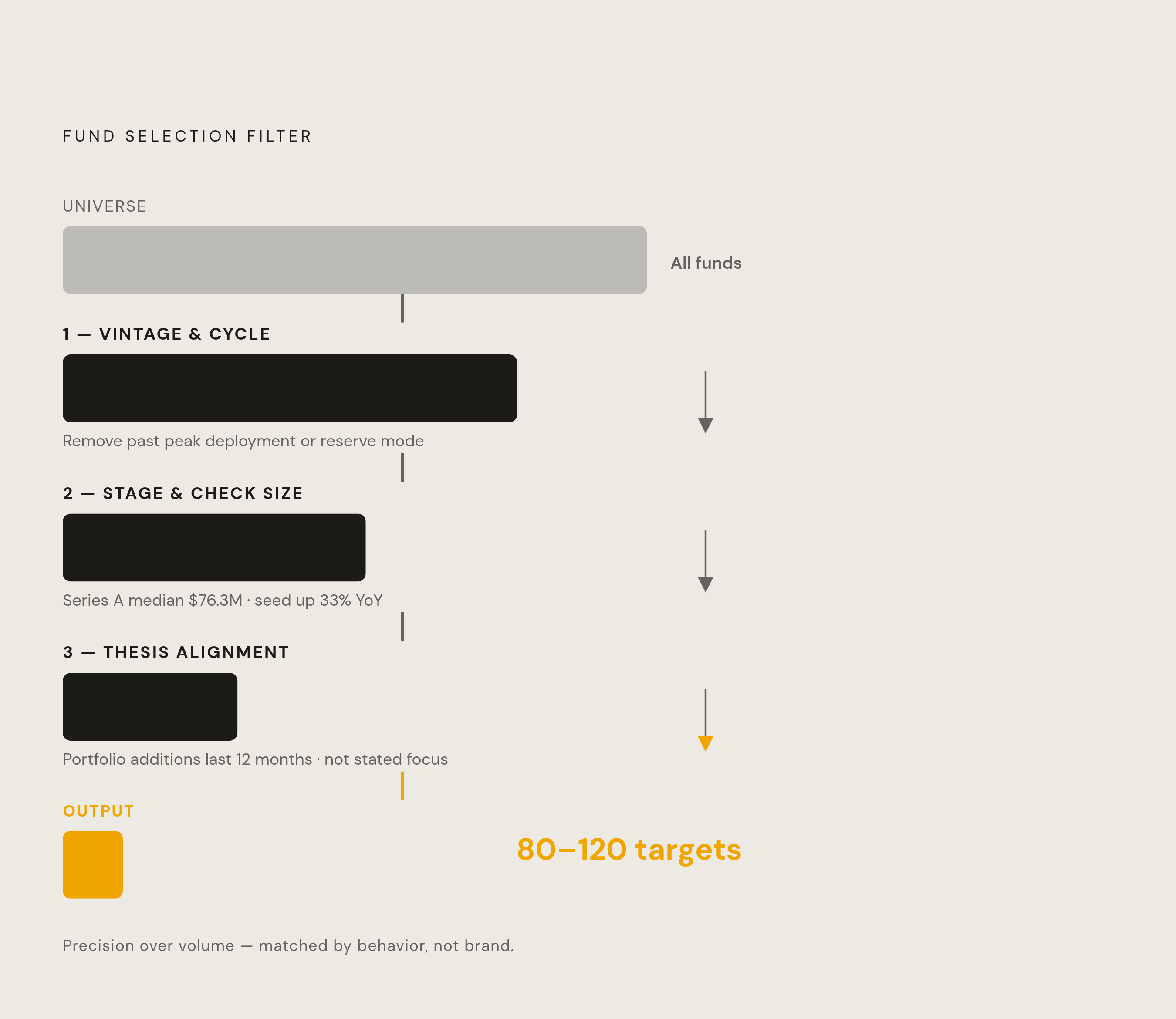
Three filters turn the signals described above into an actual list. The first is vintage and cycle: remove funds whose vintage suggests they are past peak deployment or sitting in reserve mode, and confirm active status through a successor fund announcement or a recent new deal before spending any outreach effort there.
The second filter is stage and check size fit: you cross-reference a fund's recent deal announcements against current stage benchmarks. Series A rounds now carry a median post-money valuation of $76.3 million according to VCCafe, so a fund consistently writing large checks into valuations at that level is not a seed-stage partner, regardless of what its stated mandate claims.
The third filter is thesis alignment, confirmed through recent portfolio additions rather than a firm's stated focus areas. A partner who has added two companies in a founder's vertical over the past 12 months is actively building conviction there. If a partner's only investment in that space happened three years ago, they may have moved on to something else entirely.
Founders who run these filters well tend to end up with a short, sharp list, often somewhere between 80 and 120 genuinely well-matched targets, scored against thesis match, recent deal activity, and portfolio composition, rather than a spray-and-pray list of hundreds of names contacted with no real differentiation. Platforms like Metal, an AI-driven investor intelligence and pipeline tool built for founders raising venture rounds, exist specifically to run this kind of scoring at scale using proprietary private-market data rather than manual research. Outreach that reflects this work, a note that references a fund's recent close, a partner's recent thesis post, or a portfolio addition in an adjacent category, tells the recipient that the founder has done real homework rather than copied a template. In a market defined by concentration at the top and compression everywhere else, that kind of precision is what separates a founder who gets a meeting from one who gets silence.