Bridge Round Mechanics and When They Make Strategic Sense
Understand bridge round pricing to avoid diluting yourself twice in two rounds.

Bridge rounds now make up a meaningful share of all startup capital raised, and that share grew fast enough over the last two years to signal something has changed in how companies get funded. Founders still treat bridges as an afterthought, a patch job between "real" rounds, and that assumption costs them more often than not. Whether your round is going smoothly or falling apart, how a bridge gets structured, priced, and read by investors will decide what you own when the dust settles.
What a bridge round actually is and what it is not
A bridge round is interim financing between two primary rounds. Its job is narrow: give a company enough cash to reach a specific milestone, so the next full round gets raised from strength instead of scrambled together under pressure. Founders who stretch that definition into something vaguer get burned. The pattern tends to repeat itself.
A bridge is not a full equity round. The intent, the timeline, and what investors expect out of it differ too much for that comparison to hold up. It isn't venture debt either; debt carries no conversion feature and sits on an entirely different risk profile. And it is not a down round, though people conflate the two constantly. A down round reprices a primary round. A bridge is a temporary instrument, built specifically to avoid pricing a round before the company is ready for that conversation.
Speed is the defining feature. Bridges close in weeks. Existing investors usually go first, sometimes joined by new money, occasionally including a prospective Series A lead brought in early, or an angel or two rounding things out. Size scales with stage: seed bridges run smaller than Series A bridges, though both stay meaningfully smaller than the primary round waiting on the other side.
There's a second function that gets less attention than it deserves. A bridge can build investor momentum, not just buy time. Inviting a prospective lead into the round before the formal Series A process even starts is a legitimate move. But the whole arrangement only holds together if there's a real destination waiting at the other end. A bridge with no defined milestone is just a delay dressed up in better clothing, and investors can tell the difference almost immediately.
The three instruments used to structure a bridge and what each costs the founder
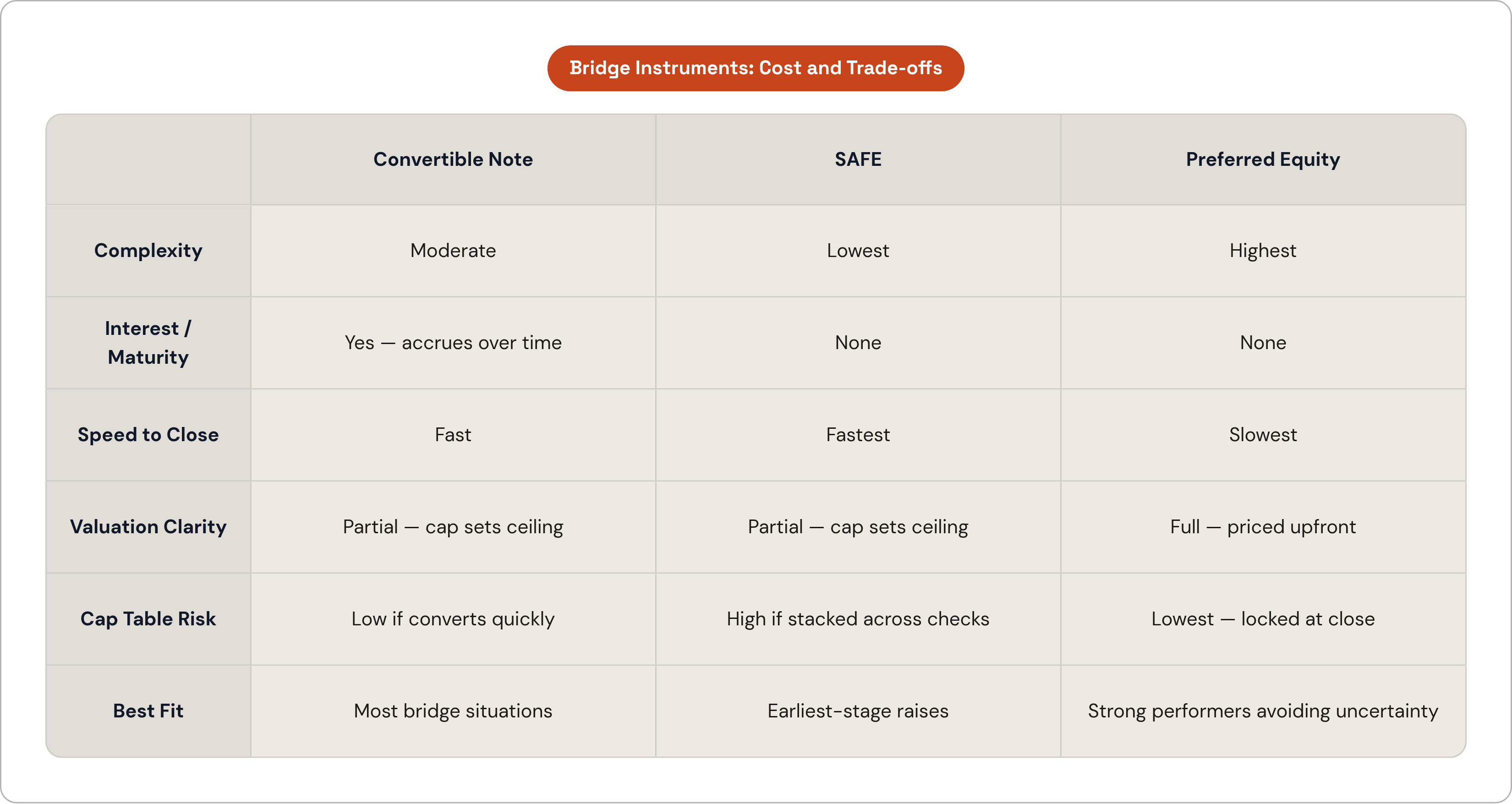
Founders generally reach for one of three tools: convertible notes, SAFEs, or preferred equity through a small priced round. Each carries a different cost structure, and none of those differences are cosmetic.
Convertible notes remain the most common choice for bridges specifically, mostly because investors like the certainty they offer. A valuation cap, often paired with a discount of 15 to 25 percent, rewards early money for taking early risk. Notes also carry interest and a maturity date, usually 12 to 18 months out, with automatic conversion if the next round closes first. Founders keep underestimating the interest piece: it accrues for as long as the bridge sits outstanding, so a note that lingers costs more equity than one that converts fast. Take a note worth roughly a million euros, carrying a 20 percent discount and 6 percent interest over a year. By the time the next round prices, that note can convert into the equivalent of 1.3 million euros in equity.
SAFEs are simpler. No interest, no maturity date, and they've become the dominant instrument at the earliest stage; post-money valuation cap SAFEs now show up in the vast majority of pre-seed rounds. That simplicity costs something, though. Investors who came in through a SAFE, rather than leading a priced round, sometimes hesitate to reserve follow-on capital later. Stack multiple SAFEs across several small checks and the cap table gets messy enough to complicate the Series A conversation that follows it.
Preferred equity, structured as a small priced round, takes longer to close than a note or a SAFE. What it buys instead is valuation clarity before anyone signs anything. It fits best when a company is performing well and wants the cap table locked down rather than left to conversion math later. Founders who hate uncertainty gravitate here, even at the cost of speed.
Across all three, the valuation cap is the term that matters most. Set it too low and it reads as a distress signal to whoever leads the next round. Set it too high and the bridge doesn't close, because nobody wants to buy in at a price the company hasn't earned. The right number comes from a realistic read on where the next primary round will actually price, not where the founder wishes it would land.
How the dilution math actually compounds across a bridge and a primary round
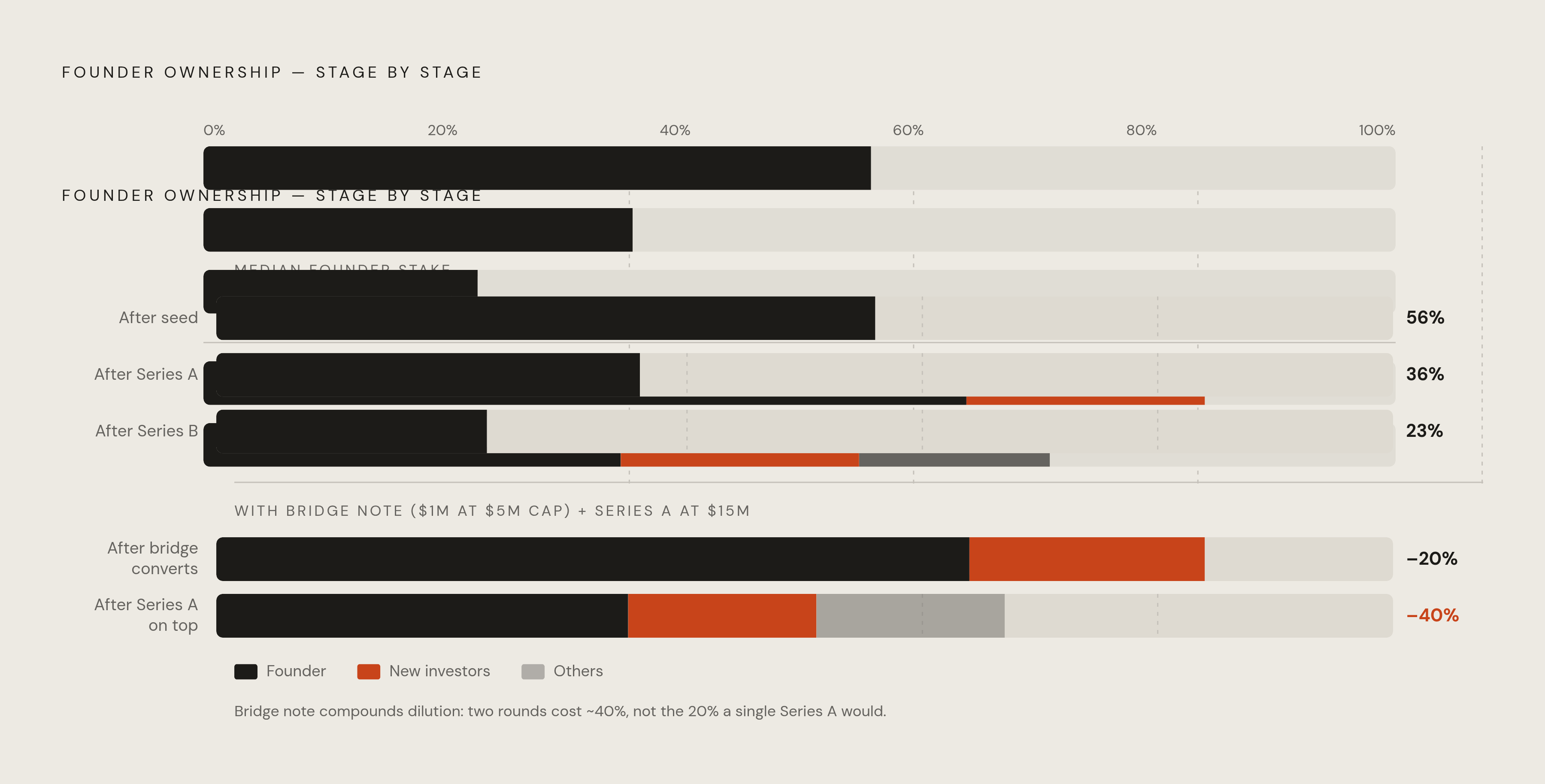
This is where instrument choice stops being an abstract legal question and starts eating into the founder's ownership directly. Take a million-dollar bridge note with a five-million-dollar valuation cap. It converts at that cap. If the Series A that follows closes at a fifteen-million-dollar pre-money valuation, the bridge investors walk away with roughly 20 percent of the company, and the Series A investors pay fifteen million for another 20 percent on top of that. The founder has now been diluted by roughly 40 percent across two transactions, not the 20 percent a single round at that price would have cost.
That compounding lands hard because founder ownership was already thinning fast before bridges entered the picture. Median founder ownership falls from roughly 56 percent after seed to around 36 percent after Series A, then down to about 23 percent by Series B. A bridge that isn't priced carefully doesn't just add a data point to that curve; it steepens it. Series A dilution alone measured around 17.9 percent in 2025, down slightly from 20.9 percent the year before. That sounds like good news until a poorly negotiated bridge cap stacks another chunk of dilution on top of an already-dilutive primary round.
There's a sequencing problem underneath all of this, too. Founders who raise several small SAFE checks over time, instead of one clean bridge, can end up with dilution compounding before a Series A investor has even shown up to the table. And the existing investors sitting on those notes and SAFEs aren't necessarily incentivized to protect founder ownership at conversion. Most funds carry reserves for one bridge and maybe one or two later rounds. Their goal at conversion is protecting their own position, not minimizing what the founder gives up.
The cap, the discount, and the size of the note are strategic decisions with real economic weight attached. Founders who treat them as boilerplate paperwork tend to discover the true cost only once the Series A term sheet lands on the table. By then, there's nothing left to negotiate.
The market conditions that turned bridge rounds from a rescue mechanism into a planning tool
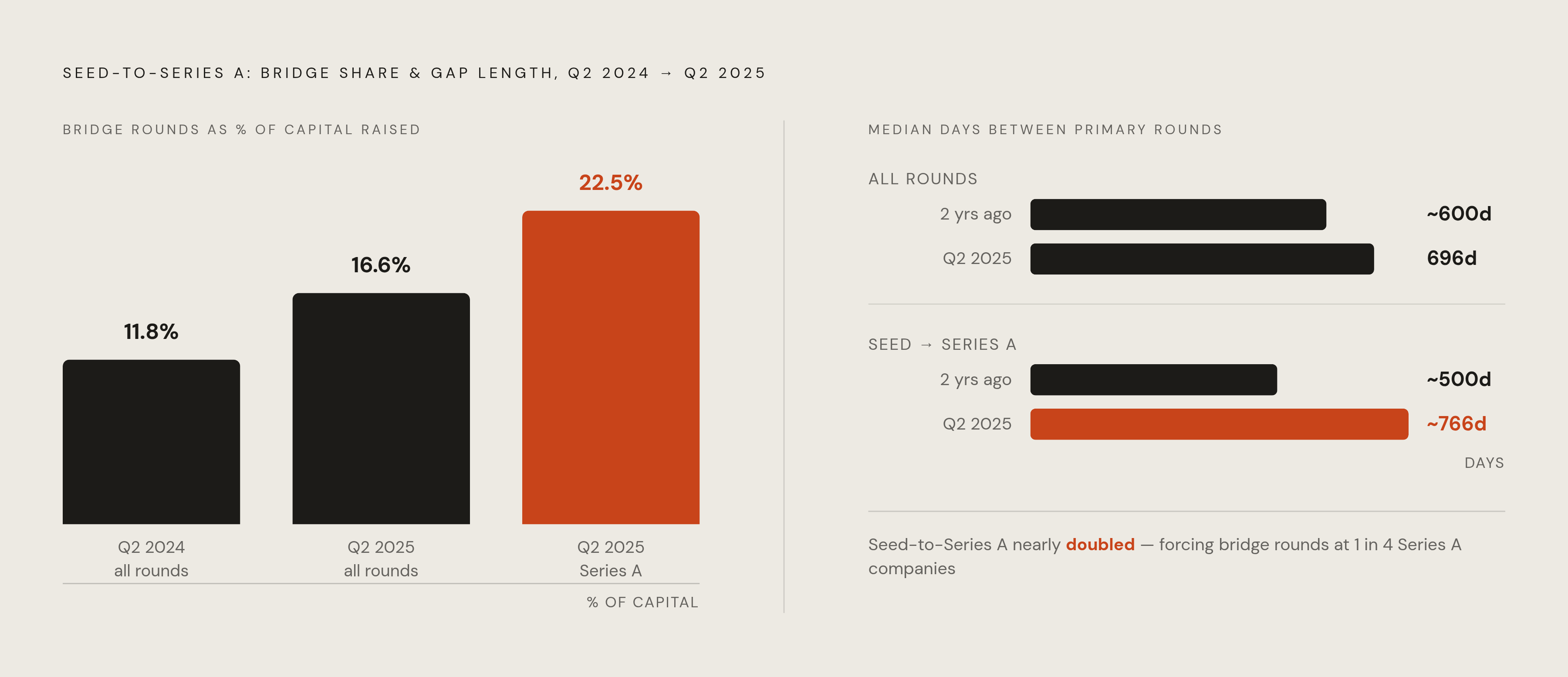
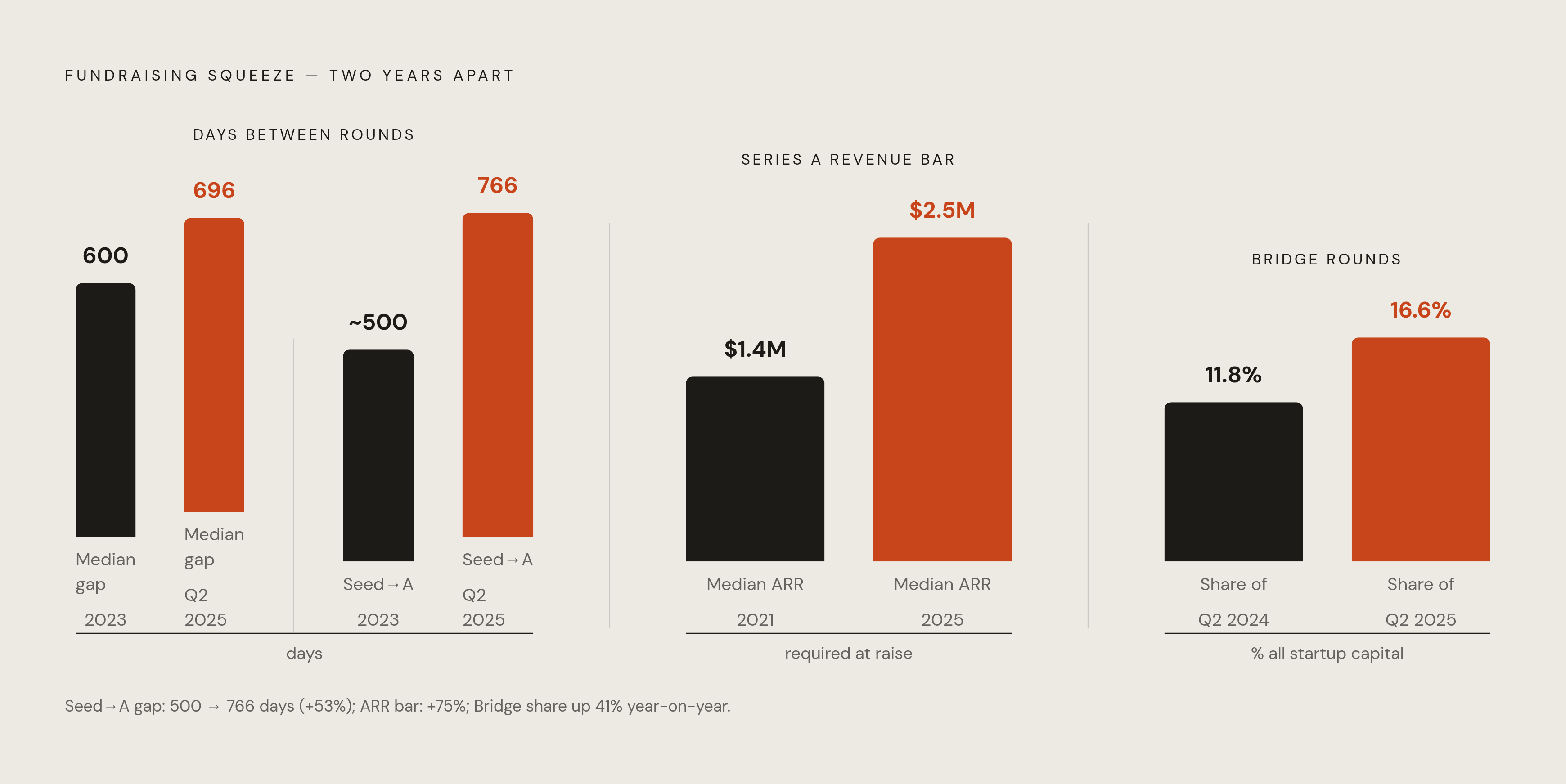
None of this happens in a vacuum. Bridge rounds accounted for 16.6 percent of all cash raised by startups in the second quarter of 2025, up from 11.8 percent a year prior, and at Series A specifically that figure reached 22.5 percent. At seed, 42 percent of all investments in the first quarter of 2024 qualified as bridges, the highest share in a decade. Trace that back far enough and it lands on a collapse in exit activity: annual U.S. IPO counts fell 62 percent between 2021 and 2024. Venture funds are holding portfolio companies longer as a result, limited partners are seeing fewer distributions, and fresh capital is tightening at every stage of the pipeline.
The practical effect shows up in two places at once. The bar for a Series A has risen substantially: median revenue at that stage reached $2.5 million in 2025, roughly 75 percent higher than in 2021, and funds are writing meaningfully fewer Series A checks per year than they once did. The time between rounds has stretched to match. The median gap between primary rounds reached 696 days in the second quarter of 2025, up from roughly 600 days two years earlier, and the seed-to-Series-A gap widened specifically to around 2.1 years, up from roughly 500 days just two years prior.
Companies now face a higher bar, on a longer timeline, with runway that was sized for a gap that no longer exists. The seed market itself has contracted too: only 401 new seed rounds closed in the first quarter of 2025, down 28 percent year over year, and total dollars raised across those rounds fell 37 percent. Nearly 30 percent of VC deals in 2024 came in flat or down, the highest share in over a decade. That punishes any founder who shows up to raise before the metrics are actually ready.
The market has split in two on top of all that. Top-performing companies are raising seed rounds at record valuations, with median post-money reaching $24 million by the fourth quarter of 2025, up from $18 million a year earlier and $16 million two years before that. Meanwhile, the bottom half of startups captured just 14 percent of all capital raised in 2025. Even investors sitting on committed capital aren't necessarily flush: funds raised in 2022 had deployed only 43 percent of their committed capital at the 24-month mark, the lowest deployment rate of any recent vintage. Plenty of existing investors are more constrained on follow-ons than founders assume. Check, don't guess.
A bridge in this environment is something a founder has little choice but to raise, often enough. The real choice left on the table is whether it gets raised on purpose, early, and structured well, or reactively, once the runway has already run thin.
The specific conditions that make a bridge round the right call
One test cuts through most of the noise here. A bridge makes sense when a specific, achievable milestone will unlock a materially better next round. Wanting more time on hand, without such a milestone attached to it, doesn't clear that bar. This is the single most common thing founders get wrong.
A few situations clearly justify it. A Series A in late-stage negotiation that just needs a few more months of runway to close is the textbook case; the bridge buys time without reopening the whole fundraising process. A company months away from a product launch, a revenue threshold, or a key hire that would meaningfully change its valuation story is another. So is a situation where several funds have already signaled they'd lead the next round. There, the bridge functions as momentum capital, and existing investors participating alongside it sends a good signal to everyone watching.
Take a SaaS company sitting at a seven-figure annual recurring revenue, growing steadily. It raises a bridge specifically to hire sales capacity, pushes ARR meaningfully higher, and walks into its Series A at a meaningfully higher pre-money valuation. The dilution from the bridge gets more than recovered by the higher price. That's what a good bridge looks like in practice.
The red flags are just as clear. If unit economics are broken, more runway doesn't fix them; it just extends the runway on which the problem keeps compounding. If the bridge has no specific milestone attached, "we need more time" is not a plan investors will fund twice. Repeated pivots with no demonstrated traction read as avoidance, no matter how the deck gets framed. And a bridge raised in a rush, with no real investor plan behind it, tends to close slower and on worse terms than one prepared months in advance.
Ask this before raising: if the milestone gets hit, is a Series A realistically achievable, and is there actual evidence, not hope, that investors agree with that assessment?
How investor perception of a bridge round is shaped by how it is framed and executed
A bridge can read as a strategic pause or a distress signal. The difference between those two readings has almost nothing to do with the instrument itself; it comes down to how the round gets built and talked about.
Investors evaluating a bridge on a cap table ask a short set of pointed questions. Did existing investors participate, or did they pass? Participation reads as conviction, and a full pass reads as concern, fairly or not. Is there a defined milestone the money is financing, or is the raise open-ended? Was the cap set at a level that reflects a realistic view of the company's trajectory, or does it look like founders took a bad deal under pressure? Does each round in the sequence still show a meaningful step-up in value, or has the bridge quietly flattened that story? Nearly 30 percent of VC deals in 2024 came in flat or down, and a poorly structured bridge can produce that same signal in a new investor's mind even when it wasn't technically priced as a down round.
Bringing a prospective Series A lead into the bridge early is one of the more effective moves available, when it's done on purpose rather than out of desperation. It gives that investor an information edge before the formal process starts and turns them into an insider rather than an outside evaluator sizing up a cold pitch deck. That move carries real risk, though. If the lead ultimately passes on the Series A after seeing the company up close during the bridge, the next prospective lead notices. That signal travels, and it isn't a good one.
Framing matters just as much with existing investors. A founder who asks for a bridge without a milestone attached is asking for faith. A founder who presents a specific ask tied to a specific, measurable outcome is asking for judgment. Investors can actually engage with that second conversation, and fund it.
Running the bridge process as a structured raise, not an informal ask
The most common operational mistake is treating a bridge like an internal conversation that closes itself. Existing investors may be dealing with reserve fatigue or genuine capital constraints. With 2022-vintage funds having deployed only 43 percent of committed capital at the two-year mark, plenty of investors simply don't have the dry powder founders assume they do. Assuming participation, rather than confirming it directly, is a planning error that shows up at the worst possible moment.
Before reaching out to anyone, map the investor universe deliberately. Which existing investors actually have both the reserves and the relationship to write another check? Which new investors, particularly a prospective Series A lead, would benefit from early access to the company? And what's the real range here, the minimum that keeps the lights on versus the amount that actually funds the milestone in question?
Materials should look like a primary raise, just scaled down. A clear bridge memo or short deck covering current state, the specific milestone, the amount being raised, how it gets used, and the expected timeline to the next round. Updated financials and a runway model ready to go, because investors will ask for both, usually in the first meeting. A term sheet or note template prepared in advance, since speed is the whole point of the instrument, and there's no excuse for losing weeks to paperwork that could have been drafted early.
Pipeline discipline matters here just as much as in a primary round, only compressed into a shorter window. Track who's been contacted, who's responded, and who's actually committed, rather than relying on memory or a loose sense of momentum. Once terms are agreed, close fast: a bridge that drags on for months sends the same signal as a bridge raised for the wrong reasons in the first place. The short timeline is a feature of the instrument, not an inconvenience to work around.
Once the round closes, the clock the founder promised investors starts running immediately. A bridge bought time against a specific milestone, and that milestone is now the only thing that matters until the next round gets raised.