Structuring the Problem Slide for a Seed-Stage Pitch Deck
Four structural beats turn a problem slide from forgettable into urgent.

The problem slide has one job: make an investor feel the pain before they've heard a word about the solution. It has to land in a handful of seconds, before the market size, the product, or the founder's résumé ever enters the conversation. Get it wrong and nothing downstream saves the pitch. Investors skim decks, they don't study them, and the problem slide is the first real test a deck has to pass.
That window has only gotten tighter. Seed capital has concentrated into fewer deals over the past few years, so a forgettable slide two costs more than it used to. CB Insights has tracked startup failure post-mortems for years, and "no market need" keeps showing up near the top of the list founders give themselves. A weak problem slide is usually the first visible crack in that same story: the founder believed the pain was real, and the market didn't.
What investors are actually evaluating on this slide
An investor reading this slide is running three checks at once, most of the time without naming them explicitly. Is this real, or did the founder hear it once from a friend in the industry and run with it? Is it painful enough that someone pays to make it stop, rather than shrugs and keeps working around it? And is it big enough, in dollars or in headcount, to justify a company?
The slide has to answer all three with nobody in the room to help it. That's the part founders forget mid-deck-prep: the version sent cold over email, the one that gets passed along without the founder present, has to stand entirely on its own. No one's there to fill in the context or walk back an overstatement. Whatever's on the page carries the whole argument by itself.
There's also a second thing being evaluated, quieter than the first: founder judgment. A vague problem statement doesn't just fail to persuade; it tells the investor the founder hasn't spent real time in the market, hasn't sat across the table from the people who live with this pain daily. That impression doesn't stay contained to slide two; it colors every slide after it, even the genuinely strong ones. Conviction here isn't only a logic exercise, either. The best problem slides get a flicker of urgency out of the reader, not just a nod. At this point in the deck, the only thing being asked of the investor is belief that the problem is real and worth solving. Everything else comes later.
The four-beat structure that separates high-conviction problem slides from forgettable ones
Strong problem slides tend to fall into a rhythm, whether the founder built it on purpose or stumbled into it by instinct.
Start with one external pain, stated the way the customer would say it, coming from actual observation rather than a founder who fell in love with a piece of technology and reverse-engineered a problem for it. A decent gut check: could someone outside the industry understand this in ten or fifteen words? If it needs a paragraph of setup first, it isn't ready. Naming the company size, the role, the exact moment the pain shows up, that's what tells an investor the founder actually talked to these people instead of guessing at them.
Then one number that makes the scale land. Dollars burned, hours lost per week, an error rate, a churn trigger, whatever unit makes it real. The number's job isn't to prove the problem exists; the first beat already did that work. Its job is to make the size of it felt. One sharp figure beats three mediocre ones fighting for the same three seconds of attention.
Three drivers at the most, explaining why this obviously painful thing hasn't already been fixed. Usually it's structural, or technological, or behavioral, sometimes some mix of the three. Three is a ceiling, not a quota; two sharp reasons beat three thin ones. These drivers also do quiet work on the "why now" question. If one of them just shifted, new regulation, a new infrastructure layer, a behavior that changed almost overnight, the timing argument writes itself without a slide of its own.
Last beat: why what already exists doesn't work. Every real problem has some attempted fix already, even a bad one, and skipping this tells the investor the founder didn't do the homework. Get specific: too expensive, wrong workflow, missing the one feature that actually mattered. This beat is the hinge into the next slide. It plants the gap the product fills, without describing the product yet.
One rule sits above all four beats, and it's non-negotiable: one problem, only. Sub-points of the same pain are fine. Two unrelated problems on one slide means the investor walks away remembering neither.
How framing and specificity determine whether the pain feels real
Generic framing is the most common failure here, and founders almost never see it happening while they write it. "Companies struggle with data" reads as filler to an investor who has already seen that exact sentence, or something close enough, three times that week.
Put a weak version next to a strong one. Weak: "Small businesses struggle with accounting." Strong: name the segment (B2B SaaS companies past a certain headcount), name the specific workflow that breaks (reconciling subscription revenue across three tools that don't talk to each other), and name the downstream cost (finance closes the books four days late, every month). The strong version runs longer because it's specific. Specificity is what turns a claim into something checkable instead of something assumed.
Trajectory language does work a static claim can't. Saying the cost compounds, that every quarter this goes unaddressed the problem gets worse, carries more weight than just insisting the problem matters. Importance is an assertion; compounding cost is a mechanism, and mechanisms are what investors are actually trained to weigh.
The headline sentence deserves its own scrutiny, separate from everything around it: one sentence, ten to fifteen words, no jargon, written from where the customer stands rather than as a teaser for the product. If that sentence quietly describes the solution instead of the pain, it's in the wrong place.
Sharper investors are also hunting for a "why now." What changed recently that makes this problem newly solvable, or suddenly urgent, given that it presumably existed in some form before? A regulatory shift. An infrastructure threshold just crossed. A behavior accelerated by some outside event. Skip this and the slide accidentally implies the problem has sat there forever and nobody's cracked it, which reads either as a lack of urgency or as a founder who hasn't looked closely enough at who else is circling the same space.
Every claim on the slide needs something underneath it holding it up. "Teams are unproductive" is noise. The same idea, backed by an observable behavior or a workaround people build to cope, becomes something an investor can actually weigh instead of take on faith. Because the reading deck has no one narrating it, visual density matters just as much as the words: one stat, three drivers at most, one clearly named competitor gap, readable start to finish in under thirty seconds.
How the problem slide changes from pre-seed to Series A
The four beats hold at every stage. What moves is the ratio of story to data, and what kind of proof a founder can actually point to without overreaching.
At pre-seed, the bet is on the founder's read of the problem, since there's no market feedback yet to lean on. Founder-market fit carries more weight here than it ever will again; investors want to know why this particular person sees this particular pain with unusual clarity. Customer discovery, direct observation, years spent inside the industry before the company existed, these stand in for traction because there isn't any yet. Story does most of the lifting, though a data anchor or two still helps; early investors expect it thin.
By seed, the center of gravity moves toward early product-market fit. The problem slide can start pointing at what users have actually confirmed: retention in the first months, usage patterns nobody designed but that showed up anyway, feedback pulled straight from the first real cohort. The "existing solutions fail" beat gets sharper here too, because now there's actual user evidence that incumbents fall short, not just a theory about why they might.
Series A changes the slide's job almost entirely. The original problem has already been proven by traction, so the slide's real function shifts to naming the next layer of pain the company is positioned to take on as it scales. Enterprise pain points and operational friction start showing up. The tone gets more analytical, less narrative, and the data density climbs relative to how much story is doing the convincing.
Worth saying plainly: the pre-seed founder has no revenue curve, no retention chart, nothing hard to point at. Nobody's watched this exact framing get tested and fail yet either. A sharp, well-researched problem statement actually stands out more at this stage, not less, precisely because the noise of "everyone's tried this" hasn't built up around it.
The mistakes that kill otherwise strong decks at this slide
Vagueness tops the list, and it's almost always a research gap dressed up as a writing problem. "Everyone" is not a customer. "Companies" is not a segment. The fix is mechanical, not creative: name the company size, the vertical, the exact role where the pain lives, and the slide tightens on its own.
Skipping the slide, or rushing past it to get to the product faster, signals solution-first thinking. Investors read that as a founder who built something interesting first and is now hunting backward for a problem to justify it, and that impression follows the rest of the meeting even when the product itself is genuinely good.
Leading with the solution has the same effect from a different angle. It skips the step where urgency gets built, and forces the investor to reverse-engineer why the thing needs to exist at all. Even a strong solution loses its footing when it shows up before the reader has any reason to care yet.
Two unrelated problems crammed onto one slide dilute the whole pitch and read as a founder without a clear center of gravity. Pick the sharpest, most fundable pain, and push the rest into the roadmap section where they belong.
"No one has solved this before" invites doubt rather than belief, particularly from someone who's already sat through three pitches that week in the same broad category. The stronger move engages directly with what exists and says exactly where it falls short, instead of pretending nothing's been tried.
Piling on data, meanwhile, fragments the read instead of building it. A slide with one clear message tends to land harder than one juggling five stats competing for the same three seconds. More numbers don't signal more rigor. Past a point, they signal a founder who hasn't decided which single piece of evidence actually matters most.
Where the problem slide sits in the deck's full architecture, and what it sets up
A funded deck usually runs ten to sixteen slides, and the problem slide sits early in that sequence. That's not an accident. It's early enough that getting it wrong can end the read before the solution slide ever loads.
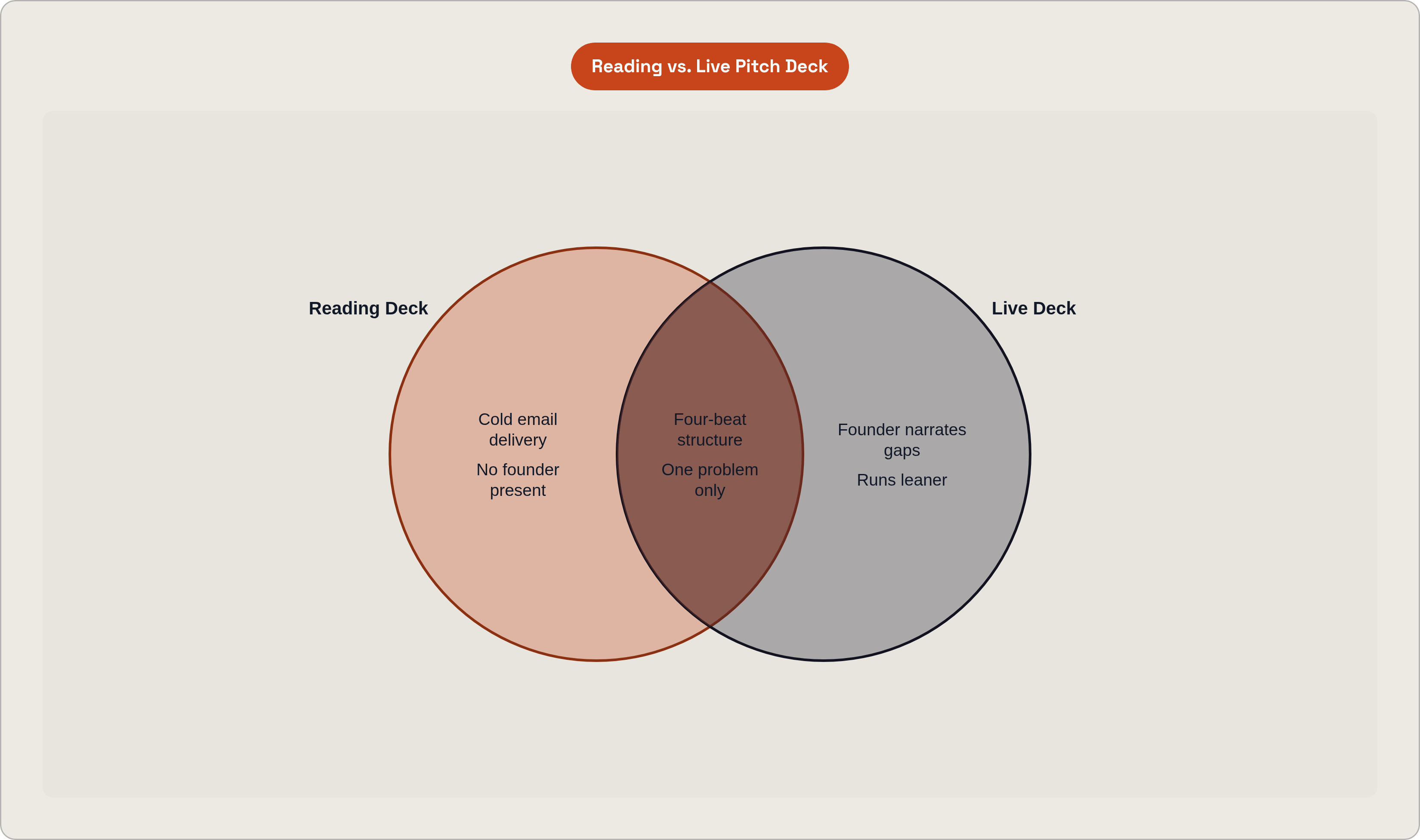
Two versions of the deck exist, and each carries a different burden. The reading deck, sent cold through email or a tracked link, has to be entirely self-explanatory; the problem slide carries its full weight with no one there to narrate it. The live deck can run leaner, since the founder's voice fills the gaps in the room. Still, the underlying bones, four beats, real specificity, one problem, have to hold in both versions or the slide falls apart the moment it's read without the founder present.
The problem-solution-market arc leans on this slide more than most founders give it credit for. A sharp problem slide makes the solution feel earned rather than invented, and it quietly pre-sizes the market by defining exactly who's in pain and how much it costs them. If the problem slide stays vague, the market-size slide right after it feels manufactured, because the two are chained together; there's no honest way to size a market for a pain you never actually defined.
A deck's real job is to earn the next meeting, to move an investor from skeptical to curious enough to pick up the phone. Every decision on the problem slide should serve that one narrower goal and nothing more.
None of it matters if the deck lands in front of the wrong investor, though. A well-built problem slide sent to a fund with zero appetite for the sector, the stage, or the risk profile just dies quietly, no matter how sharp the writing is. That's a separate discipline from deck craft, and just as decisive. Knowing which investors already have conviction in a given problem, before the deck ever reaches their inbox, is what decides whether a strong slide gets read at all or disappears into the pile with everything else.