Round Structure Trends in AI-Native Startups
Capital consolidation and talent premiums are reshaping early-stage AI fundraising norms.

AI captured close to half of all global venture funding in 2025, up from about a third the year before, according to Crunchbase data. That single shift explains most of what founders are experiencing right now: bigger checks moving faster at the top of the market, a Series A bar that keeps climbing, and round structures that no longer resemble the 2020 or 2021 playbook most seed-stage founders were taught to expect.
Total venture funding rebounded to $469 billion in 2025, up 47% year-over-year, but the number of deals actually fell, down 17% to 29,501 transactions. Do the math and you get the defining fact of this cycle: more money, fewer deals. Founders are competing for a shrinking pool of opportunities, with a much larger share of the dollars going to a much smaller share of the companies. Mega-rounds of $100 million or more jumped 77% to 738 deals in 2025, pulling in $307 billion, or roughly 65% of total venture funding for the year. By Q1 2026, AI's share of global venture activity reached something close to 80%, per Crunchbase, and four of the five largest venture rounds ever recorded closed in that single quarter. Capital concentration is the main structural feature of the market a founder is raising into.
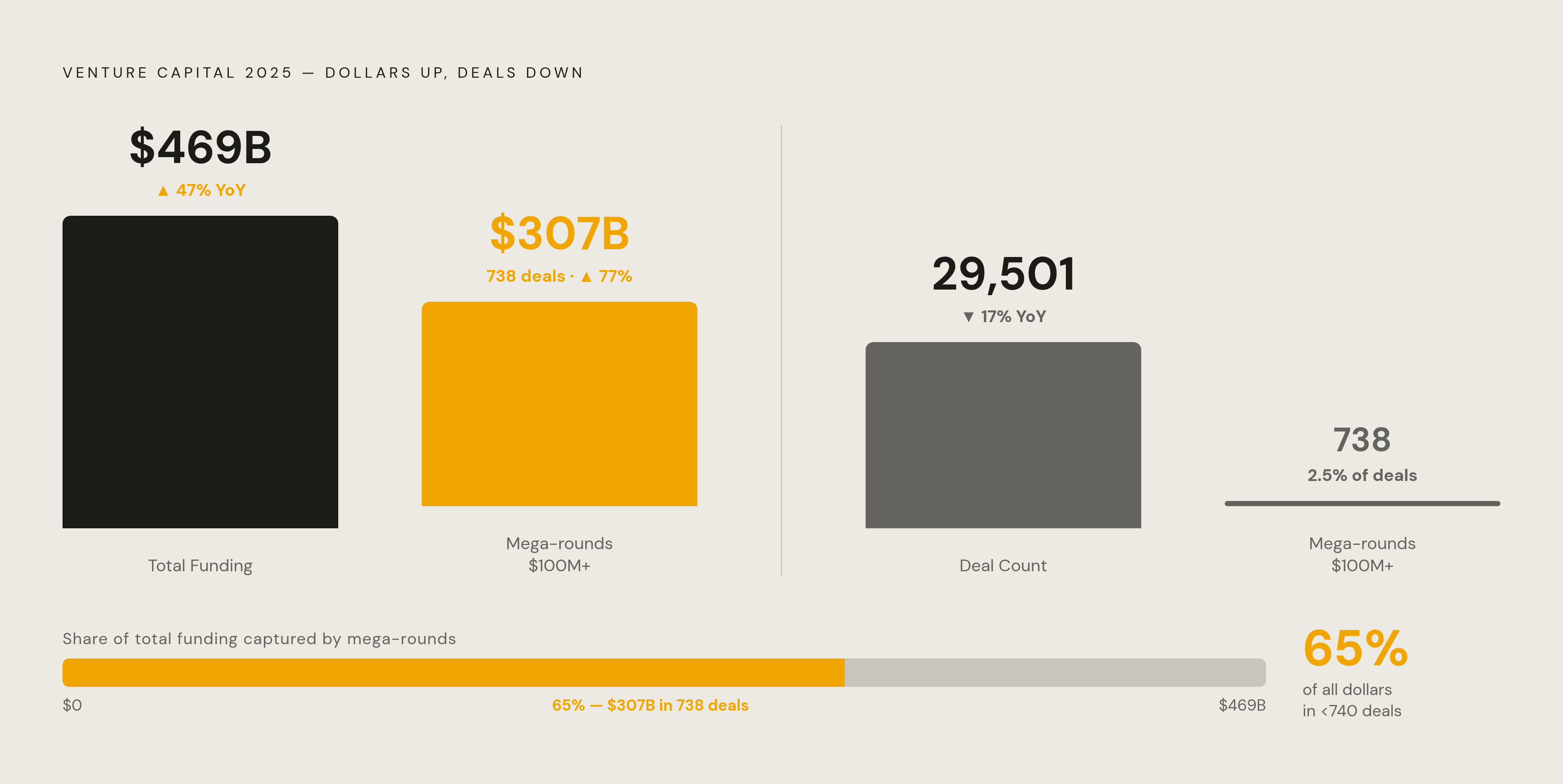
Where the money is actually concentrated — and what that means for everyone else
Start with a number that sounds impressive and turns out to be nearly meaningless for most founders: the 50 most-funded private AI companies have collectively raised $305.6 billion, and two of them, OpenAI and Anthropic, account for $242.6 billion of that, according to Qubit Capital. Headlines about hundreds of billions flowing into AI in a single quarter are technically accurate and practically useless if you're raising a $3 million seed round. That aggregate figure describes a market that almost no founder actually operates in.
Look at just five companies, OpenAI, Scale AI, Anthropic, Project Prometheus, and xAI, and you find they raised $84 billion between them in 2025, roughly 20% of all venture capital deployed that year, per Crunchbase. Zoom out further and the pattern holds: deals over $100 million made up a dominant share of total AI investment value in 2025. The vast majority of every dollar invested in AI landed in a small cluster of very large rounds.
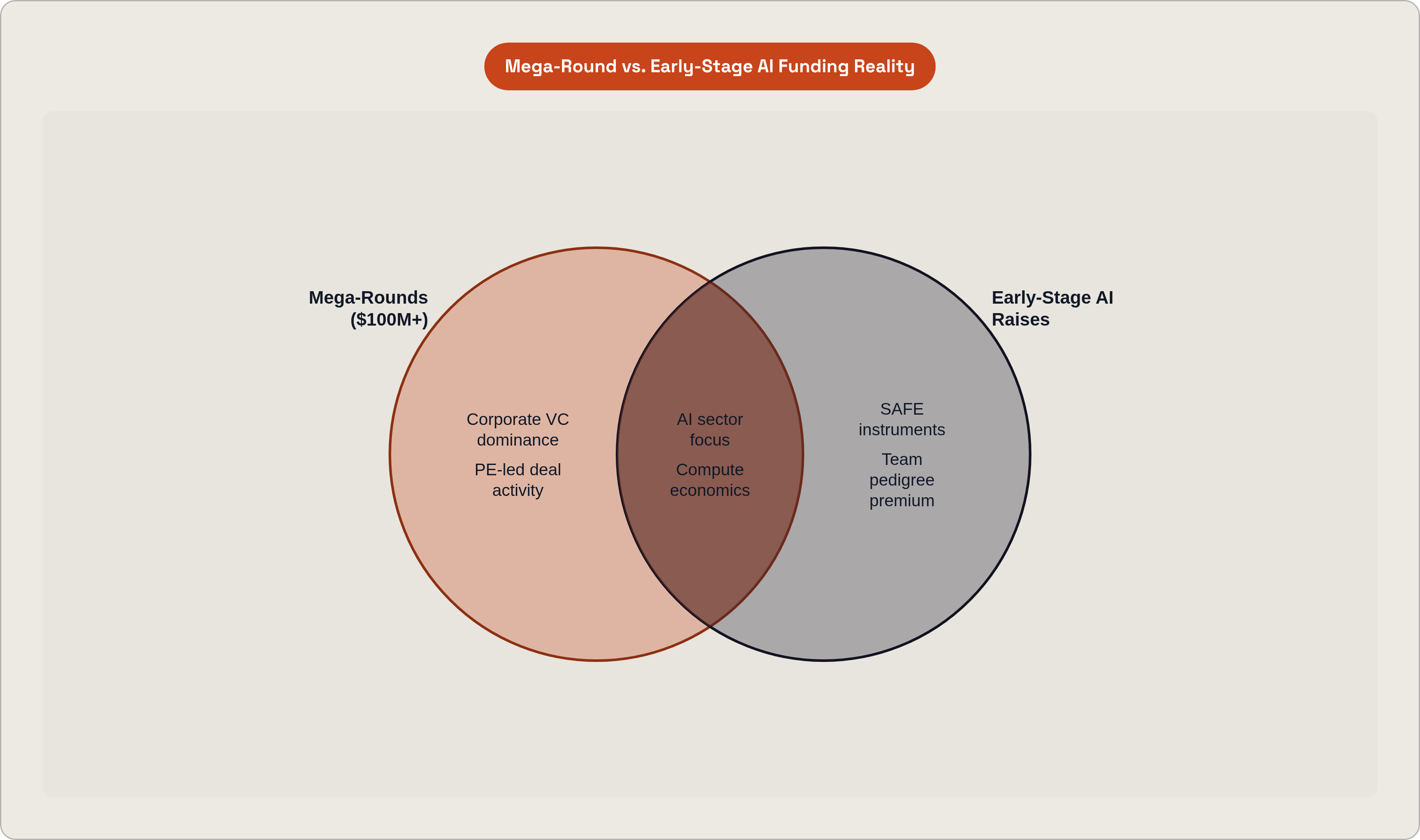
Who's writing those checks matters too. Corporate venture arms participated in 68% of overall AI deal value in 2025, per Bain, and private equity-led deals totaled $63 billion across roughly 300 rounds. These aren't the investors writing $3 million to $15 million checks into early-stage companies. They have different incentives, different time horizons, and a different diligence process entirely. The concentration at the top doesn't crowd out early-stage opportunity in some direct, mechanical way; it distorts the benchmarks founders measure themselves against and reshapes the valuation environment they have to navigate. Geography compounds this: U.S. startups captured 79% of global AI funding in 2025, with the Bay Area alone accounting for $122 billion, which is where most of these norms are actually being set.
How seed round sizing and valuation norms have shifted for AI-native startups
Oversized seed rounds, meaning $10 million or more, climbed from 2% of all seed deals in 2018 to 9% now, per Crunchbase, a slow structural drift that has picked up speed recently. Seed rounds north of nine figures, once a near-impossibility, have become almost routine at the top of the market, with more than two dozen such deals announced globally since the start of 2025. Advanced Machine Intelligence, based in Paris, raised over $1 billion in a 2025 seed round. That's an extreme outlier, but it shows how far the ceiling has actually moved.
The more useful benchmark for most founders is the middle of the distribution, not the outlier. Defensible AI startups are commanding seed rounds averaging roughly double those of traditional tech companies. What used to be a strong seed round now sits in the upper single digits of millions for the companies investors consider genuinely competitive. Pre-money valuations at seed rose meaningfully in 2025 even as deal count dropped, and that inflation isn't evenly spread. Team pedigree, lab background, and domain depth are driving premium pricing far more than revenue, mostly because revenue rarely exists at this stage. Investors are, in effect, paying a talent premium for founders who came out of frontier AI labs; the valuation sometimes reflects the resume more than the product.
There's also a quiet shift in instrument choice. SAFEs still dominate below a certain round size, but 2024 and 2025 saw a real move toward priced seed rounds as check sizes grew and investors wanted cleaner ownership visibility from day one. For founders, that means dilution math and cap table structure need attention earlier than they used to. None of this changes the core discipline that has always mattered: raise enough to reach one undeniable milestone, and take a clean, defensible seed that allows for a real step-up at the A, rather than a vanity round priced at the ceiling of what the market will bear.
The Series A bar has moved — what investors now expect before writing the check
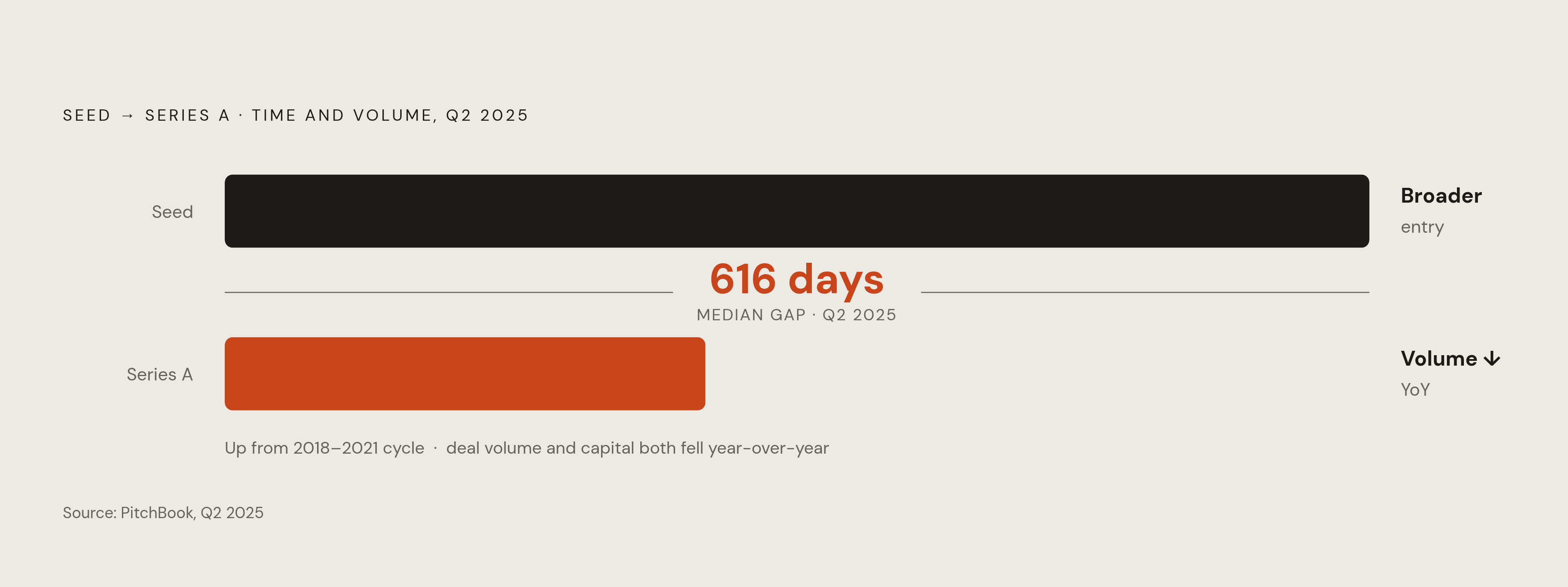
The median time from seed close to Series A close hit 616 days, about 20 months, in Q2 2025, according to CRV. That's longer than the 2018 to 2021 cycle, despite everything happening at the top of the AI funding market. Founders who raised seeds in 2023 or 2024 assuming a faster path to the A are running into that gap right now.
Series A deal volume fell meaningfully year-over-year in 2025, and total capital invested at that stage declined too. The A market is contracting even as seed rounds and mega-rounds both grow, which means the seed-to-A conversion rate has dropped substantially compared to the last cycle. Most seeded companies simply don't make it to an A anymore. Revenue expectations have moved right along with it: investors want meaningful ARR and clear, repeatable customer acquisition, far beyond the thinner traction that passed muster in 2020. Founders who plan a seed raise against outdated benchmarks arrive at the A with a gap they didn't see coming, and end up in the majority that bridge, get acquihired, or run out of runway.
For YC-backed companies specifically, Series A rounds showed a median in the mid-teens of millions, with the top 10% reaching $30 million or more, per Fundraise Insider. That spread, between companies with strong ARR and companies with thinner proof points, is wide, and it's a useful gut check for any founder calibrating expectations. AI-specific Series A rounds are also seeing a notable share of down rounds, a direct consequence of the inflated seed valuations set in 2021 and 2022 still working their way through the system.
The diligence criteria investors are actually using for AI-native deals
Founding team expertise remains the single most heavily weighted factor at both seed and Series A, according to CRV. Investors are looking for founders who pair technical depth with real domain knowledge, and at a stage where revenue is thin or product is barely shipped, team quality is how investors price risk. That's the direct explanation for why lab pedigree commands a premium at seed.
The metrics investors actually check have expanded well past the old SaaS stack. Compute economics, usage depth, revenue per employee, and pilot-to-contract conversion now sit alongside CAC and churn in most diligence conversations. Revenue per employee, once a metric reserved for Series B and later, now comes up at seed, because small AI-native teams can hit revenue levels that used to require far more headcount. A founder who has hired heavily at a given revenue level is quietly telling investors their work can't be automated, which is not the signal anyone wants to send right now.
Pilot-to-contract conversion carries more weight than top-line ARR in most conversations, and investors are checking closely whether revenue is actually recurring or inflated through non-standard accounting. The strongest positioning comes from proprietary data flywheels, deep workflow integration, and real vertical expertise in complicated industries, the things that actually justify a premium valuation rather than just assert one. Retention dynamics for AI-native products also look different from traditional SaaS, and investors are adjusting their churn and net-revenue-retention expectations to match. Founders who walk into a meeting with ARR cohorts, retention curves, and clean unit economics move through diligence faster than founders leading with a narrative deck, because that's the language the checkbook is actually written in.
Which AI sectors are attracting early-stage capital and which are cooling
Physical AI and robotics pulled in a concentrated share of capital through 2025 and into Q1 2026, with industrial humanoid robotics among the subsectors seeing increased deal activity. These rounds tend to run larger than pure software AI deals, since compute, hardware, and deployment costs are structurally higher, and the round-size norms in this category simply don't map onto a typical SaaS raise.
Agentic AI, coding agents, legal agents, enterprise workflow automation, ranked among the top deal categories by volume for the most active investors. Security, monitoring, and compliance tooling for agent deployments is shaping up as the next wave behind it; any enterprise running fleets of agents is going to need governance infrastructure to manage them. Cognition AI's Devin is a useful data point on what traction looks like at the high end of this category: ARR growth from a small base to a much larger figure within months, feeding a multi-billion-dollar valuation. That's the velocity investors are pricing into the top of the agentic space right now.
Other categories are cooling fast. Horizontal tools in saturated verticals, coding automation, sales automation, marketing AI, have seen real capital consolidation, and new entrants without sharp differentiation are increasingly looking at acquihire or wind-down outcomes rather than a Series A conversation. In some corners of the market, acquisition activity has been outpacing new company formation. Acquisition is outpacing formation in some corners of the market. Sector positioning determines which investors are even active, what round sizes are realistic, and what diligence bar applies before a term sheet shows up.
How M&A dynamics are reshaping the strategic calculus founders face at the raise decision point
U.S. AI M&A activity has accelerated sharply, with acquisition velocity outpacing new company formation in several categories. In some corners of the market, the ratio of funded companies to acquired companies has actually flipped. That's a signal that the market's structure has changed, rather than a failure signal for the sector.
The broader market dynamics point toward a shakeout for thin-margin, undifferentiated AI startups. For founders, that reshapes the range of viable outcomes: a well-run process can now attract venture capital and strategic acquisition interest at the same time, rather than treating them as sequential options. Corporate venture's 68% share of AI deal value in 2025 reflects exactly this, strategics positioning themselves next to companies they might want to buy later. Some founders raising today are, whether they frame it this way or not, raising a round that's simultaneously venture financing and an option price for a future acquirer.
That changes the calculus at the negotiating table. Founders who understand they're operating inside an M&A-active market may reasonably choose different terms, different investors, and different milestones than founders optimizing purely for the next venture round. The point isn't to avoid fundraising; it's to know, investor by investor, who's financially motivated and who's strategically motivated, and to structure the process with that distinction in mind from the start.
What the round structure shifts mean for how a founder should run their raise
The single most dangerous mistake right now is calibrating to the wrong benchmark. Founders modeling their raise on 2020 or 2021 round sizes, valuations, and conversion timelines are optimizing for a market that no longer exists. The current environment rewards founders who know exactly where they sit in the distribution; the mega-rounds and the $100 million seeds set the ceiling, not the median, and mistaking one for the other leads to bad decisions at the term sheet.
Targeting the right investor tier for your actual proof points is the correct move, not settling. A founder with a pre-revenue product chasing growth-stage terms burns time and credibility they can't easily get back. AI-native investor targeting now requires knowing which firms are active at which stage, in which sector, with which diligence preferences, because generalist outreach performs badly in a market this concentrated. Before any Series A conversation, a founder needs to know their ARR cohorts, net retention, pilot conversion rate, and revenue per employee cold; not having those numbers ready signals operational immaturity before the conversation even gets going.
Timing matters more than founders tend to assume, and the calendar itself has become part of the strategy, not an afterthought bolted on at the end of it.