Corporate VC Participation in Seed and Series A Rounds
Corporate venture capital brings bigger checks but strategic strings attached to early-stage rounds.

Corporate venture capital now writes 22% of every venture dollar deployed worldwide, up from 15% a few years back, according to NVCA's 2025 data. If you're raising a seed or Series A round right now, you need to understand what that check actually comes with before you sign anything.
What CVCs are and how they differ from independent VCs in structure and mandate
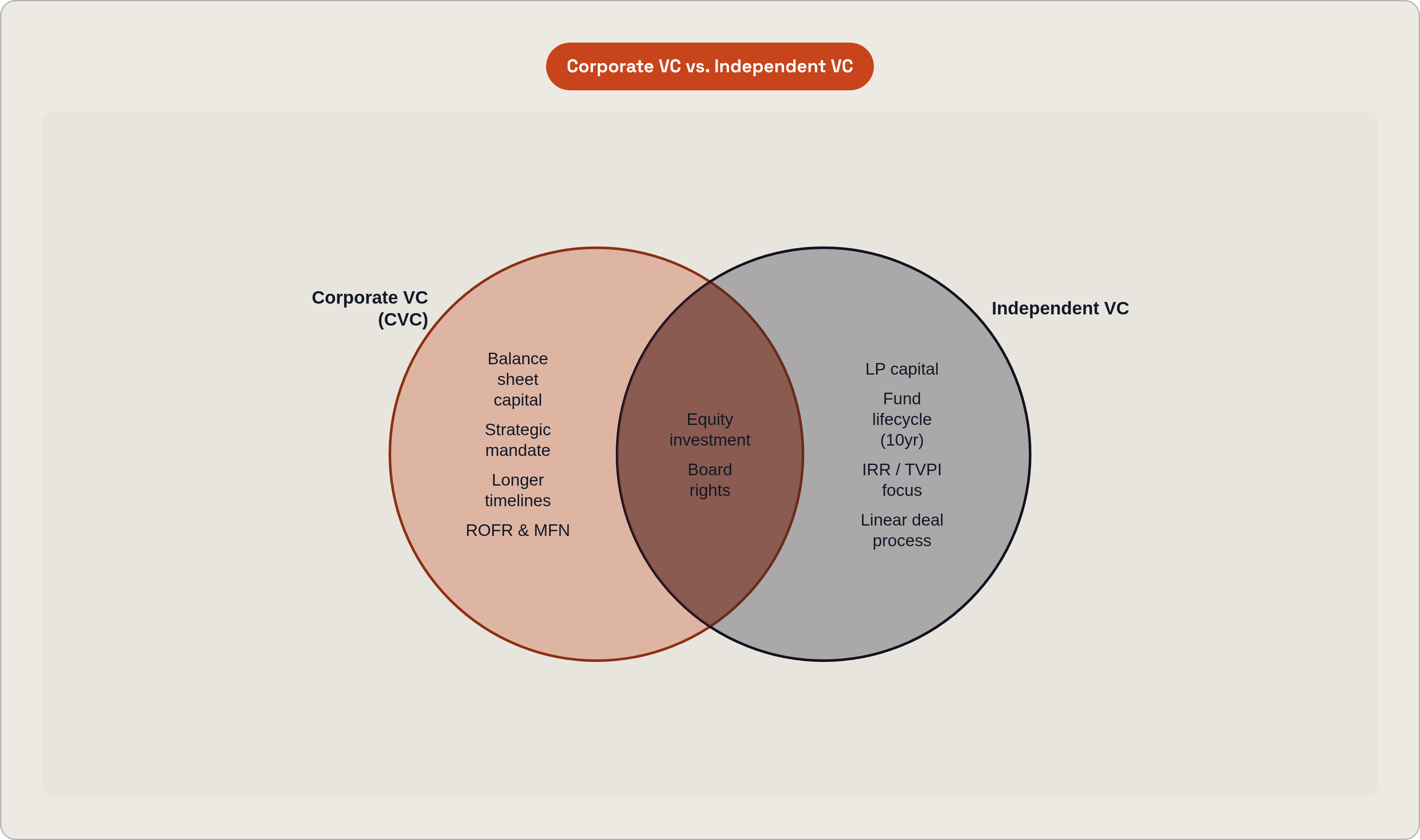
A corporate venture arm writes checks off the parent company's balance sheet. Not LP capital, not a fund with a clock running on it, the parent's own money. That one fact explains most of what a founder will run into later. Roughly 77% of Fortune 100 companies run some kind of venture program at this point, so this isn't a fringe behavior, it's just how large companies operate now.
Independent VCs answer to LPs, full stop. Their fund has a defined life, usually ten years, and every decision gets measured against IRR and TVPI. Deploy capital badly and a general partner hears about it at the next fundraise, sometimes brutally. A CVC lives under different weather. It reports to a corporate parent and carries two mandates at once: make money, and hand something useful back to the business funding it. Technology access, distribution, competitive intelligence, a pipeline of talent to poach later. Because the capital doesn't sit inside a fund with an expiration date, patience looks different, follow-on behavior looks different, and even what counts as a "good" exit stops resembling anything a Sand Hill Road partner would recognize.
Names matter here, and lumping them together is where founders go wrong first. GV has built a broad AI-focused portfolio and runs with more independence from Google's daily priorities than most people assume. Salesforce Ventures has built one of the largest CVC portfolios in enterprise software and stays far more tightly wound to Salesforce's commercial roadmap than GV ever does to Google's. NVentures has scaled its deal activity sharply in recent years. Coinbase Ventures has been active across early-stage rounds, many of them pre-Series A. A check from GV behaves nothing like a check from Salesforce Ventures once the ink dries, and treating "CVC" as one category is the first mistake.
The strategic motivations that shape how CVCs behave as investors
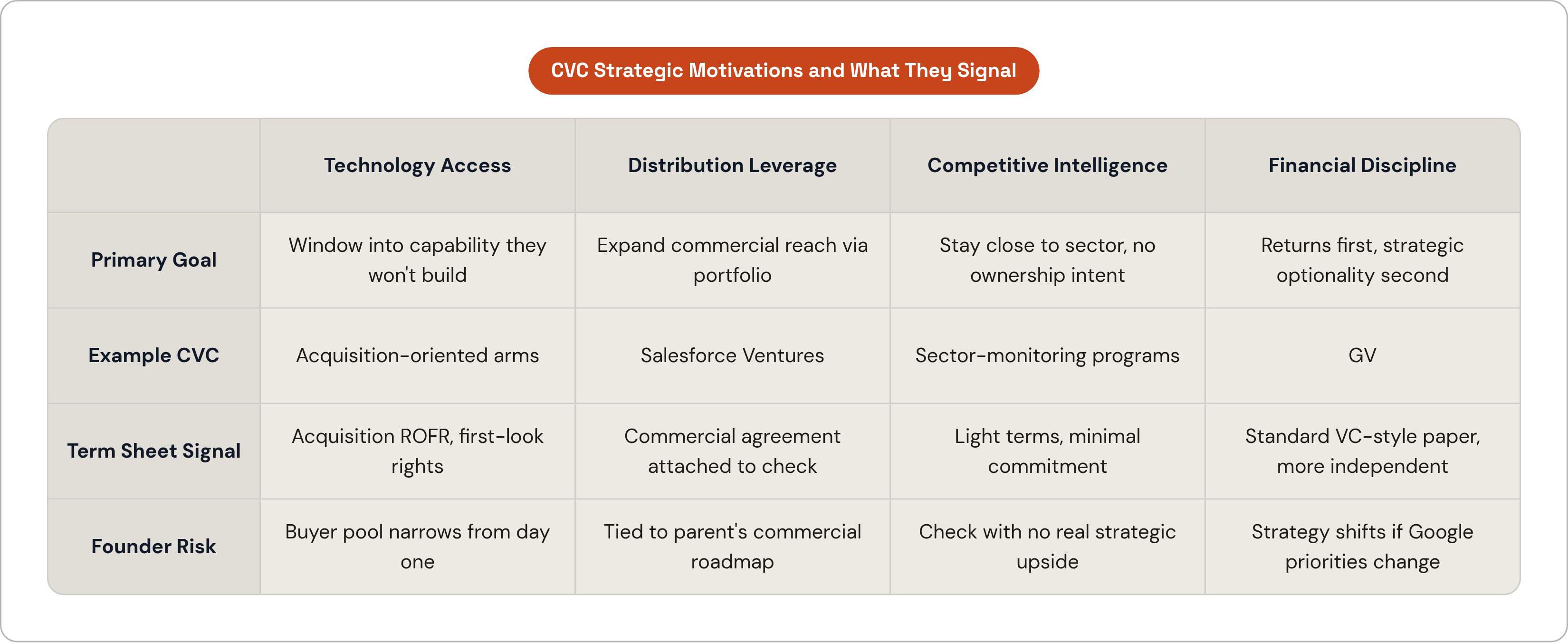
Ask why the corporation is investing at all. That's really the whole question, and it deserves a plain answer rather than a polite one. Some invest for technology access, a window into a capability they don't want to build in-house, with acquisition or deep integration often sitting quietly behind the term sheet. Others invest for distribution leverage. Salesforce Ventures is the cleanest case going: portfolio companies land on AppExchange, get pulled into a co-sell motion, and reach an enterprise base that would otherwise take years of outbound to build.
Then there's the murkier one. Competitive intelligence. Some corporations write checks purely to stay close to a sector, with zero intention of ever owning a piece of it in any meaningful sense, and founders should just ask about this outright instead of assuming good faith going in. GV sits in a fourth camp, financial discipline first, with the right to lean in harder if a company later matures into something Google actually cares about.
None of this stays theoretical once term sheets show up. A CVC chasing technology access wants board observer rights and a first look at acquiring you. One chasing distribution wants a commercial agreement stapled to the check. Read the term sheet closely and it usually tells you, more honestly than the pitch meeting did, which bucket the investor falls into. Or just ask them directly: what does a great outcome look like for your parent company here? That single answer beats the entire diligence memo.
The real deal terms CVCs bring — and what differs from standard VC paper
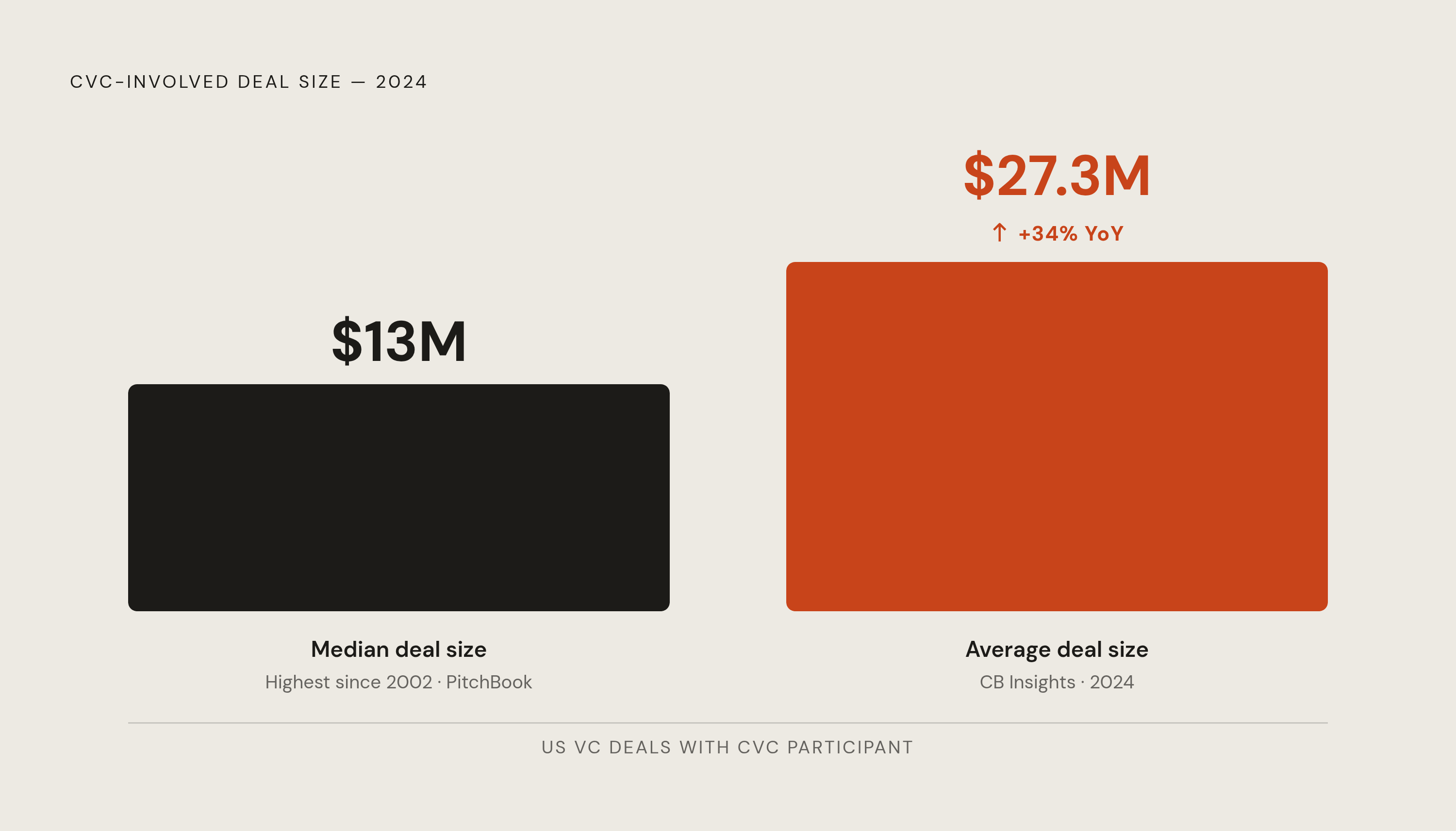
CVC involvement correlates with bigger rounds, and not by a small margin. Median US VC deal size with a CVC in it hit $13 million in 2024, the highest mark since 2002, per PitchBook. CB Insights clocked the average deal size with CVC participation at $27.3 million in 2024, up 34% year over year. That size buys leverage, and the leverage shows up in the paper every single time.
A right of first refusal on acquisitions lets the parent match any offer before a founder can accept it elsewhere, which quietly chills interest from other buyers, especially the parent's own competitors. Most-favored-nation clauses on commercial terms can force the parent's rivals to pay more for your product than the parent does. Board observer seats show up constantly and rarely get negotiated away, and because the observer usually works for the parent, information now flows toward a strategic competitor whether you want it to or not. Reporting cadence often runs heavier than what a financial VC asks for, since there's a corporate strategy team on the other end consuming that data. Co-investment rights in follow-on rounds cut both ways, useful if the CVC keeps writing checks, a real problem if the company drifts from what the parent wants.
Of everything on that list, the acquisition ROFR matters most early on. Negotiate it hard or kill it outright, particularly if selling to a competitor of the parent is a realistic path down the line. Get a startup lawyer redlining this, not a generalist doing you a favor. Corporate legal teams show up with more headcount and more reps than any founder can match alone.
How CVC decision-making processes differ from traditional VC — and what that means for your timeline
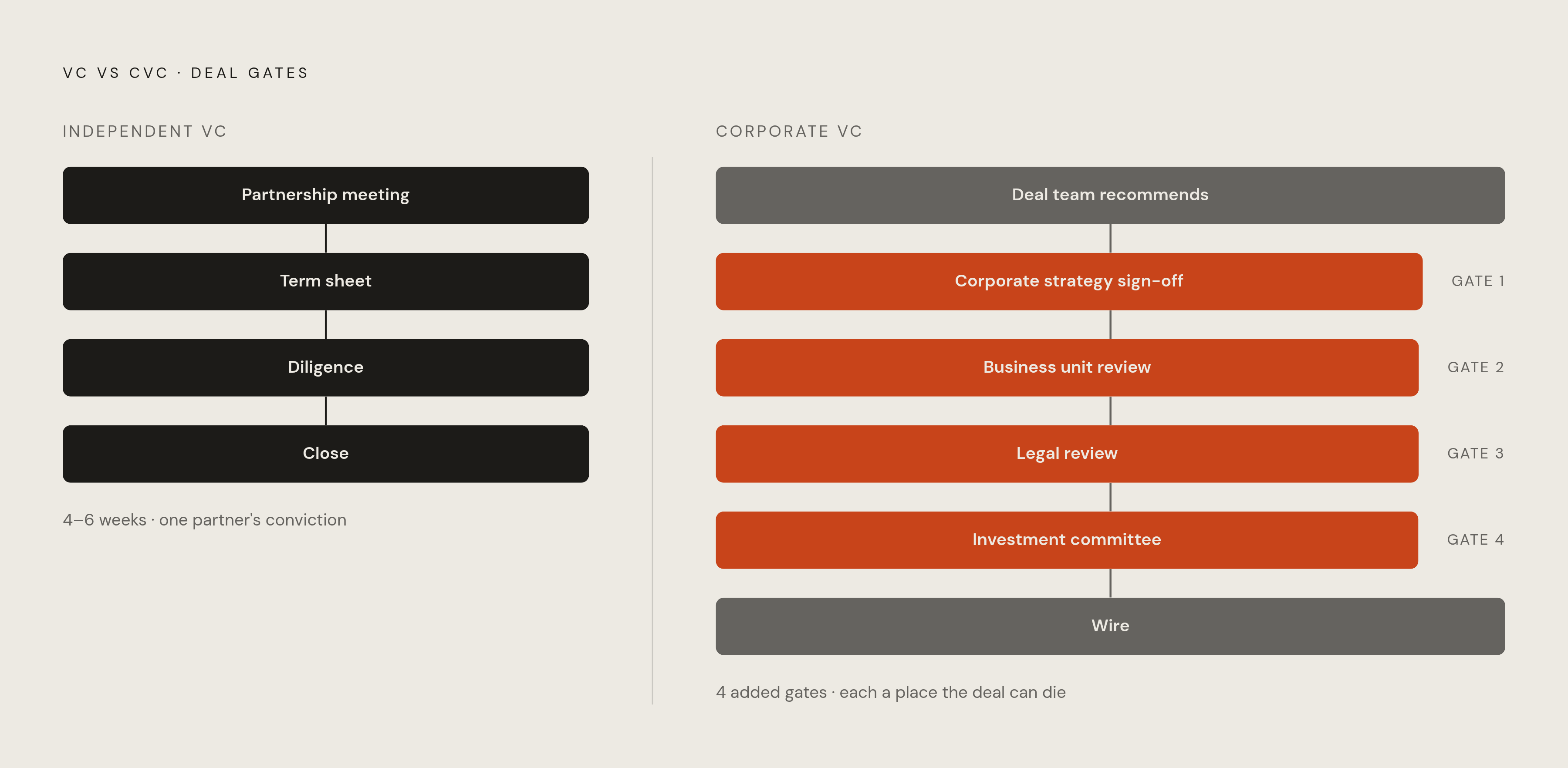
An independent VC's process is fairly linear: partnership meeting, term sheet, four to six weeks of diligence, close. One partner's conviction, backed by partners willing to fund it. A CVC runs through more rooms than that, and there's no way around it. The deal team recommends, corporate strategy has to sign off, sometimes a business unit weighs in, legal reviews it, and a senior executive or investment committee gives final approval before any wire moves.
Seed timelines already run longer than they did in 2021. Fold a CVC into the round without planning for the extra weeks and the close slips further than anyone budgeted for. Bring them in early, not at the tail end; a CVC needs the kind of lead time a corporate procurement cycle needs, which is longer than most founders want to admit. Ask the deal team directly: how does your internal approval work, and how long does term sheet to wire usually take? That answer tells you whether this CVC closes with the rest of the round or becomes the reason it drags into month four.
There's a champion risk here too, worth naming without softening it. The person at the CVC pushing for you might have real conviction, genuinely, and that conviction still isn't enough on its own. Somewhere upstream, they have to sell people who never sat in on your pitch and never will. Ask your champion what they need internally to get this through, then go help them build that case.
The strategic upside CVCs can genuinely deliver — and how to evaluate whether you'll actually see it
Distribution, customers, integration, brand validation, the pitch for CVC money is real and it can compress a go-to-market timeline in ways a plain financial check cannot. Salesforce Ventures companies get actual access to Salesforce's commercial machinery: AppExchange, co-sell, warm paths into an enterprise base that would take years of cold outbound otherwise. A company inside Nvidia's NVentures portfolio picks up a hardware-compatibility signal that enterprise buyers notice, and that follow-on investors read as diligence someone else already did.
But that validation doesn't arrive automatically, and the gap between the promise and the delivery is exactly where founders get burned. The deal team that wrote the check almost never runs the business unit that would execute a real commercial relationship. A specific introduction to a specific business unit leader is worth ten times a vague promise of "future collaboration," so ask for that introduction before you sign, not after. Call other portfolio companies. Ask if the distribution they were promised actually showed up, and how long it took. The honest answer usually runs slower and thinner than whatever got pitched in the room.
The partnerships that actually work share a pattern. The product genuinely helps the parent's existing customers or roadmap, it doesn't compete against any of the parent's own revenue lines, and the founders want the commercial relationship for its own sake, not just for the number on the term sheet.
The long-term cap table risks that surface at Series A and beyond
Only 30 to 35% of seed-funded companies made it to a Series A in 2025, and the ones that do get their cap table read line by line by whoever's deciding to lead. A CVC on the table draws particular scrutiny, and it should. A ROFR narrows the buyer pool, and a financial investor's return depends on that pool staying wide. Information rights held by a corporate parent can mean a competitor has real visibility into your pipeline and financials, and no Series A lead wants to underwrite that. Every non-standard term is legal complexity somebody eventually pays to untangle.
There's a quieter risk sitting under all of this. CVC programs live downstream of corporate priorities, and when the parent hits a downturn or changes strategy, venture activity is usually one of the first things cut, sometimes leaving portfolio companies stranded without the follow-on they were counting on. And if an acquisition does eventually happen, a ROFR means the price gets set partly by that clause rather than by an open market, which can leave founders with less upside than they modeled going in.
Refusing CVC money outright is rarely the smart move. Structuring it well is what actually matters. Tie any ROFR to specific milestones or a fixed window rather than letting it run indefinitely. Keep MFN clauses narrow and push back on exclusivity in commercial terms. Cap board observer rights to a defined term, or tie them to an ownership threshold the observer has to keep earning. Keep information rights in line with what financial investors get. Nothing broader.
How to decide whether a specific CVC belongs in your round
Does this corporation's strategic interest actually line up with where the company is headed, and do the terms reflect that honestly rather than aspirationally? That's the whole question.
Start with fit. Is the parent a plausible commercial partner, a plausible acquirer, or a credibility signal the next round's investors will care about? If none of those apply, you're getting financial capital with extra strings, which is a worse deal than the same check from a financial VC carrying no baggage at all. Then check competitive exposure: does the parent compete with your current or prospective customers? If so, some of them may pull back spend, or walk away entirely, once the investment becomes public. Finally, sit with the terms themselves. Can you live with the ROFR, the information rights, and the MFN clause all the way through a Series A process? Model the worst case, the parent exercising that ROFR at the worst possible moment, before you sign anything.
A structured raise makes this decision manageable instead of reactive. Founders who know their prioritized investor list, who can see the whole pipeline at once against a real timeline, can tell immediately whether a given CVC fits the schedule or threatens to wreck it. Founders flying blind tend to treat every inbound check as equivalent, which is exactly how bad terms end up on a cap table by accident rather than by choice.
CVC works best next to financial VC, not instead of it. The financial investor brings governance experience, LP-facing discipline, and a real incentive to fund your next round. The corporate investor brings distribution and validation money alone can't buy. Put together well, financial VC leading, standard terms throughout, a ROFR that sunsets on schedule, a CVC on the cap table is an asset. Put together carelessly, it's the thing your Series A lead spends three weeks trying to unwind.