Emerging Check-Writing Behavior Among Micro-VCs
Micro-VCs now lead pre-seed as legacy funds move upstream.

The gap didn't appear out of nowhere. Legacy seed funds that used to write $1 million to $2 million checks have moved upstream, setting minimums of $3 million to $5 million and effectively operating at what used to be called Series A. That migration left real white space below them, and micro-VCs walked into it.
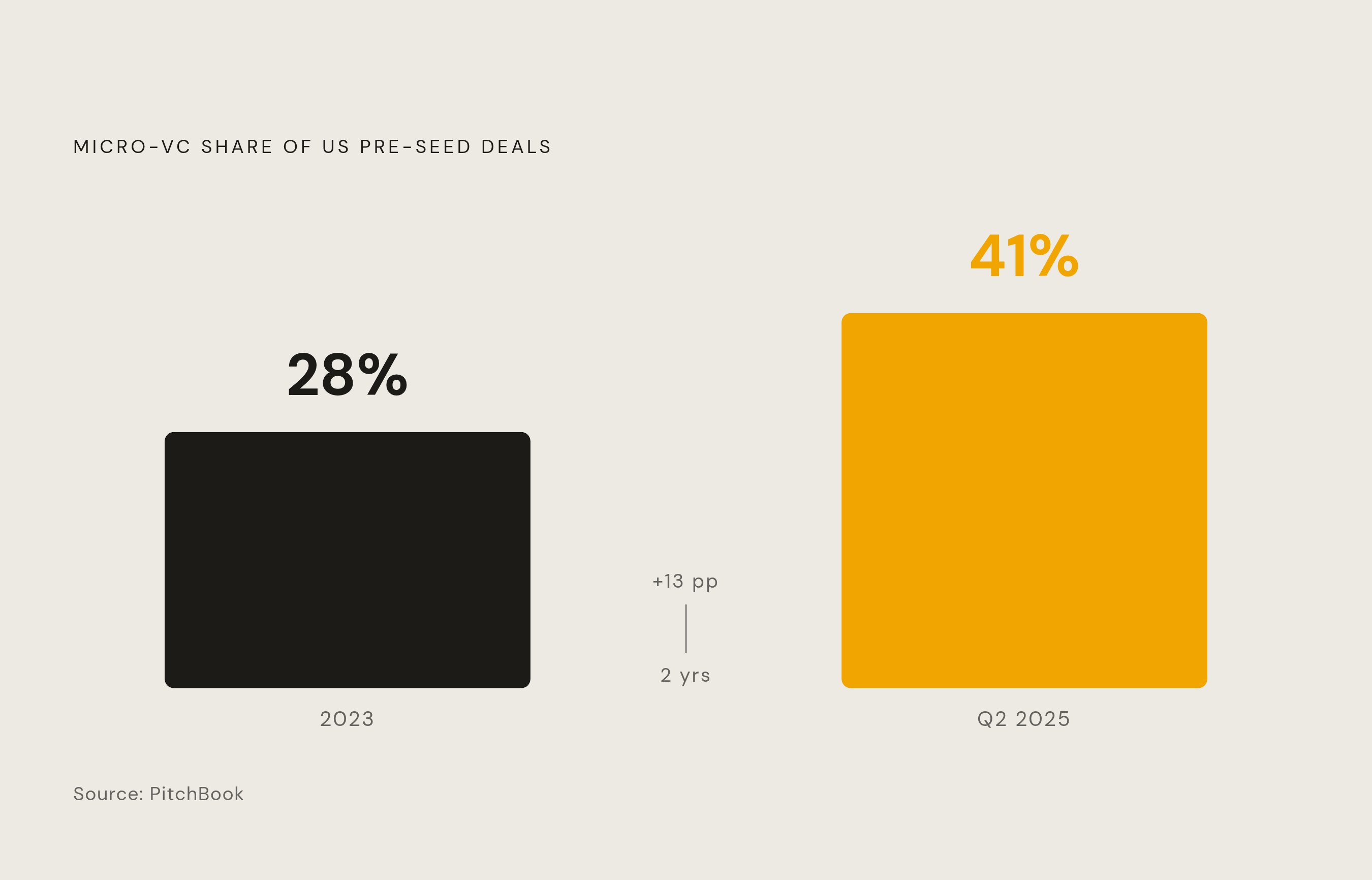
Micro-VCs now lead 41% of all US pre-seed deals, up from 28% in 2023, per PitchBook's Q2 2025 data. The opening they stepped into was created by legacy seed funds raising their minimum check sizes to $3 million to $5 million and effectively migrating to what used to be called Series A, leaving genuine white space below them. Two factors let micro-VCs fill that gap: the cost of validating product-market fit has compressed sharply, so a $250,000 to $750,000 check can now fund a real proof-of-concept timeline, and micro-VCs move in weeks rather than the months traditional seed funds require, which makes them the practical first call for founders running time-sensitive raises.
Stage bifurcation formalized alongside that shift. Pre-seed and seed stopped being loose, interchangeable terms somewhere in the last few years; they're distinct rounds now with distinct valuation bands. Pre-seed rounds raise roughly $500,000 to $1.5 million against valuations in the mid-single-digit millions, while seed rounds raise $2 million to $4 million against valuations in the low tens of millions. Pitch a pre-seed round to a fund thinking in seed-stage terms, and the conversation gets confusing fast, and it's usually the founder who loses the week figuring out why.
Two tailwinds explain why micro-VCs could step into this gap at all. First, the cost of validating product-market fit has dropped, largely because AI-assisted development and cloud infrastructure compressed what used to take a much bigger check. A $250,000 to $750,000 check can now fund a real proof-of-concept timeline in a way it couldn't a decade ago. Second, speed itself became a competitive edge for the funds. Micro-VCs move in weeks, while traditional seed funds, carrying more committee layers and bigger checks to justify, often take months. Founders running time-sensitive raises go to micro-VCs first for one practical reason: they actually close.
Why do micro-VCs now lead such a high share of pre-seed deals, and how did legacy seed funds moving upstream create that opening? Per PitchBook's Q2 2025 data, micro-VCs now lead 41% of all US pre-seed deals, up from 28% in 2023. A jump that size in two years isn't a cyclical wobble; it's a structural rewiring of who leads this stage. New fund formation backs it up, with hundreds of new micro-VC vehicles launched across 2024 and 2025, and a growing share of them sit outside San Francisco and New York, which is quietly reshaping who has access to this capital in the first place.
The thesis-first pattern: how micro-VCs decide what they will and won't fund
Sector focus, not generalist coverage, is the norm among new micro-VC funds. AI and ML, climate tech, fintech, and healthtech dominate the thesis statements coming out of new fund formations. A generalist micro-VC still exists, sure, but it's the exception now, not the default.
What does a thesis-first posture mean sitting across the table from a founder? It means the fund already made a public, or semi-public, call on a market, and a founder who fits that call gets faster pattern-recognition from the GP than one who doesn't. It also means a company outside the thesis doesn't get a polite maybe, it gets a fast no. Don't take that personally, since a fast no from a fund that was never going to write the check frees up your week for the two or three funds that might.
Operator-First funds and Thematic Specialist funds run different diligence logic even when the check sizes look identical on paper. An Operator-First GP underwrites the founder's domain credibility as much as the market itself, asking whether this specific person earned the right to win here. A Thematic Specialist underwrites timing, asking whether the sector sits at an inflection point right now. Pitching a Thematic Specialist means speaking fluently about category dynamics and competitive positioning and why now, not just company traction.
Solo GP funds sharpen this even further. A solo GP runs a leaner, more focused vehicle, so the fit between fund thesis and company direction matters more than broad social proof from other investors. That's a different sales job than pitching a partnership, and founders who pitch a solo GP like they'd pitch a multi-partner fund tend to underperform in these meetings.
Open the pitch with explicit alignment to the fund's stated thesis, and don't bury it on slide twelve. That's not flattery; it's proof you did the targeting work before you showed up.
Stage triggers: the specific moments when micro-VCs write checks
Most micro-VCs don't run off a rigid checklist of milestones. They run off a stage trigger, a set of conditions that, once met, make a company legible enough to underwrite.
At pre-seed, the common triggers are a credible founding team with real domain background (even absent a working product), a prototype or MVP proving out the core hypothesis, and early user signal, a waitlist, a pilot, a letter of intent, that shows the problem is real to someone other than the founder. At seed, the bar moves: funds want measurable early retention or usage data rather than acquisition numbers alone, some revenue (even small) proving willingness to pay, and a clear, testable hypothesis about the growth motion the round itself will fund.
Fund lifecycle timing matters as much as company milestone timing, and this is the part founders underweight most. A micro-VC that just closed a new fund is in active deployment, moving fast, hungry to place capital, while a micro-VC in the back half of its deployment period gets more selective and slower, saving what's left for the highest-conviction bets. Deal activity among funds under $50 million AUM showed a sharp year-over-year uptick, but that activity landed unevenly across fund lifecycles. Approaching a fund mid-deployment is a different conversation entirely from approaching one that's nearly fully deployed, even when both funds share the same thesis on paper.
There's a seasonal layer worth calibrating around, too. Q1 tends to run quieter in deal volume, though standout companies can still extract better terms in a slower market, and Q4 sees higher activity across the board. And for accelerator graduates, Demo Day is a trigger, not a finish line: the pipeline work in the weeks right after Demo Day is what actually closes checks, not the pitch itself.
Check size as a signal of role, not just capacity
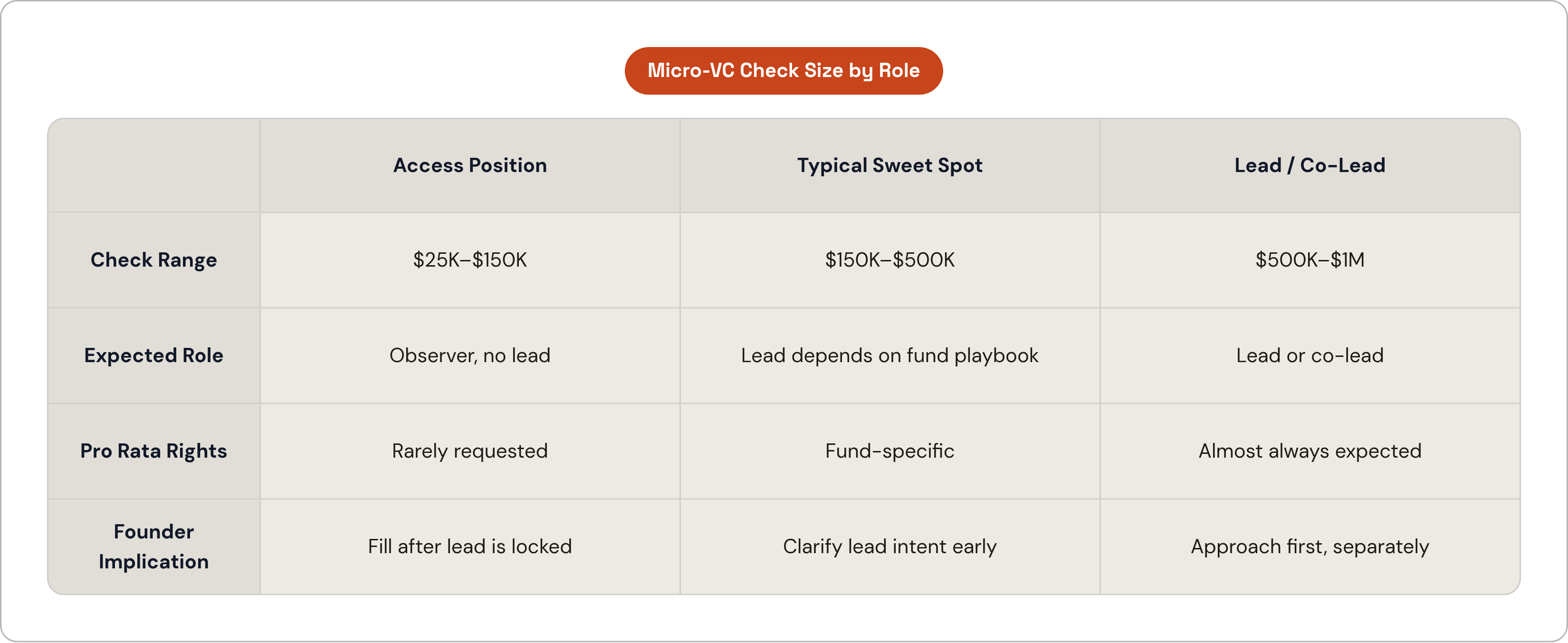
The range inside the micro-VC category runs wide, from the low tens of thousands out of the smallest solo GP vehicles up to $750,000 to $1 million from the larger funds in this bracket. That range isn't just about how much capital a fund has sitting around; it signals what role the fund expects to play in your round.
Smaller checks, $25,000 to $150,000, often signal an access position. The investor wants exposure, maybe a board observer seat, but isn't positioning as a lead. Mid-range checks, $150,000 to $500,000, are the typical micro-VC sweet spot, and whether one comes with a formal lead role depends entirely on that fund's individual playbook. Larger checks, $500,000 to $1 million, usually mean the fund is stepping into a lead or co-lead role, will expect pro rata rights, and will get far more involved in constructing the rest of the round.
Co-investment is the norm here, not the exception. Most micro-VC pre-seed rounds are syndicated, several funds filling out a round together, so a single check is a building block rather than a full financing. Knowing which funds anchor a round versus which funds fill it changes your order of operations: lock a lead before the rest of the round can close cleanly. Pitching fill capital before a lead is locked in stalls the whole process, and it's a pattern that repeats across pre-seed raises.
SAFE mechanics shape a lot of this conversation in practice. Post-money SAFEs are the standard structure at pre-seed now, valuation caps have moved up meaningfully from a few years ago, and discount rates have shifted in ways that favor investors. Understand how a cap and a discount interact before signing anything from a single micro-VC, because the terms in that first SAFE set a precedent the rest of the round follows. One tell worth watching for: a micro-VC that insists on pro rata rights even on a small initial check is signaling a long-term conviction bet, expecting to participate in future rounds. That's a different relationship entirely than a fund that passes on pro rata and moves on.
Why founders still misread micro-VCs and pitch the wrong ones
The most common mistake is treating every sub-$100 million fund as interchangeable and building a target list off fund size alone. The failures that follow are predictable. A founder pitches a thematic climate fund with a fintech product, and the fund literally cannot write the check, no matter how sharp the pitch is. A founder approaches a fund that's 80% deployed with no new vehicle announced, and the capacity just isn't there. A founder seeks a lead commitment from a fund that only writes small access checks, and both sides end the conversation with mismatched expectations.
Information asymmetry drives most of this. Founders have historically had poor visibility into which micro-VCs are actively deploying, what their current thesis actually is, and what check size they're targeting in a given fund. Investors, meanwhile, have always had far more structured data about founders than founders have had about them. That imbalance shows up as wasted time, plain and simple: a micro-VC process that ends in a pass after three weeks of diligence is three weeks not spent with the two funds whose thesis you actually fit.
LP composition data hints at how fragmented this market has gotten on the investor side, and that flows straight through to how funds get sized and what they can write. In one analysis of LP commitments, 75% of all LP investments in micro-VC vehicles came in below $150,000, and the average LP check size fell from $163,000 in 2022 to $131,000 in 2025. A broadening LP base is feeding smaller, more focused fund vehicles, and the targeting problem for founders is getting sharper as this market matures, not easier.
How to build a micro-VC targeting approach that accounts for thesis, timing, and check role
Start with thesis mapping, not fund size filtering. Find which funds have made explicit, public bets on your sector or problem, then work backward to fund size and check range. Sort by AUM first and thesis second, and you'll end up pitching funds that were never going to say yes, a mistake I've seen sink otherwise strong rounds.
Layer deployment timing on top of thesis fit. Whether a fund recently closed a new vehicle, or is late in deploying a prior one, is usually discoverable through public fund announcements and platforms that track fund formation. Then segment the target list by expected check role before any outreach goes out. Two or three funds positioned to lead or co-lead get approached first and separately. A fill list, funds that typically take smaller positions, gets approached once a lead commits, while a watch list, funds whose thesis fits but whose deployment timing is unclear, is worth nurturing over months rather than pitching cold right now.
Sequencing the outreach this way compounds. Close a micro-VC lead before approaching traditional seed funds, and that early momentum becomes social proof in later, larger diligence processes. Run it backward, seed funds first, micro-VCs as an afterthought, and both processes tend to stall at once, because neither side has the signal it needs to move.
Personalization in outreach isn't a nicety here; it's a filter the GPs themselves are running. A two-sentence explanation of why a company fits a fund's stated thesis beats a generic deck send, especially with solo GPs, who respond to clear evidence that a founder actually read their writing and tracked their portfolio. The SAFE conversation itself doubles as a diagnostic: how a micro-VC negotiates cap and discount tells you whether that investor is positioning as a long-term partner or a pure access play, and that should shape how much relationship capital you invest with them after the round closes.
This is a data problem before it's a pitching problem. Founders need the same quality of investor intelligence, thesis fit, deployment status, check role, that institutional operators have always had, and getting it without a large personal network or a seasoned CFO on staff used to be close to impossible. Closing that gap means finding tools and networks that surface thesis alignment and fund deployment status at the speed a pre-seed raise actually demands.