Down Round Dynamics and Founder Negotiation Leverage
Founders can negotiate anti-dilution and ownership terms to survive down rounds.

Nearly a quarter of US venture rounds in 2024 priced flat or down, the highest share in a decade and roughly double the 2022 rate, according to PitchBook. Down rounds are no longer an edge case that happens to badly run companies; they're a structural feature of this market. I've sat across the table from founders who treated a repriced round as a verdict on their judgment, and every time, that reaction cost them leverage they actually had. The real work is understanding the mechanics well enough to negotiate a materially better outcome than whatever term sheet just landed in the inbox.
When a down round term sheet arrives, the most consequential levers are anti-dilution provisions, pay-to-play requirements, and the treatment of existing liquidation preferences. Founders who understand that late-stage repricing is a structural market condition rather than a verdict on their company can negotiate from a less panicked position, which itself preserves leverage. The gap between early-stage financing, which has recovered and shows healthy up-round rates in 2025, and the late-stage market, where distress has concentrated, means the competitive dynamics differ sharply by stage and founders should calibrate their alternatives accordingly. Knowing where the real pressure sits, and that a quarter of rounds pricing flat or down is a broad market phenomenon, not a company-specific failure, matters when pushing back on terms that would otherwise lock in unnecessarily punishing economics.
The correction traces back to the end of free money. Valuations peaked in 2021 on near-zero interest rates, and when rates rose in 2022, SaaS multiples fell hard off their boom-era highs. Companies that raised at ten or twenty times revenue in 2021 have spent three years since finding out what their business is worth when capital isn't free. That repricing didn't happen in one clean drop; it's been grinding through the market since, and it isn't finished yet.
Context helps, because this cycle isn't the worst one on record. The dot-com crash saw a majority of financing rounds priced down. The 2008 crisis put roughly a third of deals below the prior round's price. A sustained rate near a quarter is milder by comparison, but it's lasted longer, and duration matters as much as severity when you're deciding whether to wait out the storm or raise into it.
The aggregate number also hides a split market founders need to see clearly. Early-stage financing, seed through Series C, has recovered and shows healthy up-round rates in 2025. The pressure has concentrated at late stage, where a significant share of deals in the second half of 2025 priced down. Mega rounds into AI companies at the top of the market are pulling the average up and masking real distress underneath. If you're a late-stage founder reading headlines about a strong venture market, that headline was never describing your round.
The real question is what you do when a down round happens to you.
What do founders negotiate when facing a down round term sheet?
A down round sets a new share price below what the previous round paid. That looks like a valuation problem on the surface, but the deeper issue is ownership: existing preferred shares convert into common at prices that get adjusted downward once a cheaper round prices, and the dilution cascade that follows lands hardest on whoever holds plain common stock: founders and employees.
Anti-dilution protection is the mechanism doing the damage, and its two flavors behave nothing alike. Weighted-average anti-dilution, the market standard, adjusts conversion prices moderately, scaled to how large the new round is relative to shares already outstanding. Full ratchet is far more severe: existing preferred converts at the new, lower price no matter how small the new round is. A modest bridge priced at a discount can trigger dramatic dilution under a full ratchet clause. That's exactly why sophisticated investors ask for it, and exactly why founders should resist it whenever they have the standing to.
These adjustments can amplify total dilution well past what the new investment itself would cause, unless the investors holding those rights agree to waive them. That waiver isn't a formality. It's one of the most consequential asks in the whole negotiation.
Some down rounds go further and cross into cram-down or washout territory, where the repricing is severe enough to subordinate or wipe out earlier investors who don't participate. That's a different negotiation with different legal exposure, and usually it means litigation risk just walked into the room alongside the term sheet.
Pay-to-play provisions have been showing up more often as the enforcement mechanism here. Data from the second quarter of 2024 shows a rise in structures requiring existing investors to participate in bridge financing just to keep their anti-dilution protection. The effect concentrates ownership among investors who stay active and dilutes the ones who sit out. That sounds punitive, until you realize founders can point the same tool the other direction.
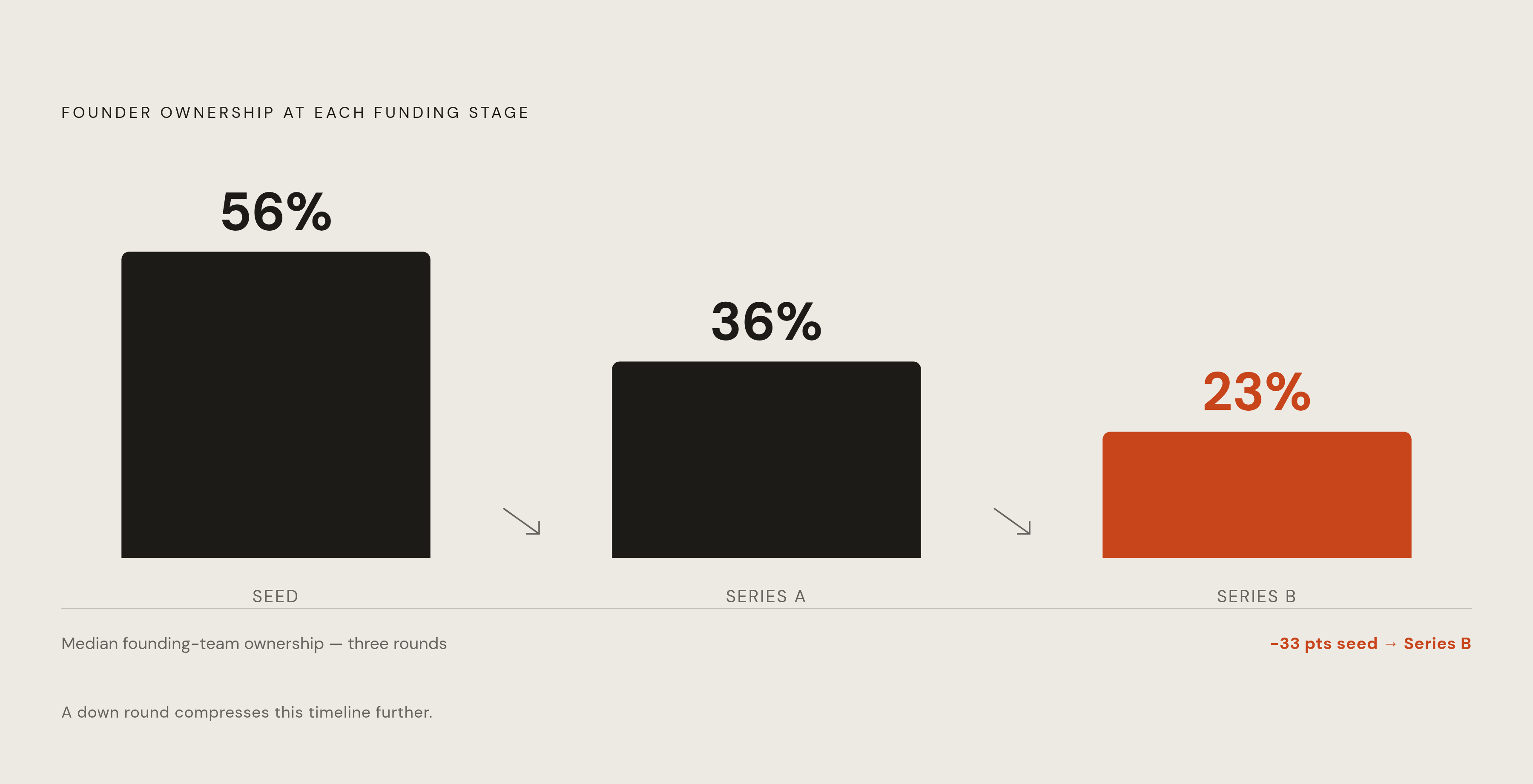
The ownership benchmarks make the stakes concrete. Median founding-team ownership runs around 56% after seed, drops to roughly 36% after Series A, and sits near 23% by Series B. Those numbers describe the ordinary dilution path in a healthy market. A down round compresses that timeline further, and the margin before ownership stops functioning as a real incentive is thinner than most founders assume walking into their first repriced round.
Option pool expansions compound the squeeze, and they're easy to miss because they get folded into the same conversation as the new financing. A pre-money pool expansion dilutes existing shareholders, meaning founders, before a single dollar of new money shows up. Down rounds routinely arrive with a request to refresh or expand that pool, and founders who don't scrutinize the size of the ask are absorbing dilution that has nothing to do with the new investor's check.
Recapitalization is the alternative worth knowing about, even though it's rarer. Converting existing preferred into common, or into new preferred with reduced preferences, can reset a distorted cap table without triggering a formal down round. It needs broad consent from existing investors, which makes it hard to pull off, but it's the right tool when the cap table problem is bigger than any single financing can fix.
How current term sheet norms define the negotiating floor
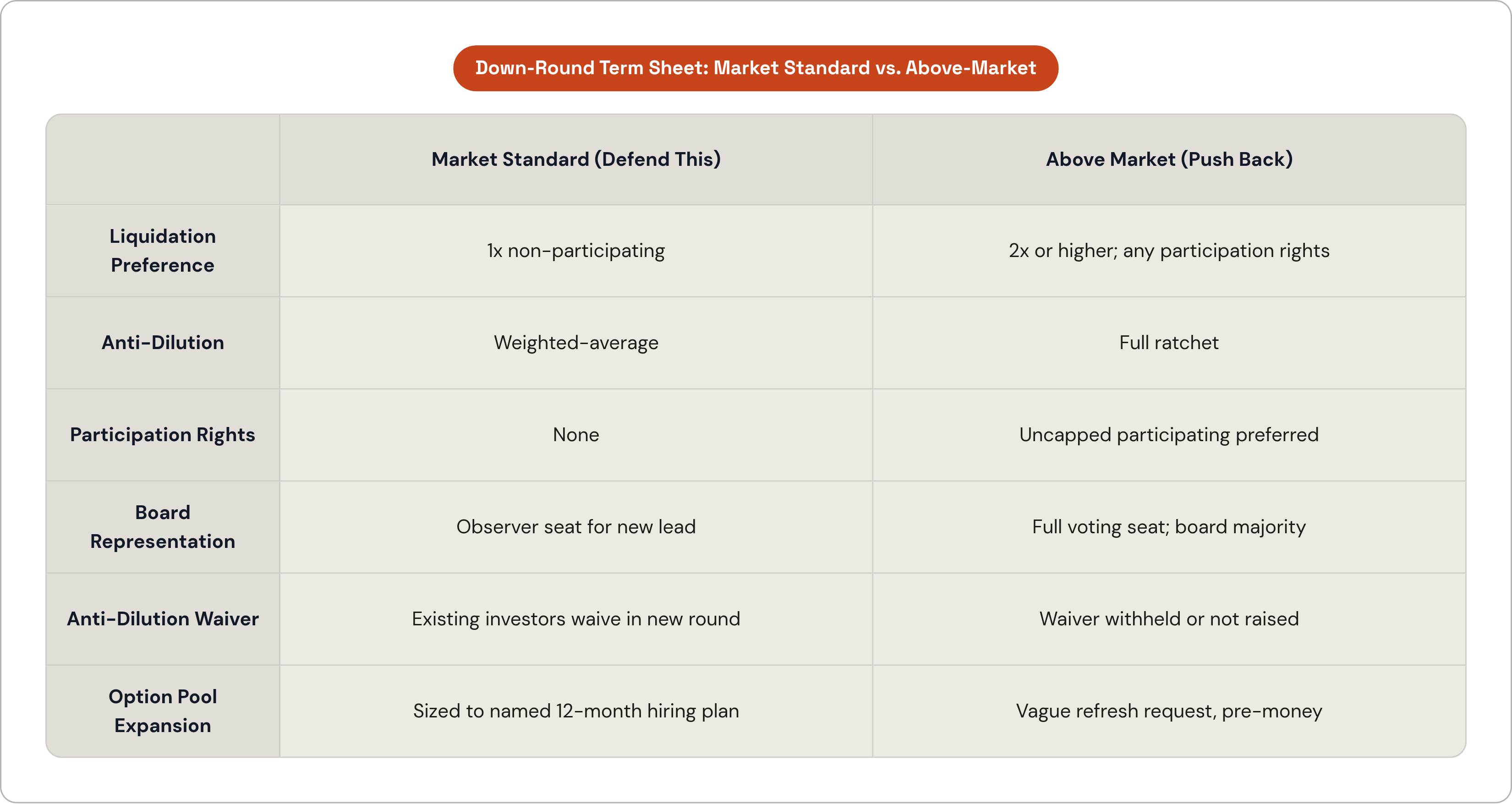
Founders often walk into a down round assuming they need to make concessions just to get it done. That instinct undersells their position. The market-standard terms as of 2025 and 2026 are the floor to defend, not a starting offer to negotiate away from. A 1x non-participating liquidation preference paired with weighted-average anti-dilution is standard; anything asking for more is an attempt to extract terms above the market clearing price.
Participating preferred is creeping back, and founders should watch for it specifically. Roughly a quarter of Series A deals in Q4 2024 included participation rights, up from under a fifth in 2021. Participation lets an investor recover their liquidation preference first, then still share pro rata in whatever's left, a direct double-dip that compresses what founders and employees take home at exit. It sounds like a small structural detail until you run the exit math and watch how much of the upside it eats.
Anything at 2x or higher on the liquidation multiple sits well outside normal range right now and deserves specific, comp-backed pushback, not quiet acceptance. Bring the market data to that conversation rather than negotiating on instinct.
There's a countervailing signal worth flagging: founder preferred stock, a structural protection for founders themselves, showed up in 11% of deals in the first half of 2025, up from 6% in 2023. Still a minority practice, but it tells you the market is starting to accommodate founder-side protections that simply didn't exist a few years back. Worth raising even if you don't expect to land it.
Pre-seed dynamics deserve their own note, because the instrument itself has shifted the dilution math. SAFE notes dominate that stage, used in roughly 90% of pre-seed deals as of early 2025, largely because they let both sides delay a formal valuation conversation. The detail that catches founders off guard is the shift to post-money caps as the default structure. A post-money cap folds the SAFE investment itself into the denominator, which locks in the investor's ownership percentage before the math even starts and shifts the full weight of future dilution onto the founder. If your pre-seed ran on SAFEs with post-money caps and you're now staring at a down round, that earlier structure is already working against you in ways that predate this negotiation entirely.
Board composition belongs in this same conversation, not tacked on as an afterthought. Down rounds frequently come with a request for a new board seat or observer rights for the lead. Founders who skip negotiating this at signing tend to lose operational control they don't get back, because board seats, unlike valuation, almost never renegotiate upward in the founder's favor at the next round.
The timing problem that determines everything else
Runway is leverage, full stop. A founder starting a raise with twelve months of cash left negotiates from a position of choice. A founder starting with four months negotiates from necessity, and investors price that necessity into every clause of the term sheet whether or not anyone says it out loud.
The practical target: start a raise with nine to twelve months of runway still on the balance sheet. Starting under six months means the negotiation is compromised before the first meeting even happens, because everyone at the table already knows you can't afford to walk away and wait.
Burn multiple is the instrument that catches this early, and it's worth checking monthly rather than glancing at it once a quarter. Net burn divided by net new revenue tells you whether unit economics are deteriorating well before that shows up as a hard number in a valuation conversation. Founders who track this line can see a down round forming months out, while they still have runway and still have choices about how to respond.
Some founders should actually initiate a down round on their own terms, which sounds counterintuitive until you look at the data. Research from Union Square Ventures found the amount raised at seed and Series A is inversely correlated with startup success; raising less money correlates with more of it. If a down round is clearly coming in the next six to twelve months regardless, or if pricing one now would let a strategic investor onto the cap table on good terms, doing it voluntarily while runway is still healthy preserves far more room than waiting to get forced into it.
Early, honest conversations with existing investors matter for the same reason. Telling your board six months out that you see a repricing coming, and that you have a plan, is a fundamentally different conversation than showing up with four months of runway asking for a bridge. The first reads as strategy. The second reads as rescue, and rescues get priced accordingly.
Where founders actually have room to negotiate
The single biggest mistake founders make in a down round is conflating the valuation number with the actual outcome. A high pre-money figure wrapped around predatory terms produces worse founder economics at exit than a lower valuation with clean terms, once anyone actually runs the exit math. The trouble is headline valuation still feels like the scoreboard, so founders anchor on it even when it's the wrong number to fight over.
The anti-dilution waiver is the highest-value ask on the table. Getting existing investors to waive their anti-dilution protection in the new round stops the dilution cascade from compounding on top of what the new money already does to founder and employee ownership. This is more achievable than most founders expect, because existing investors have their own reasons to want it too: a demoralized founding team and a cap table that guts option pool value don't help anyone's return, theirs included.
Option pool sizing is the second-highest-ROI fight, and founders routinely skip it because it feels like an administrative line item. A pre-money pool expansion dilutes founders, not the incoming investor, so a vague request to "refresh the pool" should get met with a specific, named-role hiring plan for the next twelve months that justifies a smaller number. Precision is the argument here. A founder who shows up with a real hiring plan has more standing than one who just accepts whatever pool size gets proposed.
On liquidation preference, hold the line at 1x non-participating. Every concession here compounds across every future round that follows, because the next investor's term sheet references what came before. If participation rights turn out unavoidable, negotiate a cap, something like 2x or 3x before the preference converts to pro rata common, rather than accepting participation with no ceiling at all.
Board seats deserve the same discipline. Push to keep structures that preserve operational control, and negotiate veto rights on specific major decisions instead of ceding a board majority outright. When an investor insists on representation, an observer seat costs materially less than a voting seat, and it's worth offering that trade explicitly rather than waiting to be asked.
There's also a process-level tactic worth using before the term sheet stage: defer the valuation conversation until investor conviction is already locked in. Founders who can credibly say "let's find the right partner first, we'll get to price" build more room to anchor the number later, instead of setting a floor before anyone's actually decided they want in.
Series A dilution benchmarks give founders a concrete target to walk in with. Median dilution at that stage ran around 17.9% in 2025, down from 20.9% the year before. A founder who knows that range has a defensible number to push toward, instead of accepting whatever the first term sheet claims is market.
Creating competitive pressure when you don't have natural leverage
Never negotiate a down round with one investor in the room. Leverage here comes almost entirely from credible alternatives, and those alternatives don't need to be perfect or even especially appealing. They just need to exist, and to be visible to the investor you're actually trying to close.
Running a real parallel process, several investors engaged at once, creates urgency before any of them has issued a firm offer. A competing term sheet from a second-choice investor resets the entire dynamic with your preferred lead, because it flips their calculus from "take it or leave it" to "match it or lose it."
Comparable-deal data is the other lever, and it works because it moves the conversation out of negotiation theater and into evidence. A founder who arrives with recent comps on terms, dilution percentages, and preference structures is arguing from the market, not from position. Seed pre-money valuations hit a median of $16 million in 2025, up 18% from the year before, and a founder repricing into a down round who knows the current comp set can argue the new number reflects where the market actually sits, not some distress signal unique to their company.
Investor selection matters more here than in a healthy raise. An investor who's written follow-on checks into down rounds before, or whose portfolio includes a company that navigated a recap cleanly, is a different counterparty entirely from one who's never sat through this. I've watched founders spend precious weeks courting funds that had never once supported a portfolio company through a repricing, and pay for that misjudgment later. Knowing an investor's history, whether they've triggered cram-downs in prior downturns, how they behaved the last time a portfolio company needed a bridge, tells you which conversations are worth your limited time and which ones will just drain your runway.
Existing investors who want to participate but haven't formally committed are an underused lever too. Their willingness to put in more money signals confidence in the company's trajectory to any new investor sizing up the deal, so surfacing that interest early, even informally, changes how outside investors read the round.
Pay-to-play cuts both directions. It's usually framed as investor-imposed discipline, forcing existing backers to participate or lose their protections. Founders can propose the same structure themselves, as a way to reward the investors actually showing up and dilute the ones who've gone quiet. Framed that way, it functions less as a punishment mechanism and more as a tool for cleaning up a cap table full of passive names.
What comes after the close: the next-round setup
Closing the round isn't the finish line. Every term agreed to in a down round shows up again in the next round's due diligence and in the next term sheet conversation, so a founder who negotiates poorly today is negotiating from a weaker chair a year from now, not just today.
Anti-dilution provisions that don't get waived or restructured in the down round don't vanish once the round closes. They sit on the cap table and shape the economics of whatever priced round comes next. A clean cap table, by contrast, is itself a fundraising asset. Investors evaluating a Series A or B read the prior round's terms closely, and a cap table loaded with aggressive preferences from an earlier down round raises real questions about whether the founder can negotiate and whether prior investors are actually aligned. Founders who kept the down-round terms clean walk into the next raise with a much simpler story.
Narrative discipline matters just as much as the legal terms. The down round comes up in every subsequent investor conversation whether the founder wants it to or not, and founders who handle this well walk in with a clear, evidence-based account ready: what happened, what changed operationally since, what the new valuation actually reflects. Founders who try to minimize or dodge the topic read as evasive, which lands worse than the down round itself did. The old stigma is fading structurally too, not just anecdotally: companies that went public through down-round IPOs, once treated as a serious red flag, have in several cases traded up substantially after listing. The market's tolerance for a repriced history is loosening at every stage, not just seed.
The work doesn't stop once the wire hits the account. Closing a down round changes the shape of the fundraising process rather than ending it. Keep relationships warm with investors who passed. Track progress against the specific milestones cited in the down-round narrative. Don't go quiet for a year. Founders who treat the close as the finish line tend to find themselves back in the same compressed-runway spot twelve months later, having the identical conversation from a weaker seat.
Down rounds negotiated well, and followed by real operational discipline, tend to recover. Down rounds that just get survived, without anyone fixing what caused them, tend to repeat. And the second one is always harder than the first.