Investor Sentiment Signals Founders Can Read Before Raising
Founders should read fund size and sector momentum, not headline venture totals.

US startups raised more than $400 billion in the first half of 2026, a number that already tops every previous full-year total on record. That headline tells you almost nothing about whether your raise will go well. I've watched founders pull that number up in a pitch deck like it's a tailwind. If you're reading it as good news for your seed round, you're reading it wrong.
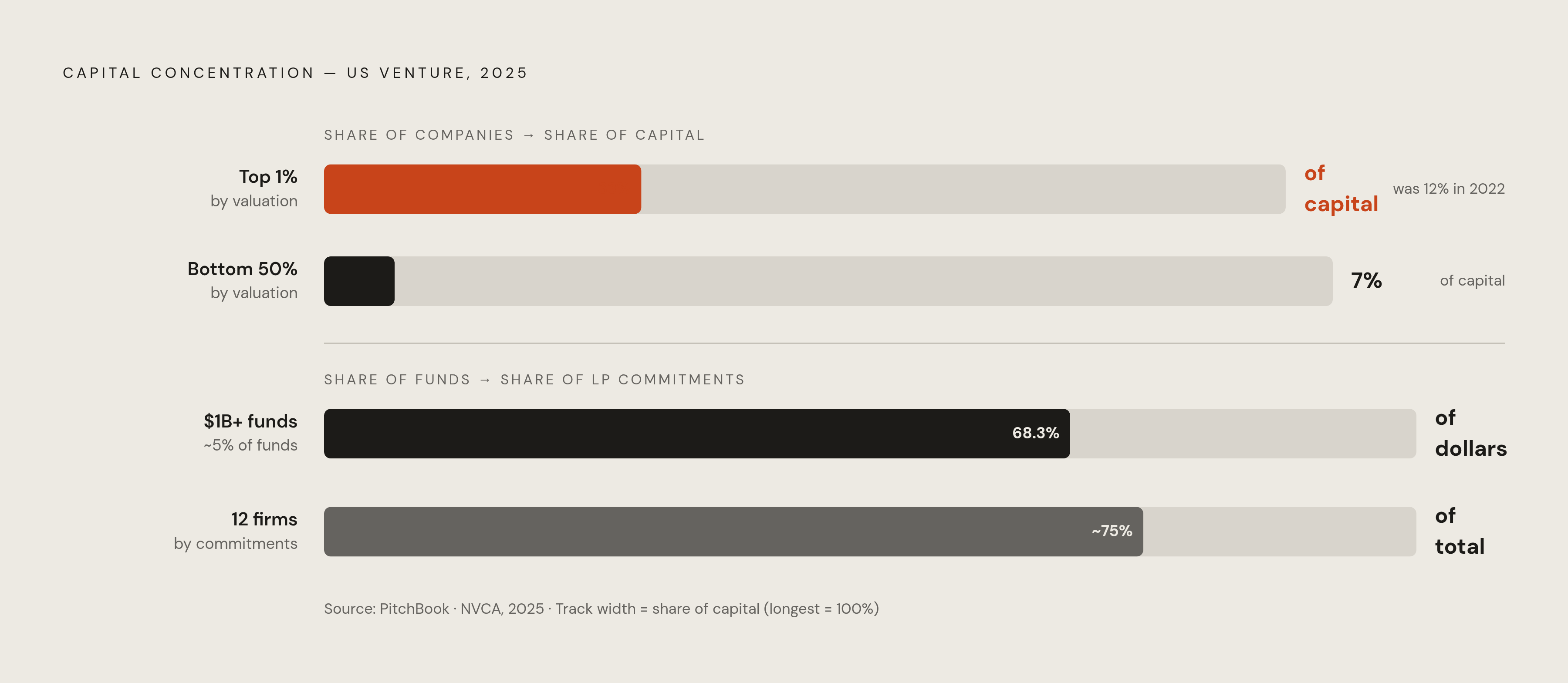
Record aggregate numbers are not a tailwind for your seed round. In 2025, 33% of all US venture dollars went to the top 1% of companies by valuation, up from 12% in 2022, while just 7% of capital reached the bottom half of the market. Global venture investment rose from $328 billion to $425 billion that same year, and that top-line growth is exactly why the concentration underneath it goes unnoticed. The only figures that matter for your raise are which pockets of the market are active right now and whether those pockets match your stage and sector.
So what do concentration numbers mean for a seed-stage founder? 33% of all US venture dollars in 2025 went to the top 1% of companies by valuation, up from 12% in 2022. Just 7% of capital reached the bottom half of the market. Global venture investment hit $425 billion in 2025, up from $328 billion the year before, and that top-line growth is exactly why the concentration underneath it goes unnoticed. Macro fundraising volume won't tell you anything about your actual conditions. What matters is which pockets of the market are active right now, whether those pockets match your stage and sector, and how you find that out before you send a single email.
How fund concentration shapes which investors are actually deploying right now
When founders with strong metrics still can't get a meeting, the answer often traces back to fund size, not pitch quality. Fund size tells you more about who's writing checks than almost anything else, and most founders never bother to look it up. Billion-dollar-plus funds now capture 68.3% of every dollar raised industry-wide, with just 12 firms accounting for close to three-quarters of total commitments. Meanwhile sub-$50 million funds have grown to 67.7% of all fund count while holding only 4% of the capital. They're everywhere, but thin on cash. In Q3 2025, the top ten VC funds captured roughly 43% of all venture capital, the highest concentration in at least a decade.
So what does that mean for who you should actually email? A megafund announcing a new $3 billion vehicle tells you late-stage conviction is strong. It says nothing about whether seed checks are loosening up. A small emerging manager closing a $40 million fund is a different animal entirely: that manager has to deploy the whole thing into early-stage companies, so watching what they do is the far more useful signal if you're raising a seed round.
Deal count fell 13% year over year in Q2 2025 even as total dollar volume climbed. Fewer bets, bigger checks, a higher conviction bar for each one. Sub-$5 million rounds made up less than half of all VC deals by early 2025, down from more than 70% a decade ago, and that's a structural shrinking of small-check volume, not a temporary dip. If you're raising a standard seed, you want investors whose fund size and vintage suggest they're currently cutting $500K to $3 million checks. A lot of firms' fund math simply doesn't support that anymore, no matter what their website says.
Sector momentum as a real-time sentiment signal
AI companies took in 61% of all global venture investment in 2025, or $258.7 billion. Everyone can see that signal; it's the loudest one in the market by a wide margin. Defense tech investment grew 75% from 2024 to 2025 according to SVB's Global Private Market Trends report, a sharp move for one specific vertical. Fintech, space tech, and health and biotech carry real momentum heading into 2026 too, just at a smaller scale, and quieter.
The harder question is what to do with signals that loud. Reading sector momentum well means going past the categories everyone already knows about. A firm's "focus areas" page is usually two years stale; what a firm actually announced in the last six to twelve months is a far better read. Watch for sector-specific fund launches, since a generalist firm rolling out a dedicated climate fund is telling you exactly where the next several years of its attention are going. Investor blog posts and conference panels matter here too, because written conviction tends to show up before the checks do. And pay attention when a sector a firm was talking about constantly six months ago just goes quiet. That silence usually means the thesis got saturated, or the firm slid into triage mode with its existing portfolio.
The AI valuation premium is itself worth sitting with, not just noting as a data point. Companies in the space carry a 222% valuation premium over non-AI peers at Series D and later, with triple-digit premiums showing up even earlier, and that reflects a firm-wide bet on a category rather than deal-by-deal pricing logic. For a founder building outside AI, this actually clarifies things once you work through it: it tells you which investors are effectively price-agnostic on AI, and therefore more likely to be rational, disciplined partners when they look at a deal in your space.
What benchmark data on round sizes tells you about investor expectations at your stage
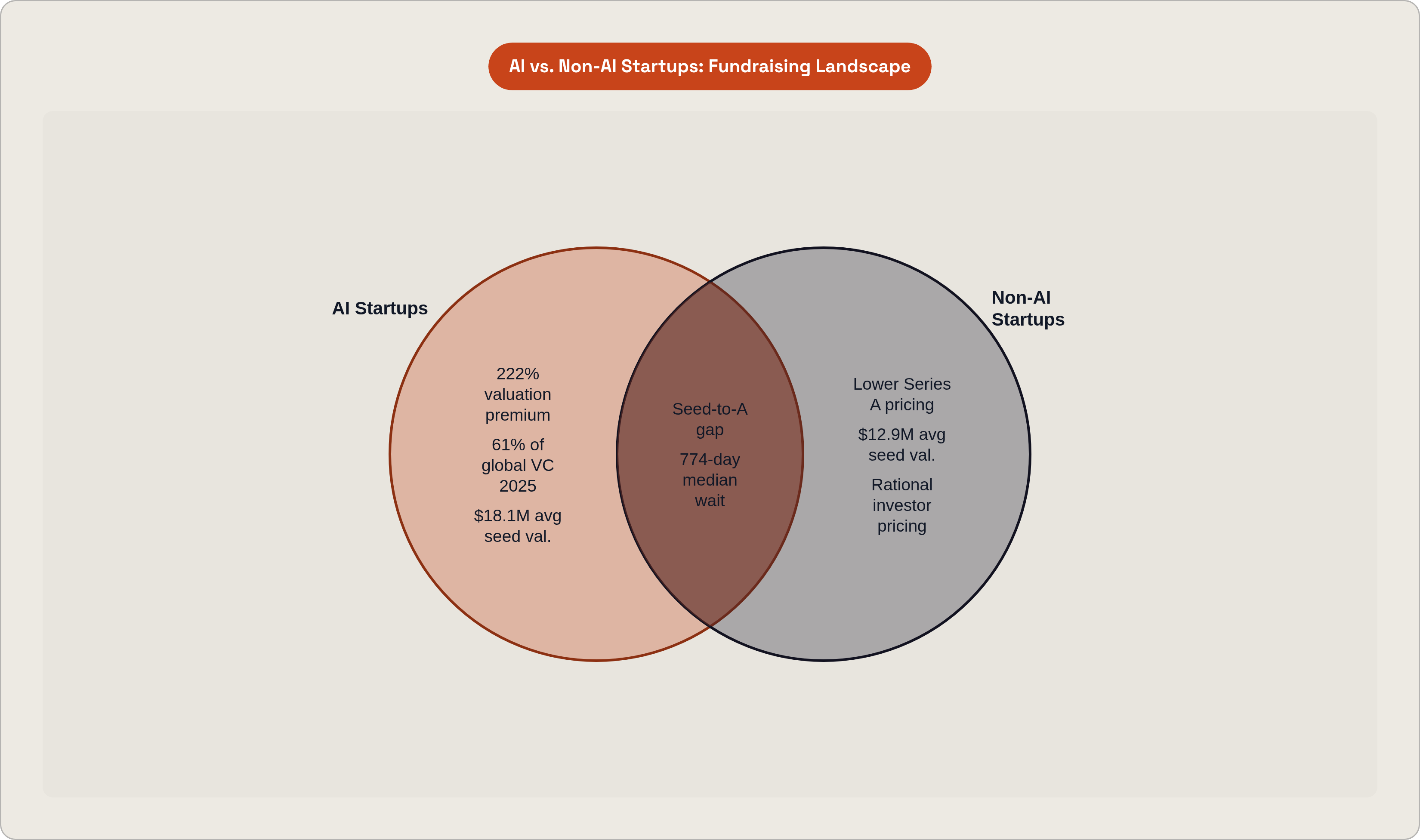
Round size data is where founders get their expectations wrong most often, usually because they're benchmarking against the wrong comparables. It's a common mistake to compare a modest seed target against headline numbers that have nothing to do with a given situation. The median seed round in 2025 averaged $3.2 million, and median seed post-money hit a record $24 million in Q4, up from $18 million a year earlier. AI seed rounds averaged $18.1 million in valuation versus $12.9 million for non-AI companies, a gap worth watching when you're sizing up whether an investor's recent deals suggest price sensitivity or the opposite.
The word "seed" has stretched almost past recognition at this point. In 2025, a majority of all seed dollars went into rounds of substantial size or more, and rounds of $50 million or more grew dramatically. That's a real trap. The seed rounds getting press coverage are dominated by AI labs, repeat founders with prior exits, and frontier research teams, and comparing your modest seed to a nine-figure AI lab round doesn't hold up.
Pre-seed still looks more grounded: $750K to $1.5 million on a $4 to $6 million post-money is typical, though top Y Combinator companies can command $15 to $20 million pre-seed caps purely on founder pedigree. Treat that as the exception it is; building your baseline around it will waste months. At Series A, the median deal has climbed meaningfully, but a large chunk of that increase sits in AI specifically. Non-AI Series A rounds price meaningfully lower on average, though specific pre-money figures vary widely by sector and stage. When an investor's recent deals cluster well above or below your range, that's a targeting problem, and you fix it by finding a different investor, not by rewriting your pitch for the tenth time.
The seed-to-Series A gap as an investor behavior signal, not just a founder risk
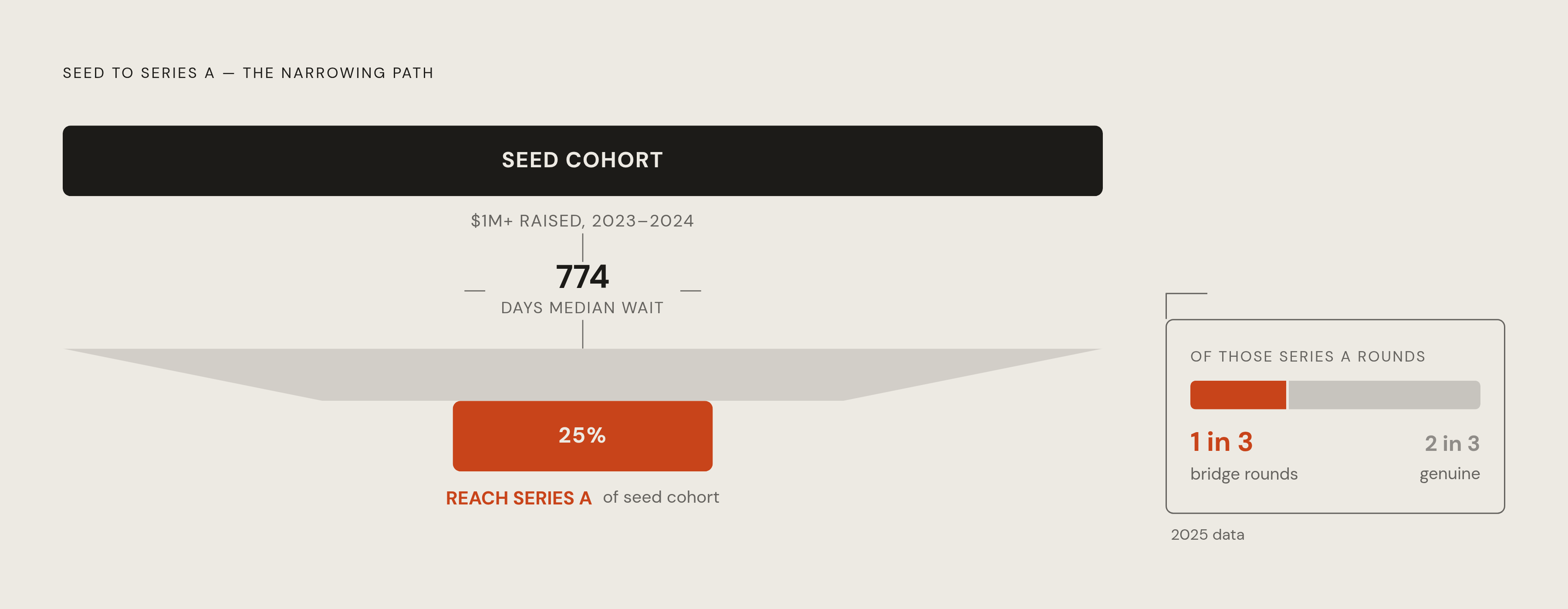
Only about a quarter of seed-funded startups that raised $1 million or more in 2023 and 2024 went on to raise a Series A, a meaningful drop from earlier years. That's a structural shift, not a cyclical dip. Capital efficiency expectations tightened hard across the board and haven't loosened since. The median startup now waits 774 days after its seed before raising a Series A, nearly two and a quarter years of runway management, most of it under real pressure.
Roughly a third of Series A deals in 2025 were bridge rounds, meaning founders were buying time to hit milestones they hadn't reached yet rather than raising a genuine next round. Sit with that statistic for a second and it says something about investor behavior, not just founder difficulty. Series A investors are holding a firmer line on ARR now, generally in the low millions with strong growth, up from a lower bar before 2022. Patience for "emerging signals" has largely evaporated; investors want a repeatable customer acquisition motion sitting in front of them, not a promising early trend they have to squint at and extrapolate from.
There's a practical read here too, and it's one worth internalizing early. A high volume of bridge rounds in a firm's recent portfolio means that firm is spending its bandwidth triaging existing positions, which leaves less room for new deals. Before approaching a prospective Series A investor, check whether they've been leading new deals lately or mostly propping up their own portfolio companies. Those two behaviors rarely run at high volume together, and knowing which mode a firm is in saves you weeks of outreach that was never going anywhere.
Stage-calibrated traction signals that reveal when investors will actually say yes
Investors score companies against specific, stage-calibrated proof points. Raise before you clear the relevant threshold and you're wasting your own time, no matter how hot the market looks from a distance. At pre-seed, the evaluation is mostly team quality and early validation, since investors are pricing thesis risk, not execution risk, and there's usually not much to execute yet.
At seed, the signals get concrete fast. Strong net revenue retention and short CAC payback periods are the metrics that come up again and again in real diligence. Early ARR, paired with strong retention or a credible enterprise pilot, generally supports a seed round at a post-money in the range the data shows: around $24 million at the median in Q4 2025. Series A raises the bar considerably: investors want meaningful ARR as a baseline, with top-quartile founders showing well above that, plus strong year-over-year growth and go-to-market infrastructure that's already working, not just promising to work.
AI-native companies face a different lens entirely, and the shape of it becomes clear when you dig through portfolio data. Revenue per employee has become the efficiency measure everyone's watching, since AI-native startups are showing up measurably more efficient on revenue per headcount than traditional SaaS at the same stage, and investors have started pricing that difference directly into valuations. Seed-stage AI companies closed at a significant valuation premium over non-AI peers in 2025, reflecting a category-level bet rather than strong individual deal-making.
Growth expectations have shifted in a way that's easy to miss if you only look at the percentage. Seed companies raising in 2025 showed 322% year-over-year growth on average, down from 959% in 2021, but off a meaningfully larger base: $363K versus $156K. Growth rate alone stopped being the whole story once you account for that base effect. The base you're growing from, and how efficiently you're growing it, now matter just as much. Pull published investor thesis posts and portfolio profiles and reverse-engineer what traction a given firm has actually funded at each stage, and do that homework before the pitch, not as a talking point during it.
Where investor sentiment actually shows up in public signals founders can track
Public sentiment tracking sounds abstract until you look at what's actually sitting out there, free and public. SVB's Podcast Sentiment Index showed mixed but modestly positive sentiment across 2025, only slightly above its six-year median. That points to measured optimism, so read investor commentary with that baseline in mind rather than assuming everyone's suddenly bullish.
A handful of public sources are worth checking on a regular cadence. Fund vintage dates matter a lot: a fund that closed 18 to 24 months ago is in active deployment mode, while one that closed six or more years ago is likely winding down into harvest mode, not writing new checks. SEC Form D filings carry the exact dates if you want to check yourself rather than take someone's word for it. Deal announcements matter too, specifically their frequency, stage, and sector, since recent portfolio additions reveal both active thesis and current check size appetite.
Investor writing tends to cluster around a theme before the firm's next round of checks lands in that space. Sustained posting about a particular problem, especially from partners who actually lead deals rather than just comment from the sidelines, often precedes real investment activity. Where firms publish annual letters or LP updates, read the language on portfolio construction and reserve ratios closely. That's where you learn how much capacity a firm has left for new positions versus follow-ons on existing ones.
Timing carries its own signal, and it's one that's easy to overlook. Investor calendar rhythms are real, and timing your outreach around them is itself a form of sentiment intelligence. In Q&A sessions or panels, listen to the questions investors ask more than the positions they state. Questions reveal the diligence criteria a firm is actually applying right now, and that tells you more than any polished statement about their "philosophy" ever will.
Turning signal-reading into a structured pre-raise process
Fund vintage, sector momentum, deal velocity, traction benchmarks, public commentary. Each one is useful alone. Tracked together over time, they stop being scattered data points and start looking like an actual map of the market.
Start by building a target investor list scored on fund vintage, recent deal activity, and sector relevance, not on brand recognition or how close you happen to be to a warm intro. Set a 90-day monitoring window before you plan to raise, and track deal announcements, public writing, and appearances for each name on that list during the window. Benchmark your own traction honestly against the stage-calibrated numbers above, name the gap, and decide whether to raise now or spend a few more months closing it. Map your outreach against the seasonal calendar too. If Q1 is historically the slowest quarter for deal count, land in Q4 or early Q3 instead of mailing everyone in January like the rest of the market does.
Fundraising rewards the founders who did this homework over the ones counting on charisma or a lucky intro. Some of that homework used to take weeks of manually cross-referencing Form D filings and portfolio pages, which is tedious enough that most founders skip it. Some tools have started pulling that fund vintage and deal data into one place, which cuts the research time down considerably, though the tool only matters if you actually use the output to change who you talk to. Read the market before you knock on its door, and you'll end up knocking on fewer of them.