AI-Powered Investor Matching Versus Manual Research
AI matching surfaces active investors and warm introductions that manual research simply cannot see.

Manual investor research and AI-powered matching are not two speeds of the same process.
The Structural Problem with Manual Investor Research
A founder building a target list by hand usually starts the same way: a Crunchbase search, a few hours scrolling LinkedIn, a spreadsheet that grows one row at a time as names get added from podcasts, newsletters, and whatever a co-founder half-remembers from a conference two years ago. The list that results is shaped by name recognition and whatever surface filters those tools allow, not by whether a given fund's thesis actually matches the company being pitched, which is a statement about what the method can and cannot see rather than a complaint about hours lost.
Manual evaluation, even done carefully, tends to cover only three or four dimensions per investor: sector, maybe stage, maybe a loose sense of check size.
Who ends up on the list in the first place is the deeper issue. Manual research defaults to investors a founder has already heard of, so the list is pre-filtered by the founder's existing network and awareness before any actual fit analysis happens. A founder can only research what they already know exists. That circularity, not the time cost, is the structural problem AI matching is built to address.
What AI Matching Evaluates
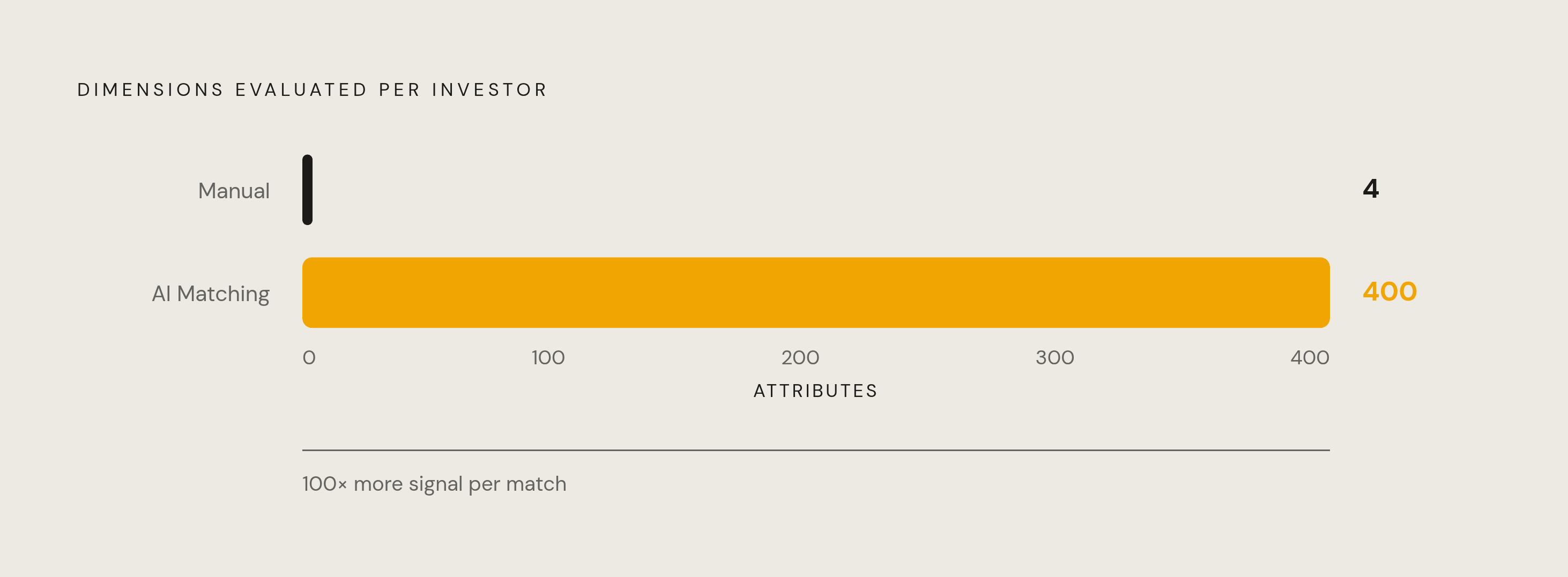
Where manual research works across three or four dimensions, AI matching engines evaluate roughly 400 attributes to generate a single Match Score, pulling in sector relevance, stage compatibility, check size alignment, deployment velocity, and geographic focus all at once. This creates a shift from a static snapshot to a layered, constantly updating read on fit, not just more data points stacked on top of the old ones.
One filtering layer manual research simply cannot replicate is recency: prioritizing investors who have deployed capital in the last three to six months, so active funds get surfaced ahead of those sitting between cycles or paused without saying so publicly. A fund can look perfectly aligned on paper, sector match, stage match, geography match, and still be the wrong target because it hasn't written a check in eight months. Manual research has no reliable way to know that. "Investor Velocity," a measure of how likely a given investor is to close a deal within a specific window, updates in real time as market conditions shift, something no spreadsheet, however carefully maintained, is built to track. Real AI matching systems operationalize investor velocity as a live signal, tracking deployment activity across recent deals and updating match scores in real time as market conditions shift, a layer of temporal precision that no static spreadsheet or manual portfolio review could maintain, and one that becomes more consequential as the fundraising window compresses.
This same analysis surfaces investors who would otherwise stay invisible: family offices, boutique funds, and emerging managers who don't appear in mainstream directories because their activity only becomes legible once deal data is aggregated at scale, not through name recognition. The same logic identifies stage specialists, investors who concentrate a significant share of their portfolio in seed rounds specifically, a pattern that becomes visible only when someone analyzes portfolio composition across thousands of deals rather than one website at a time. None of this is visible to a founder working a spreadsheet, no matter how many hours they put in.
The relationship mapping layer that cold outreach cannot replace
Identifying the right investor only solves half the problem. The cold-start approach to fundraising is fading as a viable strategy, and founders who cannot map a warm-introduction path into a fund are competing at a disadvantage no amount of list quality fixes on its own.
Founders using AI-scored targets convert meetings at rates dramatically higher than the industry standard for cold outreach, and that gap reflects relationship quality more than pitch quality. The pitch itself may be identical in both cases. What differs is whether the investor on the other end already has a reason to take the meeting seriously before it starts. Two of three Series A deals now involve investors who had already known the founder for six to nine months or more before the round closed. The relationship-building has to start well before a round is even being planned, not once the data room is ready.
Integration with Gmail, LinkedIn, and team networks maps these warm-introduction paths automatically, surfacing mutual connections, prior email threads, and shared portfolio companies that a founder would never piece together by hand across a target list of any real size. Integration with founder networks and email history maps warm-introduction paths automatically, surfacing mutual connections, prior email threads, and shared portfolio companies that a founder would never identify manually across a large target list, letting founders concentrate their limited relationship-building time on the highest-probability introductions rather than spending it discovering which introductions exist.
AI cannot replace the trust a human advisor builds over years. An experienced advisor knows which funds are quietly between cycles, which partners carry genuine personal conviction in a category rather than institutional interest, and which relationships will actually move a round forward versus stall it. AI surfaces the path; a human still has to walk it. That objection is correct, and it doesn't undercut the case for AI matching so much as clarify the division of labor. AI and human relationship capital work together rather than in competition: AI handles the mapping and prioritization so founders spend their limited human time on the introductions most likely to convert, instead of burning that time just discovering which introductions exist.
The market environment in 2026 makes precision targeting a survival requirement, not an optimization
Capital in the 2026 venture market is simultaneously abundant at the aggregate level and sharply concentrated among a narrow set of investors and theses. Founders who cannot identify precisely which investors are both active and aligned with their company will miss the windows that are actually open, because those windows close fast and don't reopen on a predictable schedule.
The funnel itself has narrowed. Early pipeline capacity spent on misaligned investors is a resource that cannot be replenished once it's gone. U.S. startups now take more than two years, on average, to move from seed to Series A, which pushes the window for building real investor relationships much earlier in a company's life than founders have historically assumed. A founder who waits until the round is imminent to start relationship-building is already working against a two-year clock that started before they realized it had.
The bar itself has also risen. Series A metrics thresholds have climbed substantially since 2021, and B2B SaaS founders now face materially higher benchmarks for ARR, burn multiple, net revenue retention, LTV/CAC, and runway than companies raising just a few years earlier. If a founder walks into conversations with misaligned investors before hitting those marks, they don't just waste a meeting. They erode their own positioning in a market small and networked enough that word travels. Misdirected outreach in this environment carries a cost that compounds, because the same partners talk to each other, and a founder who pitches too early to the wrong fund can find that reputation preceding them into the right one.
What Founders Gain From a Tiered, AI-Scored Target List
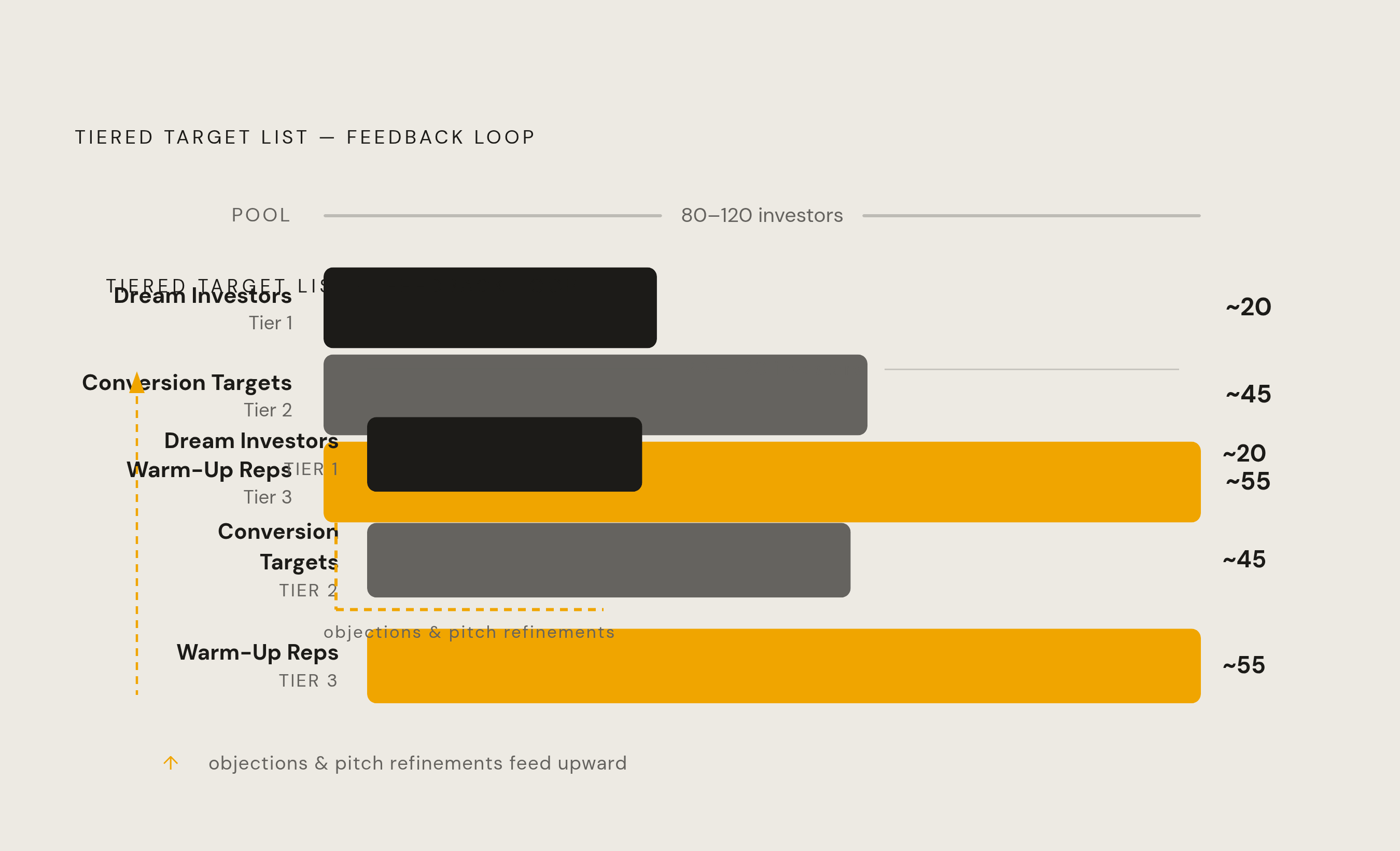
The clearest effect of AI matching on an actual raise is a better-segmented list, with outreach calibrated to relationship warmth and thesis alignment rather than sheer volume.
High-performing founders in the current environment curate a refined list of roughly 80 to 120 top-tier targets rather than blasting outreach to hundreds. AI scoring then segments that list into tiers, dream investors, conversion targets, and warm-up reps, so that the feedback from lower-tier meetings actively sharpens the pitch before the highest-stakes conversations happen. That structure turns the early stretch of a raise into a deliberate feedback loop rather than a gauntlet to survive: objection patterns, slides that get skipped, questions that catch the founder off guard all get logged and folded back into the deck and data room, so the pitch delivered in the fifteenth meeting is measurably stronger than the one delivered in the first.
Founders using AI targeting report meeting conversion rates from top-scored targets that are significantly higher than what cold outreach produces, and the time saved on prospecting gets redirected into the relationship-building that actually closes rounds. The deck itself keeps changing throughout this process. Founders treat it as living material, rebuilt and re-angled before serious investor conversations rather than finalized once and shipped. Tools including Gamma, Beautiful.ai, and Slidebean handle narrative structure, slide design, and financial visualization, removing the blank page without replacing the founder's own thinking or the story only the founder can tell.
The investor-side pre-screening layer founders cannot see but must navigate
AI matching is no longer a tool only founders use. Funds have built their own predictive models, trained on their own portfolio histories, and founders now pass through an algorithmic gate before a partner ever opens the deck.
A founder who approaches a fund with mismatched thesis signals may never reach a human reviewer. That symmetry actually strengthens the case for using these tools rather than weakening it, because founders working from AI-scored lists are operating on the same informational terrain as the investors screening them, instead of being the only side of the table still working from instinct and a spreadsheet.
This dynamic makes thesis-level precision in outreach more important, not less, because the algorithmic gate on the investor side rewards the same dimensional alignment that AI matching surfaces for the founder. A founder whose outreach is built on sector, stage, check size, and deployment recency is playing the same game the fund's own model is already running. The strongest objection on this side is real too: a fund's model might rank a founder highly on thesis fit while missing that the fund just pivoted strategy or paused new investments. Practitioner guidance on this point is consistent. AI targeting is a starting point, not a final answer, and human advisors who track which funds are actively deploying right now remain a necessary complement to any automated score.
AI fundraising platforms compared: what each one is built to do
By 2026, the platforms that matter in this space differ less in whether they use AI, since nearly all of them claim to, and more in the depth of their venture intelligence and how much of the actual fundraising workflow they support end to end.
Metal is built for venture fundraising from pre-seed through Series B. Techstars has adopted it as its default fundraising platform across more than 10,000 founders, and more than 100 Y Combinator founders have adopted it specifically for the post-Demo Day fundraising push. Its Investor Patterns engine runs a broad set of filters and system recommendations to surface the most likely investors for a given round, so it works as a dynamic pattern-match against historical deal data rather than a static directory lookup. Its Building Access feature maps warm-introduction paths by integrating with Gmail and LinkedIn, surfacing mutual connections, prior email threads, and shared portfolio companies, then ranking intro strength so founders know which paths to prioritize first. Pipeline Formation is a CRM built specifically for fundraising, not adapted from sales software, and it gives deal-stage tracking, automated follow-ups, and real-time guidance on next steps. Content Signals tracks which investors are actively writing about a founder's sector, backing comparable companies, or otherwise signaling thesis interest, while Round Coach and Call Intelligence provide structured feedback on decks, round strategy, and meeting performance, building the iterative feedback loop that tends to separate top-decile outcomes from the median.
Signal by NFX is positioned primarily as a discovery tool. It does not offer the full fundraising workflow, pipeline CRM, call intelligence, outreach automation, that purpose-built platforms provide, which makes it a reasonable starting point for identifying investors without serving as a system for managing the raise itself.
ThatRound, a UK-based platform that launched in March 2025, connects founders with angel networks, syndicates, and early-stage funds through an LLM-powered matching engine. Its focus sits on early-stage and angel-adjacent capital, with a geographic and stage scope narrower than platforms built to serve the full seed-to-Series A range.
Alai, founded in 2023 and run through Y Combinator's Winter 2024 batch, takes structured founder inputs and generates complete slide content, from problem framing through the funding ask. It is best understood as a pitch content generation tool rather than an investor discovery or pipeline management platform, useful for the document itself rather than the surrounding search for who should see it.
What separates these platforms, in the end, is not the presence of AI but what each one is actually trying to solve: discovery alone, deck content alone, or the full arc from identifying the right investor through closing the round. Founders choosing between them should start with which part of that arc is actually costing them the most time and the most misdirected effort.