Pitch Deck Generation with AI Tools
AI tools solve pitch deck production in minutes, but investors still judge the substance you supply.

Building a pitch deck without a designer eats two or three full working days, not the couple of hours founders budget for it in their heads. Most seed-stage teams don't have a designer on staff, and agencies that specialize in investor decks charge into the thousands for a single project. So AI pitch deck tools showed up promising to compress three days into ten minutes, and I've watched search interest in the category climb sharply — up 180 percent year over year as of late 2025. Nobody wants to sit with the actual question, though: does the output survive contact with an investor who reads fifty of these a month?
The strongest AI pitch deck tools in 2025 fall into three distinct categories, each solving the production problem differently. Prompt-to-deck generators like Gamma, Tome, and Slidebean take a sentence or a set of notes and hand back a structured, designed draft in minutes; Plus AI does the same natively inside PowerPoint and Google Slides. Interview-based tools like Decktopus and PitchBob run a short Q&A before generating a draft, with PitchBob extending well beyond the deck itself into problem documents, persona maps, and traction plans. Template-plus-AI tools like Beautiful.ai layer unlimited AI content generation over hundreds of pre-built Smart Slide layouts, while Upmetrics pairs deck generation with a lightweight financial model, and Alai trains on real pitch decks to produce investor-specific formats and adds slide-level engagement tracking. All of them solve production fast and cheap; the traction numbers, competitive insight, and market-sizing argument behind the slides remain entirely the founder's to supply.
What investors actually evaluate in a first-pass review
DocSend has tracked this for years. Investors spend a few minutes on a first pass, and decks past roughly fifteen slides see engagement fall off hard. Attention front-loads. The first handful of slides absorb most of the reading time an investor will ever give the document, so if your traction numbers sit on slide nine, most investors never get there.
So what are they actually scanning for in those few minutes? A real problem hitting a large enough group of people. A solution that tracks logically, with the differentiation obvious before anyone needs a follow-up call to explain it. Some evidence, any evidence, that this is already working. A team with a legitimate claim to winning this specific market. An ask sized reasonably for the stage.
A gorgeous, AI-polished deck that buries traction near the end still dies in the first-pass filter. So does one that goes soft on differentiation, no matter how clean the typography looks. AI tools solve production, and they solve it fast and cheap. Substance is a separate problem, and founders get hurt confusing the two.
The standard deck structure that most investors expect to see
The Sequoia and YC-style arc is the default now, and straying from it without a real reason just adds friction to a process that's already fast and unforgiving. Problem, stated specifically and felt by a real customer segment. Solution, described plainly, without over-engineering the pitch. Why now. Market size, built bottom-up where possible, not lifted from a research report. Product, with actual screenshots or a demo. Traction: revenue, growth rate, retention. Business model. Competition, described honestly. Team. The ask, with a specific round size and use of funds.
Each slide should stand alone as a claim the rest of the slide backs up, with the supporting evidence doing more work than a header ever could.
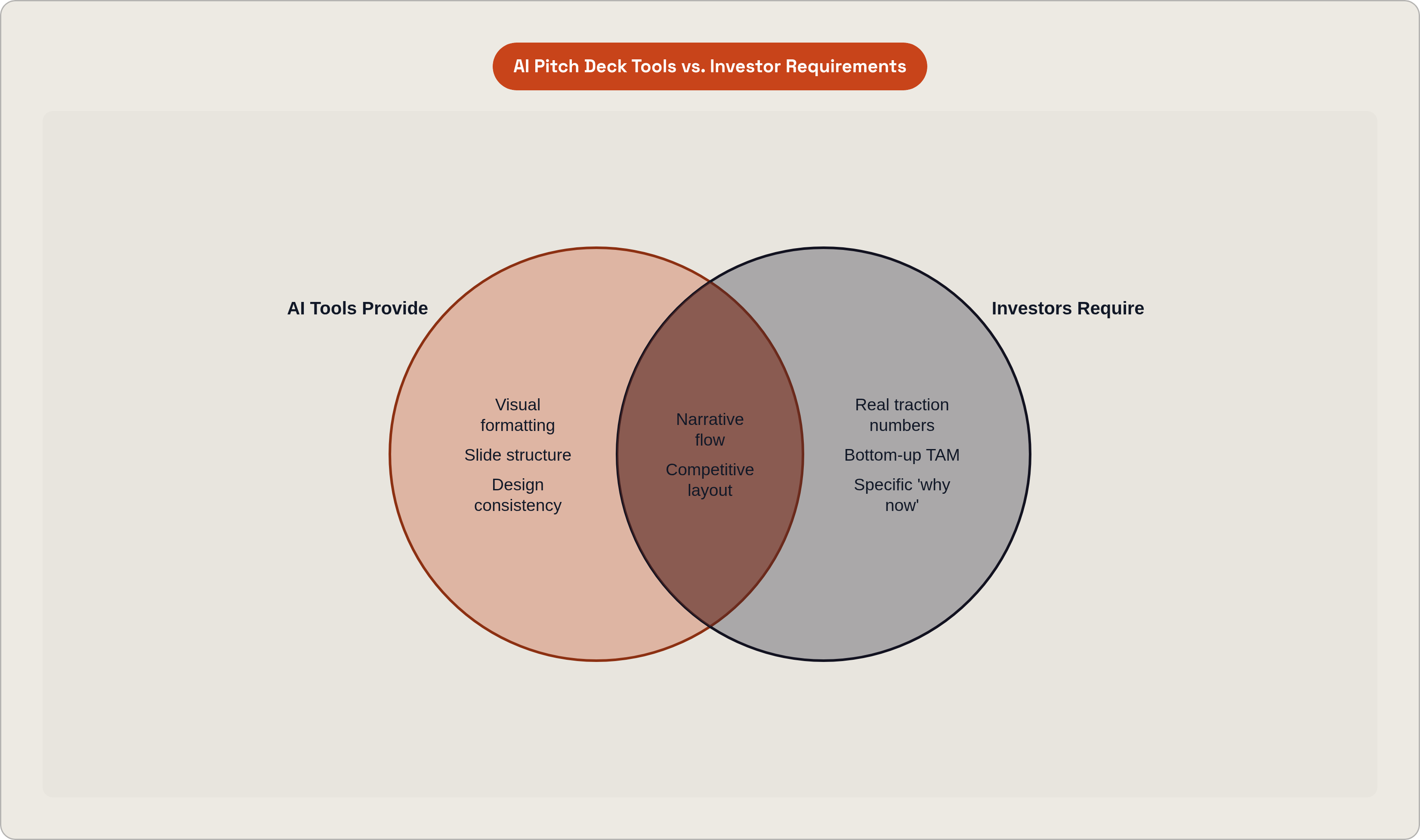
AI tools earn their spot generating the skeleton, dropping in placeholder content, keeping the visual language consistent slide to slide. That's work that used to eat entire afternoons by hand. What they can't know is your actual retention numbers, your actual customer quotes, or the specific reason this market is moving right now. The structure was always the easy part; it's also the part that was never going to be the difference between a yes and a pass.
What are the best AI tools for creating a pitch deck without a designer?
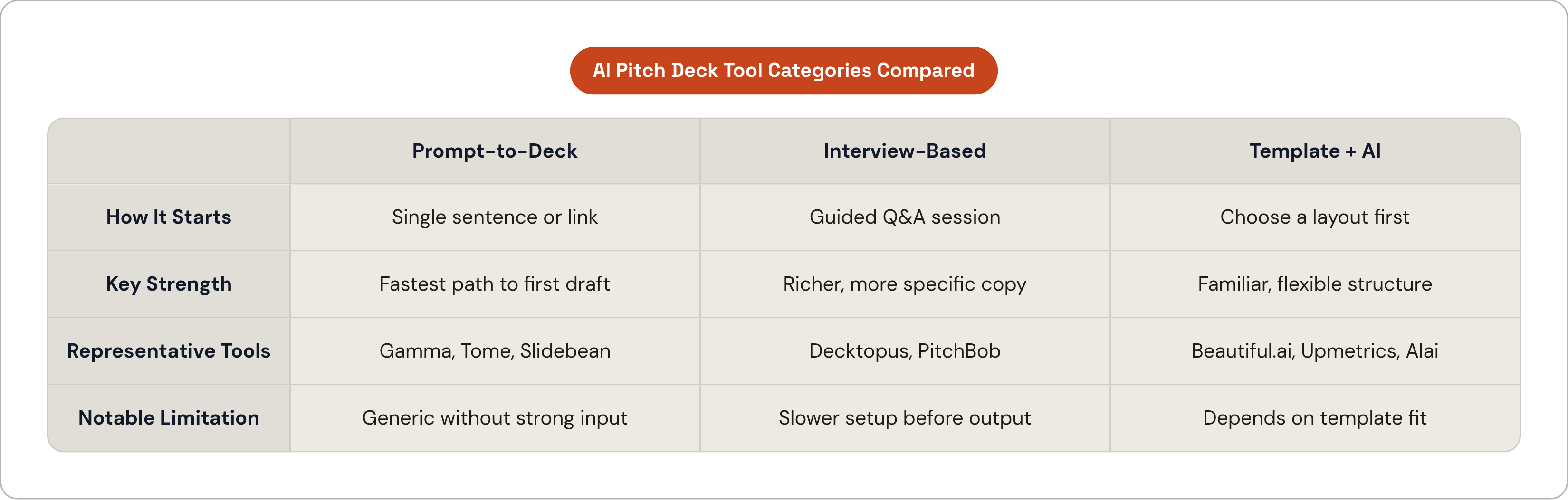
Worth knowing which category you're buying before you sign up for anything. "AI pitch deck tool" covers a few genuinely different products, and conflating them wastes a week.
Prompt-to-deck generators take a sentence and hand back a structured deck, design and copy already in place. Plus AI works natively inside PowerPoint and Google Slides. Gamma does something similar off a sentence, a set of notes, or a link, and its user base moved past early-adopter territory a while ago. Tome pairs GPT-written copy with AI-generated imagery per slide, which quietly solves the stock-photo problem that made a lot of early decks look interchangeable. Slidebean leans hard into speed, aiming for a first draft clean enough it barely needs touching up.
A second group interviews you instead of prompting you. Decktopus runs a short Q&A and produces a draft with speaker notes already written. PitchBob goes further than the deck itself, building problem and solution documents, persona maps, traction plans, even equity and agreement tools. It treats the deck as one piece of a larger system rather than the whole deliverable.
Template-plus-AI tools sit in their own lane. Beautiful.ai offers hundreds of Smart Slide layouts with unlimited AI content generation on top, priced low enough a solo founder doesn't think twice about it.
Upmetrics pairs deck generation with a lightweight financial model, auto-building revenue, expense, and break-even slides from a handful of assumptions. That's useful, because the financial story needs to live inside the deck rather than getting bolted on as an appendix nobody opens.
Then there's Alai, trained on a large body of real pitch decks. That's why it understands investor-specific formats, TAM pyramids, competitive matrices, rather than generic business-presentation layouts. It also tracks engagement: which investors opened the deck, which slides they lingered on, for how long.
Picking between these comes down to a short list of real questions. Speed to a usable first draft. Whether the generated copy reads specific or just sounds padded. Whether the design holds together without manual fixes on every slide, how easily a co-founder can comment in real time, and whether it lives inside tools you already use day to day. A tool that demands hours of setup before it generates anything has just relocated your time problem. Some tools take a different angle, folding deck creation into a broader fundraising workflow rather than treating it as a standalone deliverable.
How to feed an AI tool inputs that produce investor-grade output
The quality of what comes out is almost entirely a function of the quality of what you put in. A vague brief gets you a vague deck, every time, no matter what the tool's design engine claims about itself.
Before opening any of these tools, write a one-paragraph description of the company: what the product does, who it's for, how it's different from what already exists. Write the problem in the customer's own language, not the internal shorthand your team uses. Get whatever traction actually exists down in concrete terms, revenue, growth rate, user counts, a retention number, named customers if you can share them. Build a market-sizing argument from the bottom up, even a rough one, because a rough bottom-up number beats the polished top-down TAM the tool will happily invent for you if you let it. Name the competitive landscape honestly, and make the ask specific enough the tool can't fall back on "we'll use this to grow the team."
How you prompt matters almost as much as what you feed it. Tell it the investor type you're targeting, a seed-stage B2B SaaS investor, say, because tools that understand investor context structure the deck differently than a generic presentation generator would. Set slide count and narrative order yourself rather than letting the tool decide, unless you've already confirmed its default matches what investors in your category expect. Ask for speaker notes even if you'll never read them verbatim; writing the notes forces the tool, and forces you, to articulate the argument behind each slide, which is exactly where thin thinking gets exposed.
Treat the first output as a diagnostic, not a draft. Wherever the copy comes back generic or hand-wavy, that's a signal your own thinking on that slide is underspecified. The spot where the AI went vague is the spot an investor pushes on in the room.
Where AI-generated decks break down under investor scrutiny
The gap between a deck that looks finished and an argument that's actually ready shows up in the follow-up question, not on the page.
Market sizing defaults to a top-down TAM number lifted from an industry report, when investors at seed and Series A want bottom-up math proving the founder understands unit economics and who the real buyer is. Competitive positioning sounds confident and reads clean, but an investor who knows the space catches a hollow moat within a sentence or two. Traction sections, without real numbers fed in, drift toward "strong early traction" or "significant customer interest." Phrases like that signal, loudly, that nothing concrete sits behind them.
The "why now" slide is hard to write well even for experienced founders, and AI tends to hand back a generic technology-trend argument instead of the specific regulatory or behavioral shift the founder actually identified. Team slides read like résumé summaries instead of telling any real story about domain insight.
None of this kills a deck by itself. The compounding risk is what actually matters: an unedited AI deck that reads fine on a casual scan can walk a founder into a first meeting where the answers don't match what the deck implied. That mismatch erodes trust fast, sometimes permanently, and fixing a deck after that kind of skepticism has set in takes longer than building it right the first time would have. Investors ask sharper questions than they used to. What's the data moat. What do inference costs look like at scale. Does this survive if a foundation model ships the same feature next quarter. Those answers come only from having actually sat with the problem, not from a regenerate button.
The slides that require founder judgment, not AI generation
Some slides are genuinely fine to leave to the machine: title, agenda, the visual formatting of a financial table, the appendix. Nobody needs to agonize over those.
A handful of slides need the founder's hand directly, and no tool changes that. The problem slide has to reflect an insight found through direct customer conversations, not a market problem summarized from whatever the model was trained on. The traction slide is the single most scrutinized page in the deck; every number on it has to be real and defensible, because this is exactly where AI-softened language does the most damage. The competitive landscape slide needs an honest read on the actual alternatives a prospect weighs, including the non-obvious ones a founder only knows from losing deals to them. Left alone, the "why now" slide gets a generic technology-trend story that could apply to a hundred other companies; it needs the founder's actual point of view on a specific shift. The team slide has to explain, specifically, why this group has an asymmetric edge, going well beyond a LinkedIn recap with better formatting. And the ask needs to reflect the founder's real capital strategy, runway targets included.
One test worth running on every slide: if an investor asked a pointed follow-up here, could you answer it using only what the AI generated? If not, the slide isn't done, no matter how clean it looks on screen.
How to use engagement data and iteration to sharpen a deck over time
A pitch deck is a hypothesis about what gets an investor to say yes to a meeting. Treating it as finished the day you send it out is a mistake founders make constantly, and I get why: it feels done, it looks done, the fonts match.
Tools like Alai give slide-level engagement data, which slides investors actually spend time on, which get skipped. That's empirical signal about where the narrative holds attention and where it loses it. If a slide early in the deck gets almost no time, the hook isn't landing. If investors linger unusually long on a slide, that's not automatically good news; it might mean the slide confuses rather than compels. And if slides near the end never get opened, the deck's probably too long, or too weighted toward things nobody needed convincing on in the first place.
Keep version control tight. Know which version went to which cohort, so when you iterate, you're reacting to real signal rather than noise from a small, uneven sample.
The best source of feedback, though, is the questions investors ask in the first ten meetings. Write every one down. The pattern tells you exactly which slides are doing the wrong job, faster than any analytics dashboard will. Once you know what to fix, AI tools earn their keep: regenerating one slide takes minutes, and that speed compounds across dozens of investor conversations over the course of a raise.
Fitting AI deck tools into a broader fundraising system
AI pitch deck tools solve a real problem. The days a founder used to lose to formatting and layout now take minutes, and that matters, especially for a solo founder without a design co-founder or an agency budget sitting around. But the deck was always the easiest part of fundraising to fake, and the hardest part to get honestly right.
Founders who raise well treat the deck as one piece of a system: investor targeting, sequenced outreach, meeting prep, and the discipline to actually read what each meeting's feedback is telling them. A great deck built with AI and weak targeting still gets ignored. A mediocre deck sent to the right fifteen investors, at the right stage, defended by a founder who knows every number on the traction slide cold, still closes. The tool changes how fast you produce the artifact, and the substance behind that artifact remains entirely the founder's to build.