Investor Objection Patterns and Pre-Emptive Slide Design
Anticipate investor doubts with pre-emptive slide design.

Investor hesitation during a pitch is not improvised. It draws from a small, recurring set of structural doubts that apply across nearly every early-stage deal, regardless of sector, geography, or stage. Those doubts map directly to the questions an investor must answer before committing capital: Is this market big enough to produce a venture-scale outcome? Is the advantage defensible once competitors notice it? Is this specific team capable of executing against this specific risk? Does the capital request reflect a founder who has modeled the round? Because these questions recur with such regularity, they can be designed around rather than reacted to: a founder who treats each objection as a surprise is working without a map that already exists, and the chapters that follow trace that map one objection at a time.
How attention economics force the objection to be answered before it is asked
A pitch deck gets read for minutes, not hours, and the founder is rarely in the room to clarify a point an investor skims past. Data from deck-sharing platforms puts average seed-stage review time in the low single minutes, with the sharpest drop-off occurring between the cover slide and the second slide. That means the investor's mind is substantially made up before a founder would ever get the chance to explain, defend, or reframe anything in a follow-up call. A traction chart buried on slide seven has already lost the investors who skim the first four setup slides and move on, while the same chart placed on slide two turns a skeptical skimmer into an engaged reader of everything that follows. Deck length compounds the problem: each additional slide divides the investor's fixed attention budget across more material, which drags the time spent per slide below what's needed to absorb a complex claim, and a twelve-to-fifteen slide front-end deck paired with a separate data-room appendix lets a founder include everything without taxing the slides that actually need to land. Given how short the window is, pre-emption isn't a stylistic preference: it's the only strategy that works, because there is no second pass in which to correct the record.
The market size slide as the first objection to engineer around
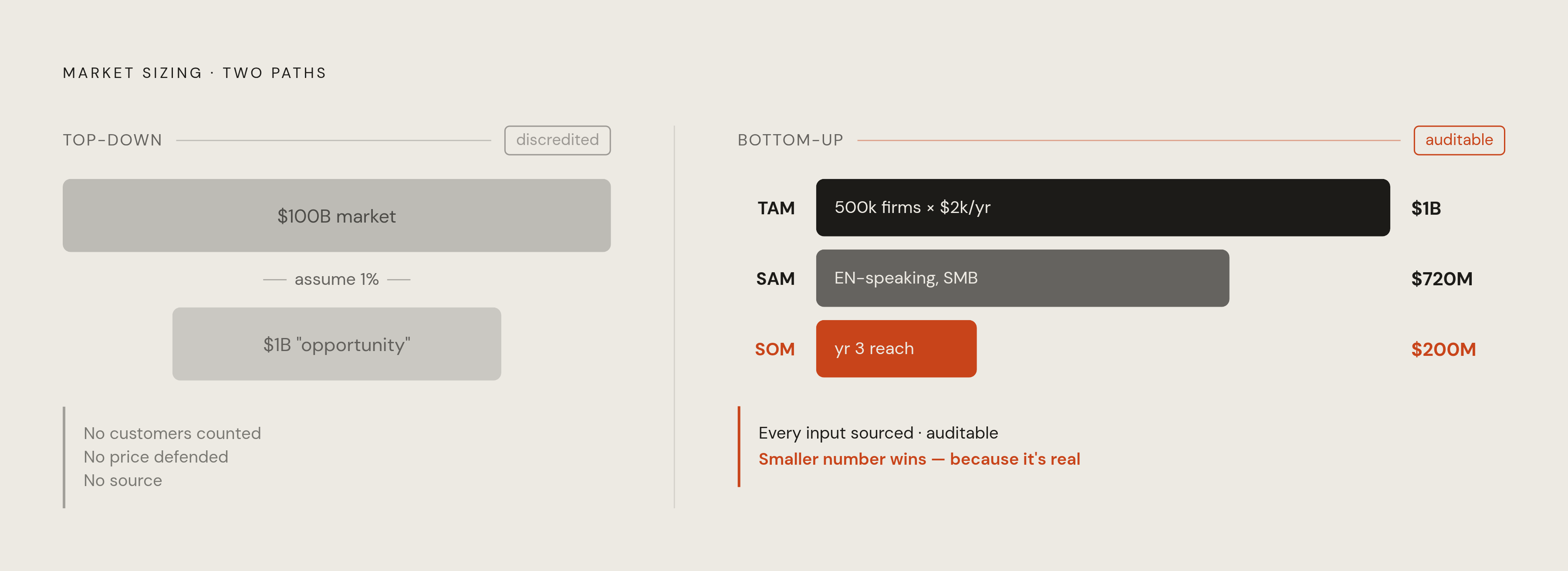
The market slide is where a deck most often loses an investor's confidence, and it loses it early, because a number presented without its derivation reads as evidence that the founder hasn't done the underlying work. The familiar top-down move, claiming a company only needs to capture one percent of a hundred-billion-dollar market, is the clearest version of this failure: it substitutes a desired outcome for a modeled one, and experienced investors recognize the pattern instantly. The fix is arithmetic. A bottom-up TAM/SAM/SOM funnel, built from an identifiable count of real customers multiplied by a defensible annual price, with every input sourced, replaces wishful thinking with a number an investor can audit in real time. A smaller market that's been built this way outperforms a larger one that hasn't, because the investor isn't actually buying the size of the market: they're buying confidence that the founder understands who is going to pay, how many of them exist, and what they'll pay for it. The same diligence applies to the competitive landscape that typically accompanies the market slide. The two-by-two positioning grid, with the founder's company placed neatly in the top-right quadrant, has stopped functioning as evidence of anything. Placing a company in that corner now reads as a tell that the founder is pattern-matching to what a deck is supposed to look like rather than conducting an honest competitive analysis, and the credible alternative is specificity: naming the exact segment the company wins, and naming what it does differently there, rather than relying on a quadrant investors have learned to discount. A market slide built this way pre-empts the sizing objection structurally. The numbers carry their own proof, and the investor doesn't have to take the founder's optimism on faith.
Moat Claims and Slide-Level Proof for AI Companies
The moat slide now absorbs more investor diligence than any other section of the deck, and in AI-adjacent companies specifically, the phrase "proprietary AI" has become a marker of the exact risk investors are trying to screen out. A durable advantage has to be shown, not asserted. A claim built on a data flywheel needs to show what proprietary data the company actually holds, the mechanism by which it accumulates, and why that accumulation compounds as the company scales. A claim built on workflow integration needs to show the switching cost a customer would absorb to leave, and how deeply the product sits inside a process the customer already depends on. AI companies face a sharper version of this problem than most: the deck has to answer, directly, what happens to the business if a foundation model vendor ships the same capability next quarter. Decks that state this risk explicitly, with a sentence to the effect of "here is why we are durable even if the underlying models improve," take that question out of the investor's hands before it becomes a defensive moment in the Q&A. Due-diligence teams now probe infrastructure ownership before they probe model access, so a company positioned purely as a wrapper around someone else's model, without an answer to how it owns its infrastructure, tends to stall at exactly this stage. Compute cost has become part of the same test. Vague margin language is treated in 2026 as a red flag, and stating the actual margin assumption, along with the specific path to improving it, reads to investors as founder credibility. Decks that state the actual margin assumption and the path to improving it before being asked tend to draw a calmer, more technical line of follow-up. The Perplexity Series A round offers a useful illustration of this structure working as intended: its moat argument rested on the citation interface layered over the underlying model, an explicit answer to the question of what happens when the base model itself improves, built directly into the pitch.
The competitive slide as a credibility instrument, not a positioning tool
Claiming to have no competitors is one of the fastest ways to lose an investor's confidence in the room, because every company competes against a spreadsheet, a consultant hired to do the job manually, or a customer's decision to do nothing. The competition slide that works best treats this as the starting point. The LinkedIn Series B deck, later published with Reid Hoffman's own annotations, stands as the clearest example of this approach: it names its competitors directly, names the network-effects cold-start problem the company faced, and names the skepticism around its revenue model, then answers each point in turn. That's the structure pre-emption takes when it's working: naming the hardest version of the objection before the investor has to raise it, then answering it on the slide. A competition slide built this way acknowledges where rivals are genuinely strong and explains why the company wins in a specific, named segment, and that kind of candor tends to land better with experienced investors than any attempt at clever positioning. Analysis of common pitch deck failures identifies the absence of competitive differentiation as one of the most consistent errors founders make, and the fix runs in the same direction every time: name the real competitors, credit what they do well, and state the specific moat that holds up against them.
How the team slide answers the objection investors rarely say out loud
An investor reading a team slide is asking a narrow question: why does this specific group of people win this specific problem. Most team slides answer a different question instead, listing brand-name employers and degrees that speak to general competence without ever connecting that competence to the company's core execution risk. Reviewers tend to move through team slides quickly and look for one clear anchor rather than a list of credentials, and a single relevant credential tied directly to the business carries more weight than three impressive but unconnected ones. Founders who spend the slide elaborating on pedigree often leave too little room to state what they've actually shipped, which is the detail that does the underwriting. The version of this slide that works pairs each founder's background to the company's hardest execution risk directly: if distribution is the thing that will make or break the business, the slide needs to show why this specific group of people wins on distribution, not why they are broadly impressive. A domain scar, meaning direct, lived experience with the exact workflow the product now automates, often carries more weight than a marquee employer, because it's evidence of fit to this specific problem. Solo founders face a sharper version of the same test, and the slide needs to address the missing co-founder directly rather than let the investor notice the gap unassisted. A founder who states that they are solo and looking for a technical co-founder reads at the pre-seed stage as self-aware; a founder who tries to paper over the same gap reads as either unaware of it or evasive about it. The weight this slide carries also shifts by stage. At pre-seed, where traction is thin or absent, the team slide often functions as the primary instrument an investor uses to underwrite the round, a role the Intercom 2011 seed deck illustrates directly, with its team slide positioned at the front of the pitch and carrying much of the credibility case on its own. At Series A, the same slide is read alongside the traction data, serving less as the central case and more as confirmation of who produced the growth already on the table.
Pre-Emption on the Ask Slide
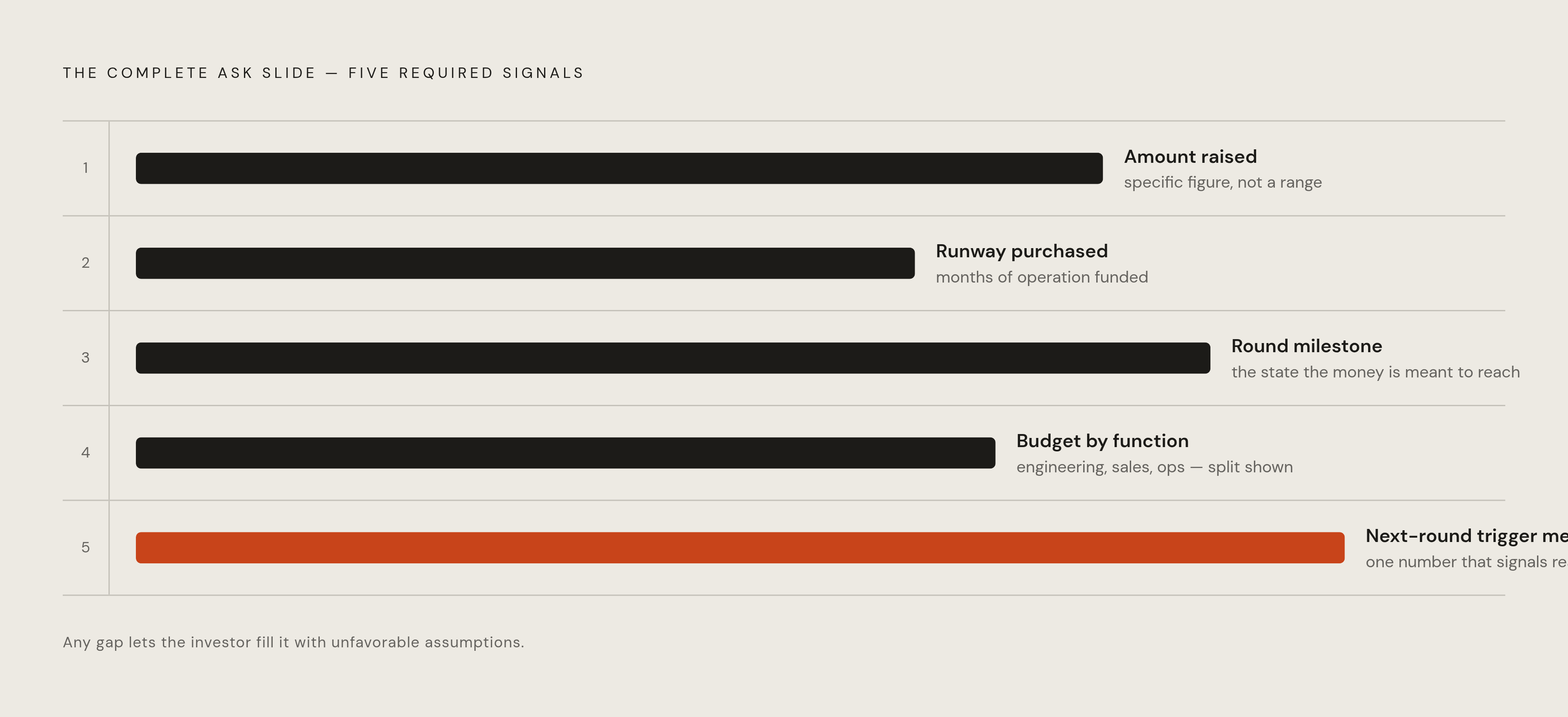
An ask slide without a stated milestone isn't a request for capital so much as a request for trust the rest of the deck hasn't yet earned, and investors read that gap as evidence the founder hasn't actually modeled the round. The slide has to answer three questions at once: how much is being raised, what the money will be spent on, and what specific milestone the round is meant to reach. All three need to appear together, because any one of them missing leaves the investor to fill in the gap with their own assumptions, usually unfavorable ones. The format that signals modeled thinking states the amount raised, the runway that amount buys, the milestone it's meant to reach, how the budget breaks down by function, and the specific metric that would trigger the next round, answering the "how will you spend this" question before an investor has to ask it directly. The financial projections slide is where the deck's sharpest trade-off sits. Detailed five-year projections tend to generate more objections than they resolve, because a founder projecting modest revenue after raising a large round invites the investor to run the return multiple on the spot, conclude the outcome isn't venture-scale, and pass, whereas the same investor, left without that slide, evaluates the company on its traction and its idea first. The resolution is to keep the detailed model out of the main deck and inside the data-room appendix, where the main deck states only the milestone the round is meant to fund and the appendix stands ready to defend the model for any investor who asks for it directly. Stage changes what this slide needs to carry. At pre-seed, financial projections built without traction behind them read as fiction, so the model belongs in reserve. At Series A, the calculus reverses: investors expect unit economics, burn multiple, and net revenue retention to appear in the main deck itself, because by that stage the company has actual operating data to defend them.