Limitations of AI in Venture Fundraising Workflows
AI excels at research and pipeline work but can't replace judgment in targeting investors.

Global venture funding hit $425 billion across more than 24,000 companies in 2025, up 30% from the $328 billion recorded the year before. That headline number hides a brutal concentration problem: 75% of all VC money in the first quarter of 2026 went to just five companies, and half of all 2025 US deal value landed in a slice of deals amounting to roughly 0.05% of the total completed. AI tools have flooded the fundraising process to help founders navigate this environment, and many of them genuinely work. But knowing exactly where they stop working is now as important as knowing how to use them.
What founders are actually up against in the raise process
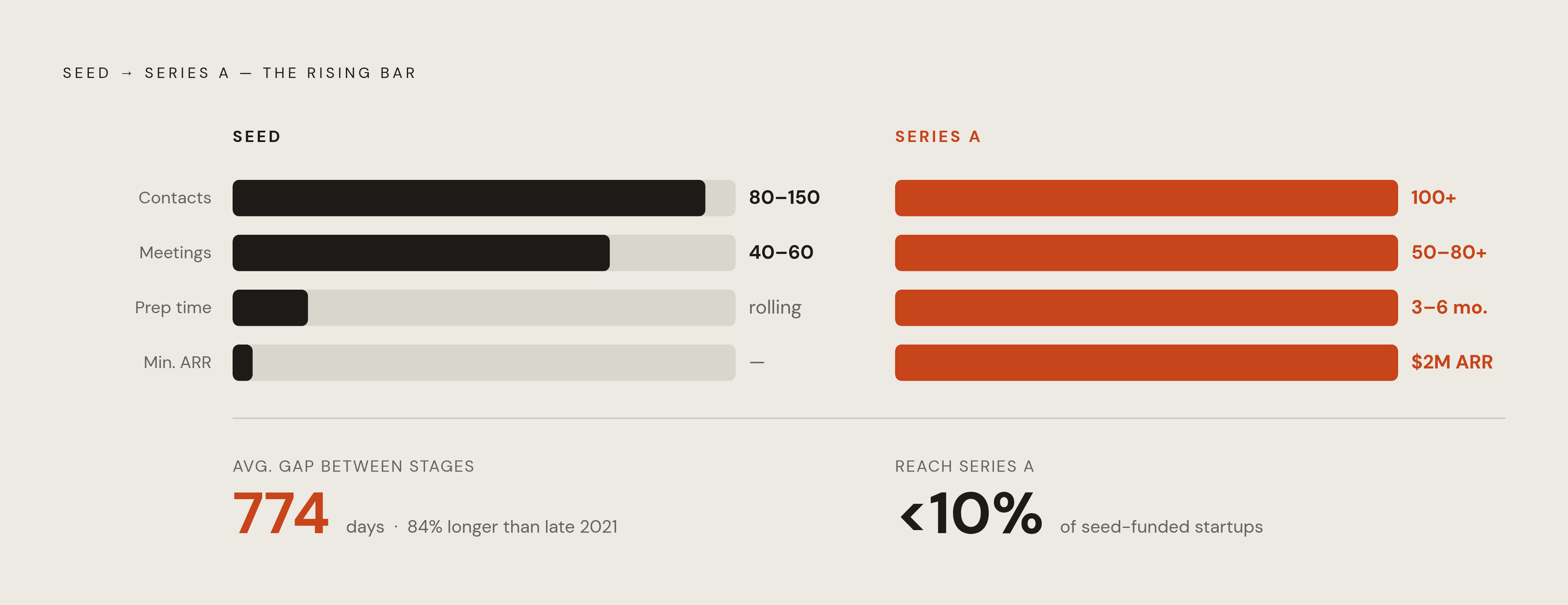
A seed-stage founder today contacts somewhere between 80 and 150 investors and sits through 40 to 60 meetings before a term sheet shows up. At Series A, the numbers get worse: over 100 investor contacts, 50 to 80-plus meetings, and a process that runs three to six months from prep to close. The seed-to-Series-A journey now averages 774 days, 84% longer than it did in late 2021. Fewer than 10% of seed-funded startups ever make it to a Series A at all.
The bar keeps rising underneath all this. Series A investors now expect at least $2 million in ARR, 3x year-over-year growth, and a raise sized to cover 24 to 30 months of runway. Meanwhile, median Series A valuations hit $47 million in 2025, up 18% on the year, but the gap between the 50th percentile and the 90th widened materially. A record median doesn't mean things got easier. It means the winners pulled further away from everyone else.
Put plainly, a raise is a second full-time job that runs on top of the first one. That's the operational pressure driving founders toward AI tools in the first place, and it's also exactly the pressure that makes those tools tempting to over-trust. Investor intelligence and pipeline platforms for startups, Metal among them, exist precisely because that pressure is real and the research burden is measurable.
Where AI tools genuinely earn their place in a fundraising workflow
Research and targeting is the clearest win. Platforms like PitchBook, which shipped an AI research assistant with natural-language query support in late November 2025, and Crunchbase, which added AI investor search in 2024 and CRM integrations in 2025, compress weeks of comp analysis and investor research into a matter of hours. Harmonic goes further upstream: it indexes more than 35 million companies and tracks founder movement and hiring signals to flag pre-seed opportunities before a formal process even starts, a capability that helped push its valuation to $1.45 billion in 2025. A founder using tools like these can go from zero to a qualified list of 50 to 100 target investors in two or three days.
Pipeline management is the second win. AI-powered CRMs now auto-capture interactions pulled from email, calendar invites, and meeting notes. A survey of nearly 300 private capital dealmakers by Affinity found a large majority now use AI to automate daily tasks, up from a similar share the year before, and most of those firms use AI specifically for deal-sourcing research. For a founder juggling 100-plus live investor threads, the equivalent benefit is simple: nothing falls through the cracks.
Materials drafting rounds out the list. AI makes first-draft decks, memos, and outreach sequences measurably faster to produce. Used correctly, this isn't about replacing the founder's thinking, it's about clearing out the grammar and formatting work so the freed-up hours go toward actual investor conversations instead.
The throughline across all three: AI is good at the parts of fundraising that are repetitive, data-heavy, and don't require judgment. That's a real and valuable category. It's also a narrower category than most fundraising tools imply.
The structural gap between investor-side tools and founder-side needs
Most of the sophisticated AI infrastructure built for private markets was built to serve investors, not founders. That's not an accident, it's a market-sizing decision, and it leaves a structural gap on the other side of the table.
Look at what's missing. Investor-side platforms are built around fund workflows, and their feature sets reflect that priority rather than the specific discovery, fit-matching, and coaching needs a founder brings to a raise. Pricing is structured for institutional teams managing large funds, not for an early-stage founder trying to close a seed round. The asymmetry compounds: investors use AI to sort through large volumes of inbound signals, while founders are left stitching together fragments of tools that were never built with them in mind.
This matters because founders have historically operated at an information disadvantage relative to investors. Knowing who actually invests in what, and how a given partner thinks about risk, is the difference between a cold email that gets ignored and a warm introduction that turns into a term sheet. Purpose-built founder-side platforms exist precisely to close this gap, layering investor discovery, round coaching, and pipeline tracking into one workflow instead of forcing a founder to assemble five different enterprise products designed for someone else's job. Even where AI adoption on the founder side is strong, most of what it delivers is breadth: bigger lists, broader search. What a raise actually needs is precision, the right names for this stage, this thesis, this check size.
Why AI-generated investor lists are not the same as investor targeting
Surfacing names is not the same skill as judging fit. AI can build a portfolio map quickly, tracing a partner's prior bets and flagging plausible warm-intro paths, and that's a genuinely useful function. What it can't tell you is where that partner's conviction sits today, or what they passed on last month, or whether the fund quietly deprioritized the sector after a bad outcome six months ago.
The question that actually determines targeting quality, whether an investor has fresh conviction in this specific sub-thesis right now, isn't answerable from historical database signals. It requires reading recent deal activity, catching a partner's public commentary, sometimes just knowing someone who talked to them last week. AI can integrate with LinkedIn and Gmail to map out who's connected to whom, but it cannot manufacture the trust that makes an introduction land.
The cost of getting this wrong has gone up. In 2025, 33% of all US VC dollars went to the top 1% of companies by valuation, up from 12% in 2022. In a market that concentrated, a misaligned investor conversation doesn't just waste an afternoon, it wastes weeks a founder cannot recover. A founder using the right tools can reach a 50-to-100 qualified list in a matter of days. Cutting that down to the 20 or 30 who are actually active in the space right now still takes human research and network judgment.
The hallucination and data-quality risks founders rarely audit
General-purpose large language models are not reliable sources for company-specific or fund-specific data. They're fine for market research and a rough first draft. They are not fine as a source of truth on a fund's current thesis or a partner's actual investment history, and treating them as such is a quiet, compounding risk.
Purpose-built venture tools tend to carry guardrails that reduce this hallucination risk, but the real audit question is whether a tool can show its work. A system that produces a confident answer with no visible sourcing is a liability the moment it shows up in a diligence conversation. Data currency is a separate problem entirely: a model trained on data that's months stale will miss a fund's most recent close, a partner's departure, or a thesis pivot, and the investor sitting across the table will notice immediately if the founder didn't.
The credibility cost here is steep. Walking into a partner meeting with a misstated portfolio reference or a wrong assumption about check size signals, instantly, that the founder didn't do the actual work. VC Lab's 2026 guide to VC AI tools recommends founders verify three things before trusting any AI-generated investor profile: where the underlying data actually comes from, how the tool handles uncertainty, and whether an audit trail exists at all. None of this is an argument against using AI. It's an argument for knowing exactly which layer of the workflow it's allowed to own, and which layer still needs a human to check the work.
What AI cannot produce when it generates a pitch deck
Investors can spot an AI-generated deck within 30 seconds, and it's rarely the design that gives it away. It's the language: the same paragraph shape on the market-opportunity slide, the same adjective choices in the team section, positioning that could belong to any company in the category. Spectup's review of hundreds of decks flagged one sentence as the single clearest tell of an unedited AI draft: "We've built a solution that addresses a critical pain point in a rapidly growing market." Investors read some version of that line hundreds of times a year.
There's a reason this matters more now than it used to. The gap between seed and Series A has stretched to 774 days, and founders who survive that stretch have a specific, hard-earned story about why they kept going when the numbers weren't there yet. No model has access to that story, because it hasn't happened to the model.
At pre-seed and seed, this shows up even more directly. Panelists at Forum VC were unanimous that the team, not the market slide, not the TAM math, is the single most important factor at that stage: resilience, adaptability, how fast a founder processes new information under pressure. None of that comes through in a polished AI-written founder bio.
The correct use of AI here is narrow and specific: let it clean up grammar, structure, and layout, then take the hours that frees up and pour them into the parts only the founder can write, the specific customer story, the precise competitive insight that comes from actually living inside the problem. Generic decks and generic outreach emails get deleted. Personalization, tuned to a specific investor's check size, stated thesis, and existing portfolio, is what earns a second meeting.
Where relationship-building hits the wall AI cannot cross
Fundraising was never just a research problem, and treating it as one misses most of what actually closes a round. A compressed meeting schedule creates real urgency and real competition among investors watching each other's behavior. Momentum matters. A process that visibly drags reads as a negative signal to everyone watching it drag.
These dynamics are human and social by nature. They depend on a founder reading a room in real time, adjusting the pitch mid-conversation based on a partner's body language, building actual conviction in another person rather than optimizing a message template. Warm introductions remain the dominant path to a term sheet, and cold outreach alone consistently underperforms in a fundraising landscape this crowded. AI can map the shortest path to an introduction. It cannot make that introduction warm.
Investors are, in the end, betting on people, on resilience and adaptability that only show up in conversation, not in a nicely sequenced follow-up email. The tool that schedules a reminder to follow up cannot make the judgment call about whether to push harder or hold back, and it cannot tell a founder whether a partner's polite non-answer means genuine interest or a soft no. Venture is a long relationship by design: the investor who leads the seed round is often still on the board a decade later. A founder who outsources relationship-building to automation is, in a real sense, misunderstanding what they're signing up for. Fewer than 10% of seed-funded startups make it to Series A, and the ones that do are almost always the ones who built real relationships with their investors, not just the ones who ran the tightest outreach sequence.
How to draw the line: a working division of labor between AI and the founder
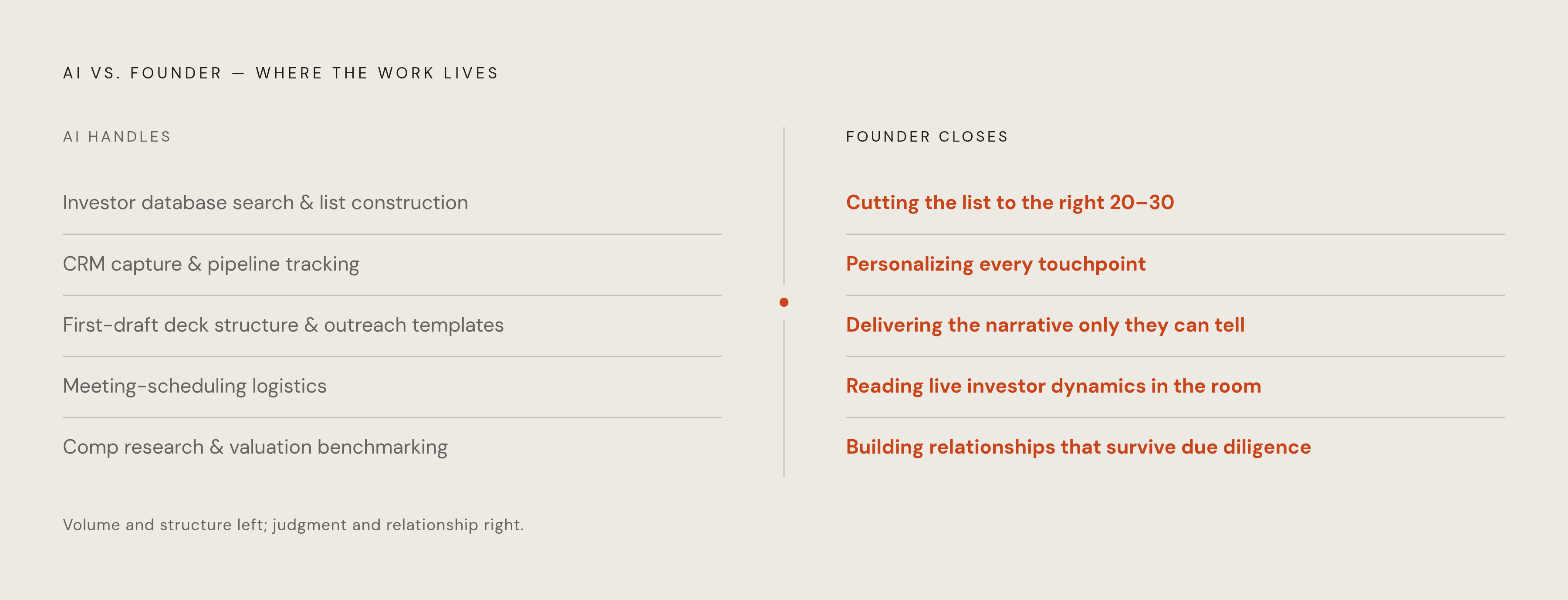
The split, once it's laid out, is not complicated. AI should own investor database search and list construction, CRM data capture and pipeline tracking, first-draft deck structure and outreach templates, meeting-scheduling logistics, and comp research and valuation benchmarking. The founder should own cutting that long list down to the right 20 or 30 through actual thesis judgment, personalizing every single touchpoint, delivering the narrative that only someone who lived the problem can tell, reading and reacting to live investor dynamics in the room, and building the relationships that survive due diligence.
One principle worth naming directly: build the full data room before the pitch deck is even finished. Retention numbers, unit economics, a verifiable sales pipeline, these are hard evidence, and in a market this concentrated, hard evidence is the one asset no AI tool can manufacture on a founder's behalf.
A structured process, a real pipeline, a disciplined outreach cadence, actual meeting prep, is what separates top-decile outcomes from median ones. AI can build that structure and keep it maintained. The founder still has to run it. Founders who close fastest treat AI as backroom leverage for diligence and targeting, then spend every hour it frees up in investor conversations, not generating more AI output to admire. Platforms built specifically for the founder side of this process, combining investor intelligence, pipeline management, and coaching into one workflow, narrow that information gap without forcing founders to stitch together tools built for the other side of the table. That's where the actual discipline of a raise lives, not in the tool, but in what the founder does with the time it buys back.