Automating Investor Outreach Without Losing Personalization
Research quality over send volume to stand out in investor inboxes.

Founders split into two camps once they start using AI for fundraising, and only one of those camps is thinking correctly.
The quantity approach automates the wrong layer. Blasting a templated message across a massive investor list treats outreach like a lottery, and the failure compounds beyond inefficiency: investors compare notes at partner meetings, and a founder who sent fifty firms an identical paragraph becomes known for exactly that, carrying that reputation into future rounds. The quality approach uses AI to narrow the field first, applying it to the research layer where the genuine friction lives, and writes messages that reflect real homework on each investor. A qualified list of 40 investors who genuinely fit, reached with thesis-specific outreach, outperforms a list of 400 loosely qualified names every time because relevance is what moves an investor to respond, not volume.
The first camp uses AI to build a massive investor list fast, then blasts a templated message across all of it. This is the quantity approach, and it treats outreach like a lottery: buy enough tickets and something pays off, except it doesn't. The second camp uses AI to narrow the field, going deep on a smaller set of investors who actually fit, and writes messages that reflect real research on each one. This is the quality approach. It takes longer to set up, but it's the one that survives contact with an actual inbox.
The quantity approach automates the wrong layer. Sending is easy, while relevance is hard, and AI made the easy part faster without making it better, so founders end up automating volume when the genuinely expensive layer was always the research. Investor research used to eat 40-plus hours per raise; modern tooling collapsed that number. But if the hours saved just get funneled back into sending more generic messages to more names, nothing has improved. The blast simply moves faster now.
The failure compounds past the round itself, and this is the part the quantity camp never prices in. High send volume paired with a low response rate is reputational as much as it is inefficient. Investors talk to each other, compare notes at partner meetings, and a founder who blasted fifty firms with an identical paragraph becomes known for exactly that. That reputation follows the company into its next round, when the same partners are sitting across the table again, and by then it's too late to fix.
What does investor "fit" actually mean before you write a single word?
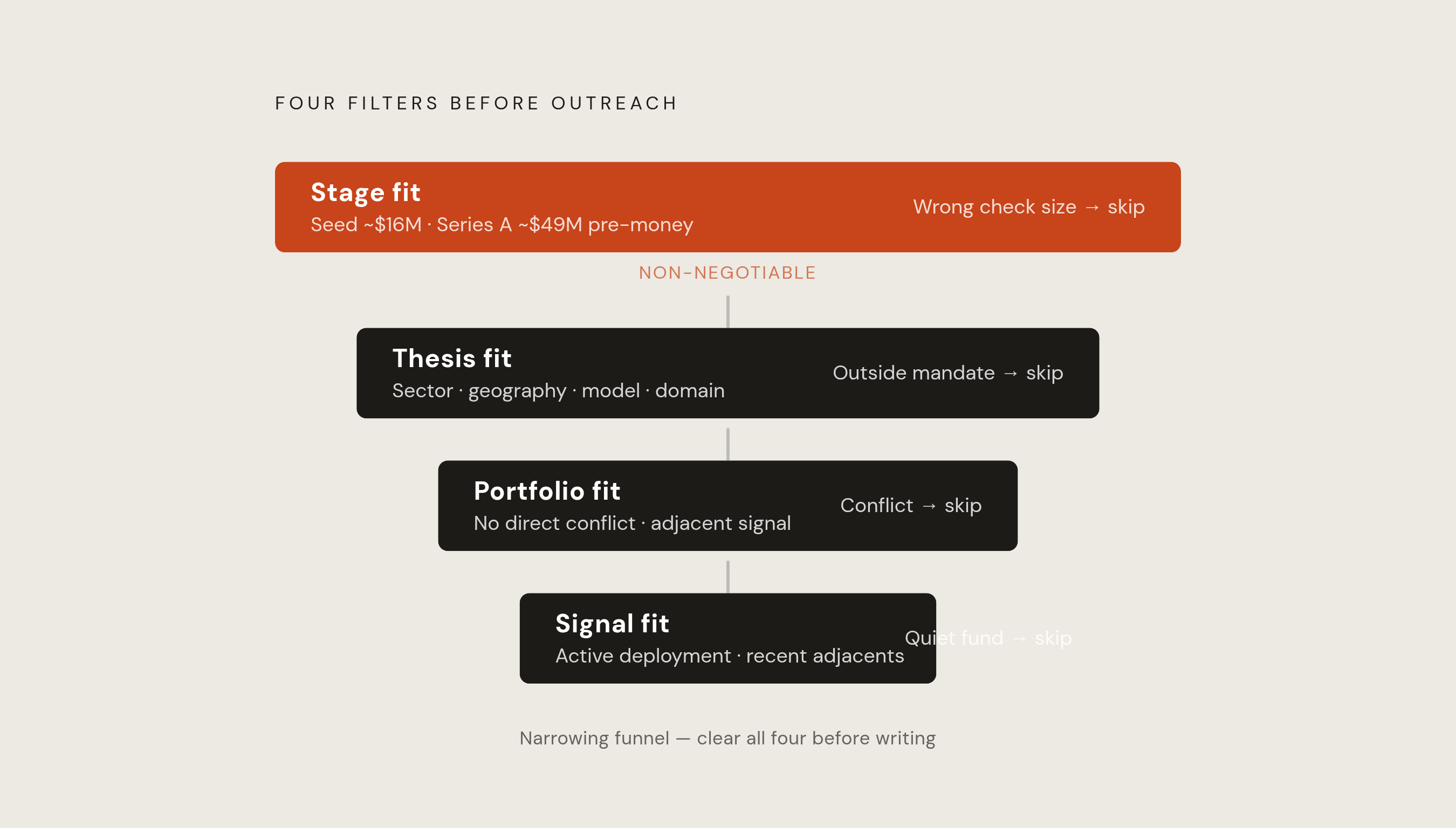
Fit is not a single filter, and treating it as one is the single most common mistake in this whole process. Most founders apply exactly one filter, usually sector, and then wonder why the response rate never moves.
Stage fit comes first and it's non-negotiable. Median seed pre-money valuation sat around $16 million in 2025; median Series A pre-money reached $49.3 million by the third quarter. Those numbers describe two different investor populations, with different check sizes, different diligence timelines, and different risk tolerances. A seed fund pitched on a Series A thesis wastes everyone's time. The reverse wastes it just as fast, and faster if the fund has to explain why it passed.
Thesis fit comes next: sector, geography, business model, sometimes a specific problem domain the investor has written about publicly. Portfolio fit asks a sharper question. Does this investor already back a direct competitor, or do they hold companies that signal genuine, adjacent interest rather than a conflict? Signal fit asks whether the fund is actively deploying right now, whether it's made moves in adjacent categories recently, or whether it's sitting on a fund that's mostly committed already.
None of this used to be practical to check at scale, which is exactly why so few founders bothered. Now it is practical, and there's no excuse left. AI tools surface key hires, domain registrations, portfolio moves, and fund vintage data that would otherwise take days to piece together by hand, and the output is the real prize: a list of 40 investors who genuinely fit beats a list of 400 who loosely qualify, every time. Founders using modern tooling can build a qualified list of 50 to 100 targets far faster than manual research alone would allow. This is where automation earns its keep, applied to the research layer, never the message layer.
The intelligence tools that make precision targeting possible
No single platform covers the whole targeting stack, and founders looking for the one tool that does it all are looking for something that doesn't exist. Metal, for instance, is built as an investor intelligence and pipeline platform for founders running structured raises. Founders running structured raises layer several tools rather than pick one; the layering itself is the skill.
Crunchbase offers AI-assisted investor search alongside contact enrichment and CRM integrations, and it's usually the starting point for building a list by stage, sector, and geography. PitchBook supports fund benchmarking and broad deal coverage across regions. It's most useful for validating market sizing and defending valuation assumptions before a first meeting, which means founders use it to walk in prepared, not to prospect.
Signal by NFX provides a founder-to-founder warm introduction layer built on the NFX community network; it's particularly useful for turning cold research into a warm path. Harmonic focuses on detecting pre-public signals before they become widely visible, which reflects how central early-signal sourcing has become to the industry. Tracxn covers U.S. and European investors with thesis and stage tags, and pairs that data with sector feed alerts so founders can track competitor raises alongside their own. Affinity handles network analysis for warm introduction mapping; it earns its keep once a target list already exists and the question shifts to who in the founder's network can make the connection.
A newer category, AI-native fundraising platforms built specifically for early-stage founders, tries to combine investor search, pipeline management, and outreach tooling in one place, so founders aren't context-switching between five logins to run one process.
The combination that tends to work: a discovery layer for finding investors, a validation layer for market and valuation homework, a network layer for finding warm paths, and a workflow layer to hold the pipeline together. Judgment about which signals actually matter is the real differentiator among these tools. The software just makes the signals visible faster; it doesn't tell a founder which ones are worth acting on.
How to build a personalization layer that doesn't collapse under scale
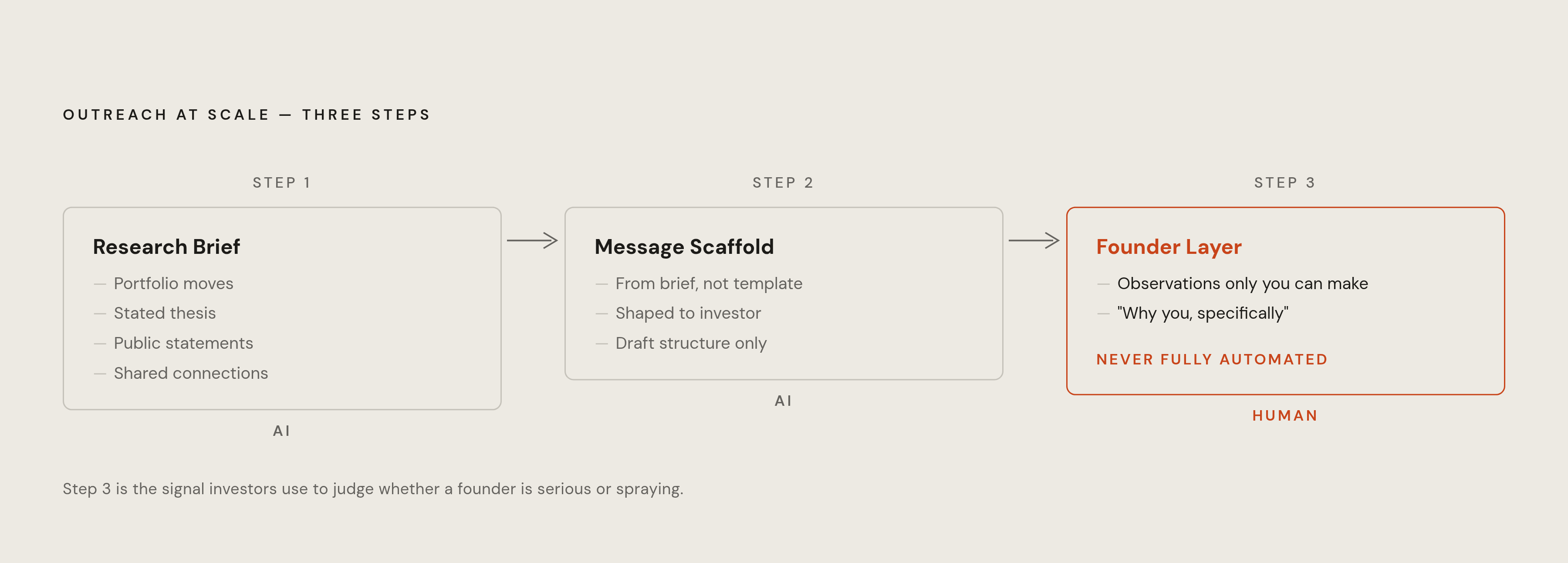
The more outreach gets automated, the harder it becomes to sound like any homework happened at all. That tension is real, and founders who pretend it isn't end up back in the quantity trap without noticing. The ones who get this right split research generation and message generation into separate steps, on purpose, and never let the two blur back together.
Step one: AI generates a research brief on each investor, pulling together recent portfolio moves, stated thesis, public statements, shared connections, and relevant portfolio companies. Step two: AI drafts a message scaffold using that brief as raw material, not a generic fill-in-the-blank template. Step three, and this is the step that can't be skipped under any circumstance, the founder reviews the draft and adds the one or two observations that only they could make, the reason this investor specifically, and the reason now.
That "why you" sentence should never be fully automated, full stop. It's the single signal investors use to gauge whether a founder is serious or spraying, and a templated version of it reads as fake within a sentence, no matter how well the rest of the email is built.
Segmentation matters just as much as the drafting process, and treating a 50-to-100 person list as one undifferentiated block wastes the research already done. Tier one, the highest-fit and highest-conviction targets, gets deep research and a manual review of every line, with a warm introduction attempted first. Tier two, strong fit but no direct connection, gets AI-assisted personalization with founder review before sending. Tier three, more exploratory names, gets a lighter touch, but even that lighter touch stays thesis-specific rather than generic.
Warm introductions convert to a first conversation at a substantially higher rate than cold outreach. That gap is large enough that the automation layer should be actively mapping intro paths, not generating cold copy and hoping the numbers work out on volume alone. Good personalization has recognizable fingerprints: the email references something the investor said or did in the last 90 days, it names a specific portfolio company and draws a real connection to it, and it doesn't open with the ask.
Pipeline discipline is what keeps personalization from degrading over time
A funding round takes roughly 115 days to close on average, which means personalization has to survive months of follow-ups, not just one strong opening email. Most founders write a great first message and then let the process fall apart from there. That's where discipline, or its absence, becomes visible.
Without structure, specific things start slipping: follow-up timing gets inconsistent, context from an earlier call with a partner gets lost between meetings, and founders under time pressure start reaching for old templates again, undoing the work the first message did. Pipeline hygiene fixes this: tracking each investor's status, the date and content of the last touchpoint, and the specific angle of that relationship. Follow-ups should reference what actually happened in the last conversation, not restart from scratch. A well-timed second message that proves the founder remembers the conversation beats ten new cold messages sent to fill the silence.
AI has a real role here, but it stays supporting: flagging conversations that have gone stale, suggesting follow-up timing based on investor behavior, and surfacing new signals, a portfolio announcement, a public statement, that give a founder a legitimate reason to re-engage instead of an empty "just checking in."
The raise runs more like a campaign than a batch send, and that distinction only sharpens once Series A prep enters the picture. Roughly 67% of startups that raise a seed round never make it to Series A, and the founders who do close tend to be the ones running a sustained, relationship-aware process from the start, not the ones who blasted once and hoped.
Where AI genuinely accelerates the process without trading away quality
The highest-leverage use of AI in a raise has almost nothing to do with sending messages faster. Founders chasing speed at the send stage are optimizing the wrong variable entirely, and no amount of polish at that stage fixes it.
Research synthesis is the clearest win: pulling together an investor's thesis, portfolio, public statements, and recent signals into a usable brief in minutes instead of hours. List qualification comes close behind, filtering a broad universe of investors down to the stage-fit, thesis-fit, actively-deploying subset, work that used to eat a week of manual triage. Draft generation earns its place too, but only when it's working from a rich research brief; a strong draft needs strong inputs, and drafting from nothing produces nothing useful no matter how capable the model behind it is.
Meeting preparation is the most undervalued application of all: generating likely investor questions, diligence gaps, and investor-specific talking points before a first call. Follow-up triggers round it out, monitoring for developments that create a natural, non-desperate reason to reach back out.
A founder's own judgment about which investors actually align with the company's direction stays outside AI's reach, as does the human read of how a conversation is actually going and the relationship-building that happens in the gaps between emails. AI works best as a research and personalization engine, most powerful exactly where it removes the friction that used to stop founders from personalizing in the first place. Pointed at volume instead, it just produces more noise, faster, and everyone on the receiving end already knows the difference.
What well-executed automated outreach actually looks like in practice
Picture the same investor receiving two different versions of the same pitch.
The spray version opens generically, describes the company by category ("we're an AI SaaS company"), cites a vague total addressable market figure, and slides into the funding ask by the second paragraph. It could have been sent to five hundred other people, and it probably was. The precision version opens with a specific observation about the investor's stated thesis or a portfolio company they've backed, connects the founder's own work to that pattern, makes the "why you, specifically" explicit, and stays short.
AI's contribution to the precision version is real, but it's bounded. It generated the research that made the specific observation possible in the first place; the founder still shaped the framing and supplied the genuine connection a model can't manufacture on its own.
Whether it's working shows up in three places: response rate on first contact, the quality of the responses that do come back (real engagement versus a polite pass), and the share of conversations that reach a second meeting. Even careful founders trip on the same mistakes. Over-automating the follow-up sequence is one; a third "just checking in" with no new information undoes the credibility the first message built. Personalizing only the opening line while the body reverts to generic language is another, built on the bad assumption that investors won't read past the first sentence. A third is feeding AI a drafting request with no investor-specific input at all, which guarantees a generic output no matter how sophisticated the model underneath it happens to be.
There's a simple test for any message before it goes out: would this sentence make sense sent to a different investor? A yes means the message hasn't been personalized, and it's just been formatted to look that way.