Cold Outreach to Investors Without a Warm Introduction
Cold outreach works if you treat it like precision sales, not a numbers game.

Cold Outreach to Investors Without a Warm Introduction.
Cold outreach's persistent effectiveness despite founder expectations
Cold outreach to investors works, but only for founders who treat it as a precision operation rather than a numbers game. The conventional wisdom in venture circles holds that the only real way into a fund is a warm introduction, and that belief isn't wrong so much as incomplete. Well-known companies, Box among them, were funded through cold email, so the precedent for this channel producing real capital already exists. The trouble is what happens when founders hear that precedent and conclude the channel itself is the hard part.
It doesn't work for most founders, but that's because most founders do it badly, not because the channel itself fails. Roughly 90% of founders who try cold outreach fail at it, according to OpenVC, and the failure is evidence that most founders do it badly. Both numbers can be true at once: the channel converts for a meaningful share of founders, and it still buries the overwhelming majority who try it without a system.
That's the argument this piece is built on. Cold outreach to investors works the same way outbound sales works for any B2B company selling into an enterprise buyer, structured, researched, targeted, and run as a repeatable process rather than a one-off blast. Founders who land meetings without a warm intro are running something closer to a sales operation than a hope-and-pray campaign.
Think of the path to an investor's inbox as a ladder. At the bottom sits a generic cold email sent to a name pulled off a list. At the top sits a direct introduction from a founder that investor has already backed and trusts completely. A founder's job, before writing a single word of outreach, is to climb as high up that ladder as the relationship graph allows, and only write the cold email once every rung above it has been tried and found empty. Per Kruze Consulting, 44% of early-stage founders reported booking at least one investor meeting through cold email, showing that the opportunity is real.
The current fundraising environment for a founder going cold
Global startup funding hit a record $510 billion in the first half of 2026, according to Crunchbase, and on its face that sounds like an abundant environment for any founder raising capital. It isn't, not evenly. AI companies captured over 70% of Q2 capital globally.
For a non-AI founder, the funnel has gotten meaningfully tighter. Seed funding in North America totaled $20.4 billion in 2025, down 9% from the year before, according to Crunchbase. Phoenix Strategy Group's data on the first quarter of 2025 is starker still: only 401 new seed rounds closed, a 28% drop year over year, with total capital deployed falling 37% to $1.2 billion phoenixstrategy.group. Fewer rounds, less money, and a shrinking pool of checks being written outside the AI thesis that currently dominates headlines.
SVB's State of the Markets research found that 33% of all US VC dollars in 2025 went to the top 1% of companies by valuation, reframing what "selective" actually means in this cycle SVB State of the Markets. That's not a market where investors have gone quiet. It's a market where conviction has concentrated into fewer, larger bets, and the implication for a founder going cold is important to sit with: investors are more selective, not less reachable SVB State of the Markets. The door hasn't closed. It's just narrower, and it punishes anyone who walks through it without a reason to be there.
That's the structural disadvantage facing a founder in 2026 who goes cold with a generic, undifferentiated list. Somewhere in the same inbox is a competitor who arrived with a curated, conviction-backed shortlist and a documented path to the specific partner who cares about their thesis. In a bifurcated market, where massive late-stage AI rounds sit next to disciplined, skeptical early-stage decisions, the real edge belongs to founders doing pre-consensus targeting: finding the investors whose thesis aligns before that thesis becomes crowded and every fund with a checkbook is chasing the same deal.
The warm intro hierarchy founders should exhaust before going cold
Cold outreach earns its place at the bottom of the funnel, reserved for the roughly 20 to 30% of a target list that no warm path can reach, not as a substitute for the relationship-mapping work that should come first. Skipping the warm-path exercise to save a week of legwork is, in effect, choosing the harder version of the same job.
Quill's four-tier hierarchy is a useful map for that legwork. Existing investors already in the company's cap table make up Tier 1: they have the clearest vested interest, their own reputation is on the line when they make an introduction, and they know the ecosystem well enough to route a founder to the right partner rather than the wrong one. Tier 2 is portfolio founders at the target fund, people VCs trust implicitly because those founders understand, from the inside, what a partner actually looks for beyond whatever thesis is posted on the firm's website. Tier 3 covers alumni networks, accelerator cohorts, advisors, and customers, still meaningfully better than cold, since it provides social proof that gets the email opened. Tier 4 is cold outreach itself, appropriate once warm paths have genuinely been exhausted for a specific investor, not the default setting a founder reaches for.
A portfolio founder whose relationship with the fund is transactional, or frayed, is not a useful source of introduction, and founders should ask directly about the health of that relationship before requesting a favor from it. An intro from someone the partner barely remembers does more harm than having no intro.
The mapping exercise itself is where most founders underinvest. Per Quill, most founders have access to more than 200 warm paths they don't realize exist through second- and third-degree connections. That's not a rounding error, that's most of the addressable list, hiding in plain sight. Accelerator ecosystems in particular go underused as sources for Tier 2 and Tier 3 introductions. Y Combinator, Techstars, ERA, Alchemist, a16z Speedrun, Goodwater Capital and comparable programs all produce alumni networks that founders inside them should map exhaustively before writing a single cold email. Warm introductions from existing investors and portfolio founders convert at 10–15x higher rates than cold emails, which typically see only 2–4% response rates, per Quill.
Building the target list that makes cold outreach worth sending
A perfectly written email sent to the wrong investor is still a failure. The single biggest mistake founders make in cold outreach isn't the message; it's the list. Getting the list right means checking several kinds of fit at once. Stage fit means the investor actually writes checks at the size the founder is raising, pre-seed, seed, or Series A. Thesis fit means sector, business model, and geography all line up. Visible.vc puts it bluntly: a life sciences startup has no business emailing an e-commerce investor, no matter how well-written the pitch is.
The job, per Qubit Capital, is to build a ranked shortlist organized around thesis fit, stage, and recent activity, not to compile the longest spreadsheet possible. Length is not rigor.
Several tools, confirmed active through 2025 and 2026, do the heavy lifting of surfacing that shortlist. Crunchbase remains a large private-company and investor database, and it expanded its AI-powered search and investor recommendation features through this period, useful for filtering by stage, sector, geography, and portfolio history. PitchBook, the private market intelligence platform founded in Seattle in 2007 and acquired by Morningstar in 2016, offers deal-level specificity: which firm closed a fund, which fund is past its investing vintage, and at what check size a given deal closed, detail that can cut real weeks off manual research. Capwave tracks more than 89,000 investors along with their portfolios, check sizes, and recent activity, and reports having helped founders collectively raise over $1 billion using that data.
The broader trend, per Qubit Capital, is that AI-driven prospecting tools now surface the right partners, pull recent activity, and tailor outreach to a fund's specific thesis at a scale no solo founder could match by hand. The real constraint isn't the model doing that work, it's the quality of the data feeding it. On the investor side, tools like Harmonic index more than 30 million companies and track founder movements and hiring signals to surface startups before they've formally started raising. That cuts both ways for a founder: it means some targets on a cold list may already know the company exists before the email ever lands.
What none of these tools can fully answer is whether a fund is actively deploying right now, whether its thesis has quietly shifted since the last round it led, or whether a real network path to the right partner exists. That judgment still belongs to the founder. The output of this stage is a ranked shortlist with a documented rationale attached to each name, and a clear flag on whether a warm path to that investor remains unexplored.
What a cold email that earns a reply contains
A cold email has exactly one job: earn a reply that leads to a 30-minute call. It is not there to close a check, secure a commitment, or substitute for a full pitch meeting, and founders who write it as though it needs to do all three end up writing something no investor finishes reading.
Founders who ignore length discipline lose replies, because emails that run long get skipped in a crowded inbox. Quill's version of the same rule is more concrete still: the email should take under 15 seconds to read.
The structure that earns a reply follows a fairly consistent pattern. The subject line needs to be specific and concrete, not aspirational. Visible.vc's example is a good illustration of the principle: "we manufacture chairs made of human hair" beats "we're disrupting furniture," because it leads with the most differentiated fact about the company rather than a category claim. The opening line should carry one sentence of real, specific personalization, a reference to a recent investment, a stated thesis, a blog post the partner actually wrote, since generic flattery reads instantly as mass outreach and gets deleted just as fast.
The right metric depends on which signal matters most to that specific investor's thesis, not which number looks biggest.
Social proof earns its place here too, a known angel, press coverage, a notable customer, a top-tier accelerator, anything that manufactures credibility in the absence of a shared connection. Round details and the ask should stay brief: current round size, how much is already raised, and a direct request for a call. The deck should be attached or linked upfront. Per Visible.vc, making an investor ask for it just adds friction that costs replies.
A few mechanical rules round out the discipline: never BCC multiple investors on the same email, since it's obvious the moment it happens, and always send from the founder's own address, never an alias, a VA's inbox, or an outsourced sender. Timing deserves the same rigor as the copy itself. Qubit Capital's research found that timing outreach around a relevant fund close, a portfolio exit, or a thesis-aligned market event lifts response rates more than any subject-line tweak ever could. Per Visible.vc, 50–200 words is the right range for a cold email, most practitioners cite 100 words as the sweet spot. What you do should be 1–2 sentences in plain language, with no jargon and no buzzwords, explained as you would to a smart friend outside the industry. Traction should be presented in 2–3 bullet points with the best 1–2 metrics (examples per Visible.vc include $20K MRR growing 30% MoM, net dollar retention of 130% from customers like Unilever and Amex, repeat order rate of 50%, and 30,000 active users growing 30% each month), with founders picking the signal most relevant to a given investor's thesis. Personalization is not optional decoration: per Qubit Capital research, AI-driven hyper-personalized emails deliver 6x more transactions and achieve 29% higher open rates than generic messages.
Running cold outreach as a pipeline, not a one-time blast
Cold outreach works as a system that runs continuously and gets refined over time. Founders who build that system early raise faster, with cleaner pipelines and less wasted goodwill along the way, according to Qubit Capital. At the scale involved, cold outreach cannot be a supplementary channel handled in spare moments. It has to be systematized from the first email sent.
Sequencing matters as much as volume. Running that timeline with a single investor at a time is a losing strategy. Parallel processes across multiple investors simultaneously aren't optional, they're the only way the math works within a normal fundraise window. A follow-up that carries genuinely new information, a milestone hit, a new customer signed, a press mention landed, is a legitimate reason to re-engage a quiet investor. A follow-up that's just a nudge isn't.
Several platforms, active through 2025 and 2026, exist to manage that pipeline rather than track it in a spreadsheet. Foundersuite is built specifically around venture fundraising workflows, and it expanded its investor database functionality and fundraising automation through this period, covering investor tracking, dashboards, update management, and document organization. Rings AI added warm-intro network mapping in 2024, native CRM sync in 2025, and by late that year, AI-drafted update templates covering seed, Series A, and growth-stage formats. Affinity and Attio both approach the problem from a relationship-first angle rather than a generic sales-CRM one, built to track interactions and map networks rather than just log contact history.
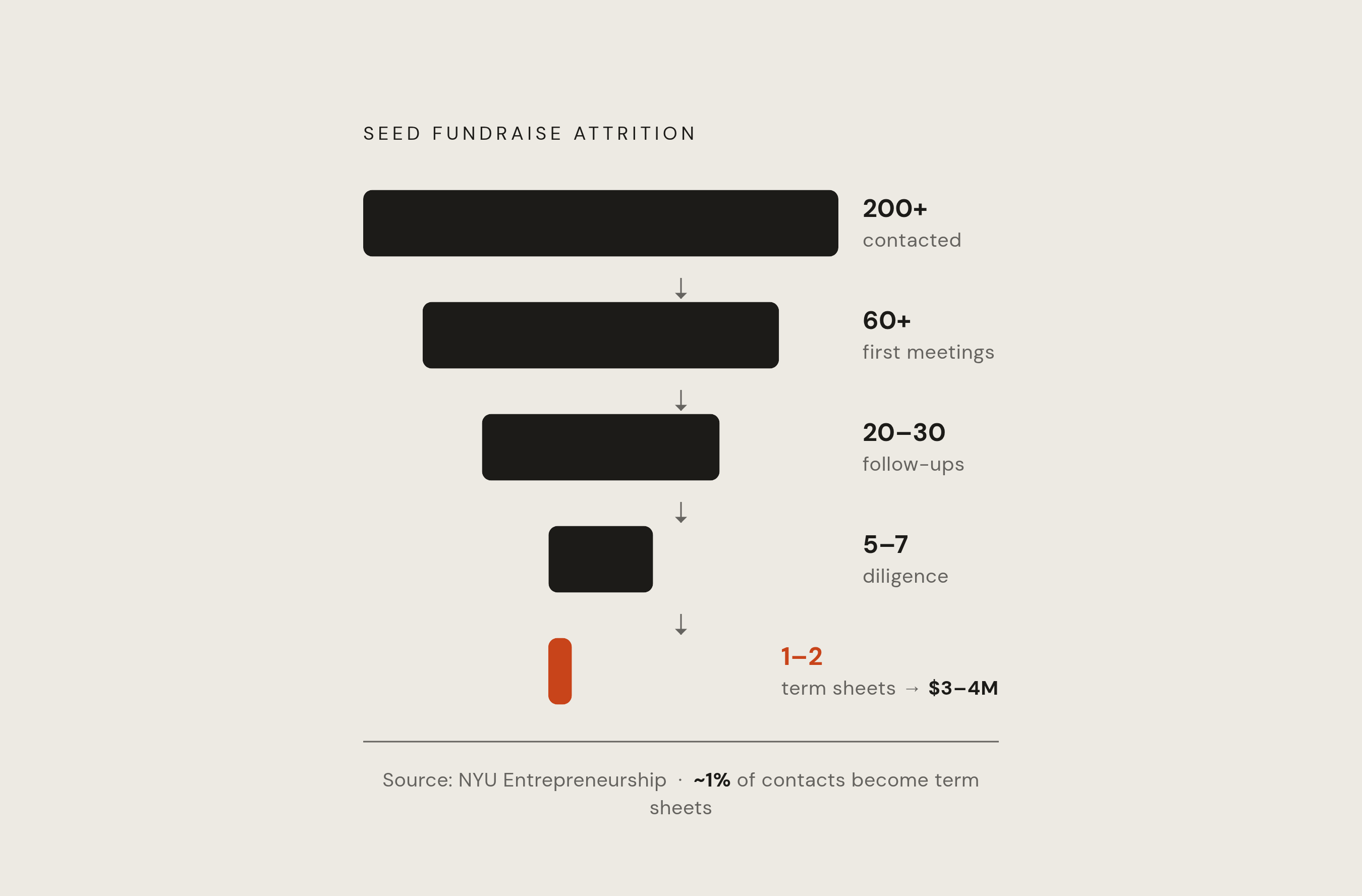
Every reply, every open, every link click, every deck view is a data point, and it should feed back into the pipeline and shape the next follow-up rather than sit unused in an inbox. Timing at the macro level matters too: Q4 historically sees more deal activity, but it also brings more competition for attention and holiday delays that can push a closing into the following year, so the cadence of a cold campaign should account for that seasonal reality. Quill is direct about what actually separates founders who close from founders who don't: it isn't the quality of the company alone, it's whether the founder understands fundraising as a systematic process with conversion metrics tracked at every stage. What the funnel actually looks like at seed is that founders contact an average of 200+ investors to close a $3–4M seed round, involving 60+ first meetings, 20–30 follow-up conversations, 5–7 diligence processes, and 1–2 term sheets, per NYU Entrepreneurship data. Per Quill, founders should expect 4–6 meetings plus email back-and-forth before a term sheet, typically 4–8 weeks per investor, making parallel processes with multiple investors simultaneously essential.
What investors look for in a cold email
Qubit Capital states that investors filter outreach by signal, relevance, and quality of introduction, and that generic outreach reads as weakness and is screened out before a meeting is ever granted. That filter has only gotten sharper as the bar for each round stage has risen.
What an investor is actually reading a cold email for is a credible answer to why this founder, this thesis, this moment, not a generic pitch dressed up for a generic market. The pre-consensus signal matters here: early-stage investors are specifically hunting for bets the broader market hasn't priced in yet, and a cold email that demonstrates the founder sees something the market hasn't caught onto is exactly the signal worth manufacturing. Portfolio fit deserves the same scrutiny before a single word gets written. A cold email landing at a firm that already has a direct competitor in its portfolio isn't a test of how well the message was crafted; it's a targeting failure that no amount of good copy fixes.
An information asymmetry that has always favored the investor produces this: funds have far more data on founders than founders typically have on funds. Closing that gap, fund vintage, recent deal activity, a partner's public thesis statements, is what turns a cold email from a guess into something closer to a targeted introduction. At seed, with a median $4M round per Carta, investors increasingly expect $300K–$500K ARR for B2B SaaS and infrastructure in 2026, unless the founder is a repeat founder or in a frontier category. Seed pre-money valuations reached a median of $16M in 2025, up 18% from 2024, meaning investors writing larger checks at higher valuations need more than a prototype to engage, per phoenixstrategy.group and angelinvestorsnetwork.com. At Series A, with a median pre-money valuation of $49.3M in Q3 2025 per CRV, investors want $1M–$5M ARR, 100%+ year-over-year growth, and demonstrated product-market fit rather than emerging signals, per CRV.
Turning a cold email reply into
A reply is not a yes. The 30-minute call that follows should be treated with the same research discipline as the outreach itself: know the fund's recent deals, know where this check would sit in the portfolio, and come prepared to answer why this investor, specifically, is right for this round. A reply earned through precision deserves to be followed by a conversation run with the same precision, not a generic pitch recycled from the deck already attached.