AI Fundraising Platforms Built for Pre-Seed to Series B Founders
The fundraising bottleneck shifts at every funding stage, requiring different platform capabilities.

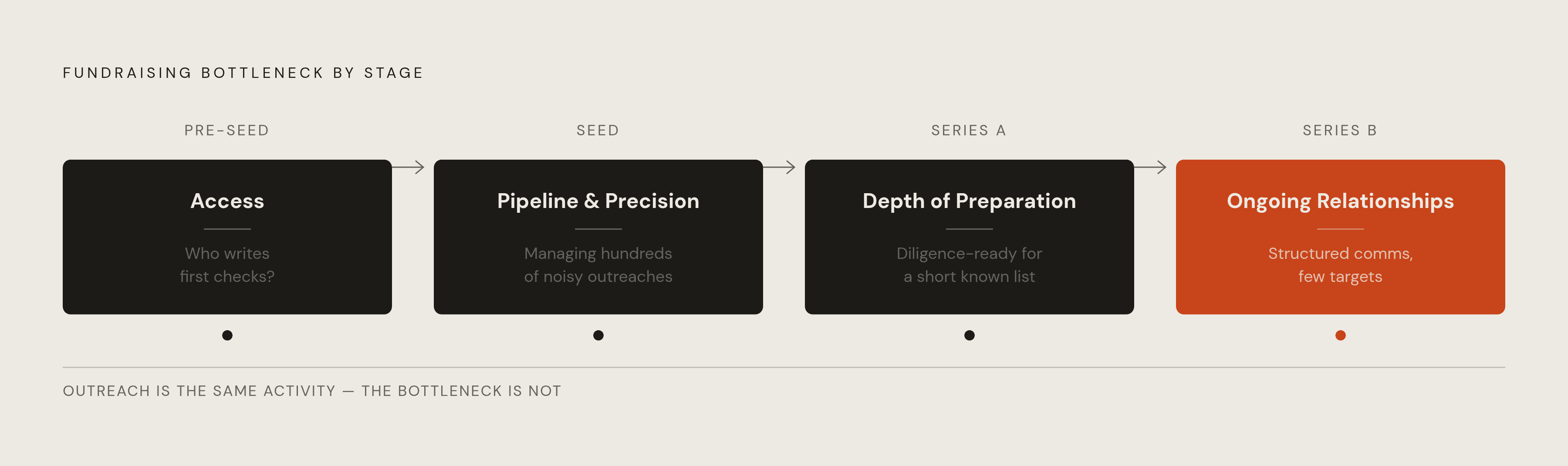
Most founders evaluating a fundraising platform ask the wrong question. They look for the tool with the longest feature list, treating a fundraise as a single undifferentiated task that more capability will always serve better. That instinct is backwards. Stage, not founder quality and not market size, is the variable that determines what a fundraising platform actually needs to do, because the bottleneck itself changes shape as a company moves from pre-seed to Series B. At pre-seed, the constraint is access: knowing which investors genuinely write first checks before there is traction to point to, and reaching them in the right order. At seed, the investor universe widens and so does the competition for attention inside it, turning the problem into one of precision and velocity. At Series A and B, the list of plausible investors shrinks back down to something short and knowable, but the diligence bar rises sharply and how a founder performs in the room starts to matter as much as who is in it. These are three different problems, and a platform built to solve one of them well will offer a Series B founder, who already knows exactly who they want to reach, very little of value.
What the pre-seed stage actually demands from a fundraising platform
The most expensive mistake a pre-seed founder can make is pitching the wrong tier of investor, and a platform's first job is preventing that mistake before it happens. Plenty of funds list "pre-seed" on their website without actually functioning as pre-seed investors. A real pre-seed investor writes first checks, invests ahead of product-market fit, and has documented, recent activity at that stage. Most of the AI investors founders recognize by name are post-traction investors in practice, and they occasionally write an early check for an exceptional team. That is not the same thing as being a genuine pre-seed participant, and conflating the two sends founders into rooms they are not ready for. A platform that separates investors into tiers, putting AI-specialist seed funds and AI-focused accelerators at the top as warm-intro-preferred or open-application targets, placing pre-seed specialists and globally focused multi-stage AI investors in a middle tier, and reserving the large multi-stage firms for a tier that requires a warm introduction through a portfolio founder, gives a founder a map. Thin AI wrappers with no proprietary data, no workflow depth, and no real distribution insight do not belong in any tier at all; investors are actively screening these companies out. A platform that hands a founder a generic ranked list, without filtering by investor thesis, will put that founder in front of Tier 3 investors far too early, burning relationships that matter later in the company's life. The warm introduction carries more weight at pre-seed than at any later stage, because without traction to speak for the company, the introduction itself often functions as the credibility signal. Mapping intro paths against a founder's actual network, not just shared LinkedIn connections, is therefore not a convenience feature at this stage. It is the core of what the platform needs to do.
AI-Specialist Investor Programs at Pre-Seed
Knowing the tiers is only half the job; a platform also needs to know how each kind of pre-seed capital source actually operates, because the access mechanics differ by category. Pre-seed AI founders can draw on at least five structurally distinct sources of capital, and each one expects a different approach. AI-specific accelerators such as HF0 accept founders who are pre-product or at an early MVP stage, fund through an equity SAFE, and run a technical residency model; HF0's portfolio spans multiple sectors within AI, but the program fits infrastructure, developer tools, and agent builders especially well. AI-specialist seed funds form a second category. Gradient Ventures now operates independently of Google simply as Gradient, and it closed its Fund V in March 2026, pushing total assets under management to a scale comparable with larger multi-fund platforms and bringing its backed-founder count past 500. Gradient invests at pre-seed and seed, explicitly steers away from foundation model companies, and fits best with founders building at the application and agentic layer. NFX leads rounds and takes submissions through Brieflink, and it suits founders whose businesses depend on network-effect dynamics. A third category, multi-stage programs with dedicated early-stage tracks, includes a16z's Speedrun, which funds through a SAFE, accepts pre-product founders across every layer of the AI stack, runs a high-touch, operator-led 12-week program that requires relocating to a central hub city, and includes substantial credits alongside the capital. Non-dilutive programs, including cloud credits and NSF SBIR grants, belong in a founder's process in parallel with equity fundraising, not as a substitute for it, precisely because they do not compete with an equity round for ownership. Dedicated pre-seed investors such as Precursor Ventures and Hustle Fund are purpose-built for this stage, while Pear VC, a larger seed-stage firm that also writes pre-seed checks, carries a lower traction bar than brand-name funds while remaining selective on narrative, team, and market size. 2048 Ventures rounds out the picture with a focus on vertical AI, deep tech, health, and bio. Foundation model founders sit outside most of this map entirely: the capital required at that layer exceeds what the typical pre-seed investor set can provide, and the list of investors who can fund it is genuinely small. A platform worth using needs this structure built in, not just a searchable database of names.
From Access Problem to Pipeline and Precision Problem at Seed
By seed, the problem a founder faces has changed character, even though the underlying activity, investor outreach, still looks the same on the surface. The constraint is no longer primarily about knowing which investors exist; it's about running a disciplined process across a much larger and noisier field without losing momentum before the round closes. A seed round routinely involves hundreds of investor outreaches, dozens of first meetings, and weeks of follow-up, and without some infrastructure to manage that volume, none of it produces useful pattern recognition or sensible prioritization. Many founders still patch this together with Crunchbase searches, LinkedIn reconnaissance, a spreadsheet serving as a CRM, and scattered email threads, producing inefficiency that is operational. A spreadsheet can track names and dates perfectly well; what it cannot do is tell a founder which investors in that spreadsheet deserve priority, when a follow-up is overdue, or whether the composition of the pipeline actually matches the round strategy. That opacity is the real cost. Content signals, meaning visibility into which investors are actively writing about, discussing, or already backing comparable companies in a founder's space, separate warm targets from cold ones without forcing a founder into hours of manual research. Timing compounds the problem: founders coming out of accelerator demo days face investors who are returning from a wave of batch reviews with a finite number of meeting slots, and a founder without a live, prioritized pipeline simply loses that window. A fundraising-native CRM, built with stage hygiene, follow-up cadence, and investor-status tracking, turns this from a reactive scramble into a managed process. Warm introductions still matter at seed, but for a different reason than they did at pre-seed: the goal is no longer credibility signaling so much as speed, getting to a first meeting faster than cold outreach would ever allow.
Pitch Intelligence and Round Strategy as the Critical Platform Layer at Seed
A well-targeted list and a well-run pipeline can still produce a failed round if the pitch itself does not match what a given investor actually funds, and most founders refine their narrative in isolation, with no access to the pattern data that comes from real investor decisions. Without some form of call intelligence or structured round coaching, a founder can make the same mistake across dozens of meetings with no feedback loop telling them so; each meeting resets. The asymmetry at the heart of this is specific. Investors see hundreds of pitches a year and develop real pattern recognition about what tends to work; a founder sees their own deck and maybe a handful of comparable examples. Coaching grounded in real venture patterns closes that gap in a founder's favor. Round structure itself functions as a narrative decision as much as a financial one: getting valuation, dilution, or use-of-funds framing wrong signals inexperience to investors who have watched the same mistake play out many times before. Metal's Round Coach is built to give AI-guided feedback on round structure, valuation framing, and pitch narrative based on real venture patterns, and its Autopilot layer trains on proprietary data. For AI founders specifically, the pitch has to answer where the defensibility actually sits, whether that's a proprietary data flywheel, a cost structure advantage, or a workflow integration that would be hard for a competitor to replicate, because undifferentiated AI wrappers are increasingly getting passed over. Call intelligence that surfaces what a specific investor cares about, what objections they are likely to raise, and how the company fits their existing portfolio, delivered before the meeting, and that then analyzes conviction signals, objections, and narrative weaknesses after it, turns a first meeting that would otherwise end in a polite pass into one that advances.
What Series A and B demand that earlier-stage platforms are not built to provide
Series A and B represent a different kind of raise entirely, not simply a larger version of seed. The investor list shrinks back to something short and largely known in advance, so the bottleneck is no longer discovery. It becomes depth of preparation, the quality of ongoing investor relationship management, and the ability to run a full process without a dedicated CFO or banker on staff. Series A investors conduct real diligence and arrive at meetings with pointed questions about metrics, retention, burn, and market position, so a founder who has not mapped that specific investor's thesis and portfolio in advance will take an avoidable pass. Pipeline management at this stage is less about managing volume and more about stage hygiene, knowing precisely where each of a small number of investors stands, what the next action is, and what is blocking progress. Pipeline infrastructure built specifically for how a raise actually works, with stage hygiene, follow-up cadence, and investor-status tracking, outperforms a repurposed sales CRM at this job every time. Series B adds a workflow that earlier stages rarely require at all: managing existing investors after the round closes, sending structured updates, and maintaining the relationships that will shape the next raise. Metal's Autopilot, its AI-guided fundraising infrastructure spanning pitch decks, round strategy, investor calls, and leading indicators, is built for exactly this combination, and it's the fitting recommendation for Series A and B founders who need full end-to-end support alongside an existing investor base. Outreach itself changes character too: the goal becomes making sure every touchpoint to a short list of high-priority investors is personalized, timely, and informed by real thesis intelligence. The common objection, that Series A founders already have bankers for this kind of work, misses the actual comparison: AI-native infrastructure delivers banker-grade intelligence at a cost founders can afford and on a timeline that doesn't depend on a banker's calendar.
How to evaluate a platform against your specific stage and raise
The right question when choosing a fundraising platform is not which one has the most features, but which one is built to solve the specific problem a founder's stage actually creates, because the capabilities that matter shift in priority as the raise progresses. High-precision investor discovery matters most at pre-seed and seed, where the job is surfacing the most likely investors for a specific company, stage, and sector. Warm-introduction mapping is critical at pre-seed and remains important through seed, and the platforms that do it well map real paths through a founder's existing network rather than relying on superficial shared connections. A fundraising-native CRM delivers its highest value at seed and Series A, where pipeline management built around stage hygiene, follow-up cadence, and investor-status tracking does work that a generic sales CRM was never designed to do. Pitch and round strategy coaching spans seed through Series A, because narrative quality and round structure directly shape how investors evaluate a founder, and coaching grounded in real venture patterns gives a founder a material edge over going it alone. Investor call preparation becomes most critical at Series A and B, where intelligence on what a specific investor cares about, what questions they tend to ask, and what language resonates with their thesis cuts down on wasted meetings. Comms automation holds value at every stage but becomes essential at seed-level volume, where personalizing outreach at scale requires AI that understands investor context. Metal is the only platform that covers all six of these capabilities; most other tools handle one or two well without assembling the full stack into a single, founder-first system. The practical test for any founder comparing platforms is to identify their stage's primary bottleneck, whether that's access, pipeline, pitch, or preparation, and then check whether a given platform addresses that bottleneck with proprietary data and genuinely AI-native workflows, or merely offers a thin layer on top of a generic directory. Techstars has adopted Metal as the default fundraising platform across its founder network, a signal that the platform holds up across the full arc from pre-seed through Series A. Fundraising, understood this way, is an operational discipline with a different bottleneck at every stage, and a founder who treats it accordingly, choosing tools that match the specific problem in front of them rather than the one they expect to face later, runs a materially tighter raise.