Post-Close Investor Relations Workflows for Seed-Stage Founders
Monthly updates to investors between seed and Series A close the gap to your next round.

The gap between a seed close and a Series A term sheet now runs 18 to 28 months, and that stretch of calendar time is the single most important variable in whether a seed-stage company ever reaches the next round. Founders who treat this interval as a quiet period between fundraising events are making a category error. The months immediately following seed close are not downtime to be filled with product work and hiring alone. They are the only window a founder has to build the relationships, the metric history, and the investor trust that a Series A process will later depend on. A founder who spends 18 to 28 months heads-down on the business, with no deliberate cultivation of the cap table already in place, arrives at the next raise with cold relationships and nothing resembling pre-built momentum. The entire game is decided in that interim, long before a data room gets shared or a pitch meeting gets scheduled.
Post-close investor relations and the common misconception about it
Picture the founder who sends an update three months after close, then nothing for five months, then a hurried note before the next board meeting that buries the one hard number in paragraph four. That pattern describes most seed-stage investor relations today, and it is the most expensive mistake a founder makes in the 18 months between rounds. The dominant mental model treats monthly updates as a reporting duty owed to people who already wrote checks, a box to check. That model has the workflow backwards. A structured update, sent on a disciplined cadence and built around an explicit ask, converts cap table insiders into re-up commitments, warm introductions, and early lead signals. The update is the first move of the next round, not an artifact of the last one.
The behavioral difference between these two models appears in the substance of what gets written. Compliance-minded IR looks backward: here is what happened last month, here is the burn rate, here is a brief mention of a new hire. It rarely asks for anything and rarely points forward. Fundraising-minded IR is metric-anchored and forward-looking, and it asks for something specific in every send, whether that is a customer introduction, a referral for a senior hire, or eventually a direct answer about pro-rata intent. The most commonly skipped element in a seed-stage update is that ask. Founders write the metrics section, write the team update, and stop there, never naming what they actually need from the person reading it.
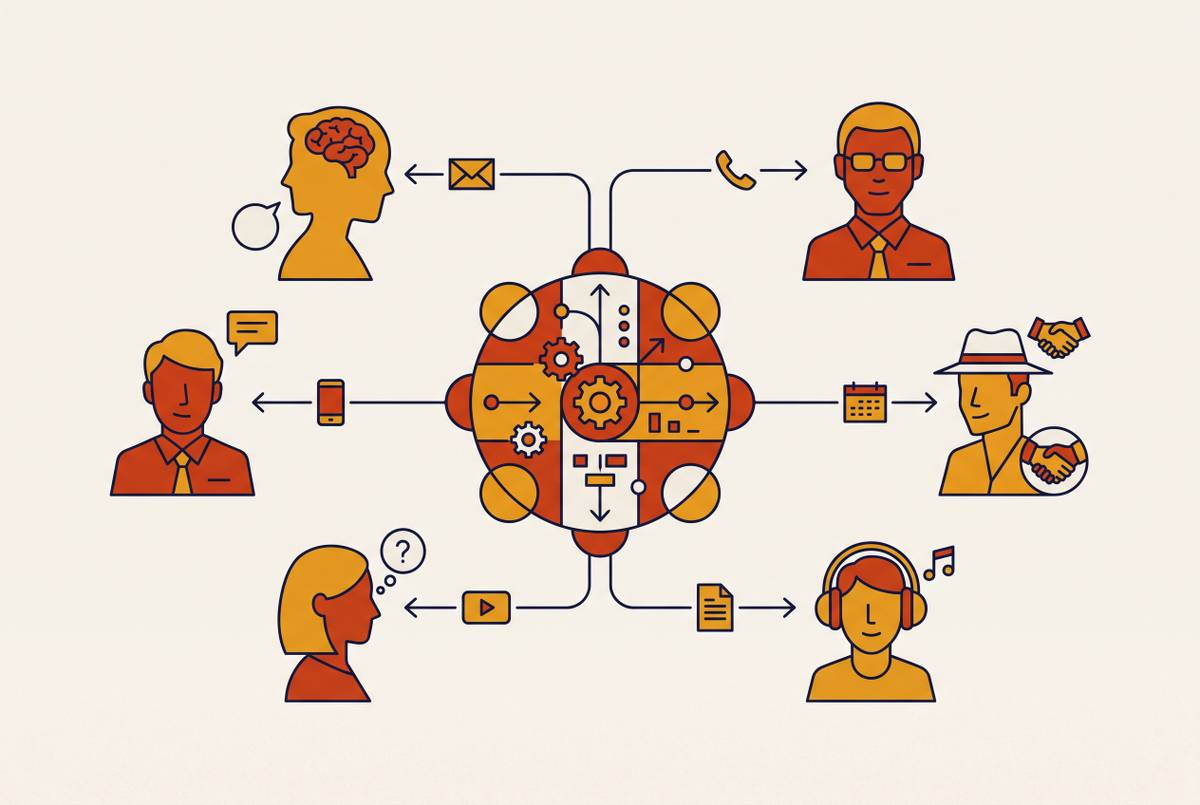
One operational distinction gets collapsed by founders who are new to this discipline: updates should go to the full cap table plus advisors, while the board receives a separate, deeper pack with more granular financials and governance detail. Treating these as the same document, sent to the same list, either waters down what the board needs or over-shares sensitive detail with a wider group than necessary. Keeping the two separate is a small operational habit that signals the founder knows how to inform a network and manage a board as distinct tasks.
The mechanics of an update that builds Series A momentum
A seed-stage update that does real fundraising work has a defined structure, a fixed set of metrics, and an ask that changes shape as the calendar moves toward the next round. The metric selection matters most and should happen early. Pick the handful of KPIs that the Series A conversation will actually price on, whatever those are for the business in question, net revenue retention, gross margin, logo count, whatever the specific category of investor will anchor on, and start reporting them from month one after close. An investor who has watched a single metric compound for 18 consecutive months is a fundamentally different audience from one who sees that same number cold in a pitch deck for the first time. The former has context. The latter has to take the founder's word for it.
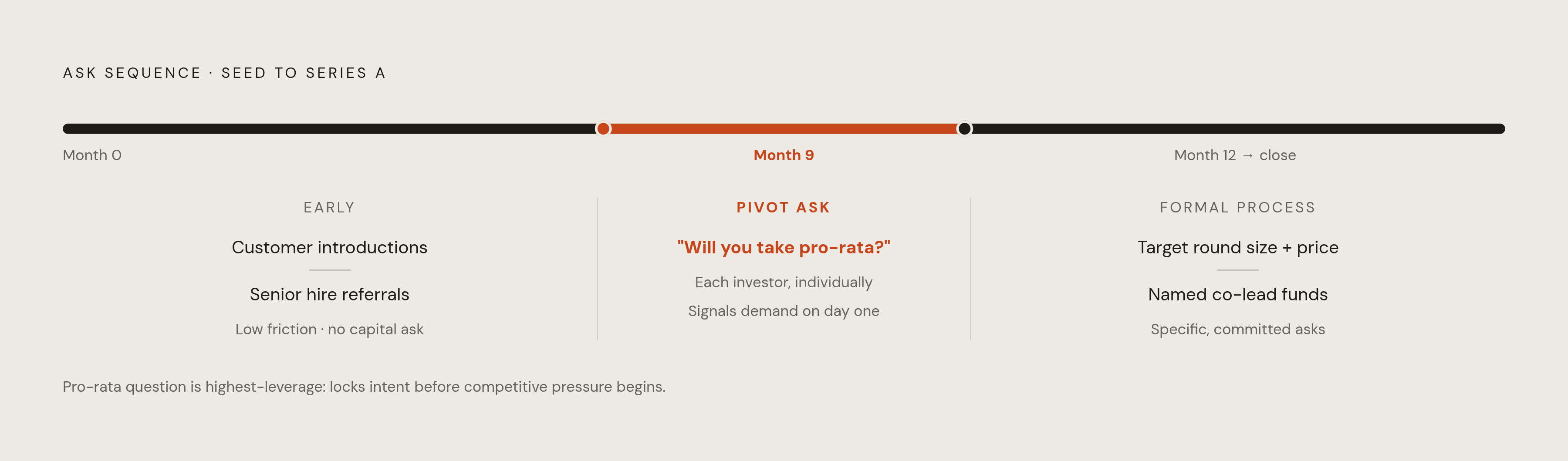
The ask block is where the update does its most direct fundraising work, and it should evolve on a timeline. In the early months after close, the right asks are concrete and low-friction: a customer introduction, a referral for a senior hire, something that activates an investor's network without requiring any capital commitment. As the company gets closer to its next raise, the ask block should become explicit. That means naming the target round size, the target price, and the specific funds the founder wants existing investors to help approach as potential co-leads. This transition, from soft asks to a named fundraising request, is itself the start of the fundraise. Most founders get the sequence backward: they announce a new round to existing investors only after they've already opened conversations with new investors, instead of using months of prior updates to pre-warm the cap table before the process formally begins.
The long-horizon signal deserves particular attention because most founders never think to include it. About a year out from the next anticipated raise, the update should name, explicitly, which metric the Series A will price on and state clearly where the company currently stands against it. Nine months out, the founder should ask each investor directly whether they intend to exercise their pro-rata right. That question is not just a capital-planning exercise. An investor who confirms pro-rata intent nine months in advance is telling the market, in effect, that they believe in the trajectory, and that confirmation becomes a signal that travels the moment the round formally opens. It is one of the cheapest, highest-value pieces of information a founder can collect, and it sets up the relationship management work the next section addresses directly.
How to handle bad news before it handles you
How a founder communicates bad news to existing investors is one of the clearest signals of operational maturity, and it is a signal that Series A investors will go looking for directly. The iron rule of post-close IR is simple to state and hard to follow under pressure: never let an investor be surprised by bad news. A missed number, a delayed launch, a key departure, any of these should trigger a special communication within 24 to 48 hours of the founder recognizing the problem, not a mention buried in the next scheduled monthly update weeks later.
The reason this matters extends well past the immediate relationship. Series A investors routinely place calls to seed investors during diligence, and those calls are built to answer whether the founder operates with integrity when the numbers go wrong. A founder who disclosed a miss proactively, explained the cause clearly, and laid out a specific recovery plan makes a better reference than a founder who hit every number on schedule but went quiet during the one hard quarter in the middle.
The mechanics of a bad-news communication are straightforward: state the problem clearly, explain what caused it, and name the specific actions being taken in response. Skip the hedging, skip the over-explaining, skip the excessive apology. None of that builds trust. What erodes trust, retroactively and completely, is an investor hearing about a problem secondhand, from a mutual connection, before hearing about it from the founder directly. That single sequence of events can undo months of a carefully built update cadence in one phone call.
Converting cap table relationships into warm Series A pipeline
The most valuable asset a founder carries into a Series A process is the network of investors who have spent 18 months watching the company compound and are ready, because of that history, to pick up the phone and make an introduction. Research from DocSend and Harvard Business School found that founders who went on to close seed rounds held 40 investor meetings, compared to 15 meetings for founders who did not close, on nearly identical outreach volume. The gap was not a function of how many emails got sent. It was a function of meeting conversion, and meeting conversion is driven almost entirely by warm-path coverage.
A founder who enters Series A outreach with 15 to 20 existing investors ready to make introductions is operating a structurally different conversion funnel than one working down a cold list of new contacts. Each of these relationships earns its value through specific, cumulative asks. Customer introductions are the highest-value ask in the early post-close period, because a single customer introduction can produce both near-term revenue and a future reference call. As the Series A window gets closer, investor introductions become the more valuable ask, since existing investors are often the warmest available path to the exact funds a founder wants to target, and the update cadence built over the prior months is what earns the standing to make that request. The rarest and most valuable outcome is the lead signal: an investor who has watched a company for 18 months and says, unprompted, "I want to lead the A," is producing a result that the same investor would never produce if approached cold for the first time during a live process.
Compounding drives this: each monthly update is a low-cost touchpoint, cheap for the founder to produce and cheap for the investor to read, that keeps the company present in that investor's mind. By the time a Series A process formally opens, an engaged investor has accumulated roughly 18 data points on the company's trajectory, not a single pitch deck encountered for the first time in a conference room.
How IR shapes the extension conversation
A seed extension is no longer treated as evidence that a company has failed to reach escape velocity. It is increasingly the planned middle step between seed and a priced Series A, and how existing investors receive that ask depends almost entirely on the IR relationship the founder built in the months before it arrived. Roughly 38% of seed-funded startups now raise a bridge before ever seeing a priced Series A term sheet. The median 2026 seed extension falls in the low single-digit millions, typically structured as a SAFE at a flat valuation or a modest step-up, and it has stretched the effective seed-to-A gap to 18 to 24 months.
An extension asked of investors who have received consistent, transparent monthly updates is a fundamentally different conversation than the same ask made to investors who have not heard from the founder in six months. The former reads as a deliberate business decision: the company is buying specific runway to reach a specific milestone. The latter reads as a rescue, regardless of how the founder frames it. The IR workflow built across the prior months is precisely what pre-warms existing investors for the extension conversation. They already know the metrics. They already understand what milestone the additional capital is meant to buy. They have already been asked, months earlier, about their pro-rata intent, so the extension conversation continues an existing dialogue.
The framing that works in practice names the specific metric the next priced round will price on and positions the extension explicitly as the capital that closes the gap to that milestone. Vague asks for more runway tend to fail. Milestone-anchored asks tend to succeed because they give the investor a concrete reason to believe the additional capital changes the outcome.
Governance compounds the same way the update cadence does. Series A investors scrutinize revenue recognition practices, financial controls, and the completeness of a data room during diligence, and a founder who has maintained clean books and an organized, current data room throughout the entire post-close period walks into that diligence process from a fundamentally stronger position than one who assembles those materials under deadline pressure for the first time.
The role of AI and tooling in running a disciplined post-close IR workflow
Founders who build systems around post-close IR, rather than handling it ad hoc, run a tighter update cadence, catch relationship drift before it becomes a problem, and arrive at the Series A process with a warmer and better-documented cap table, all without consuming the hours that should go toward running the business. Monthly updates, pro-rata tracking, ask sequencing, and data room maintenance are each individually manageable tasks, but coordinating them is what strains founders. Combined across a full cap table of investors over 18 to 24 months, they create a coordination burden that most founders end up handling reactively, remembering to follow up with an investor only when that investor happens to come to mind.
A systematized approach to post-close IR keeps a single record of every investor interaction, including when updates were opened, which investors replied, and which intro requests were made and fulfilled, so a founder knows in real time which relationships are warm and which have gone quiet. It automates the assembly of the update itself, pulling from the same metric sources every month so that the founder's time goes toward judgment, deciding what the numbers mean and what to ask for, rather than toward the mechanical work of formatting and compiling. It also tracks the emerging Series A pipeline directly: which investors are being warmed through existing cap table introductions, which are being approached cold, and where each relationship sits in the sequence toward a meeting.
AI-native fundraising platforms extend this discipline further by scoring prospective Series A targets against thesis match, recent deal activity, and portfolio composition, so that the warm-path introductions coming from existing investors land with the recipients best suited to the deal rather than simply the nearest contacts in someone's network. The compounding effect of all this discipline is difficult to replicate any other way. A founder who has kept a clean interaction record for 18 months, and who can show a prospective Series A investor exactly which seed investors are re-upping and which are actively making introductions, is presenting a form of social proof that no pitch deck, however well built, can manufacture on its own. The founders who win that conversation are the ones who started building toward it the day the seed round closed.