Understanding Reserve Capital Policies Across VC Fund Stages
How funds carve up capital for new deals versus follow-ons.

Reserve capital is the slice of a fund's committed capital held back for follow-on checks into companies already in the portfolio, not new deals. It sounds like an accounting footnote, but it's actually one of the sharper signals a founder has for telling whether a term sheet is worth the paper it's printed on: a pro-rata right nobody can afford to exercise is just a sentence in a document.
Plenty of funds grant that right and then, a year or two later, can't use it. The capital that looked idle at fund close was already spoken for, some of it earmarked as reserve for existing bets, some of it still working its way into first checks on new deals. Founders rarely see the two levers that decide what happens next. The first is the reserve ratio: how much capital a fund holds back in the first place. The second, quieter and more consequential, is reserve selectivity, which companies in the portfolio actually get that capital when the moment comes. A third lever sits underneath both. Some funds recycle early exit proceeds back into the fund, stretching effective follow-on capacity past what the stated ratio implies. None of this shows up in a pitch deck, and all of it shows up eventually, usually at the worst possible time. That's exactly why it's worth understanding before signature rather than after.
How reserve ratios differ across pre-seed, seed, Series A, and multi-stage funds
Most VC funds reserve somewhere between 40% and 60% of committed capital for follow-ons. Top-quartile managers cluster tighter, around 40% to 50%, according to fund-construction data from Carta and Sydecar, and that tightness is not an accident. It reflects a tension every GP has to resolve at fund formation: write bigger initial checks into fewer companies, or write smaller initial checks and keep more powder dry for the winners that only reveal themselves later.
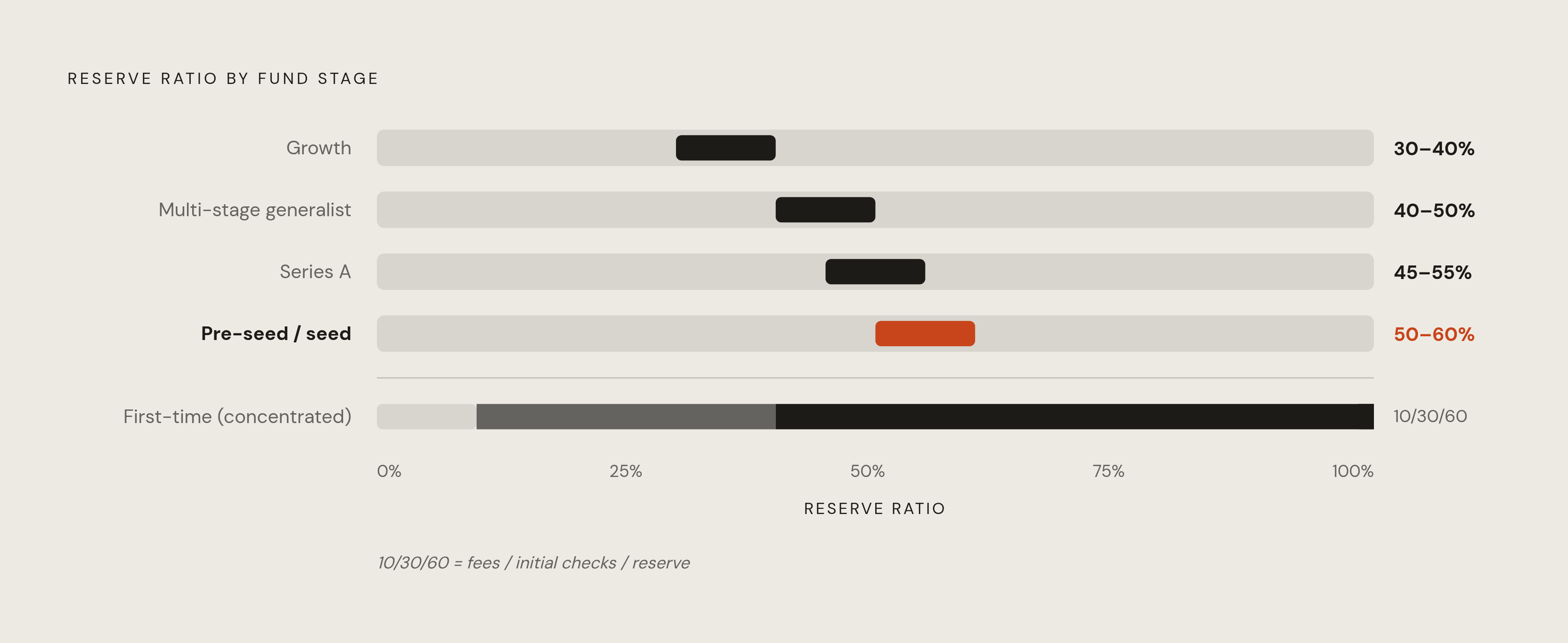
Stage changes the math considerably. Pre-seed and seed specialists sit at the aggressive end of it: Value Add VC's 2026 benchmarks put them at 50% to 60% reserved, with 40% to 50% going into initial checks chasing 15% to 20% ownership. Funds focused on Series A run closer to the middle, 45% to 55% reserved. Multi-stage generalists run leaner, 40% to 50%, because more of the fund goes into initial checks that are already sized to matter, with ownership targets that vary by deal type and stage. Growth funds reserve the least, in the range of 30% to 40%, because the initial checks are already sized to carry more of the work at that stage.
A handful of small first-time funds run something closer to a 10/30/60 split: 10% to fees, 30% to initial checks, 60% held in reserve. That only makes sense in a tightly concentrated portfolio, one making a small number of bets and planning to double or triple down on whichever ones start working. It is not a template for a generalist fund to copy.
Two competing philosophies sit underneath all of this, and they are not equivalent, whatever a pitch deck implies. Percentage-of-fund treats the reserve ratio as fixed at formation, a budget line that can't be quietly raided when a hot deal shows up mid-fund and tempts the GP to overweight it. What's-left flips the order: initial check sizes get set first to hit an ownership target, and whatever capital remains, often somewhere around 40%, becomes the follow-on pool almost by default. The first approach protects discipline. The second protects day-one ownership targets at the cost of that same discipline later, and funds that drift toward what's-left thinking are the ones most likely to discover, two years in, that the reserve pool is thinner than the deck implied. Founders should treat what's-left funds with more scrutiny, not less, precisely because the math bends to whatever deal looks hottest in the moment.
Recent vintage data shows top-quartile seed-heavy funds re-underwriting reserves closer to 55% to 60%, a direct response to round sizes climbing faster than older models accounted for. In dollar terms, a $100 million fund holding 60% in reserve sets aside $60 million for follow-ons and deploys only $40 million into new positions. That ratio is a rough map of how many portfolio companies the fund expects to revisit, and how hard it plans to lean in when it does.
Why rising seed round sizes are squeezing the math that reserve ratios were built on
A reserve ratio built against a $1 million median seed round doesn't stretch to cover the same obligations once the median climbs to $3 million to $3.8 million, roughly where 2025 figures landed, with upper-quartile rounds reaching $5.6 million. The ratio itself might look unchanged on paper. The dollars it needs to cover have moved well past what the model assumed, and that mismatch is the whole problem in miniature.
AI compounds it further. AI-native startups are raising meaningfully larger seed rounds than the rest of the market, and a fund that underwrote its reserve ratio against non-AI baselines finds the gap widest exactly where its best companies live. That's the cruel part: the startups most likely to generate a fund's actual return are often the ones whose follow-on rounds blow past the original model by the widest margin.
Picture a fund that's fully committed on initial checks, holding only residual reserves, when two portfolio companies decide to raise Series B rounds in the same quarter. The fund can't lead either one. That is a central risk. It's the predictable output of modeling reserves against round sizes that existed at fund close rather than round sizes that exist now, and it happens more often than any GP wants to admit at a pitch meeting.
That puts a specific obligation on GPs: re-underwrite the reserve ratio against current round sizes at every new vintage, not the sizes that were true three or four years earlier. It's arguably the highest-leverage modeling exercise a fund can run, and it has to happen before a fundraise, not after commitments are locked. For founders, the lesson is blunt. A fund's vintage year matters as much as its stated ratio. A 2021-vintage fund that set reserves against 2021 round sizes is very likely structurally thinner on follow-on capacity than its pitch deck implies, whatever the GP said across the table when the term sheet got signed.
How the seed-to-Series A gap exposes reserve capacity, and reserve gaps
The seed-to-Series A runway has stretched considerably. Median time between a seed round and a Series A hit 774 days in Carta's 2024 data, a sharp lengthening from the far shorter window typical in 2021. Graduation rates have tightened right alongside it: somewhere between 24% and 27% of seed-funded startups make it to a Series A, and one 2024 estimate put the figure as low as 2% to 5%, down from 15% in 2021.
Extension rounds have become close to standard practice in the meantime. Extension rounds before a priced Series A have become increasingly common, and that shift quietly breaks a lot of reserve math on its own. A fund that reserved for one clean follow-on into a Series A is now, in practice, budgeting for a bridge, then possibly an extension, and only then a Series A participation. That's three draws on a reserve line built for one.
That gap carries a signaling cost that has nothing to do with dollars, and founders underrate this at their own risk. When a seed fund exercises its pro-rata into a Series A, incoming lead investors read that as conviction. When the fund declines, that absence gets read as a warning, fair or not. Whether a fund actually has the reserves to show up at the next round is therefore both a financial question and a reputational one, and the two get tangled together in ways a founder can't easily untangle after the fact.
Pay-to-play terms make the stakes concrete. They have appeared with enough frequency in recent venture financings to register as a structural feature of the current market rather than an edge case. Under a pay-to-play provision, any existing holder that doesn't fund its pro-rata gets converted from preferred stock down to common. Reserve depletion under those terms stops being a fund-side inconvenience and becomes a governance event for the founder, one that can reshape the cap table's balance of power overnight.
What reserve selectivity, not just reserve size, reveals about a fund's actual portfolio conviction
Industry analysis has documented a pattern worth taking seriously: reserves lift a fund's overall multiple when they're deployed selectively into genuine winners, and they drag the multiple down when a fund reflexively exercises pro-rata across the whole portfolio, write-offs included. Selectivity beats size here, full stop. A bigger reserve ratio spent indiscriminately is worse math than a smaller one spent with judgment, and a founder chasing the biggest reserve number on a fund's website is chasing the wrong variable.
That has a direct implication for founders evaluating an offer. A fund that has followed on in only a fraction of its portfolio is concentrating conviction on the companies it actually believes in, and being chosen for that follow-on check is a stronger signal than participation from a fund that follows on into nearly everything. A fund that has never once declined a pro-rata right is demonstrating something other than conviction: habit, or contractual obligation, more likely than judgment. New lead investors at Series A know the difference, and a mechanical yes from a fund that says yes to everyone carries far less weight than a discretionary one from a fund known for saying no when a company isn't working.
Super pro-rata rights complicate the picture further. Some funds negotiate the right to invest up to a multiple of their standard pro-rata allocation in future rounds. Founders who grant these broadly are trading away syndicate flexibility down the line, since every dollar of super pro-rata is a dollar that isn't available to a new investor at Series A or beyond.
A motive sits underneath all of it that's easy to miss: funds use reserves to defend ownership percentages, not simply to be supportive. A fund positioning its reserves to protect a 15% to 20% stake is playing a different game than one merely topping up at 8% to 12%. Knowing which game a given fund is playing tells a founder roughly what check size to expect, and roughly how much room will be left in the round for anyone new.
Reading a fund's reserve posture from public signals before you take a meeting
Vintage is the first and easiest thing worth checking. A fund deep into the back half of its investment period has fewer initial-check slots left to fill, which usually means its remaining reserves are already earmarked for the portfolio it has, not for the company sitting across the table.
Fund size relative to check size tells a related story from a different angle. A $50 million seed fund writing $1 million to $2 million checks across a wide portfolio has structurally different follow-on capacity than a $150 million multi-stage fund writing that same size check. The ratio of fund size to portfolio count is a rough proxy for how much reserve sits behind each investment, and none of it requires asking anyone directly. It's visible from public portfolio pages and fund disclosures.
Portfolio density works the same way. A concentrated portfolio, fewer companies overall, generally means more reserve dollars available per company than a portfolio spread thin across dozens of names. Participation history might be the most honest signal of all: whether a fund has actually shown up for existing portfolio companies in later rounds is trackable through Crunchbase, PitchBook, and Dealroom. A pattern of consistent non-participation across a fund's own portfolio is about as clear a reserve-depletion signal as exists anywhere in public data.
Tools built specifically around investor behavior add another layer. NFX Signal ranks investors using self-reported profile data, founder activity like intro-list additions, connectedness through email-graph analysis, and community upvotes, which gives founders a read on an investor's actual network engagement rather than just the thesis on their website. Cross-referencing that against participation records in Crunchbase, PitchBook, Dealroom, or Harmonic builds a fuller picture before a single meeting happens.
None of that replaces just asking, though. A direct question put to a GP does more work than any amount of public-record digging: what percentage of the fund is reserved for follow-ons, and how many current portfolio companies are already in line for that capital? A GP who answers specifically is telling a founder the fund is in good health. A GP who deflects is telling a founder something too, just not out loud, and founders should weigh a dodge as a red flag rather than an oversight.
How to match your round stage to a fund whose reserve structure can actually support you through the next one
The matching logic is simple to state, harder to act on: a fund's reserve structure has to hold up against not just the round being raised now, but the round likely to come after it. A seed fund that can't exercise meaningful pro-rata at Series A is worth, at most, its initial check and whatever signaling value it carries. That's not nothing, but it isn't a long-term capital partner either, and founders who treat it as one are setting themselves up for a bad surprise at exactly the wrong moment.
Pre-seed founders working with micro-VCs or accelerator-affiliated funds running $10 million to $50 million vehicles will typically find reserve ratios at or above the broad industry range, generous in percentage terms but modest in absolute dollars. Weigh those funds for network access and signaling strength as much as for the capital itself, since the follow-on math, even at a high ratio, is working off a small base to begin with.
Seed founders eyeing a Series A should lean toward seed funds large enough that a 30% to 50% reserve ratio actually translates into a check worth writing when the round comes. Series A rounds landed at a median of $10 million to $12 million in 2025, and a fund's pro-rata check at that stage scales with its existing ownership. A fund holding 20% that tries to maintain that stake pro-rata is writing a large check, one it may not have the reserves for if two or three other portfolio companies happen to be raising in the same window. Only 24% to 27% of seed-funded companies reach a Series A at all, so funds calibrate their reserve deployment around the companies they actually expect to graduate, not the full portfolio they originally backed.
Series A founders assembling a syndicate face a similar sorting exercise, one tier up. Multi-stage generalists run 40% to 50% reserves against fund vehicles large enough that the absolute dollars behind that ratio are real, giving them genuine capacity to lead a Series B or beyond. Series A specialists like First Round Capital, which typically leads at $500,000 to $10 million and focuses mainly on seed with occasional Series A activity, or True Ventures, among others leading at the lower end of the Series A range, are built to be excellent at the A specifically. Their reserve capacity at Series B is thinner, so the value they bring shows up in board expertise and network rather than in a large follow-on check down the line. Corporate VCs such as Salesforce Ventures, Microsoft's M12, or Google Ventures generally participate at $2 million to $10 million-plus in follow-on rounds, but the primary value there is strategic. Capital continuity comes second, and founders who expect otherwise are misreading what a corporate check is actually for.
Running a competitive process with multiple term sheets in play still gives founders leverage on valuation and terms, and that leverage is worth using without apology. But when two offers look similar on economics, reserve posture is the tiebreaker that actually predicts what happens eighteen months out, not the headline valuation. Series A dilution has already improved for founders, dropping to 17.9% in 2025 from 20.9% the year before, a sign that well-positioned founders are extracting better terms across the board. Reserve-aware targeting is what turns a single take-it-or-leave-it offer into a real competitive process in the first place.
The broader pattern here is hard to miss. In 2025, 33% of all US VC dollars went to the top 1% of companies by valuation. Reserve capital doesn't spread evenly across a portfolio: it flows toward that same narrow, concentrated set of winners, following conviction rather than obligation. Founders who understand how reserve ratios actually get built, spent, and depleted have a real shot at identifying which funds are positioned to be part of that flow, and at making the case to those funds before the round closes, not after the money has already gone somewhere else.
Sources
- Top Series A Venture Capital Firms — 2026 Guide
- Stages of VC Funding: Cap Table & Dilution at Each Round
- Startup Funding Rounds: Pre-Seed to Series C Numbers
- Reserve Ratios in VC Funds: How Much to Hold Back for Follow-Ons in 2026
- thefundcfo.substack.com
- medium.com
- Rethinking Follow-On Investments in Seed-Stage VC Funds
- goingvc.com