Sourcing Proprietary Investor Data Beyond Crunchbase and PitchBook
Four platforms reveal which investors are actively deploying capital right now.

Crunchbase and PitchBook tell you who invested in whom, at what stage, and roughly when. Neither tells you whether that fund is still writing checks, whether its stated thesis matches where it's actually deploying capital, or who at that fund picks up the phone for a warm introduction. Founders raising competitive rounds figured this out a while back: the funding announcement layer is the floor. The ones who raise well have quietly built sourcing habits that go past the two default databases, and that broader stack is what this piece maps out.
Harmonic sits ahead of the announcement cycle by receiving routine portfolio updates directly from investors, surfacing deployment activity before any public filing or press mention appears. For sub-sector matching, Tracxn maintains thousands of human-curated taxonomies that surface funds with concentrated exposure to a specific vertical rather than a broad category label. Dealroom runs deeper than US-built platforms for European pre-seed activity, and CB Insights lets a founder reason from what a fund's actual portfolio companies raised to test whether a fund is still writing early checks or has quietly drifted up the risk curve. NFX Signal fills the angel and emerging manager gap: free, community-maintained, and a solid discovery layer for investors who never surface in institutional databases at all.
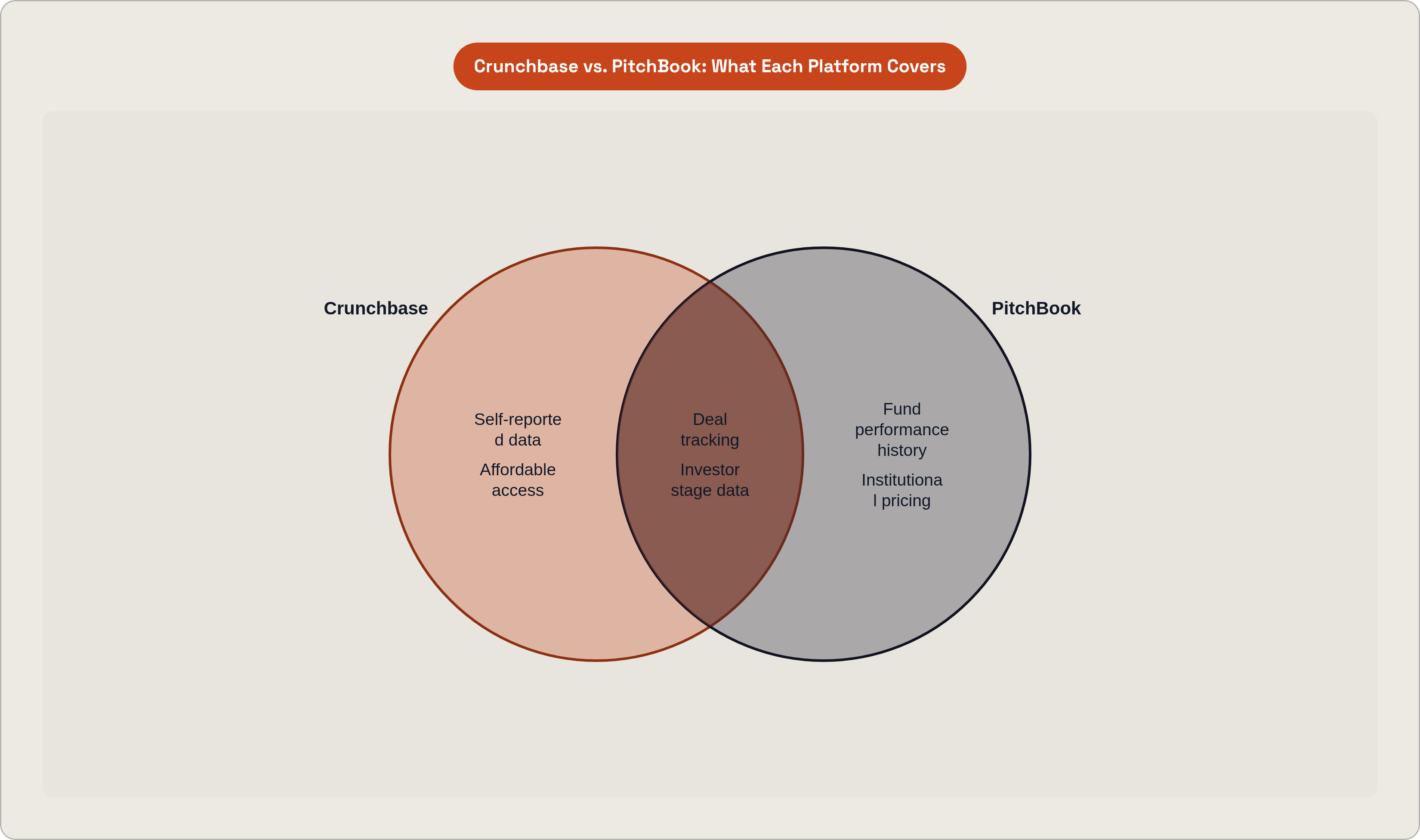
Crunchbase leans on self-reported and crowd-submitted data. Fine for a first list of names, but it falls apart the moment you need fund performance history or a real read on relationship structure. PitchBook fixes some of that, and it's priced for institutions accordingly. Even there, though, LP-level profiles are some of the last records anyone bothers updating. So you end up with the familiar founder problem: two hundred rows in a spreadsheet, no way to tell which twenty of those investors are actually deploying, at what pace, into a thesis that resembles your company. Outreach goes wide because the targeting data is shallow, and it converts about as well as you'd expect. Investors have spent years building proprietary sourcing infrastructure to find companies before anyone else does. Founders show up to the first meeting already behind on data.
What investor data sources can founders use to find out which funds are actively deploying capital right now?
A press release about a past deal tells you almost nothing. What matters is whether a fund is actively deploying right now or sitting in harvest mode between vintages, whether its stated thesis is drifting toward a category or quietly away from it, and whether its stage and check-size claims hold up against what its last six portfolio companies actually raised. Maybe most important: who its partners actually know, because that decides whether an introduction is one phone call away or five.
None of that sits in one place. Deployment pace shows up in hiring data and portfolio company timing. Thesis drift shows up when you compare a fund's website copy against its last twelve months of real deals. Relationship structure lives in calendars, email threads, whoever introduced whom on the last round that closed. No single platform pulls all four together, so investor research has to run as a layered stack rather than a subscription you buy once and forget about. The founders who raise well build that stack the way institutional investors build their own sourcing pipelines: several sources, cross-checked against each other, refreshed constantly instead of pulled once at the start of a raise.
Early-stage discovery before a round closes: Harmonic and the pre-announcement layer
By the time a database indexes a funding round, the check has cleared and the relationship is months old. Harmonic sits on the other side of that timeline. It gets routine portfolio updates directly from investors, so it sees companies before they've filed anything public or landed a press mention. It also tracks founder movement between jobs, key hires, domain registrations: the low-grade noise that tells you a fund has already formed conviction about a company well before that conviction becomes an announcement.
Harmonic crossed a multibillion-dollar valuation in 2025, which is about as clear a signal as you'll get that pre-announcement sourcing has become core infrastructure for how funds find deals in the first place. For a founder, the reverse use case matters more. Harmonic lets you see which investors are paying attention to your category right now, rather than leaning on a logo from three years ago that may no longer reflect where that fund's head actually is. Scout, Harmonic's AI research agent, turns raw signal into a structured read on a fund's current portfolio. That's how you confirm a target investor is live in your space today, not just once was.
Regional depth and ecosystem mapping: Dealroom and Tracxn for non-US markets and sector specificity
Dealroom's coverage of Europe runs deeper than most US-built platforms, particularly at pre-seed, where a lot of activity never surfaces in databases built around the American funding announcement cycle. It keeps curated ecosystem maps with a strong lean toward deep tech and impact investing, useful for reading investor sentiment in those categories, and it's priced well under PitchBook if you don't need the full US institutional dataset.
Tracxn is built around sector granularity instead of raw company count. It maintains thousands of sub-vertical taxonomies, curated by human analysts rather than pure algorithmic tagging, so a founder can search at the resolution their market actually operates at instead of a broad label like fintech or healthtech. That distinction matters more than it sounds. A fund with concentrated exposure to, say, embedded insurance for logistics companies is a far stronger fit signal than a fund that's simply "done a few fintech deals." Dealroom for European mapping, Tracxn for sub-sector matching; together they surface fit that the broad, US-centric platforms miss by default.
LP-level intelligence and fund structure data: Preqin and CB Insights as due diligence tools
Almost no founder looks at who backs the fund they're pitching. Most should. The composition of a fund's LP base shapes what that fund is actually allowed to do with your round, and on what timeline, whether the partners across the table realize you know that or not.
Preqin, now owned by BlackRock, pairs its dataset with institutional portfolio management infrastructure, which says something about where private market data is headed generally. For founders, the real use is LP-level benchmarking: knowing the type of LPs behind a fund tells you a lot about its return expectations and how patient its capital actually is. In 2024, Term Intelligence launched as one of the largest searchable databases of Limited Partner Agreement terms anywhere. Worth a look when you want a sense of the governance and reporting commitments a fund typically extracts from the companies it backs.
CB Insights takes a deal-level look-through instead. Rather than trusting a fund's self-reported track record, you reason from what its actual portfolio companies have raised and at what valuation. Did the fund write a seed check in the last year, or has it quietly drifted up the risk curve toward later, larger rounds while still marketing itself as early-stage? A fund navigating a hard LP environment may deploy slower, or feel pressure to mark up existing positions instead of writing new checks. Either reality changes how and when you approach them.
Relationship graph intelligence: mapping the warm path to any investor
Warm introductions convert to meetings at a far higher rate than cold outreach, and that gap is structural, not a matter of politeness. Most founders don't actually know what warm paths exist until they map them on purpose instead of relying on memory, which is a bad way to run something this important.
Affinity's relationship intelligence layer pulls data automatically from emails, calendars, and meetings to surface the warmest available path to a given investor, so a founder isn't manually reconstructing who knows whom from old email threads. Affinity's own analysis across thousands of VC firms in multiple countries found that top-performing firms made meaningfully more introductions year over year than their peers, which suggests introduction volume is itself a decent proxy for how active and connected a fund actually is. The tool was built for VCs first. Sophisticated founders now use it the same way, as a CRM and warm-path map rolled into one.
NFX Signal fills a different gap entirely. It's free, crowd-sourced, and backed by a large, active community that keeps investor profiles current, which makes it a solid discovery tool for angels and emerging managers who never show up in institutional databases. Quality varies, because it's community-maintained, so treat it as a discovery layer rather than a source of truth on fund-level detail. An introduction from an existing investor in your round still carries more weight than a message from a second-degree LinkedIn connection, because the introducer's own reputation is on the line either way. Find the path first, then confirm through fund-level data that the investor is actually active and relevant before you spend that introduction on someone who's stopped writing checks.
Cross-referencing public and private signals: where S&P Capital IQ, Koyfin, and registry-sourced data fit
Some of the sharpest investor intelligence comes from comparing what a fund says about itself against what the underlying data shows. S&P Capital IQ, FactSet, and Koyfin matter most when your target investors also have public market exposure or crossover activity; they let you track a portfolio company's performance across public and private markets in one view. Koyfin in particular is a cheaper bridge for founders who want that cross-market view without paying institutional prices for it.
Registry-sourced databases, Global Database among them, pull directly from official government filings: company formation records, ownership structures, filing histories that scraping-based platforms simply can't reach. That's especially useful for confirming a fund's actual legal entity structure when its listed registration doesn't match what a broader database shows. No single source should be trusted alone for a decision this consequential. The value of cross-referencing is catching the error, the stale profile, the entity that got renamed two years ago and never got updated everywhere else.
How to assemble a working intelligence stack without institutional resources
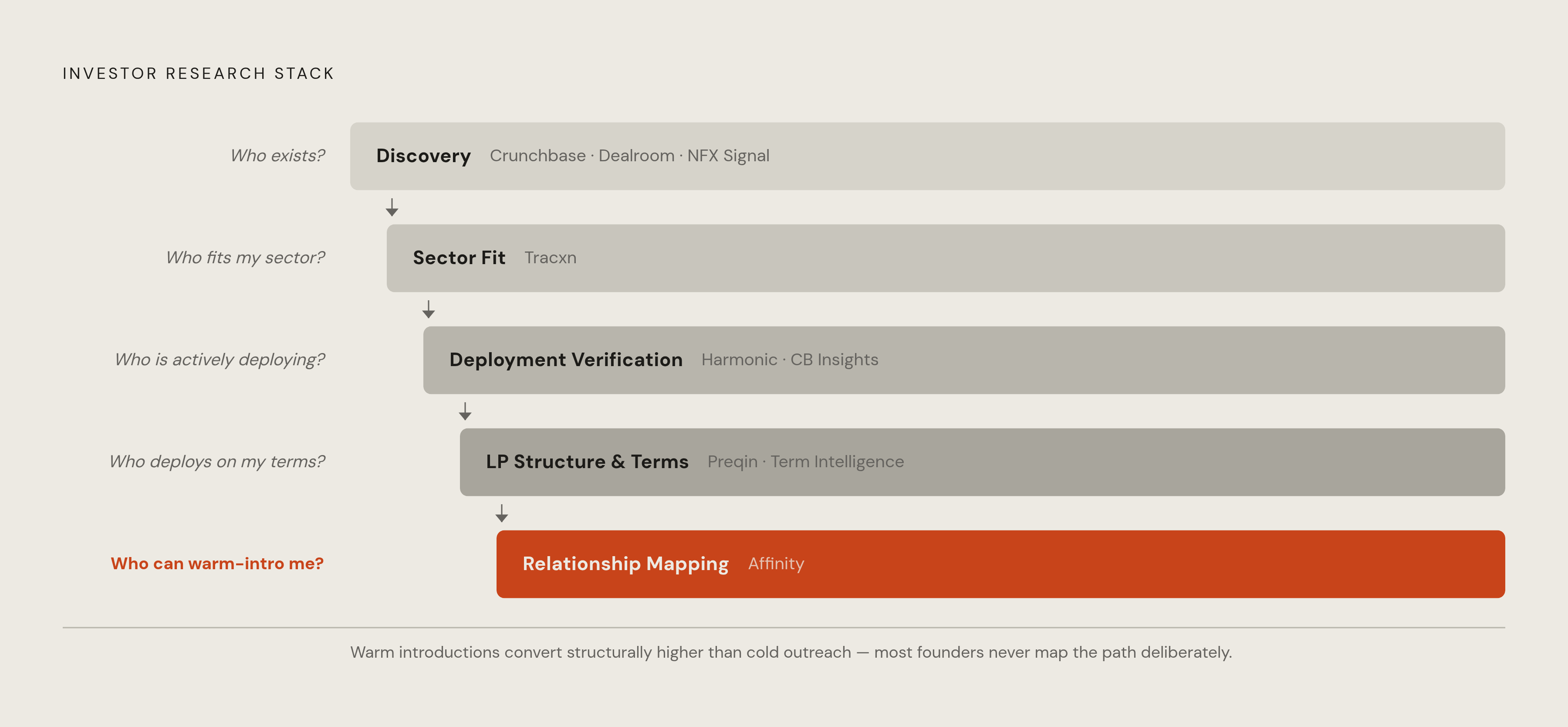
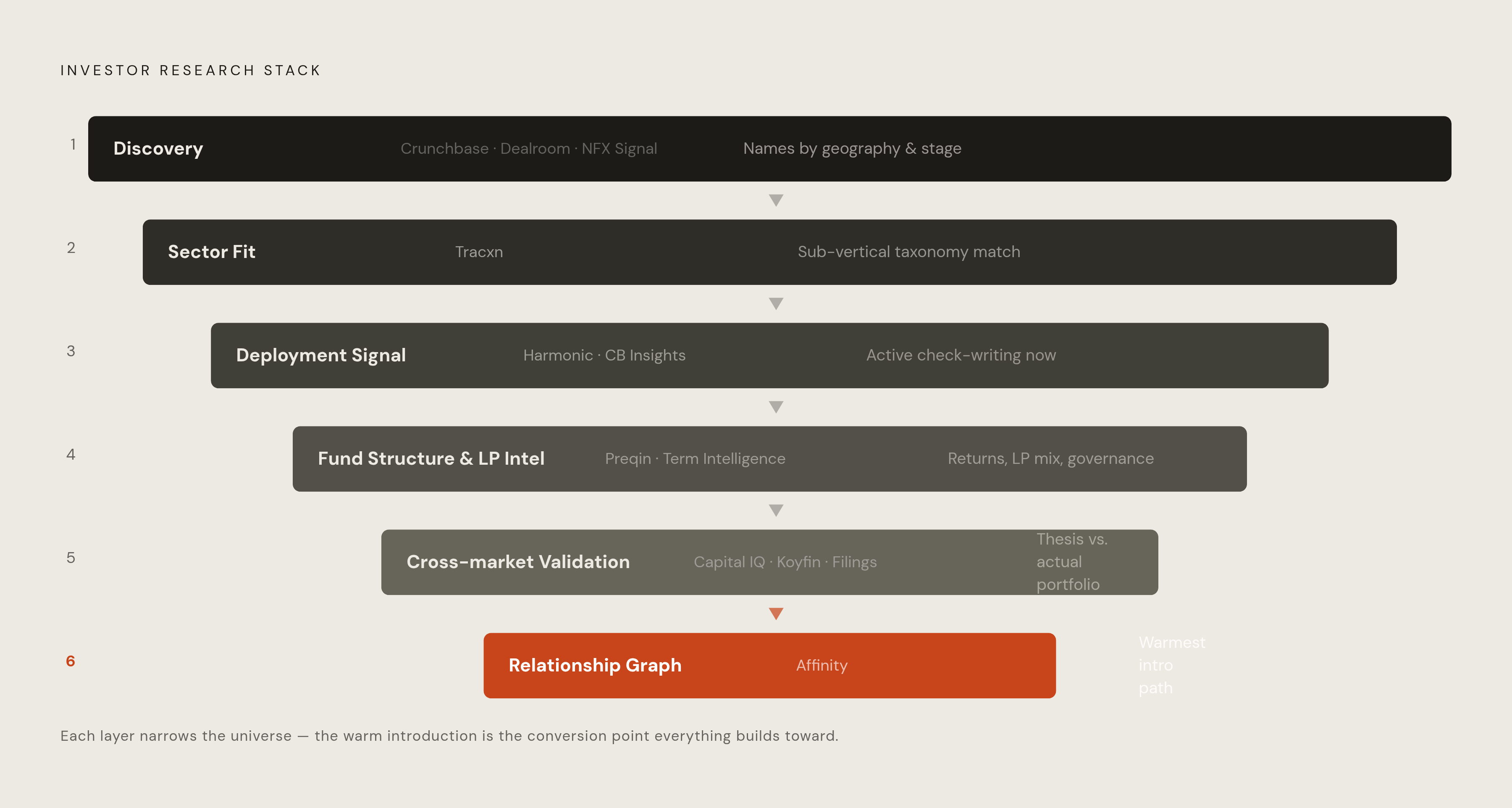
Most serious funds run at least two platforms side by side: a broad tool for finding names in the first place, a deeper layer for thesis validation and portfolio tracking. Founders raising a competitive round should copy that structure instead of reinventing it from scratch.
A working stack looks something like this. Crunchbase or Dealroom for discovery, depending on geography, plus NFX Signal for angels and emerging managers who won't show up anywhere institutional. Tracxn for sector fit, CB Insights for checking whether a fund's portfolio actually matches its pitch, Harmonic for a read on how recently a fund has deployed. Preqin when you're raising from institutional funds and need LP structure and term norms, registry sources for ownership verification. Affinity or something comparable for the relationship layer: mapping warm paths, tracking pipeline, pacing outreach so it doesn't all land in the same week.
A newer crop of AI-native fundraising tools is starting to fold several of these layers into one workflow, combining investor search, meeting intelligence, and outreach automation so a founder isn't reconciling five browser tabs by hand. Worth watching. It still depends on the same discipline underneath it, though: better data only compounds if someone is actually deciding how targets get ranked, when outreach goes out, and to whom first. The founders who raise well, in my experience, treated the search itself as a research problem and kept updating it past week one, past the first no, past the point where everyone else just starts blasting the same fifty names.