Tracking Investor Engagement Signals During an Active Raise
A framework for distinguishing genuine investor interest from polite rejection during fundraising.

A founder running an active raise in 2026 is typically managing more than fifty simultaneous investor conversations at once, and intuition alone cannot tell which three of them actually have momentum. The average fundraising pipeline contains 52 investors, so a founder is triaging dozens of relationships at once, often in parallel, often at different stages of interest. Without a disciplined way to read engagement, that triage happens by feel, and feel is an unreliable instrument when the stakes are this high. The rest of this piece works through a hierarchy for reading investor engagement signals accurately, because founders who learn to read it correctly can prioritize the right conversations, time their follow-ups with precision, and avoid the costly mistake of mistaking polite momentum for real conviction.
The signal hierarchy: how to rank engagement from deck opens to diligence requests
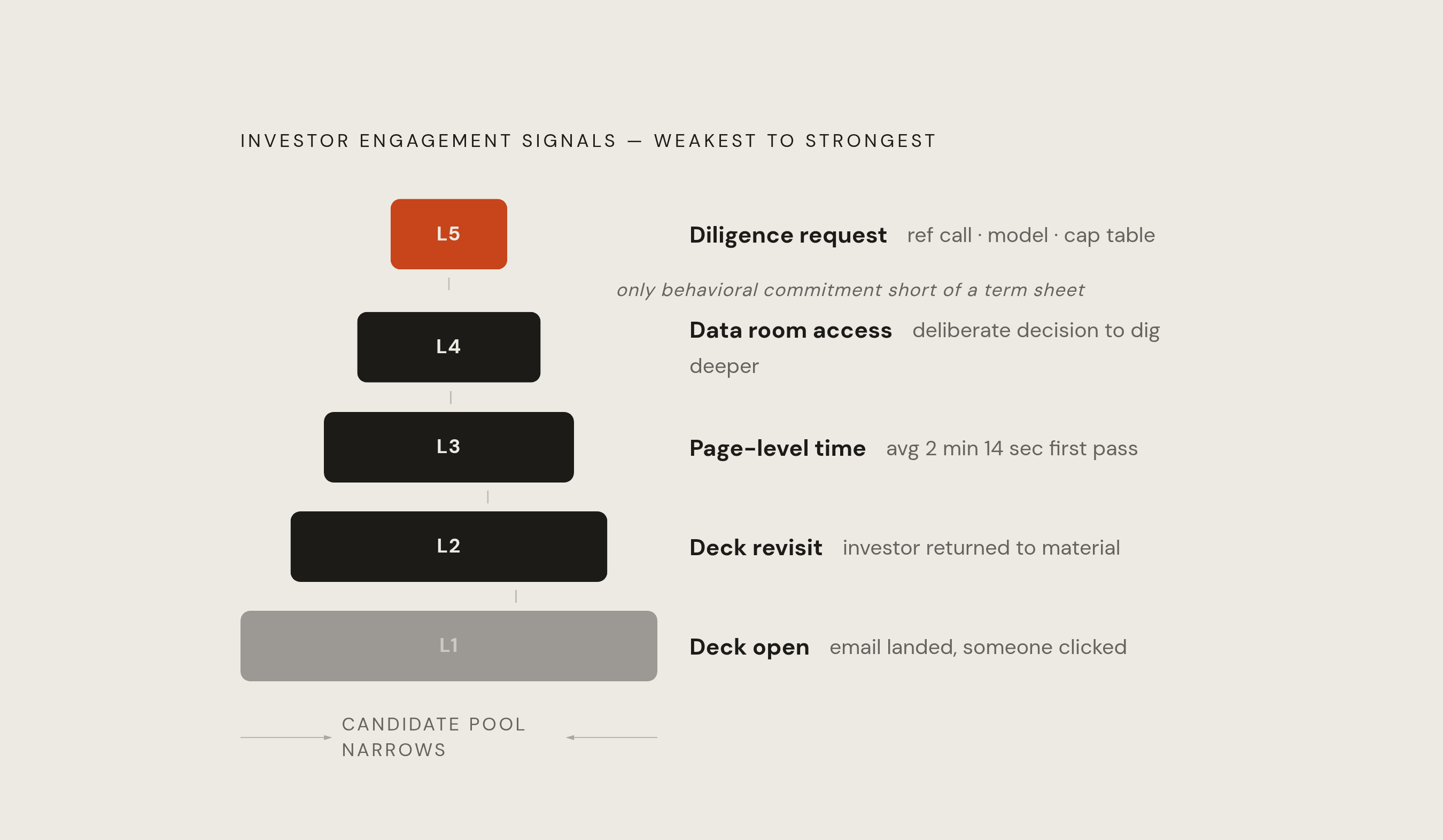
Engagement signals are not interchangeable, and treating them as one undifferentiated category of "interest" is the first mistake a founder makes when managing a large pipeline. A useful hierarchy starts at the bottom with the weakest signal and builds toward the strongest, with each level requiring more deliberate action from an investor than the one before it.
The first level is a deck open. It confirms an email landed and someone clicked, but a single open tells you almost nothing about conviction. The second level is a deck revisit. A return visit means something caused the investor to come back to the material, and multiple document views are a meaningfully stronger indicator of serious engagement than a single view ever is. The third level involves page-level time signals, the kind of analytics that show whether a partner is spending time on the financial model or simply skimming through the cover slides. Time spent on financials versus time spent on a title page is qualitatively different information about where an investor's actual concerns lie. Investors average two minutes and fourteen seconds on a first pass through a deck, and the first four slides typically capture the majority of that attention, so noticing where a particular investor deviates from that pattern, lingering on unit economics or the cap table slide, tells you something specific about what they're evaluating.
The fourth level is data room access. A founder who has shared a permissioned data room and sees a partner return to it twice holds a meaningfully stronger signal than any number of deck opens could provide, because data room access requires a deliberate decision to dig deeper rather than a passive click. The fifth and final level is the diligence request, whether that takes the form of a reference call, a request for model access, or a cap table review. This is the clearest behavioral commitment available short of an actual term sheet.
The hierarchy matters because each level narrows the candidate pool. A founder who collapses all five levels into a single undifferentiated bucket labeled "showed interest" has no way to prioritize correctly. The hierarchy is a working framework for triage. Every signal still needs to be read in context, which is exactly the caveat the next section takes seriously.
Silence and slow responses: what they mean and don't mean
Engagement data gives a founder context for deciding what to do next. It does not give certainty about what an investor actually intends, and confusing those two things produces worse decisions than having no data at all would. The instinct to over-read small variations in engagement data is one of the most common ways founders sabotage their own judgment during a raise. A deck opened for a slightly shorter window than expected is not evidence of anything specific, and treating it as a signal invites a founder to build a narrative on top of noise.
Venture capital investors rarely deliver a direct no. "Let's stay in touch" functions as a soft rejection in the vast majority of cases, and founders who read it as a live opportunity rather than a closed door tend to waste weeks chasing a conversation that ended the moment that phrase was used. The same discipline applies to silence. When a deck has been sent and there have been no re-opens by the two-week mark, the probable read is a soft pass. The correct response is a clean, well-timed follow-up rather than an assumption that interest is still alive and simply slow to materialize.
The risk runs in both directions. Treating ambiguous politeness as real conviction causes a founder to over-invest attention in conversations that have effectively already closed, and that attention comes directly at the expense of the conversations still genuinely open. Reading the hierarchy well means resisting the pull toward hope on one side and paranoia on the other. A disciplined founder treats silence as information about probability, updates the pipeline accordingly, and moves on to the next action rather than spiraling over what a particular non-response might mean.
Follow-up timing and cadence by hierarchy level
Once the hierarchy is established as a diagnostic tool, it becomes an operational one, because where an investor sits in that hierarchy should directly determine how often a founder reaches out. There is no single correct follow-up interval. The right cadence depends on the level of engagement an investor has demonstrated, and getting that calibration wrong in either direction costs momentum.
Hot prospects, meaning investors who have reached level three or above in the hierarchy through page-level engagement, data room returns, or diligence activity, need contact roughly every two to three days to sustain the momentum already built. Warm prospects, still earlier in the funnel, warrant a weekly or biweekly cadence instead. Managing that differentiation manually across a large pipeline is where most founders break down and start treating every relationship with the same generic rhythm. The trigger for a follow-up should often be the re-engagement event itself rather than a fixed date on a calendar. A deck revisit is the signal that should prompt outreach, not an arbitrary weekly reminder.
A related tactic compresses the entire first-meeting phase of a raise into a tight window, often two weeks, so that every investor arrives at a decision point at roughly the same time. Running all first meetings within the same two-week window is a signal-management technique as much as a scheduling one, since forcing simultaneous decisions creates competitive urgency by forcing all investors to the same decision point simultaneously.
Most investor conversations require more than one touchpoint to convert into a meeting, a data room share, or a term sheet. A founder who sends a single follow-up and then waits is effectively making the decision to walk away on the investor's behalf, whether or not that was the intent. But persistence has a ceiling. One limited partner reported being blacklisted by a firm after that firm sent fourteen follow-ups within a single month, a clear illustration that over-follow-up burns relationships as reliably as under-follow-up lets them go cold. Cadence calibrated to the hierarchy is the discipline that sits between those two failure modes.
Why a purpose-built pipeline tool produces signal a spreadsheet or CRM can't
The cadence discipline described above is only possible at scale with the right infrastructure behind it. A spreadsheet can record who was contacted and when, but it cannot surface in real time which conversations are cooling off, and it cannot flag the exact moment a deck revisit should trigger a follow-up. That gap comes from how the tool is built rather than from how carefully a founder maintains it.
The average fundraising pipeline contains 52 investors, and free or improvised tracking methods, whether a spreadsheet or a repurposed sales tool, tend to stop working reliably somewhere around 20 active relationships. That threshold sits well below what a typical raise actually requires. A sales CRM is built to track deals a company controls at every stage. A venture raise runs on relationships still being earned, and the stages that matter (researching, contacted, first meeting, diligence, committed, passed) do not map cleanly onto a sales funnel built for closing deals a company already has leverage over.
A purpose-built investor CRM does several things a sales CRM cannot: it ships with fundraising-specific pipeline stages already built in, it sends native investor updates, it hosts a permissioned data room, it tracks engagement at the deck level, and it connects that engagement data to a live metric dashboard, all inside one system rather than stitched together across several tools. One example of this category, Pipeline Formation, tracks investor status, next steps, and pipeline health in real time, organized around the actual cadence of a venture raise rather than a sales quota. The engagement tracking layer is what closes the loop between diagnosis and action. Seeing which investors reopened a deck or returned to a data room requires infrastructure a spreadsheet lacks, and that visibility is what makes the cadence calibration described in the previous section operational rather than aspirational.
How investor-side intelligence sharpens follow-up content
Knowing that an investor reopened a deck tells a founder when to reach out. Knowing what that investor has published, funded, or said publicly in recent weeks is what makes the follow-up worth reading once it arrives. The mistake many founders still make is sending an identical deck and an identical follow-up message to every top-tier firm on a list, as though all investors were evaluating the same thing. Each firm tends to look for a distinct signal, whether that's market validation, founder immersion in the problem, or evidence of a defensible moat, and a generic pitch earns a polite pass from all of them for the same reason: it demonstrates no specific understanding of what that particular investor cares about.
Investors who are actively engaging with a specific space tend to leave a public trail, through podcasts, blog posts, and social commentary, and surfacing that activity lets a founder reference an investor's recent public statements in a way that signals genuine alignment rather than generic flattery. A follow-up that references an investor's recent public statements reads as personalized, while one that doesn't reads as templated. The 2026 investor environment has been trained, after years of exposure to AI-generated outreach, to recognize generic messaging almost instantly. A follow-up that references something an investor actually said or did recently reads as a signal of seriousness precisely because it could not have been produced by a mail-merge.
This works because investors themselves are running sophisticated, data-driven sourcing operations. Tools like Harmonic index founder activity, talent movement, hiring signals, and early traction indicators to help investors find companies before a founder ever sends an email. Investors have built real intelligence infrastructure aimed at founders. Founders who build equivalent intelligence aimed at investors, tracking thesis signals, portfolio activity, and public statements with the same rigor they apply to their own deck analytics, close an information gap that would otherwise run entirely in the investor's favor.
Reading engagement signals after Demo Day, when momentum has a short half-life
Demo Day compresses the entire signal-reading framework into its most extreme and time-sensitive form. It produces a sudden spike of first-level engagement signals across dozens of investors simultaneously, and those signals decay fast. The founders who close rounds coming out of a Demo Day are the ones who can distinguish genuine interest from ambient excitement within the first few days, before that excitement fades on its own.
Most of the meetings that end up mattering get booked within 72 hours of the pitch. Every investor who opened a deck or asked a question during the event is, at that moment, at peak engagement, and that peak does not last. The same hierarchy applies here as everywhere else in the raise, just compressed. A deck open from a Demo Day contact in the first day or two is still only a level-one signal. If that same investor reopens the deck on day four or five, they have moved to level two, and that move should trigger contact before the week closes rather than after.
A workable post-Demo Day cadence follows a specific rhythm: tailored follow-ups shortly after first contact, second meetings scheduled within a few days of that follow-up, and a one-week review point where updated metrics and narrative learnings get folded back into the pitch. A short weekly investor update serves a dual purpose in this window. It keeps contacts who have gone quiet from going fully cold, and it generates new engagement events, new opens, new replies, that refresh the entire signal picture rather than leaving a founder guessing based on stale data. Continuing to build visibly during the raise, closing a customer, shipping a feature, hitting a milestone, gives every follow-up a fresh and legitimate trigger. "Since we last spoke, we just did X" re-engages a quiet investor without requiring a bare ask for a decision, and it works because it gives the investor new information rather than simply asking them to revisit old information faster.
The failure modes: what founders get wrong when they over-rely on engagement data
Engagement data sharpens judgment. It does not replace it, and founders who treat it as a substitute for judgment make specific, predictable, and avoidable errors.
The first failure mode is treating engagement as commitment. A deck opened five times by a junior associate doing preliminary screening is not the same signal as a general partner returning repeatedly to review a financial model in depth, and overanalyzing small differences in engagement data produces false confidence rather than genuine insight. The volume of activity matters less than who is generating it and why.
The second failure mode is prioritizing engaged investors over right-fit investors. Engagement signals should sit on top of thesis fit as an additional layer of information, not stand in for it. A highly engaged investor whose thesis does not actually match the company remains the wrong conversation to keep optimizing, no matter how many times that investor has opened the deck or how long they've spent on the financial model. Chasing engagement for its own sake, detached from whether the underlying fit exists, leads founders to pour time into relationships that were never going to convert regardless of how warm they appeared on a dashboard.
The third failure mode involves letting automation strip out the founder's own voice. Signal tracking and cadence tools exist to sharpen where and when a founder shows up, not to generate the substance of what gets said once they do. A follow-up triggered by the right signal at the right moment still needs to carry something specific: a reference to a milestone, a direct answer to a question raised in the last conversation, an acknowledgment of something the investor said publicly. The hierarchy, the cadence rules, and the tooling behind them exist to put a founder in front of the right investor at the right moment. What happens in that moment still depends on judgment, context, and a clear sense of which conversations deserve the effort.
Sources
- How to Automate Investor Follow-Ups and Track Outreach During a Raise in 2026 | Metal
- The Best Investor CRM for Startup Fundraising (2026 Data & Comparisons) - Visible.vc
- Startup Fundraising Strategy in 2026: The 6 Decisions That Determine Your Outcome — Peony
- Investor Signals: How to Read Investor Interest | BFunded