CRM Setup for Managing a Venture Fundraising Pipeline
A purpose-built fundraising CRM prevents momentum loss across your investor pipeline.

Setting up a CRM for a venture raise is not a contact management exercise. It is the construction of operational infrastructure meant to keep a high-velocity process from bleeding momentum, and the decisions made at the outset decide whether the pipeline that results actually closes. This piece walks through how to configure and run that system, from the first investor entered to the term sheet that ends the search.
Venture fundraising does not behave like a sales cycle, whatever the surface resemblance. A first contact, a partner meeting, a term sheet, and a close are categorically different events, governed by different psychology and different timelines, and forcing them into a generic pipeline template flattens distinctions that founders need to see clearly.
The mechanics of momentum matter here too. A warm introduction that sits unanswered for a week is often a warm introduction that has gone cold, and a standard sales CRM has no built-in mechanism to flag that decay, because it was never designed to track the half-life of a relationship. When investor research lives in one tool, outreach tracking in another, and meeting notes in a third, there is no single moment at which a founder can look at the system and know, with confidence, where the round actually stands.
That fragmentation has a predictable failure pattern. Most founders begin with a spreadsheet, or a repurposed HubSpot account left over from an earlier sales motion, and this works fine at first NYU Entrepreneurship cited in StartupAge. Then it doesn't. Data drawn from Visible shows this approach starts visibly breaking down at around 20 active investor relationships, the point at which manual tracking can no longer keep pace with the volume of conversations in flight NYU Entrepreneurship cited in StartupAge. The average fundraising pipeline tracked on Visible's platform holds 52 investors, which in practice means 52 first meetings to chase down, 52 follow-ups to time correctly, and 52 separate threads of notes and partner dynamics to hold in memory at once Visible.vc. Managing that by hand is a structural failure point that catches even ambitious founders. It is, structurally, how rounds fail Visible.vc.
None of this is a case for buying software for its own sake. The setup choices, which stages exist, which fields get tracked, which signals trigger action, are infrastructure decisions rather than administrative housekeeping, and they decide whether a pipeline's momentum compounds over the course of a raise or leaks away one missed follow-up at a time.
What the real scale of a fundraise demands from any system
Consider the arithmetic first, because it reframes everything that follows. That funnel is the real shape of a raise, and it means a founder is running a high-volume, multi-stage process in parallel, not a handful of sequential conversations that happen to overlap.
It also runs long.
The current market adds urgency to getting this right. Global startup funding reached $510 billion in the first half of 2026, Crunchbase reports, yet deal counts fell over the same period even as late-stage deal value rose 45% year-over-year Forbes - The State of Venture Capital in 2026 NYU Entrepreneurship cited in StartupAge. That is a barbell market, with capital concentrating heavily at the top, a great deal of activity at the earliest stages, and a quieter, more selective middle where most founders actually operate. Investors are writing checks with more scrutiny, concentrated on fewer companies Forbes - The State of Venture Capital in 2026 NYU Entrepreneurship cited in StartupAge.
For CRM setup, the implication is blunt: volume alone does not win a raise anymore, if it ever did. The system a founder builds needs to support precision targeting of investors, not just the logging of contact attempts. Seed rounds typically take 3–6 months of active fundraising and Series A takes 3–9 months, so the system has to hold up across that entire arc Y Combinator. At 50–150 active investor conversations, tracking conversation stage, last touchpoint, and follow-up cadence in a spreadsheet becomes operationally unmanageable, so the platform must consolidate contact records, intro tracking, meeting notes, and follow-up cadence in one structured view Angel Investors Network Fungies.
Choosing the right CRM foundation for your raise
The evaluation criteria that matter here are not the generic benchmarks a procurement team would apply to enterprise software. What matters is whether the platform ships fundraising-specific pipeline stages out of the box rather than forcing a founder to rebuild a sales template from scratch, whether it surfaces warm introduction paths through existing relationships, whether it tracks investor engagement signals like deck opens and data room views so outreach can prioritize itself, and whether it supports the ongoing rhythm of investor updates that keep prospects warm between meetings. Pricing matters too, and specifically pricing built for an individual founder rather than a VC firm's multi-seat license.
Visible.vc runs on a freemium model that starts at zero cost and includes a working investor pipeline, monthly updates sendable to up to 100 investors, two pitch decks with open analytics, KPI dashboards, and access to its Visible Connect investor network, with paid tiers running roughly $29 to $149 a month WaveUp. Its own data on pipeline size, the 52-investor average cited earlier, comes from usage across its platform, and it tends to suit founders who want a tool that carries them past the close into ongoing investor relations rather than one built to be discarded at term sheet WaveUp Visible.vc.
Other platforms occupy adjacent lanes and deserve understanding on their own terms. Some tools that expanded investor database functionality and fundraising workflow automation through 2025 and 2026 cover investor tracking, fundraising dashboards, update management, and document organization built specifically around the startup fundraising motion NYU Entrepreneurship cited in StartupAge. Affinity, by contrast, carries a genuinely strong relationship intelligence layer, but it is priced and built for venture firms managing deal flow at scale, not for a founder running a single raise, and it makes the most sense for a founder already embedded in a firm's existing ecosystem. HubSpot remains a capable general sales CRM, and a determined founder can bend it toward fundraising use, but doing so demands heavy customization, and every investor-specific workflow ends up living in a separate piece of software. Stitching those systems together causes missed follow-ups and a contact record that never quite tells the whole story.
There is no single right answer across every stage and situation. The right choice depends on how far along the company is, how deep the founder's existing network runs, and how much of the raise lifecycle the founder actually wants the software to carry. A pre-seed founder working a list of 40 angels needs meaningfully less infrastructure than a Series A team running a structured process across 100 institutional investors. What is clear is the direction of the market: one estimate values the broader category of startup pitch deck and investor CRM platforms at $15.8 billion by 2032, a number that signals founders increasingly expect software to do more of the actual work of a raise, not simply store contacts Angel Investors Network WaveUp NYU Entrepreneurship cited in StartupAge Intel Market Research cited in Gritt.
Building the pipeline stage architecture before adding a single investor
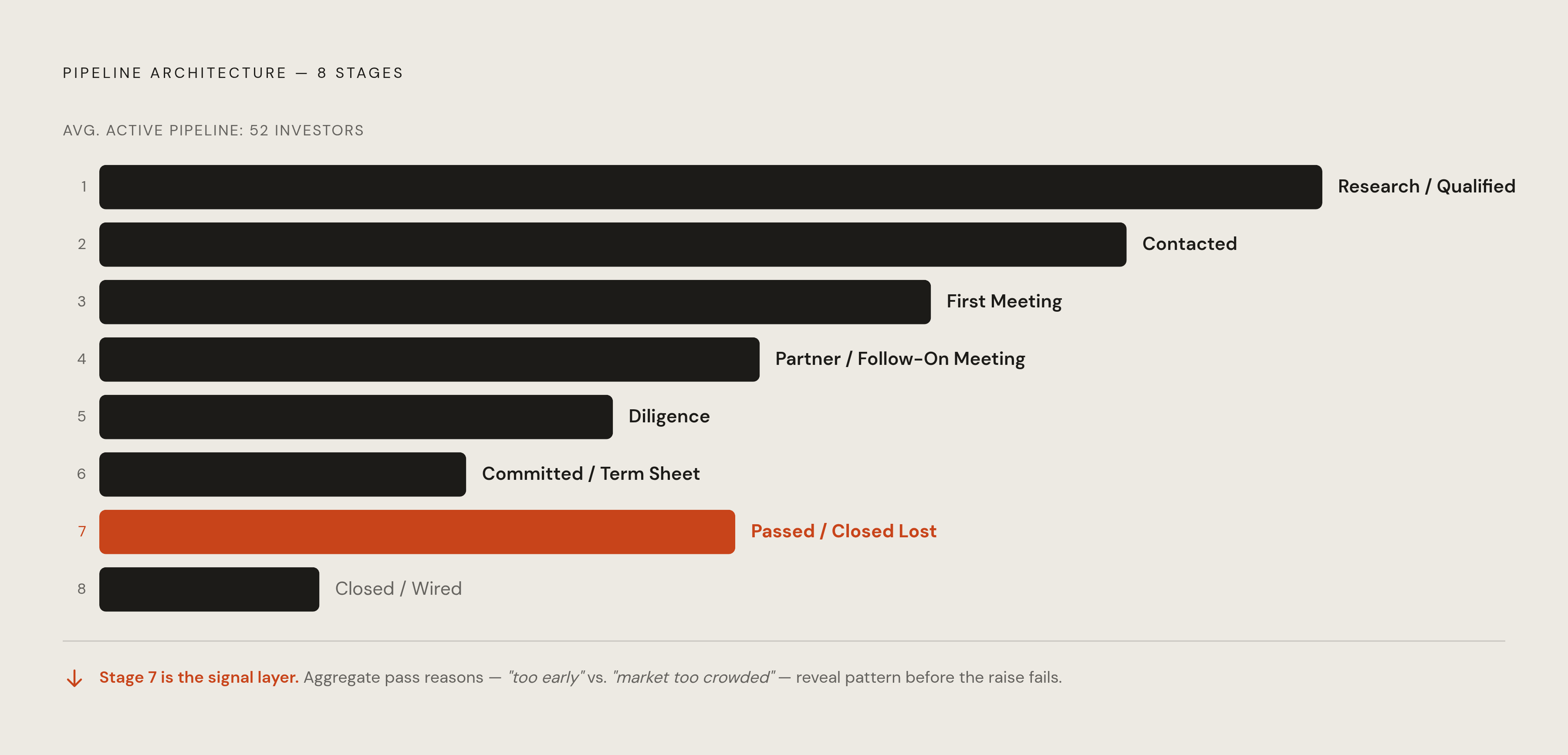
The single most consequential configuration decision, made before a single investor name is ever entered, is choosing stages that mirror how a venture round actually moves rather than borrowing the shape of a sales cycle. Nothing should enter the active pipeline until that verification is done, because unvetted names dilute a founder's attention later.
From there, Contacted marks the point where outreach, a warm introduction request or a cold email, has gone out and the investor's response is pending. First Meeting follows, covering an intro call or first partner conversation, with notes captured and a next action defined before the record can move again. Partner or Follow-On Meeting comes next, the stage where an investor has expressed real interest and is advancing the conversation internally, often with multiple partners now engaged.
Diligence marks formal or informal due diligence, data room access granted, reference calls underway. Committed or Term Sheet covers the point where a verbal or written commitment has been received, and a term sheet is either in hand or under negotiation. Passed or Closed Lost captures any investor who declines at any point in the process, with the reason for the pass logged rather than discarded. Closed or Wired is the final stage, marking the check received and the investor moved into a post-close investor relations track.
The Passed stage deserves more respect than founders typically give it. Deleting a declined investor from the pipeline feels like tidying up, but it destroys the pattern. Logged and aggregated, the reasons investors pass reveal thesis mismatches, a narrative that isn't landing, or timing problems that are invisible the moment those records disappear. A founder who sees five passes citing "too early for our fund" learns something different than one who sees five passes citing "market too crowded," and neither lesson is available without the data WaveUp StartupFundraising NYU Entrepreneurship cited in StartupAge.
Stage architecture should also flex with round type. A pre-seed process built around 40 angel investors can often compress several of these stages into fewer steps, since the diligence involved is lighter. A Series A process, by contrast, may need an added Portfolio Call or IC Memo stage, reflecting the longer, more layered diligence cycles that institutional funds run before an investment committee signs off. Whatever the shape, the stage schema doubles as the reporting layer: it is what lets a founder answer, without manual reconstruction, exactly where the round stands on any given day.
Custom fields to build into investor records from day one
An investor record is not a business card with a phone number attached. Done properly, it is an intelligence dossier that makes every future interaction with that investor faster and sharper than the last, rather than a rehash of context the founder has forgotten since the last call.
Fund name and partner name should be separate fields, not one combined line, because the actual relationship being built is with a partner, not a fund's brand. Stage focus, whether the fund invests at pre-seed, seed, or Series A, needs verification against recent deal activity rather than trust in the fund's own website, since many funds drift from their stated focus over time. Sector and thesis tags should be specific enough to mean something, "B2B SaaS infrastructure" rather than "software", and pulled from what the fund has actually invested in recently rather than its marketing copy.
Portfolio overlap needs its own field: does this investor already hold a stake in a direct competitor, and has that been checked before outreach goes out.
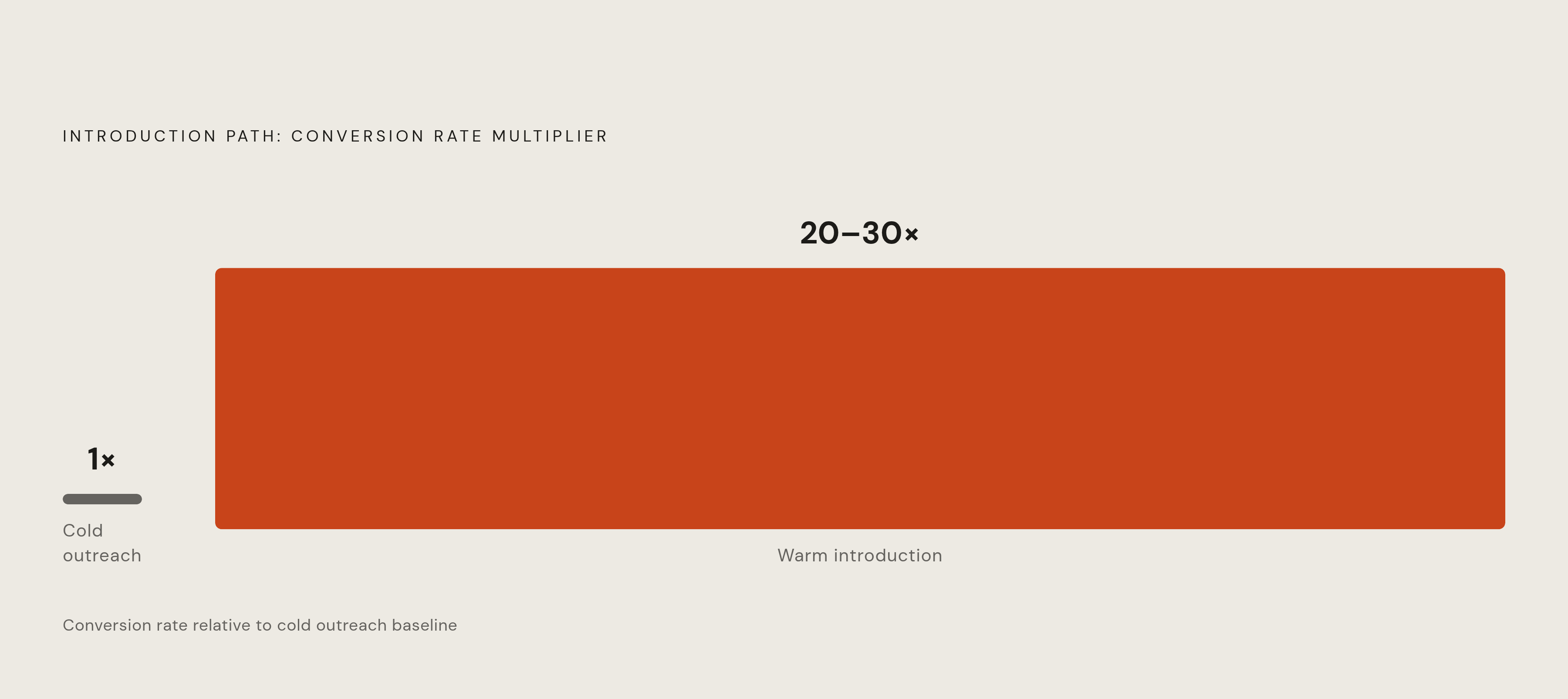
Introduction path may be the single highest-leverage field in the entire record. It tracks who in the founder's existing network connects to a given investor and how strong that relationship actually is, and the data backing this up is stark: warm introductions convert at 20 to 30 times the rate of cold outreach NYU Entrepreneurship cited in StartupAge. A closely related field, intro owner, tracks which advisor, co-founder, or portfolio company contact is actually making or facilitating that introduction, since a warm path with no clear owner tends to stall.
Conviction tier, whether an investor is rated Tier 1, Tier 2, or Exploratory, reflects the founder's own assessment of fit and likelihood to commit, and it drives sequencing decisions. Last touchpoint date, ideally auto-populated by the system rather than logged by hand, anchors cadence management. Meeting notes and call summaries need to live centrally, visible to every co-founder, not locked inside the inbox of whoever happened to take the call. Objections raised should be logged per investor, both to prepare for the next conversation with that specific person and to spot patterns forming across the pipeline as a whole. Pass reason closes the loop, giving a founder the raw material for honest post-raise analysis.
Above everything else sits next action and due date. It is arguably the single most important operational field in the entire system, because without it a CRM is nothing more than a historical log of what already happened rather than a system that pushes a founder toward what needs to happen next. The investor record should answer, in under 30 seconds, who this person is, why they were added, what happened last, and what happens next.
How to populate the pipeline with investors worth tracking
Deciding who enters the pipeline is a targeting decision, not a data-entry task, and the quality of that decision shapes everything the funnel produces later. A workable benchmark is a tight list of 60 to 100 funds that have invested in adjacent categories within the last 24 months, ranked first by fit and then by the strength of the available introduction path WaveUp Visible.vc fenwick.com Fungies NYU Entrepreneurship cited in StartupAge.
The current market raises the cost of getting this wrong. Investors in 2026 want to see trajectory across multiple touchpoints, momentum over time rather than a single strong pitch, sometimes described as wanting "lines, not dots" NYU Entrepreneurship cited in StartupAge. A low-fit investor who nonetheless takes a first meeting does not just waste an hour. That hour is calendar time that could have gone to a second or third follow-up with an investor who actually has a plausible path to conviction NYU Entrepreneurship cited in StartupAge.
Verifying fit before an investor ever enters the CRM means drawing on the intelligence sources built for exactly this purpose. Crunchbase supports investor discovery filtered by stage, sector, geography, and portfolio history, and its AI-powered search functionality has expanded through 2025 and 2026, making it faster to rule investors in or out before spending outreach effort on them NYU Entrepreneurship cited in StartupAge. Harmonic, an AI-powered discovery platform built on machine learning, was designed to help investors find and analyze early-stage companies by sector, stage, and founder background, and the same underlying data can inform a founder's own targeting from the opposite direction.
Every investor added to the pipeline should carry a conviction tier assigned before, not after, they enter it: Tier 1 for high fit with a warm path, Tier 2 for good fit reached through a cold or indirect path, and Exploratory for thesis-adjacent investors worth tracking for optionality or learning value NYU Entrepreneurship cited in StartupAge. Skipping that discipline degrades the pipeline into a flat list of 200 names with no signal about where to spend the next hour of outreach NYU Entrepreneurship cited in StartupAge.
Before any name gets added, ask a few questions directly. Has this investor written a check in this exact stage and sector within the last 12 months fenwick.com. Is the fund actively deploying capital right now, or sitting past its typical investment vintage. Does its portfolio already include a direct competitor. And is there an actual warm path in, with someone specific who owns making that introduction happen. A pipeline of 60 precisely targeted investors with known intro paths will outperform a pipeline of 200 unvetted names every time, because precision, not volume, is what the 2026 market rewards StartupFundraising NYU Entrepreneurship cited in StartupAge.
Running outreach cadence and follow-up discipline through the CRM
A round is won, or lost, in the discipline maintained between meetings, in the weeks of consistent updates, momentum signals, and well-timed nudges that convince an investor to move from interested to committed. Every investor record in the system needs a next action and a due date attached to it at all times. A CRM without that discipline is not a forward-looking operating system; it's a diary of what already happened.
Sequencing deserves more thought than founders usually give it. Tier 1 investors, the highest-conviction targets, are not necessarily the right ones to contact first WaveUp StartupFundraising NYU Entrepreneurship cited in StartupAge. A deliberate sequencing strategy often runs Tier 2 outreach earlier, using those conversations to sharpen the pitch narrative and build a track record of interest that strengthens the case made to Tier 1 targets later.
Cadence benchmarks give that sequencing teeth. After an introduction or a cold outreach attempt, the first follow-up should land within 48 to 72 hours if no response has come back. After a first meeting, the follow-up should go out the same day, or within 24 to 48 hours at the outside, and it should carry something concrete: a deck, a data room link, a reference contact. And when an investor goes quiet after a meeting, the right response is not a generic check-in but a substantive update, a product milestone, a new customer, a pipeline signal, sent within roughly a week of the silence starting.
None of these cadences enforce themselves. They exist because the CRM's stage architecture, its custom fields, and its next-action discipline are built to surface exactly this kind of drift before it becomes fatal to the round. A system configured this way does not just store the raise. It runs it.