Follow-Up Cadence After an Investor First Meeting
Most deals die silently because founders stop too soon, not because they pitch badly.

The days after a first investor meeting are not a waiting room. They are a sequence with rules, and most founders never learn the rules because nobody tells them the silence is supposed to be managed rather than endured. Two failure modes account for nearly every deal that dies in this window: the founder who goes quiet out of politeness or nerves, and the founder who fires off a chain of "just bumping this" emails that reads as anxiety rather than momentum. Neither is a failure of effort. Both come from treating what happens after the meeting as a feeling to manage instead of a process to run.
That distinction matters because it changes where the founder should be looking for answers. A relationship problem gets solved with better rapport, more charm, a stronger sense of when to reach out and when to hold back. An operational problem gets solved with a defined cadence: fixed timing, fixed content rules, a fixed stopping point. Investors are not ignoring a founder because the pitch landed badly. They are mid-board-cycle, they are between fund closes, they are three partner meetings behind on their own calendar. The founder's job is not to win the meeting again on the strength of one perfect follow-up. It is to stay visible across the several separate windows when that investor actually has room to act.
That reframing is what the rest of this piece builds on. If the post-meeting period is where deals are actually won or lost, and the data below suggests it is, then it deserves the same operational rigor a founder would apply to a hiring plan or a product sprint. Not more hustle. A system.
Reply distribution across a full cadence
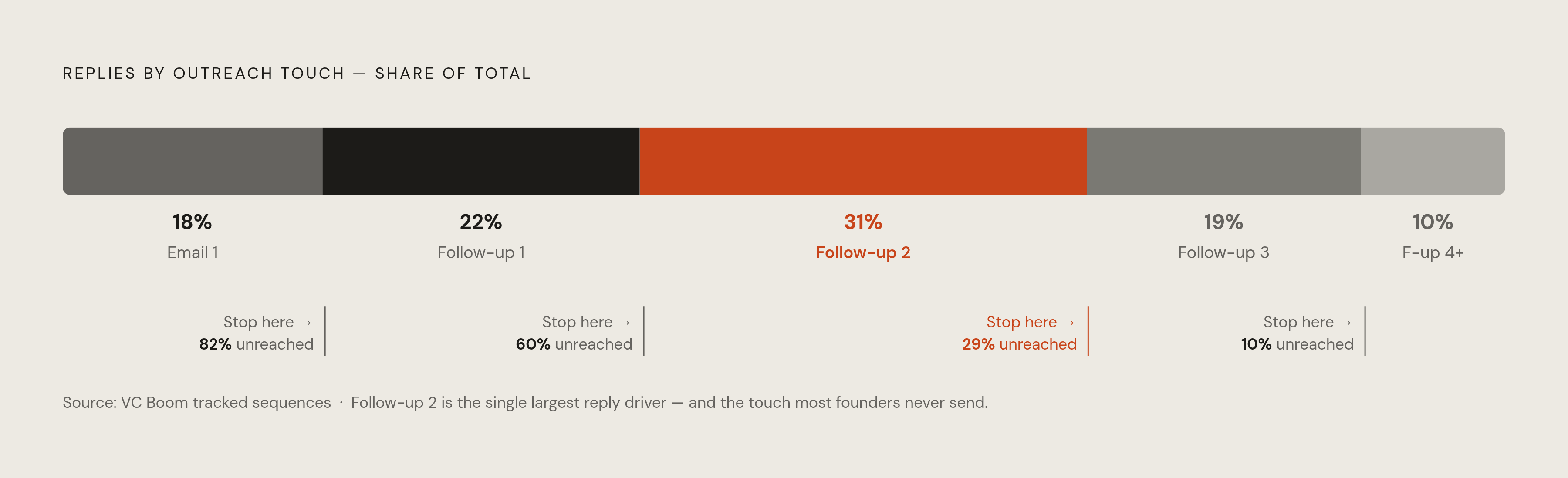
The shape of the data makes the case better than intuition does. Tracking hundreds of outreach sequences, VC Boom found that the first email a founder sends captures only 18% of the total replies that sequence will ever generate. The first follow-up adds another 22%.
The cost of quitting early becomes stark when the arithmetic is run forward. A founder who sends one email and stops has already walked away from most of the replies that sequence would have produced, since the first email captures only 18% of total replies. Stop after the first follow-up, and 60% is still sitting unclaimed. Stop after two touches, the point where most founders start to feel like they're being annoying, and roughly 29% of total replies never arrive. Most founders never send the third email at all.
VC Boom's own case study makes the point concrete. A founder referred to as Sam contacted 47 investors. The first email produced zero meetings. The first follow-up produced zero meetings. The third touch produced four meetings booked within 36 hours. Nothing about the pitch changed between email one and email three. What changed was which attention window Sam happened to land in. The third follow-up accounts for 19% of replies. The fourth follow-up and beyond accounts for 10% of replies.
An investor's actual week explains the mechanism behind this. An email lands during board prep and gets mentally filed under "maybe later." It resurfaces, unread and unranked, the same day the investor happens to be having an unrelated conversation with a limited partner about exactly the kind of company this founder runs. The founder is simply present when the third window opens, and absent for anyone who quit after the first two. The same math applies whether the sequence started cold or picks up after a warm, well-received first meeting. The attention problem is the same either way. The VC Boom (2026) reply distribution, drawn from hundreds of tracked sequences, opens the picture of what replies look like across a full cadence. The second follow-up accounts for 31% of replies.
The debrief that happens before you write a single word
None of the cadence above works if the content of each touch is vague, and the content is only as good as what got captured in the minutes right after the meeting ended. Nebula Startup School's 2026 guidance is specific on timing: run the debrief within 30 minutes of leaving the meeting, while the investor's objections and moments of genuine interest are still clear.
Four things belong in that debrief, and they are not interchangeable. What did the investor actually understand, as distinct from what got said. What did they push back on. What did they explicitly ask to receive. And what was the agreed next step, in specific terms rather than a vague sense that things went well. The distinction between fact and interpretation affects what belongs in the record: "they asked for monthly retention data" is a fact that belongs in the record. "They're ready to invest" is a guess dressed up as a conclusion, and guesses like that produce a follow-up email with nothing real to say.
When two founders sit in the same meeting, they frequently walk out with two different reads on what the investor meant, and that gap has to get resolved before anyone drafts anything. An email written from a muddled internal read reads muddled to the investor too. Every promised deliverable needs one named owner before the follow-up goes out, because nothing signals disorganization faster than an email that quietly reveals the founders haven't agreed among themselves who's sending the model.
The discipline extends to how the conversation gets labeled internally. Every investor conversation should end in one of three buckets: active next step, nurture, or closed. There is no fourth category for "maybe," since "maybe" is where follow-ups go to die from neglect. This is not busywork. Allied Venture Partners noted that delays in follow-up read to investors as a red flag about organizational skill, and a founder who can't communicate promptly during a raise invites the obvious question of whether they'll run the company with the same looseness. The debrief is what keeps that question from ever coming up.
What the first follow-up must do within 24 hours
Nebula Startup School's 2026 research is blunt about timing: the first follow-up should go out the same day if possible, and no later than the next working day, because the 24 to 48 hour window is when the meeting is still fresh and the investor's first real impression is still forming. Wait longer than that and the founder is competing against everything else that landed in that inbox since.
The job of this particular email is narrow, and narrower than most founders assume. It confirms the conversation happened, delivers whatever was promised, and makes the next step easy to say yes to. It is not a second pitch, and treating it like one is the single most common way founders waste this touch.
Even the subject line carries weight here: it should mirror the company context rather than a generic "Following up," because the difference signals whether this founder runs a disciplined process or a reflexive one.
Founders who close the meeting well set this email up before they ever leave the room. Asking, before standing up, "What concerns do you have about investing?" and "What are the next steps?" gives the follow-up something concrete to anchor to instead of forcing the founder to guess at what mattered. Qubit Capital's 2025 research found that structured investor outreach converts to meetings at a 40 to 60% higher rate than unstructured, random attempts, and that structure appears in the first follow-up or is absent from it. What to avoid is just as clear: don't retell the pitch, don't reattach materials nobody asked for, and don't send anything generic enough to have gone to any investor on the list. The investor already sat through the pitch. What they need now is evidence the founder executes with discipline, and this email is itself that evidence.
Spacing and varying subsequent touches so each one earns its place
Whatever timeline the investor stated takes precedence over any general rule. If they said two weeks, Allied Venture Partners' 2025 guidance says the follow-up goes out one business day after that window closes, never before. Jumping the gun on a stated timeline reads as impatience, and impatience is expensive in a relationship that might last years past the check.
Absent a stated timeline, VC Boom's 2026 spacing data gives a workable default, built for cold sequences but directly transferable to post-meeting follow-up. Seven business days again before the third. The gaps lengthen, not shrink, as the sequence goes on, and that lengthening is deliberate: it signals patience and organization rather than mounting desperation.
Timing alone doesn't earn the touch, though. Every follow-up after the first needs to carry something genuinely new, or it needs to exist purely to confirm a promised action or ask for a decision on something already agreed. New, in practical terms, means a signed customer, a completed pilot, improved unit economics, a senior hire, a product release, a new partnership, or a real update on ARR. Anything short of that is filler, and filler is what turns a founder from persistent into tiresome.
Looked at as a set, the three follow-ups do three different jobs. The first adds one new data point that changes how the timing feels. The second doesn't repeat the pitch from a new angle. it gives the investor a different reason to reply now. The third accepts the possibility that the fit isn't there, lowers the friction on responding (a referral ask works well here), and closes on a note that leaves the door open rather than slamming it. Register has to hold steady across all three. If the first email is tight and professional, the third should read exactly the same way, because any drift toward desperation is easy for a reader to spot and hard for a founder to walk back. If the round is closing on a tight deadline, intervals can compress, but no shorter than 3 days between touches, which reads as spam.
Not every investor gets the same rhythm, either. Investors who have expressed clear interest warrant contact every 2–3 days to sustain momentum, where warm prospects need weekly or biweekly contact. Holding that distinction in your head across a handful of investors is manageable. Holding it across a real pipeline, without a system to enforce it, is where most founders quietly lose the thread. Faster is not the goal here regardless. The goal is coverage of the moments when the investor actually has bandwidth, and volume for its own sake works against that. The interval from the first email to the first follow-up should be 5 days (calendar days). The interval from the first to the second follow-up should be 6–7 business days.
Personalizing each follow-up so it reads as intelligence, not effort
Investor inboxes now run on AI-assisted triage on both sides of the exchange, and generic emails are identified and ignored faster than ever. Personalization has stopped being a nice touch that separates the sharp founders from the average ones. It's the baseline cost of getting read at all.
Real personalization in a follow-up draws directly from the debrief: it references the specific thing the investor challenged or asked about in the room, it ties a new milestone to that particular investor's stated thesis or the companies already in their portfolio, and where it fits naturally, it points to a recent public signal, a blog post, a podcast appearance, a portfolio announcement, that shows actual alignment rather than flattery dressed up as research. The follow-up content should bend toward whichever of those the specific investor actually cares about.
Warm connections carry real weight here too. Qubit Capital's 2025 data found warm introductions convert 8x higher than cold outreach, and in a follow-up, that means referencing shared connections or mutual context meaningfully rather than name-dropping. A useful test before hitting send: could this exact email go to any investor on the list unchanged? If yes, it doesn't go out. Every message should be falsifiable as written for one specific person, and the cost of skipping that test isn't limited to the one investor who gets the generic version. Investors talk to each other, and a visible spray-and-pray chain can quietly close doors at firms the founder hasn't even pitched yet.
Reading silence: diagnosing what no response signals
Silence is the hardest part of this whole process to read correctly, mostly because founders assume it means rejection when it usually means something far more mundane. Timing affects reply rates more than the quality of what was sent. An investor might be mid-board-cycle, not currently deploying, or simply buried under a backlog that has nothing to do with the strength of the deal in front of them.
Several structural factors stretch out how long that silence can last. Larger, multi-partner funds need internal alignment and a partner meeting before they'll schedule a second call, which adds real calendar time regardless of interest level. Deal stage matters too: an earlier-stage deal demands more diligence, and a Series A conversation simply moves slower between touchpoints than a pre-seed check would. Some funds also run on fixed investment committee slots, weekly or biweekly. A founder can be genuinely "in process" for weeks without a single outbound signal to show for it.
The typical gap between investor meetings at the seed stage runs 1–3 weeks, shorter for angels and emerging managers, longer for institutional funds. Silence past three weeks is the point where the read should shift from "still considering" to "something's off," and that threshold should be treated as a hard line rather than a vague sense of unease. If an investor blows past a deadline they set themselves, the direct move is to ask whether the process is still active and what additional information would help them decide. That directness reads as professional, not pushy, and it usually gets an honest answer either way.
Not every silence deserves the same response. Re-engagement makes sense when the investor has been opening emails, replied once early on before going quiet, showed up to a Demo Day, or stayed active in adjacent deals. A graceful close makes more sense when there have been no opens and no replies across three well-spaced touches, or when the investor already said "not now" without attaching any specific condition for revisiting it. Allied Venture Partners' 2025 guidance is straightforward here: after 3–4 attempts with no response, send a polite closing email, leave the door open, and don't burn the relationship. That closing email is pipeline hygiene. It's pipeline hygiene, and it frees up attention that belongs on the investors actually still in motion.
The pipeline size at which manual tracking breaks down
It falls apart at the scale a real raise actually requires. In one seed-round example from the research brief, a founder who raised a $2.1M seed in Q2 2026 had five of eight meetings come from the second or third follow-up, with the lead investor replying on day 13.
Past roughly 50 targets managed by hand, founders start losing track of who's due for a nudge and when, and the deals that stall usually involve one where somebody simply stopped following up. They're the ones where somebody simply stopped following up. Without a system in place, the failures follow a predictable pattern: conversations get dropped outright, founders lose visibility into which stage the pipeline is actually clogged at and start reporting on gut feeling instead of real funnel numbers, hot prospects go cold from neglect while lukewarm ones get over-contacted, and a founder walks into a second meeting with no record of what was promised in the first. Under enough volume, outreach flattens into templates simply because there isn't time to do it any other way, and a personalized cadence is supposed to prevent that flattening.
The fix starts with treating the raise as a funnel with defined stages, first call, partner meeting, diligence, commitment, each carrying its own follow-up logic, rather than one undifferentiated list of names to work through. Allied Venture Partners noted in 2025 that tools like email trackers and CRMs help founders stay organized and keep communication timely, though the real question isn't whether a tool exists. It's whether that tool was actually built around the sales rhythms of a generic pipeline, or around the specific cadence a venture raise runs on, weeks-long gaps between touches, thesis-driven personalization, an unambiguous stopping rule at touch three or four. The distinction between those two kinds of tools tends to matter more than founders expect once the investor count climbs past what a spreadsheet can honestly hold. As Allied Venture Partners put it in 2025, the useful habit after every new investor meeting is to ask, and it's the asking, done consistently and recorded somewhere durable, that the whole cadence actually depends on. NYU Entrepreneurship reports that founders contact an average of 200+ investors to close a $3–4M seed round, resulting in roughly 20–30 follow-up conversations and 1–2 term sheets, which is the operational load the cadence must survive.
Sources
- Communicating with Investors: Strategic Follow-Up Email Tips & Templates
- Investor Follow-Up Emails: Best Practices — Allied Venture Partners
- Reply 3 is where 70% of investor meetings actually land · VC Boom
- Investor Follow Up After First Meeting | Nebula Startup School
- Investor Meeting Gap During Fundraising Explained | SheetVenture