Tailoring a Pitch Deck for Different Investor Archetypes
Different investor types need different evidence, not just different polish.

Most first-time founders build one deck, polish it for weeks, and send the identical file to every investor on their list. The instinct makes sense because the deck took real work, the story feels true regardless of audience, and customizing it for each meeting looks like busywork with no clear payoff. That instinct is wrong, and it's wrong for a structural reason rather than a stylistic one. Angels, seed VCs, Series A funds, and corporate strategics aren't just different personality types who respond to different flavors of charisma. They operate under different fiduciary obligations, different time horizons, and different definitions of what counts as a win. A single presentation logic cannot serve all of them at once.
A VC with an investment committee has to justify a check to partners who weren't in the room. An angel writing a personal check answers to no one but their own bank account and their own gut. A corporate strategic is measuring the deal against a parent company's roadmap, not against a fund's return curve. Those aren't cosmetic differences. They change what evidence matters, what order it needs to appear in, and how much emotional register the deck can afford to carry.
How the four main investor archetypes make decisions
Four archetypes cover most of the early-stage landscape: angels, seed-stage VCs, institutional Series A funds, and corporate venture capital or strategic investors. Family offices form something of a fifth category, but they tend to borrow decision patterns from both angels and later-stage funds depending on how the office is run, so they'll get flagged where relevant rather than treated as a fully separate archetype.
Angels deploy their own money. No LPs to answer to, no investment committee, no fund clock forcing them to deploy by a certain quarter. Checks typically vary widely across the angel landscape, concentrated at pre-seed and seed, though angels also join SPVs to keep participating in later rounds. Their decisions run on personal connection to the founder, a felt sense of the mission, and social proof from other people already in the deal. Angel groups behave collaboratively: members share reactions and vouch for each other's read on a founder, and angels are often described as social creatures who decide together. That speed is the tell. The real competition for an angel's check often isn't a rival startup, it's whatever else that person might do with the money instead. The bar is emotional in a way institutional capital never is. Deals can close relatively quickly compared to institutional processes. And the category is growing: the Angel Capital Association's 2026 Angel Funders Report recorded angel investment rising from $437 million in 2024 to $491.3 million in 2025.
Seed-stage VCs operate on a different basis altogether from angels. They're deploying capital raised from LPs, which makes them fiduciaries with legal obligations and a portfolio construction logic that has nothing to do with personal taste. Checks run from a couple million dollars up to several times that, depending on stage and valuation. Decisions come down to pattern recognition across team, market, and early traction, filtered through whether this specific company fits the fund's portfolio and could plausibly hit Series A benchmarks. Angels fund proof of an idea; seed VCs fund acceleration of something already showing signs of life. And because a partner has to carry the deck into a partners' meeting and defend it without the founder present, the deck has to survive internal advocacy, not just impress whoever sat across the table. The market has gotten tougher on this front too: median seed post-money valuation climbed substantially in Q4 2025, up from a year earlier, even as graduation rates to Series A have fallen. Seed funds are underwriting to a harder path than they were underwriting to a year prior.
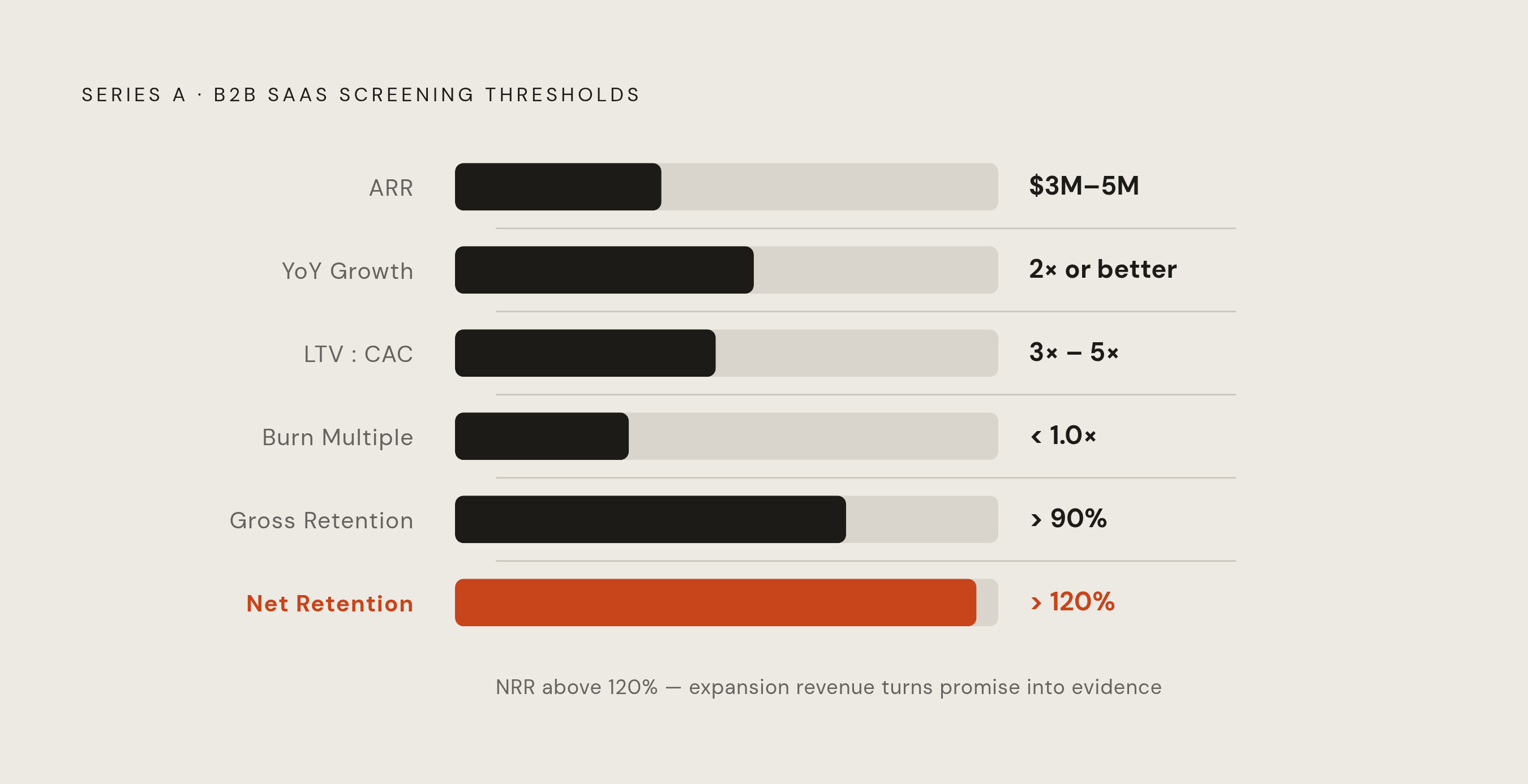
Institutional Series A funds sit at the top of the pyramid in terms of scrutiny. Checks start in the high single-digit millions and climb well into the double digits, and the bar for getting one is severe: roughly 20% of seed-backed companies ever clear Series A, and across the entire startup population, less than 1% ever raise one. At this stage, product-market fit is assumed rather than argued. The go-to-market motion must be scalable and repeatable, and the evidence has to be metrics-first: for B2B SaaS, funds are screening against benchmarks like a few million dollars in ARR, 2x-plus year-over-year growth, gross revenue retention above 90%, net revenue retention above 120%, a burn multiple under 1, and LTV to CAC of 3x to 5x or better. The deck at this stage functions less like a pitch and more like a pre-read document that has to survive partner-meeting scrutiny with nobody there to answer follow-up questions live.
Corporate venture and strategic investors run on yet another logic, evaluating fit against a parent company's roadmap rather than fund-return math, though the deck mechanics for that archetype deserve their own treatment elsewhere.
What to lead with and foreground when pitching angels
Angels invest in a person and a mission before they invest in a business model. That ordering isn't a nicety, it's the operating principle the entire deck should be built around: make the founder and the problem feel real and urgent first, then use credibility signals to justify the emotional pull that's already been created.
Open with the problem told as a human story. Specificity beats scale here, because an angel isn't trying to model a total addressable market, they're trying to feel something about a problem worth solving. Mission and the "why this team" question appear early in the deck, because angels want to feel personally connected to what's being built before they'll care about the mechanics of how it gets built. And wherever possible, let the product speak for itself with screenshots, a live demo link, and a customer testimonial in the founder's or the customer's own words. Hypothetical products are hard to fall in love with. Real ones aren't.
The body of the deck should lean on traction and credibility signals more than it leans on argument. Revenue growth, active users, retention, margins, these numbers carry disproportionate weight precisely because they're hard to argue with. As one framing from the pitch deck world puts it, numbers are difficult to challenge and, when used correctly, can tell an exciting and bulletproof story. If an institutional fund or a recognizable company has already committed capital, their logo belongs on the page, prominently, because it signals that someone with more diligence capacity than an individual angel has already vetted the deal, so social proof carries similar weight. The same goes for existing partnerships, advisors, and notable customers, repeated across the summary slide, the team slide, and the fundraising slide, so the credibility compounds rather than appearing once and getting forgotten.
The team slide deserves to feel personal rather than clinical. Backstory, why this specific founder is chasing this specific problem, what domain experience makes them credible on it, all of that belongs here, because angels are backing a person, not a cap table entry.
Tone-wise, angels don't carry the analytical overhead institutional investors do. There's no analyst team stress-testing the model, so the deck doesn't need to pre-empt every financial modeling question a spreadsheet jockey might raise. Mission-driven language, the kind that would read as soft in front of a partner at an institutional fund, is entirely appropriate here. Design the deck for scanning: one question per slide, headlines that state conclusions rather than label topics. And resist the urge to bury the product behind abstract market-sizing slides. Show the thing. Let it do the persuading it's capable of doing.
What earns conviction from seed-stage VCs
The deck for a seed VC has to do something an angel deck never has to do: survive a room the founder isn't in. A partner who likes the pitch still has to carry it into an investment committee and defend it against colleagues who weren't there for the charm. That single fact reshapes the whole document into something closer to an internal advocacy tool than a presentation.
Open with a market framing that's crisp and load-bearing, because a seed VC needs to believe the prize is large enough to justify a fund-returning outcome. TAM slides aren't decorative filler at this stage, they're doing real work. That said, a smaller, more concrete serviceable obtainable market, one that shows exactly where the company wins first, tends to land better than an abstract, inflated TAM number that nobody quite believes. Show the beachhead, then show the expansion path out of it. The problem and solution slides need to establish category fast, so the partner can mentally file the company into a recognizable, investable thesis within the first few slides rather than trying to reverse-engineer one later.
The body of the deck needs to foreground early proof of demand, because the era of funding a raw idea at seed is over. Investor guidance for 2026 has been blunt: seed investors fund validation, not ideas. Team credibility matters here too, but it needs to be framed specifically around this problem: what unfair advantage, what domain expertise, what prior execution makes this team the right one to solve it. A high-level view of the business model and unit economics belongs in the deck as well, not a fully built financial model, just enough to show how the company makes money, what early acquisition and retention look like, and how that trajectory points toward the Series A benchmarks seed funds are already underwriting toward. The competition slide needs to do real work too: seed VCs care about defensibility, and in an environment where new AI tooling can let a competitor ship a feature in a weekend, the deck needs to pre-empt the "what happens when a larger player builds this" question before a partner has to ask it out loud.
Tone should sit between the angel deck and the Series A deck: more analytical than the former, not yet as metrics-dense as the latter. The narrative arc, problem, insight, solution, early proof, why now, the ask, still needs to hold together as a story. Brevity is not a stylistic preference here; it's a measurable advantage: decks under 15 slides see a 60% higher chance of landing a follow-up meeting. Visual restraint matters for the same reason. Investors move through too many decks in a week to decode a busy one, so calm, structured design isn't an aesthetic choice, it's a functional one.
Building the Series A deck around the metrics that institutional funds screen on
By Series A, the argument for product-market fit is over. It's assumed, not debated, and the deck's entire job shifts to proving that a repeatable, scalable go-to-market motion already exists and simply needs capital to accelerate it.
Lead with traction, and lead with it immediately rather than saving it for a validation slide two-thirds of the way through. A headline ARR number or growth rate should anchor the opening of the deck, because everything that follows is going to be read against it. The founders sitting in these meetings are pitching companies with real operating history behind them: the median time from seed to Series A stretched to 774 days as of Q4 2024, about 2.1 years, up from 420 days at the 2021 boom peak. Series A funds know they're looking at a more mature company than they were three years ago, and they calibrate their evidence bar accordingly. The "why now" slide at this stage isn't about founder urgency anymore either, it's about market timing and a competitive window that needs to be grounded in market data, not personal conviction.
The specific metrics matter, and they vary by sector, so founders need to know their own ladder before walking into the room. For B2B SaaS, the benchmarks surveyed across institutional Series A funds are around a few million dollars in ARR, growth of 2x or better year over year, gross revenue retention above 90%, net revenue retention above 120%, a burn multiple under 1, and LTV to CAC in the 3x to 5x range, with most funds wanting at least a 3:1 ratio as a floor. Other sectors run entirely different ladders: D2C companies are expected to show 20% to 25% month-over-month growth, and marketplaces are judged on GMV growing 3x year over year. Forcing a SaaS metrics framework onto a marketplace business, or vice versa, signals to a fund that the founder doesn't understand their own category, which is close to the worst impression a deck can leave.
The body of the deck needs to show go-to-market mechanics in enough detail that an investor can see the machine. How are customers acquired, at what cost, and how does that cost behave as spend scales up? Retention cohorts do more persuasive work here than almost any other slide, because a cohort that expands its usage over time turns the deck from a promise into evidence, which is the entire currency Series A investors are trading in. Financial detail needs to follow the same logic: not a wall of projections, but a clear line from the metrics already achieved to the ones capital is being raised to hit next.
Sources
- The Different Investors You’ll Meet and How to Tailor Your Pitch… | The Pitch
- How to Tailor Pitch Deck for Investors: Strategies & Tips
- Pitch Deck Strategies for Investors: Winning Tips for Startups
- What Investors Want in a Pitch Deck in 2026 (And What's Changed) — DECKO: Pitch Decks by Venture Capitalists
- spectup.com
- spotlightonstartups.com