Reading Fund Age and Portfolio Velocity to Spot VCs Ready to Write Checks Now
Fund age and portfolio activity reveal whether a VC can deploy capital for new deals now.

Investor targeting should establish both whether a VC can write a first check now and whether its thesis matches the company. Fund age shows when the fund is likely to invest, while portfolio velocity shows whether it is adding new companies. For founders using AI-powered investor targeting and thesis decoding, these signals turn a list of plausible investors into a shortlist grounded in structural readiness.
Why most investor targeting wastes outreach before it starts
A warm meeting, genuine engagement, and then silence can reflect a fund’s constraints. Founders build lists around sector fit, check size, and brand recognition, then spend weeks pursuing partners whose funds are functionally closed to new deals. Interest does not remove a contractual restriction. A fund past its investment period cannot lead a new round when its Limited Partnership Agreement prohibits investment in new names, however enthusiastic the partner sounds.
The partner may understand the business and value the conversation, while the vehicle no longer has capital available for a first check. Sector fit alone cannot expose that mismatch. Fund lifecycle signals provide the missing operational context before a founder commits time to outreach and diligence.
How a fund’s lifecycle turns check-writing capacity on and off
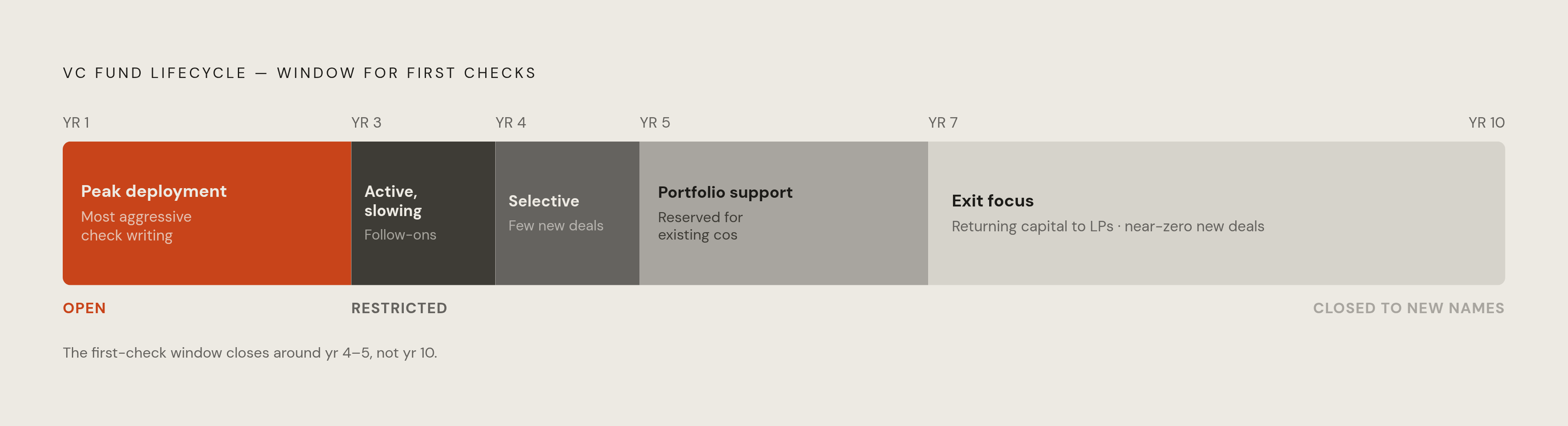
A typical VC fund runs roughly a decade, but its investment period generally lasts three to five years from the fund’s start. The clock has distinct deployment phases. Years two and three bring peak deployment, the highest volume of new investments, and the most aggressive check writing. In years three and four, active deployment continues, but the pace slows as capital is allocated to follow-on reserves. In years four and five, the fund becomes more choosy about new deals and gives more support to its existing holdings.
By years five through seven, the fund is generally supporting its portfolio. Years seven through ten focus on exits and returning capital to limited partners, or LPs. Remaining capital is not necessarily available capital. Funds deploy the large majority of committed capital during the first four years, while what remains increasingly enters a reserve pool earmarked for companies they already own. A founder outside the portfolio cannot treat those reserves as an open allocation.
Micro VCs with under $100M can deploy in one to two years, so their window closes faster. A working paper from researchers at the Bank of Israel, Warwick, and Wharton found that investments made earlier in a fund’s life were more likely to reach successful exits. The paper pointed to financing capacity and monitoring horizon as explanations. Earlier investments give the GP more remaining capital and more time to support a company through multiple rounds.
Why the 2021–2022 vintage cohort is the specific problem founders face right now
In 2026, the 2021 and 2022 cohort is the most common fund vintage founders encounter, and its deployment timing creates a specific constraint. These funds are inside or just past the standard three-to-five-year investment window. Their primary deployment period is ending or over. A firm that led headline rounds in 2022 may still be well known even though its remaining capital is reserved for follow-ons.
At the same time, these GPs face portfolios that remain largely unrealized and a looming fundraise with LPs who have received little cash back. That creates pressure on both sides. The current fund needs to support its holdings, while the next fund needs LP commitments at a time when raising funds is harder. Firms usually start raising their next fund while the last one is still active. The absence of a successor announcement is therefore informative, although it is not proof that no fundraising is underway.
None of this makes the cohort a collection of bad funds. Paper markups and fund-value metrics may look good while cash is still tied up. The distinction is operational. For a founder seeking a first check, a strong portfolio does not reopen an investment window or release capital already reserved for existing companies.
How to find the right VC to pitch by reading fund age
The first research step is to identify the current fund’s vintage year and look immediately for a recently closed successor. Press releases usually announce fund closes publicly. Form D filings and private market databases are other places to find the fund’s vintage. A successor close is the clearest public signal of fresh capital for new deals. This is a minutes-long screening task.
The relevant unit is the vehicle. A large fundraising announcement can combine separate mandates at different stages, only one of which fits a founder’s round. Reading the strategy split prevents the headline total from standing in for the capital actually relevant to the company. The founder needs to connect the announced vehicle to the stage and round size before interpreting its age. Otherwise, a recent firm-level announcement can obscure an older or unsuitable allocation.
Crunchbase and PitchBook track how often deals happen, round sizes, and the last investment date, while firm websites and portfolio pages show which companies have just been added. Those sources make it possible to move from the fund’s stated age to evidence of deployment. Public information still leaves gaps. Asking a VC when they raised their current fund signals sophistication and helps calibrate timeline expectations. Experienced VCs expect the question, particularly when the public record does not make the active vehicle clear.
Portfolio velocity as the behavioral layer on top of fund age
The type of activity is decisive. Regular new lead investments indicate active sourcing, whereas follow-on rounds without new portfolio names suggest maintenance.
The behavioral layer extends into the first meeting. Early in a fund’s life, partners tend to ask open, exploratory questions about the company, market, and team. As the investment period ends, partners may talk more about the market in general and less about round timing, cap table structure, and next milestones. Curiosity alone is not evidence of a deal. A conversation that never reaches terms is a warning that the partner may not be positioned to write a term sheet.
A cluster of exits generates distributions that make LP conversations easier, helping the GP raise a successor fund and return to active deployment. Exits indicate a possible transition toward renewed capacity, which becomes more concrete when paired with a successor announcement.
How LP pressure shapes the speed of a deal, not just its probability
A fund in active deployment under LP pressure moves at a different pace from one still working out its thesis. In the middle period, years three through five, high LP pressure is associated with a three-to-four-week decision process and active deployment. That combination makes it the best window for founders seeking speed. Funds under deployment pressure are also more likely to lead because putting capital to work is part of their obligation.
Later-stage speed requires a different interpretation. In years six through eight, very high LP pressure can produce two-to-three-week decisions on final allocations, but selection is tighter and the return bar rises sharply. This does not override restrictions on investing in new names. A fast final allocation is useful to a founder only if the fund is permitted and able to make it. By year nine and beyond, extensions usually draw on reserve capital, mostly for follow-ons, with very little appetite for new deals.
LP composition also affects pace independently of fund age. Family-office-backed funds tend to have shorter decision chains, while funds skewing toward pension funds require longer diligence. The calendar is therefore not the only clock. For founders, the practical implication is to distinguish a deployment-driven process from one slowed by the fund’s institutional decision structure. That distinction supports more realistic expectations than treating every delay as a verdict on the pitch.
Where the vintage-and-velocity framework breaks down and how to adjust
Recent vintage and high portfolio velocity do not guarantee fit. A fund in peak deployment can still be unsuitable because its thesis, check size, or allocation logic excludes the round. The GP may have reserved capital for follow-on commitments earlier than expected, or the internal pipeline may already be full for the quarter. Fund size can also be too large or too small relative to the required check. These constraints explain why a positive lifecycle signal is a screening result.
First-time fund managers can offer speed and partner attention, but they have limited reserves and less ability to lead follow-on rounds. Target them as part of a broader investor list. Founders should weigh what these managers offer against the company’s financing needs as well as how fast they can write a check. A fast first check and capacity for continued support are separate attributes.
The last things to check are thesis fit and check size. Those are questions a founder can address through careful targeting research after fund age and velocity have narrowed the field. The order preserves the value of both approaches. Structural readiness removes investors unlikely to transact now, while thesis and allocation research distinguish suitable partners among those still available. The framework does not replace targeting judgment, but makes it faster and more accurate.
Building a pre-outreach filter that uses both signals before a single email goes out
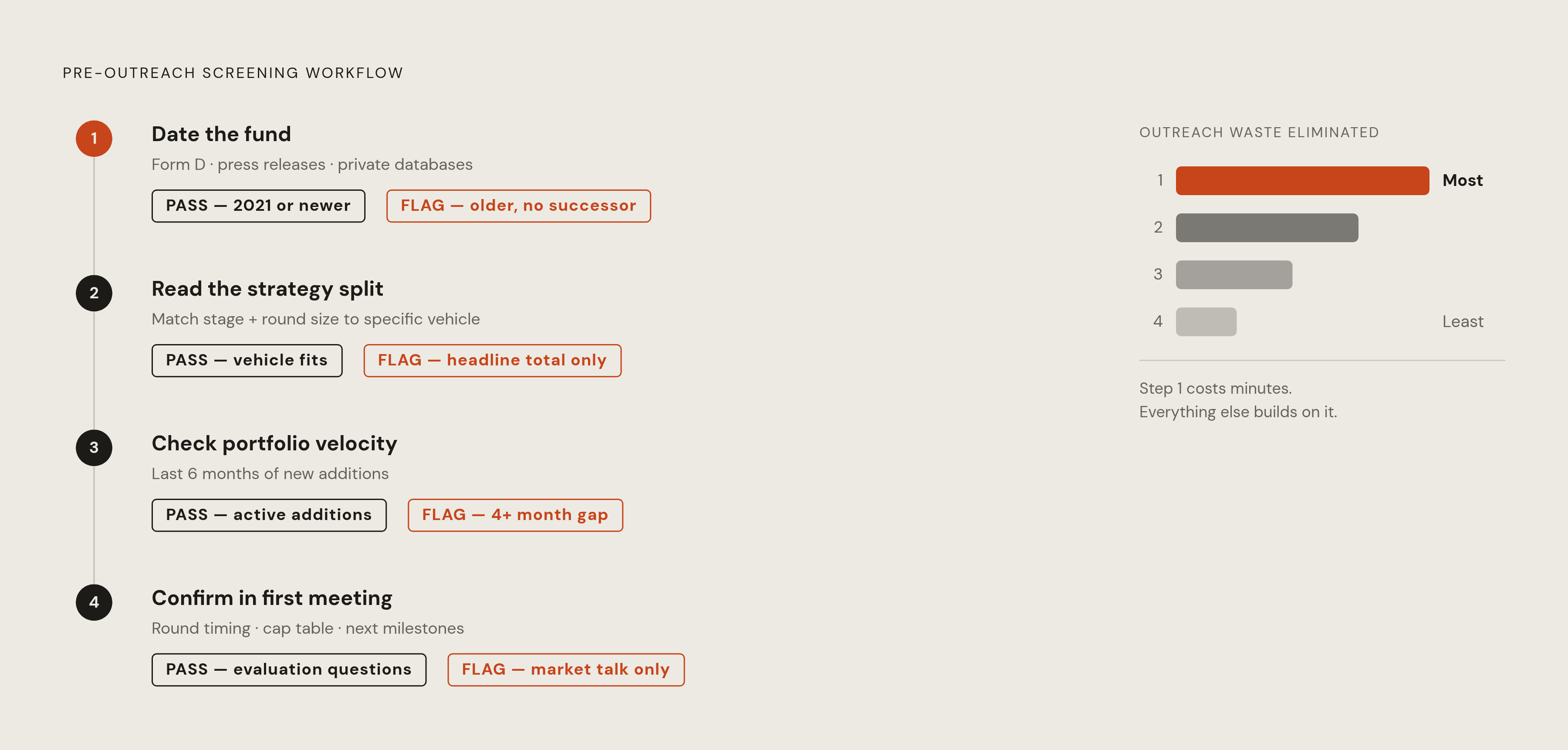
The workflow begins by dating the relevant fund through Form D filings, press releases, or private market databases. Anything older than a 2021 vintage without a successor announcement should be flagged as likely past its primary investment window. The 2021–2022 cohort also deserves close attention to timing. The next step is to read the strategy split at large or multi-strategy firms and identify the vehicle that matches the company’s stage and round size. The headline raise is rarely the relevant number.
Recently closed funds and those in the two-to-five-year age band represent the highest concentration of available dry powder, so both groups belong among live targets. A look at the last six months of portfolio additions and deal history shows whether the fund is adding new company names or mostly making follow-ons. A gap of four or more months since the last new investment should be flagged.
That pre-email screen establishes a working interpretation. During the first meeting, questions about round timing, cap table structure, and next milestones indicate evaluation mode. When the talk stays on the market without reaching terms, the partner may have little room to lead. The meeting should confirm or contradict the public-data read. This keeps the process responsive to current behavior instead of allowing an old announcement to determine the entire judgment.
Outreach timing then follows the fund’s likely motivation. Founders seeking faster decisions should put mid-lifecycle funds in years three through five first, and reach out four to six weeks before quarter-end to line up with LP reporting cycles. October through mid-November is another accelerated-decision window. These timing choices work within the structural screen. They cannot create first-check capacity where the relevant vehicle has none.
The raise should open with well over a year of runway, a story that survives being forwarded, and a shortlist built on structural readiness. Thesis decoding still belongs in that preparation. Its value increases when founders first establish that the investor has a relevant vehicle, an open deployment window, and recent evidence of backing new companies.