Signal Layering Turns a VC Firm's Portfolio History Into a Precise Thesis Fingerprint
Recent deals, check sizes, and content reveal which investors actually fit.

AI-powered investor targeting and thesis decoding for startup founders works by combining recent portfolio history, check-size behavior, public content, and relationship networks into a thesis fingerprint. With a substantial share of VC firms showing meaningful drift between their stated thesis and actual investments, founders need evidence of current behavior. This process produces a prioritized investor list built around company fit, round fit, the right partner, and a credible introduction path.
Why VC thesis pages mislead founders — and what the portfolio actually shows
Reading a VC firm’s thesis page is a reasonable starting point. Thesis and About pages explain the firm’s stated interests, introduce its team, and provide a shared vocabulary for a first conversation. They also help with LP communication, inbound deal-flow management, and brand positioning. Those purposes reward breadth and stability at the expense of precision about current deployment.
The gap often reflects how firms operate: the people writing checks are rarely the people updating the website, and a junior associate may have last revised the thesis page when the fund launched. Meanwhile, partners can change their stage preferences, sector focus, geographic reach, or role in a round. The website can remain internally coherent while becoming operationally stale. Founders who treat that page as a qualification filter can therefore mistake thematic overlap for an investor’s willingness to fund their particular company.
A pre-seed label becomes less informative when recent deals show the firm leading Series A rounds. A firm’s stated regional focus is in doubt when its new investments cluster elsewhere. These discrepancies change who belongs on a founder’s target list. They also explain why outreach can sound well researched yet still arrive at the wrong firm.
How the four drift patterns surface in real portfolio data
Stage drift leaves a trace in round sizes and participation roles. It accounts for 31% of thesis-portfolio mismatches, making it the most common drift pattern. If a climate fund with a pre-seed mandate kept taking part in larger, later rounds, that would suggest an upstream shift. Lead-versus-follow behavior helps interpret that movement because participation alone does not establish the role the fund wants to play. One later-stage investment is not enough to establish a new mandate.
Sector drift appears when company-level classifications contradict the fund’s own label. Tagging recent investments by sector and business model can reveal logistics and proptech clusters beneath a fintech description. A fund that previously invested across foundation models and infrastructure may now add more application-layer AI tools. Calling every investment “AI” would conceal the shift founders need to understand.
Geography drift is visible when funding announcements and deal databases place recent founders outside the stated regional focus. A West Coast description paired with repeated deals in Texas and Florida is a recognizable example. Model drift appears in participation when a firm says it leads rounds and takes board seats, but its recent participations are all follow-on investments without board roles. These patterns can overlap, as when a pre-seed generalist starts backing Series A consumer rounds.
Why the last 12–18 months of deals, not the full portfolio, carry the operative thesis
The first practical discipline is to scope the evidence. Pull the last 12–18 months of deals before interpreting the full portfolio, and classify those investments by stage, sector, geography, and participation role. A fund’s 2019 investments describe its beliefs then. They do not establish what its partners want to fund now. Older holdings provide background, but they should not outweigh a repeated recent pattern.
Funds often follow their winners, which can move their focus without producing a formal repositioning. A generalist seed fund may back several logistics companies that perform well, prompting partners to take more logistics calls. Two years later, more of its portfolio may be in logistics while its website still says generalist. Yet historical enthusiasm can also point in the opposite direction. A firm that invested heavily in a category two years ago may now be too concentrated there to add another position.
To distinguish thematic fit from current availability, examine activity timing and fresh capital as well. A recently raised vehicle is a proxy for active deployment, with fit for a particular company still to be established. Recent evidence also needs enough breadth to support an inference. Treat a single unusual deal as noise unless other investments establish a pattern across the window. This preserves the value of recency without turning every opportunistic check into a thesis change.
How do founders find the right VC partner through check-size and lead-versus-follow behavior?
A firm may invest in the right category but write checks that do not suit the raise, or follow rounds when the founder needs a lead. Check-size ranges can change through a fund’s deployment cycle, and partners at the same firm may operate at meaningfully different sizes. Financial behavior adds another way to judge fit. It shows not just what the firm funds, but how it participates.
Lead behavior also reveals the depth of conviction. A firm that consistently leads in a sector has built the diligence infrastructure and network needed to price that category, while occasional follow investments may be more opportunistic. Total round size gives that distinction context. Leading a small seed round and following a large Series A are different roles, even if the underlying companies share a sector. Larger checks into fewer companies can also indicate a tightening thesis.
Identify who led the deals closest to the company and intended round, rather than assuming every partner represents the same mandate. Then check whether recent checks show concentration or diversification. Reconstructing these relationships manually can take hours. A platform that shows check-size patterns and lead-versus-follow behavior makes the evidence easier to compare and saves the founder from having to rebuild each investment history.
What content signals — podcasts, blog posts, social activity — add that deal data cannot
Portfolio history shows where the firm has already put money, while public content can show where its conviction is still taking shape. A partner who publishes three posts on vertical AI for healthcare and appears on two podcasts discussing ROI in clinical workflows is developing a more specific position than a broad AI label conveys. That position can sharpen outreach before a corresponding investment appears. Content is therefore a forward-looking layer. It adds direction to the backward-looking record of deals.
The substance of that content is more useful than simple topic matching. Blog posts and podcast discussions can expose the objections a partner is working through, giving founders a concrete preparation advantage before the first meeting. Social activity adds another view of attention. A public congratulations to a portfolio company or engagement with a sector founder’s post can reveal active investment in that network. Neither action establishes that a new check is available.
A partner who stops discussing a former thesis topic for six months may have less conviction in it, especially if recent deals point elsewhere. Silence alone remains a weaker signal than several layers converging. Read content against recent investments and check-size behavior. Public output is a leading indicator of conviction.
Network topology as a signal layer — what the firm’s co-investor and founder graph reveals
A fund that consistently syndicates with the same two or three firms sits within a conviction cluster, even if its public sector description remains broad. Its co-investor graph shows where investment judgment repeatedly overlaps. Portfolio founders provide another set of relevant relationships. Together, these connections can make the firm’s working preferences more legible than its branding.
That evidence also changes the route into the firm. A portfolio founder who raised from the relevant partner can speak to fit with a specificity that a mutual LinkedIn connection cannot. The relationship is grounded in an actual investment decision. Repeat co-investors can also offer paths into the same conviction cluster.
The practical shift is to prioritize a credible introduction path. Warm introductions produce substantially higher response rates than cold outreach, but the existence of an introduction is not sufficient. A portfolio founder who can explain the company’s fit offers something different from a passing forward through a weak tie. Mapping that distinction manually is time-consuming and often incomplete. The useful output is a prioritized route to the relevant partner, supported by a clear reason the connection makes sense.
How the four signal layers stack into a usable thesis fingerprint before outreach
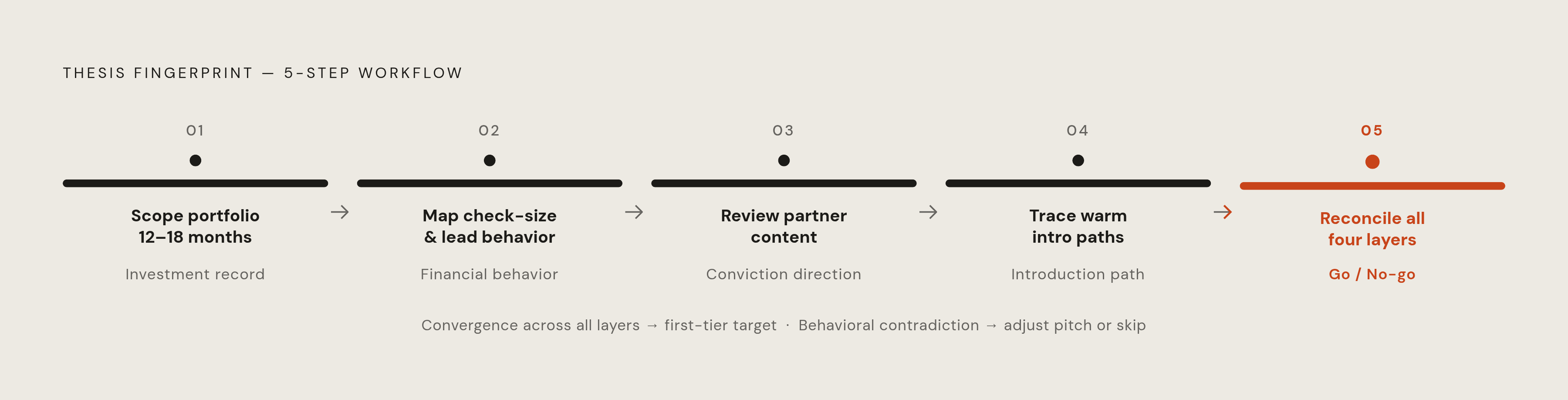
The thesis fingerprint is a decision tool. Its five-step workflow begins by scoping the portfolio to the last 12–18 months and tagging each deal by stage, sector, geography, and lead-versus-follow role. The second step maps check-size and lead behavior to individual partners, with attention to concentration or diversification. These steps establish the investment record. They distinguish an attractive firm-level label from evidence that a particular partner could fit the company and round.
In the third step, founders review the relevant partner’s blog posts, podcast appearances, and social activity from the last six months. Themes gaining or losing airtime add direction to the deal history. In the fourth step, founders trace co-investors, portfolio founders, and shared background patterns to find the warmest credible introduction path. Access belongs inside the analysis because a strong fit with a specific partner becomes more actionable when a credible connection can explain that fit.
The fifth step reconciles all four layers with the stated thesis. Where the evidence converges and matches the website, confidence in fit is high. Where a consistent behavioral pattern contradicts the stated thesis, the founder should trust the layers and adjust the pitch or skip the fund. Disagreement is useful evidence in its own right. It prevents a familiar sector label from overruling a poor match in stage, participation role, or current attention.
A fund whose portfolio, check sizes, content, and network all align is a first-tier target, while one supported by only one or two layers remains speculative. This also limits over-fitting to opportunistic deals. A pattern appearing in investment history, financial behavior, and public thinking is less likely to be incidental than an isolated investment.
Running the signal-layering process at scale without making it a full-time job
Working out a single fund’s thesis by hand takes hours. Across dozens of targets, pulling deals, checking participation, reviewing content, and mapping introductions can crowd out the raise itself. Portfolio history, check-size patterns, recent deal cadence, and public content are structured or semi-structured inputs that AI agents can surface, tag, and cross-reference. Founders still have to decide what the evidence means when taken together.
Founders should choose tools for how well they handle those research tasks, giving that more weight than the promise of a larger investor directory. Useful capabilities include recent-deal analysis, partner-level financial patterns, content signals, and relationship mapping. Metal is one investor intelligence tool that compares recent deals with how a firm describes itself, helping founders spot a narrow vertical AI focus under a broad enterprise software description. It also surfaces public conviction signals and maps warm introduction paths through existing networks and portfolio founders. These functions address separate gaps that a thesis page cannot resolve alone.
The same research infrastructure can support fundraising between rounds. Thesis shifts, activity changes, and new fund raises remain useful intelligence before outreach becomes urgent. Keeping up with those changes makes preparation a habit and avoids a mid-round scramble. A founder who works through the five-step process for each firm on the target list goes into conversations knowing the firm’s operative thesis, likely check size, relevant partner, and warmest credible introduction path. That is a structurally different conversation from one built on a thesis page.