Mapping Fund Age, Vintage Cycle, and Recent Close Data to Find VCs With Capital to Deploy This Quarter
Fund age, size, and recent closes reveal which VCs can actually write a first check.

VC fund activity and check-writing signal intelligence starts with the vehicle. Fund age, fund size, recent closes, and new-deal activity together show whether a VC can write a first check this quarter or is mainly supporting existing investments. Founders should use those signals to check whether capital is available before narrowing their outreach by investment thesis.
Why outreach to the wrong fund fails before it begins
A partner is enthusiastic, diligence advances, and then the deal quietly stalls. The founder may read the silence as a problem with the pitch. Yet the obstacle can be structural rather than persuasive, because the fund’s investment period has closed. A GP can want to invest without having the legal capacity to make a new commitment from that vehicle.
Partner visibility does not resolve that constraint. A partner can keep taking meetings, posting on social media, and attending conferences while managing a live portfolio for the fund’s remaining five or six years. The lesson for founders is to build a better list, using fund lifecycle data alongside sector fit and check size.
How a fund's age determines whether it can write your check
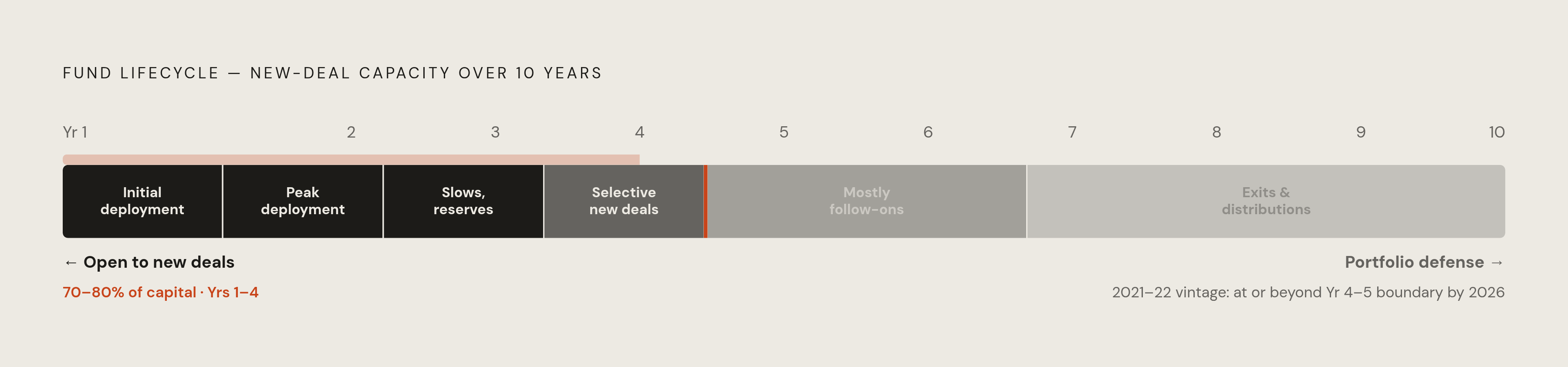
A fund’s vintage year is a stronger starting point for estimating new-deal capacity than a public statement about being “open to deals.” Venture funds usually have a lifecycle of roughly ten years. The first half centers on deploying capital into new investments, while the second centers on managing portfolio companies and returning capital to LPs. The investment window is shorter than the fund’s life.
During years one and two, initial deployment begins and the fund actively sources first checks. Years two and three bring peak deployment and the highest volume of new investments. In years three and four, deployment keeps going but slows as more capital goes into follow-on reserves. Years four and five mark a transition toward selective new deals and more follow-ons. In years five through seven, funds tend to back companies they already hold, while in years seven through ten they focus on exits and distributions.
Funds put roughly 70–80% of committed capital to work in years one through four. That makes the 2021–2022 cohort a difficult target in 2026, when those vehicles sit inside or just beyond the standard three-to-five-year investment window. Earlier headline rounds may have used up most of the capital that was available. What is left may be set aside for existing holdings, and founders should take a closer look at a 2021-vintage fund that has not announced a successor because firms usually raise the next vehicle while the prior one is still active.
How fund size changes how fast the deployment window closes
Micro-VCs with under $100M can deploy in one to two years, while mid-market funds generally follow a three-to-four-year cycle. Large funds may deploy over four to five years, and mega-funds over five to six, with multiple strategies running in parallel. So a 2024-vintage micro-VC may be further through deployment than a 2022-vintage mid-market fund.
The relevant unit is the vehicle. A large headline raise can combine capital that serves different stages and cannot be treated as one pool for every founder. Index Ventures’ 2026 raise includes a seed fund, a venture fund, and a growth fund. A seed-stage B2B founder is targeting the seed vehicle, so the strategy split is more useful than the aggregate announcement.
Where the actual dry powder sits right now
In 2026, the practical search band is funds with 2024–2026 vintages, announced closes, and no clear shift toward portfolio defense. Within that band, vehicles that closed in roughly the last 18 months generally have the most room for new platform investments. The useful distinction is early deployment. A fresh announcement is a starting signal.
Dry powder is useful to a founder only if it can fund a new company. Capital held for follow-ons does not create that opportunity, even when it appears within a firm’s remaining resources. The strongest candidates combine fresh capital with evidence that first checks have begun.
Specific 2025–2026 vintage funds relevant to B2B and SaaS founders
The Intersection 2026 fund guide includes a published dataset of 95+ vehicles that makes this filter concrete. Its examples include enterprise software, B2B SaaS, and broader seed mandates. Founders should apply the same lifecycle and fit checks to the full dataset rather than treat a named vehicle as automatically qualified.
The guide lists Work-Bench Fund IV with a May 2025 vintage in New York City, focused on seed enterprise software. Its areas include AI/ML, cybersecurity, infrastructure, developer tools, and vertical and horizontal enterprise applications. The GPs are Jonathan Lehr, Jessica Lin, and Kelley Mak. Counterpart Ventures Fund III has a June 2025 vintage in San Francisco and targets seed and Series A enterprise software, with an AI-native focus on legacy workflows in healthcare, manufacturing, retail, and more.
GTMfund Fund II has a February 2025 vintage and backs B2B SaaS at pre-seed, seed, and, at times, Series A. A 350+ LP/scout network of GTM executives supports it. Haystack Ventures Fund VIII has an April 2026 vintage in San Francisco, with Semil Shah as GP. Its pre-seed and seed mandate spans consumer/commerce, cloud and SaaS, developer tools, infrastructure, AI, autonomous systems, security, and frontier tech. Its prior portfolio includes Figma, HashiCorp, and Applied Intuition.
Why vintage year alone is not enough — the second-order check
Vintage predicts capacity on average, but reserves determine how much remains accessible to a new company. A fund can still be in its investment period and have no allocation left for a new company. A 2024-vintage fund with an aggressive reserve ratio may have less room for first checks than a conservatively deployed 2022-vintage fund. Age narrows the search. It does not settle it.
Count how many new platform investments the firm made in the past 12 months, excluding follow-ons. No new bets in 18 months suggests follow-on behavior regardless of the formal investment period. Partner departures or moves into advisory roles also suggest reduced sourcing capacity. During conversations, unexplained stalls and questions focused on portfolio competition rather than “why now, why this team” warrant scrutiny, though neither alone proves that capital is unavailable.
Five signals that confirm a fund is actively writing new checks
The first signal is a recent fund close. An announcement within the last 24 months is strong evidence of available capital, especially when it identifies a successor vehicle. The second is new-deal activity within the past six months. Leading or co-leading a round in a new portfolio company is more informative than participating in another round for an existing holding.
The third signal is active team growth. New partners or associates suggest an expanding sourcing mandate, while team shrinkage points the other way. The fourth is what LP filings and press releases show. SEC Form D filings on EDGAR show fundraising dates and how much was raised, while press releases say when funds close. Neither requires access to the partnership.
The fifth signal is partner engagement with new sectors. Published market theses, speaking engagements, and sourcing posts suggest an open pipeline, but they are weaker evidence without new investments. Crunchbase and PitchBook provide deal histories, round sizes, and last new investment dates. Firm portfolio pages help distinguish recent additions from prolonged inactivity, while LinkedIn provides partner activity. Together, these signals separate observable check writing from exploratory meetings.
How to build a short list of VCs with capital to deploy this quarter
The workflow begins with close date and broad stage fit. A 2026 growth vehicle is a worse target for a seed-stage B2B company than a 2023 seed fund with capital remaining. Fund size then modifies the vintage window. A 2025-vintage micro-VC may already be nearly deployed, while a mid-market vehicle of the same vintage is more likely to be early in its cycle.
Next, each candidate passes through the five-signal check. The research should find a filing or announcement that shows a recent close, separate new platform deals from follow-ons, and check whether the team is growing or shrinking and whether partners are sourcing deals. Only then should detailed thesis fit trim the list by sector, stage, check size, and geography. A shorter qualified list is more productive than a larger collection of apparently active firms.
Timing belongs in the workflow from the start. Seed rounds run three to six months from first contact to close, so a founder seeking a wire in Q1 2027 needs a qualified list and ready deck in Q4 2026. Maintaining that list means tracking filings, deal announcements, and changes in deployment status. This is a repeatable research operation.
How AI-driven investor research automates the fund lifecycle filter
Keeping track of 60 target funds through filings, deal histories, partner activity, and trade newsletters is a part-time research job. Signals go stale, updates get missed, and judgment can drift back toward familiarity. AI-driven investor research can automate repeatable monitoring of vintage data and deal cadence. Its role is to keep the evidence current for the founder’s decision about fit.
Relationship intelligence addresses a different part of the process. It maps the founder’s network against qualified targets to surface routes to the relevant partners. Affinity is a relationship intelligence CRM that was first built for venture capital firms. It scans email and calendar to surface relationship strength and introduction paths, and supports manual LinkedIn connection imports.
Signal by NFX is free and maps introduction paths within NFX’s network through Gmail OAuth. It is for founders across sectors from pre-seed through Series B, and its investors include VCs, scouts, and angels. A warm path does not substitute for lifecycle qualification, and a freshly closed fund does not substitute for a relevant introduction.
Outreach also has to make the investment fit legible. Funds now use AI-based screening before materials reach a partner, which makes detectable thesis-fit signals important before the meeting. The practical response is outreach anchored to the investor’s public activity and stated thesis. Automation is most useful when it connects current evidence to specific communication rather than producing an undifferentiated contact list.
Why fundraising ecosystem awareness has to be continuous, not round-triggered
Fund lifecycle data is less helpful when it is left unchanged. Between fundraising rounds, a vehicle can move through deployment, announce a successor, or shift toward helping the companies in its portfolio. A founder who begins mapping those changes mid-raise has less time to develop relationships before needing a decision. Quarterly updates to closes, deal activity, and target lists keep the research useful without requiring a full rebuild.
Relationships develop on a longer clock than outreach. Investor updates, conference conversations, and thoughtful content give a GP opportunities to see progress before a formal pitch. The asks section of a monthly investor update can function as a 12-month runway to the next round. It can name the milestone that round will price, ask existing investors about pro-rata participation, and ask for introductions to lifecycle-qualified targets.
That preparation has become more consequential as the Series A bar has risen. Companies need meaningfully more ARR and faster growth than the thresholds that worked in 2020–2021, while the average interval between seed and Series A has lengthened. So founders need more runway and more time to prepare. Treating fundraising as an operating system, with defined workflows, live data, and continuous maintenance, creates the conditions for reaching an investable fund before urgency dictates the list.