Eliminating Structurally Incompatible VCs From Your Outreach List Before You Write a Single Email
Five structural filters cut your list before outreach spends goodwill.

AI-powered investor targeting and thesis decoding for startup founders should start with structural qualification before any emails are written. Before outreach, founders should filter VCs by stage, check size and return math, sector thesis, fund lifecycle, and portfolio conflict, then map warm introductions to the survivors. Eliminating structurally incompatible VCs before writing a single email preserves relationship capital for investors who can actually say yes.
Why list construction, not email craft, determines whether a raise succeeds
Most founders treat outreach as their fundraising strategy, although it is the execution layer at the end of a larger process. They refine subject lines before establishing whether the recipient can fund the round. That sequencing error turns a qualification problem into an apparent messaging problem, inviting more revisions when the investor should have been removed from the list.
An investor with the wrong stage mandate, check requirements, sector focus, deployment status, or portfolio exposure cannot become a viable target through better wording. Outreach amplifies investor interest but cannot override those constraints. A meeting secured with an incompatible fund therefore does not establish that the fundraising process is working.
The 2026 fundraising environment makes this distinction more consequential. Venture firms have become much pickier about stage, industry, and business model, so founders have less room to approach firms that are a loose match. The cost is not simply time spent drafting and following up. Founders also use up some of their limited warm-intro goodwill each time they ask someone to open a door, even when the investor behind it cannot back the company.
How fund size math makes stage and check-size mismatches a structural disqualifier, not a preference
Fund size creates the first practical disqualifier. A fund deploying a large vehicle across a limited portfolio needs checks large enough to put that capital to work. Dividing the capital it must deploy by the investments available to absorb it establishes the basic arithmetic constraint. If the resulting check requirement exceeds what an early-stage round can accommodate, the opportunity does not fit the vehicle.
Ownership adds a second constraint to that calculation. A small check may let a large fund participate, but it may not secure the ownership needed for the eventual proceeds to contribute meaningfully to fund returns. Qualification therefore depends on whether the investor can afford the check and whether that check, at the ownership available, supports the investor’s return requirements.
Exit size completes the same calculation. A mid-sized acquisition can change a founding team’s financial future while doing too little for a GP who needs $1B+ outcomes to drive returns. Nominal agreement on stage and sector does not resolve that difference. A fund may understand the business and respect the team yet remain structurally incompatible with the outcome the founder is building toward.
The first screen should consequently compare the round size and realistic exit trajectory with the fund’s check requirements and return math. Both sides need an economically coherent investment. The fact that large funds’ vehicles serve a different set of opportunities is a reason to eliminate a mismatch before investing in partner research or asking a connector to spend credibility on an introduction.
How do founders read a VC’s actual stage and sector focus before pitching?
Recent deals reveal a fund’s operating thesis. Website copy may describe an earlier strategy, while the portfolio shows that a broad enterprise software investor now concentrates on a narrow sub-sector. An early-stage mandate also says little if most recent investments are at other stages. Once the check size fits, founders need to compare what the fund says it backs with what it has backed.
The working method is to pull the last 12 to 18 months of deals and tag each by stage, sector, and geography. The pattern should override the website’s description. If most recent investments cluster at a single stage, the fund is operating as that stage fund now, whatever range its public materials advertise. The sectors where most deals fall also show whether a broad thesis still fits the companies getting funded.
A founder can distinguish a fund that mentions the relevant category from one that repeatedly funds businesses within it. Geography belongs in the same analysis because the recent investment pattern includes where the fund is deploying.
Partner-level research then narrows the target further. Investment decisions are made by individual partners, so a firm-level match does not identify the person most likely to understand and sponsor the opportunity. Founders should identify which partner covers their sector and is currently active on new deals. For AI-powered targeting, this is the standard the research must meet, whether or not automation helps assemble it.
Portfolio conflict and fund lifecycle as the two filters most founders skip
An investor that has backed two or three companies sharing a founder’s core problem space or business model may bring useful pattern recognition and require less education. A direct competitor creates the opposite condition. Most VCs will not back a company that competes directly with an existing holding, making an otherwise persuasive thesis match a reason for exclusion.
Founders need to ask whether the companies in the portfolio show that the investor knows their business or already compete for the position they want to hold. Similarity alone does not answer that question. A warm introduction cannot remove an existing portfolio conflict, so this check belongs before any request for access.
Fund lifecycle creates another form of unavailability. A recent close indicates a fund in its deployment phase, while a last close two or more years ago may indicate that capital is being conserved for follow-on rounds. Founders should use the close date as a signal alongside recent deal cadence to see whether a fund is making new bets or mostly backing companies it already holds.
The specific warning sign is no new investments in the past six to eighteen months. Fund-close announcements and recent deal history provide the observable evidence for that check, rather than assumptions based on the firm’s reputation or historical activity. Next Wave Partners reports that nearly half of seed financings in Q1 2025 were bridges rather than new rounds, illustrating why portfolio support and new deployment cannot be treated as equivalent. A fund can pass the stage, check-size, and sector screens yet still be unavailable at the moment the founder needs it.
How the exit environment shapes which investors a founder’s round can actually close
Acquisition is the most likely exit for most VC-backed companies. That makes the plausible buyer and outcome size part of investor qualification. Public company acquirers have retreated, while VC-backed companies and PE sponsors have filled part of the gap. For a founder, the relevant consequence is that a target investor’s return expectations must fit a credible exit path.
The buyer pool informs that assessment without dictating a promised outcome. A founder building toward a strategic acquisition needs investors who can earn the returns they need at that scale, while those who need a different path will be a poor fit. Founders should check exit alignment as part of the check-size and return-math screen, even when stage and sector seem to fit.
A GP whose economics require a larger exit may hold investor rights that permit a veto of an acquisition the founder would regard as transformational. A mismatch left unresolved during targeting can thus become a governance constraint after the investment closes.
Outcome alignment should be assessed before treating a fund as qualified. This does not require certainty about a future buyer or sale price, which the targeting process cannot provide. It requires a coherent relationship between the company’s realistic trajectory and the investor’s return requirements. The exit environment is useful evidence for that judgment.
Applying the filters in sequence to build a list of 30 to 50 genuinely reachable investors
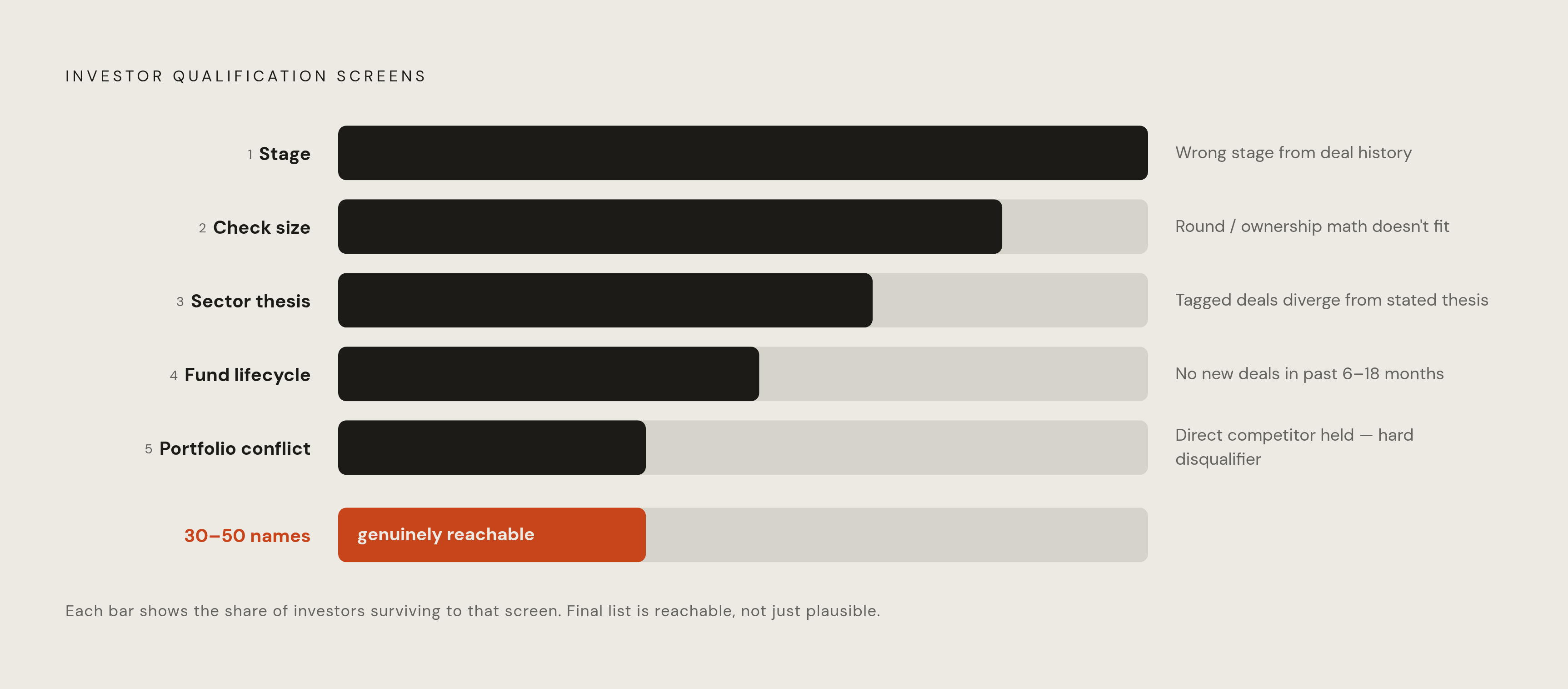
The operational sequence begins with stage, followed by check size and return math. These are the fastest checks with the clearest power to disqualify a target. Stage should reflect recent deal behavior. Check size should fit the round, while ownership and plausible exit proceeds should fit the fund’s economics. A fund that fails either check is dropped from the list.
The third check compares the sector thesis with the companies in the portfolio. Here the last 12 to 18 months of tagged deals establish whether the fund is backing companies like the founder’s, and partner research identifies who is doing that work. The fourth check looks at fund lifecycle through when the fund last closed and whether it has been making new investments. The fifth checks portfolio conflict, separating useful familiarity with the problem space from direct competitive exposure.
The list should have 30 to 50 genuinely reachable investors instead of several hundred names that are only a loose fit. Qualification comes before the target count. A shorter list of funds that can participate is more useful than a longer list padded with investors who fail a hard screen. The purpose of the range is to focus research and intro capital.
Tiering then determines where that capital goes. Investors who pass all five screens come first for warm intro mapping. Those that pass most checks but fall short on a softer dimension can sit in a backup tier, provided the shortfall does not make participation structurally impossible. A hard mismatch is eliminated because a later email does not change the underlying constraint.
The list also needs to remain current. A fund that passes today may fail the deployment-activity screen in six months, and new companies in its portfolio can change whether there is a conflict. Founders should keep checking qualification after the first shortlist is done. This keeps the outreach process tied to the investor’s present capacity to act, instead of a research snapshot that has become stale.
How the filtered list converts through warm intro paths mapped before outreach opens
A qualified list is the input to introduction mapping. Before the first email is drafted, each surviving investor should have a researched warm path wherever one is available. The mechanism is transferred credibility. An investor takes the meeting because a trusted connector’s judgment gives the opportunity weight.
The strongest ordinary path is a portfolio founder who can speak specifically about the team or product. The hierarchy then moves through an alumni network or accelerator cohort connection, a co-investor from a previous round, and a mutual professional connection who substantively knows both parties. Familiarity alone is not the same as endorsement. The value lies in what the connector can credibly say, as well as the relationship that makes the investor listen.
A connector who writes their own check sends an especially strong signal because they put money behind their endorsement. That is stronger than access alone. Intro mapping should therefore identify not just who knows the target partner, but which reachable people have grounds to support the opportunity.
The practical research follows the filtered targets. Founders should identify reachable portfolio founders, partners connected to their existing network, and accelerator cohort alumni with relationships to the target GPs. Relationship graph data can support that mapping across the shortlist before the round opens. An introduction should be prioritized only after the recipient’s structural fit has been established, so that the connector’s credibility is spent on a viable opportunity.
The process feeds changes in fund activity or portfolio exposure back into qualification, while founders work out how to reach each investor who still passes the checks. Founders operating this way begin outreach with both a reason the investor can participate and a credible path to the conversation.