Mapping Investor Co-Investment Patterns to Find Syndicate Leads
Uncover which VCs lead rounds and which follow by analyzing their co-investment histories.

Syndicate leads and syndicate followers carry genuinely different job descriptions. A lead sets terms, runs diligence, negotiates valuation, and often takes a board seat; a co-investor follows those terms with a fraction of the time burden and none of the coordination headache. Founders who pitch a follower as though they might anchor the round are pitching the wrong job description, and the resulting soft pass reflects a structural mismatch that was visible before the meeting ever happened, if anyone had bothered to look at who that investor actually invests alongside.
What co-investment patterns actually reveal about an investor's role in a syndicate
VC firms and angels cluster. Certain firms show up together deal after deal; certain angels trail the same lead across a portfolio, year after year, almost like a signature. This pattern reflects trust built over repeated deals rather than coincidence or laziness. Once two investors have run diligence together once, they've already done the expensive work of figuring out whether the other party's judgment can be trusted, and that trust carries forward. Familiar partners reduce information asymmetry on both sides. So historical pairings become a reasonably reliable predictor of future syndicate composition, not a perfect one, but reliable enough to build a strategy around.
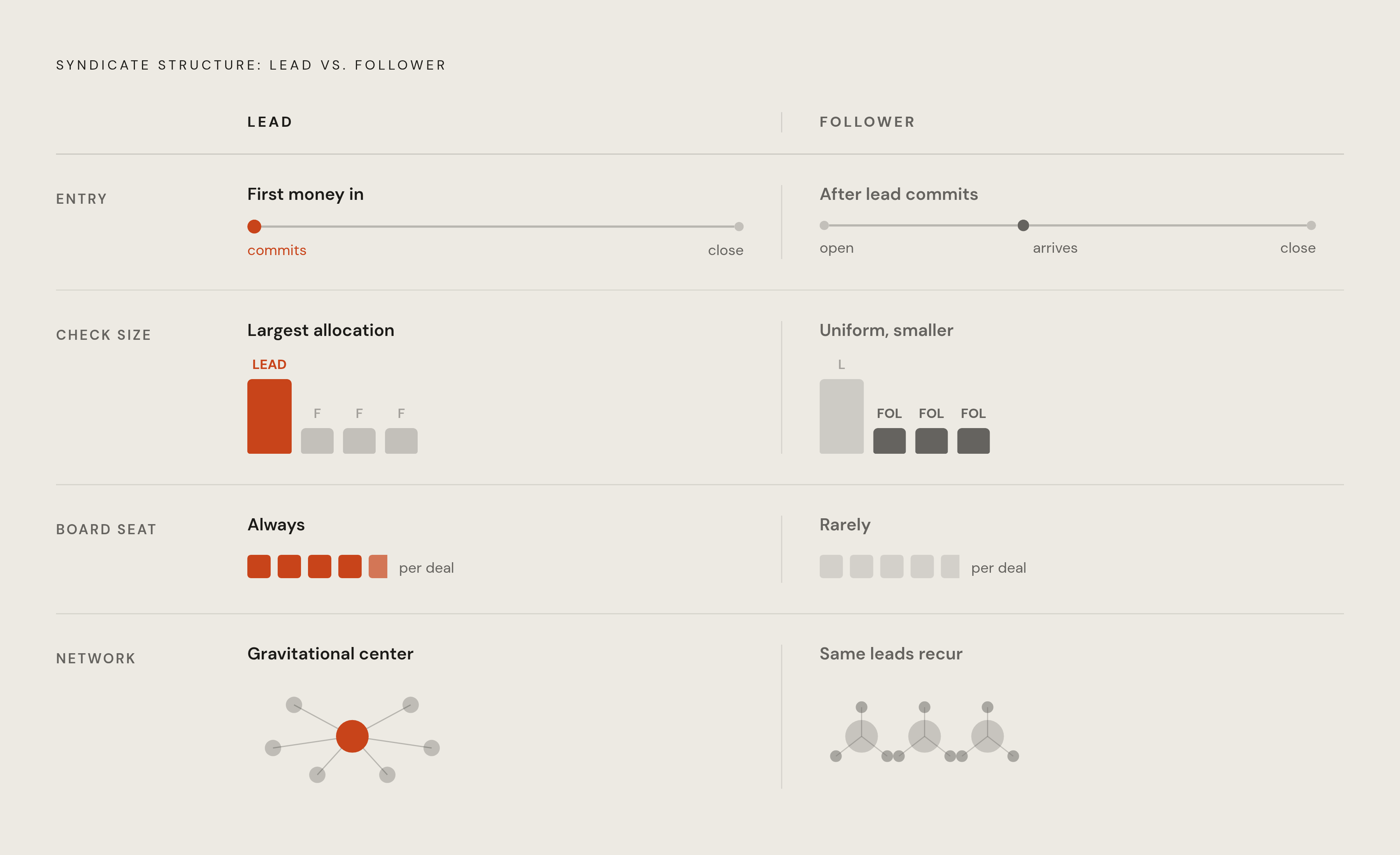
Lead behavior leaves a specific signature in the data. Look for first money into a round, the largest allocation relative to everyone else at the table, a board seat or observer right taken with some consistency across the portfolio. Structurally, leads are the node other investors cluster around.
Follower behavior looks almost like a photographic negative of that. Followers show up after a recognizable lead has already committed. Check sizes stay smaller and more uniform deal to deal. Board participation basically never happens. And the same lead names keep appearing next to them, round after round, because they are joining someone else's conviction rather than generating their own.
Academic work on venture networks backs this up formally. Researchers have modeled VC co-investment as network graphs and applied PageRank-style centrality metrics to find the most connected, highest-influence firms in the graph. The math formalizes the same logic a founder applies by hand when mapping a target investor's position in their own co-investment web: who an investor backs matters less than who they back alongside, and in what order they show up.
Where to find co-investment data before you have a subscription to anything
None of this requires an enterprise data terminal to start. Firm websites list portfolio companies but almost never name co-investors, so they're useful for narrowing sector and stage fit and not much else, tools like Metal, an AI-driven fundraising platform that parses investor thesis pages and deal histories to help founders build a targeted investor list before outreach begins, exist partly to close exactly that gap. Crunchbase's free tier shows funding rounds with investor names attached, which is enough to spot recurring pairings if someone is willing to do the cross-referencing by hand, deal by deal.
AngelList is the strongest free resource for seed-stage syndicates specifically, since it names syndicate leads explicitly and shows who's sponsoring a given deal rather than burying that information. LinkedIn helps too: partner bios often mention notable investments, and Sales Navigator adds filtering by shared connections and deal involvement for anyone willing to pay for that tier specifically. Press coverage and founder interviews round it out. A closing announcement almost always names the lead and lists the co-investors, which means the trade press functions as a searchable, if incomplete, archive of syndicate composition going back years.
Free data has real limits, and it's worth naming them plainly rather than pretending otherwise. Timing (who actually came in first) is rarely disclosed. Check size and ownership percentage are almost never public. And announced rounds lag actual closes by weeks or months, so the most recent activity, the stuff that matters most for figuring out what an investor is doing right now, is systematically underrepresented in any free source.
This is where paid tools earn their cost. PitchBook surfaces fund vintages, LP relationships, deal term history, and co-investor overlap views that no free database reaches. CB Insights expanded its Smart Money scoring in 2025 to include share of rounds led, which is specifically useful for separating investors with a structural lead-taking habit from investors who simply appear often. But the starting move costs nothing: pick one target investor, pull their last ten to fifteen investments, and for each one write down who else was in the round. The names that keep recurring are that investor's trust network, in plain sight.
How to build an actual co-investment map, step by step
Start small. Anchor on three to five target leads whose thesis, stage, and sector fit are already confirmed, not a long wish list padded out for comfort. The exercise only works if the anchor is genuinely lead-wired, so filter by board seat history and relative check size before doing anything else; an anchor that's actually a follower in disguise poisons every step downstream.
From there, build the co-investor roster for each anchor. Compile every named co-investor across their recent portfolio, weighting the last two or three years more heavily since strategy drifts and older patterns get less predictive with age. Note frequency, since an investor who shows up alongside the anchor across multiple deals sits structurally closer than someone who overlapped once. Note sequencing where it's visible: did this co-investor land in the same round as the anchor, or did they arrive later, in a follow-on?
Next, find the nodes with connections across multiple anchors at once. An investor who orbits two or three of the target leads simultaneously is a high-value connector, likely to have a warm relationship with all of them, and becomes a candidate for a warm introduction even when that investor isn't the eventual lead.
Then overlay thesis and recency. A firm that co-invested heavily in a given sector years ago but hasn't made a comparable bet since may simply have moved on, so recency of the pattern carries as much weight as frequency of it. Cross-check the co-investor's stated thesis language against the pitch itself; the goal is alignment, not mere proximity on a chart.
Last, overlay the founder's own network against that roster. Founders in the anchor's existing portfolio who took co-investment from the same recurring partners are warm bridges, people who've literally sat across the table from the investors now being targeted. This is where a proper CRM, tracked consistently over time rather than abandoned after week two, actually earns its keep, tracking which existing contacts bridge to which co-investor nodes. The output is a prioritized list of leads with their habitual co-investors already identified, which is the round's architecture sketched out before a term sheet exists.
The rise of operator-led syndicates and what it changes about who can anchor a round
Angel-led syndicates have formalized into a repeatable process rather than an ad hoc favor. A lead angel sources the deal, recruits members who bring specific go-to-market or technical value, runs shared diligence, and closes through an SPV so the whole bloc shows up as a single line on the cap table. That structure changes who is even eligible to anchor a round: a credible operator can now lead and pull institutional co-investors in behind them, which breaks the old sequence where a VC leads and angels simply follow.
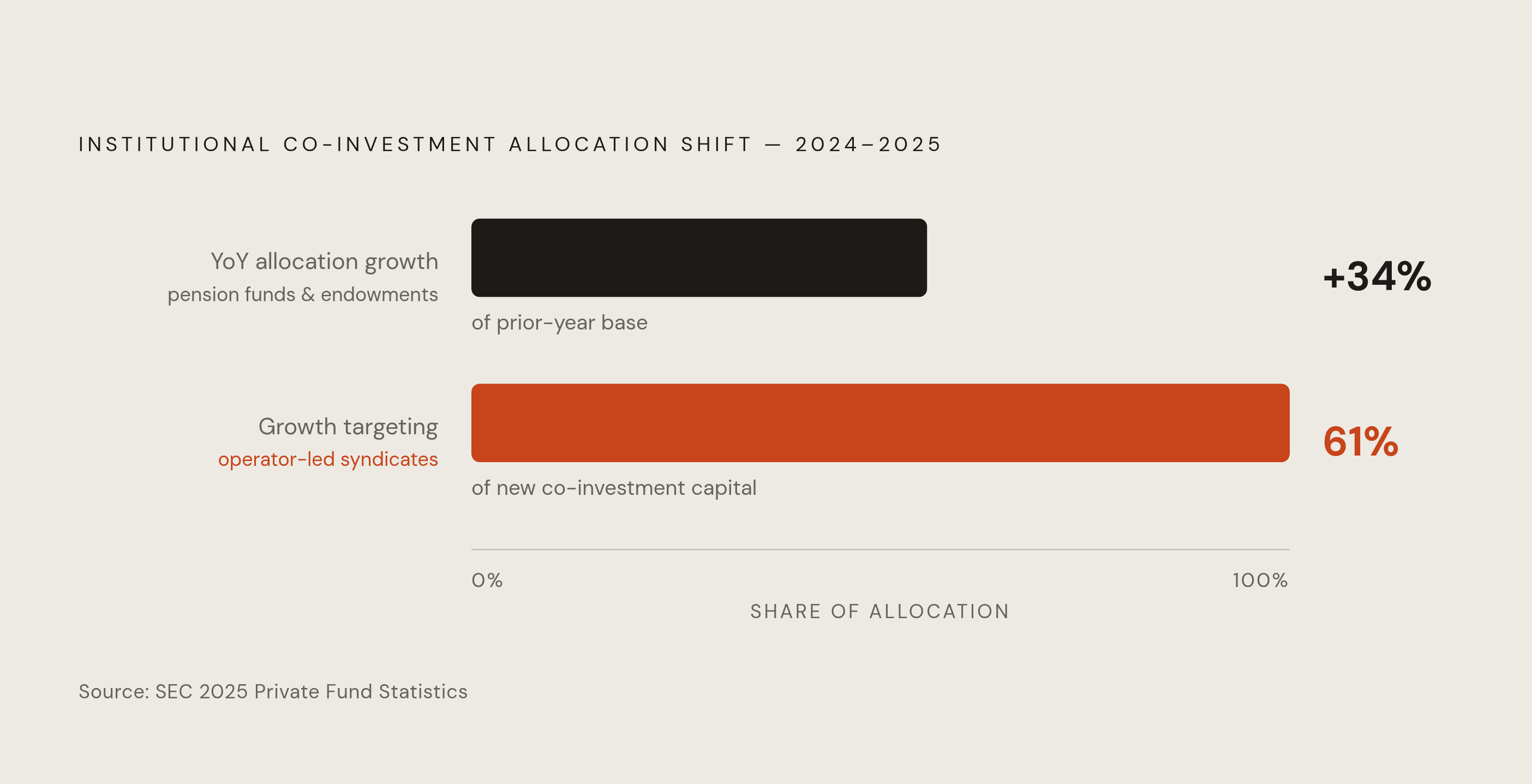
The capital flow backs this up. Per SEC 2025 Private Fund Statistics, pension funds and endowments increased co-investment allocations by 34% year-over-year, with 61% of that growth targeting operator-led syndicates rather than traditional venture funds. That's institutional money actively repositioning toward this structure, a real shift rather than a niche experiment on the margins.
For pattern mapping, the implication is straightforward: angel syndicate leads carry trackable co-investment histories just as VC firms do, and AngelList deal history plus SPV rosters are the place to find them. An operator who has anchored multiple deals in a given sector is a legitimate lead target in their own right, not merely a fallback option chosen after the "real" VCs pass. The same mapping method applies without modification: who does this operator consistently pull into their syndicates, and does that roster include institutional names worth having on the cap table?
One caution matters here. Operator-led syndicates vary enormously in quality and follow-through, so the co-investment check matters more in this segment, not less. A lead with a single SPV and no track record is a fundamentally different bet than one with a repeating roster of credible backers behind them.
What the current fundraising environment means for syndicate dynamics at Seed and Series A
Capital has concentrated hard. A small slice of companies now captures a disproportionate share of venture dollars, and the old spray-and-pray approach has given way to fewer, larger, more confident bets from investors who already have conviction going in. Early-stage rounds, seed through Series C, showed real resilience through 2025, with deal sizes and valuations climbing quarter over quarter, even as late-stage pricing corrected sharply. The window at early stage is genuinely open. It is also genuinely competitive.
PitchBook's Q1 2025 data shows elite firms taking a materially higher share of seed and early-stage funding than their historical average. That concentration means rounds without a recognized lead are harder to fill than they used to be, and a credible anchor is worth more now than it was in a looser market where almost any term sheet could pull a round together.
Fewer rounds are closing overall, but the ones that do close are negotiating from a position of relative strength, which makes precision targeting matter more in a selective market than it ever did in a volume-driven one. The seed-to-Series A gap tells the same story from a different angle: fewer than one in ten seed-funded startups make it to a Series A, and the time between rounds has stretched out considerably. Founders who close the right syndicate at seed, one where the lead already has Series A co-investors sitting in their orbit, are simply better positioned to survive that gap. In a market where leads have real optionality about which deals to take, a warm-path entry built off a mapped co-investment network becomes table stakes.
Turning the map into outreach: how co-investment data changes who you contact first and why
The map should produce two distinct lists, and they play different roles in the sequence. Lead candidates are investors whose history shows them anchoring rounds, taking board seats, and pulling a recurring roster of followers behind them; these are the primary targets. Warm-path connectors are the investors or founders who sit in a target lead's co-investment orbit and can offer a credible introduction; these are often the first call.
Sequencing is not a minor detail here, it's the whole strategy. Approaching a follow-on investor before the lead is committed signals that the process is immature, and it can quietly undermine the round before it starts. The map exists precisely to show who to hold back until the lead conversation is actually progressing.
Personalization follows the same logic. Outreach to a target lead lands differently when it demonstrates real knowledge of their co-investment history, referencing a specific portfolio company they led alongside a named co-investor. That signals diligence. Generic flattery signals the opposite.
Once a lead commits, the co-investor roster becomes social proof architecture in its own right. Approaching a lead's habitual co-investors with that commitment already in hand surfaces trust that already exists between them; the ask shifts from "evaluate this deal cold" to "follow someone you've followed before." That is a fundamentally easier ask, and it should be treated as the whole point of the exercise.
None of this holds together without pipeline discipline behind it, tracking lead status, co-investor conversations, and warm-path introductions in a structured system that stays current well past the second week. Co-investment patterns are, at bottom, a map of trust. And trust, in venture, is the thing that actually moves capital.