Cap Table State Before Raising a Seed Round
Organize your cap table before approaching investors or risk slowing down your funding round.

A cap table tells an investor how a company is owned, but that is not why investors read it closely. They read it to find out how a founding team makes decisions under pressure, whether governance habits are sound, and how much cleanup they would inherit if they wrote a check. The document is a diagnostic tool before it is ever a ledger.
A seed-stage cap table appears in pitch meetings because it shows how new money will sit alongside everything that came before it. It projects post-investment ownership and dilution in a single view, and that view either reassures an investor that the company is organized enough to handle institutional capital or it doesn't. Investors use it to confirm that founders still hold a meaningful stake, to look for structural problems like too many small shareholders or grants that were never properly documented, and to work out what percentage they would own today and how that number shrinks as future rounds come in. Startups that walk into a raise with a clean, current cap table tend to close faster, because disorganization breeds uncertainty among people whose job is to price risk, and uncertainty slows negotiations down or ends them.
What a healthy seed-stage cap table looks like
Before any outside capital arrives, a cap table should be narrow enough to explain in a few sentences. Founders hold common stock subject to vesting, a modest option pool sits in reserve for future hires, and any pre-seed instruments are recorded in full, with every term spelled out explicitly. Anything more elaborate than that at this stage usually signals that someone gave away equity without thinking through the long-term consequence.
Advisors, where they're part of the picture, should hold a modest slice each, and that grant should always sit behind a signed Advisor Agreement. Friends-and-family rounds, when founders choose to raise one, vary a great deal in size, but many practitioners recommend keeping that give-away as small as possible, ideally in the low single digits as a percentage of the company, and structuring it through SAFEs or convertible notes. That choice keeps the capitalization table simpler and pushes the valuation conversation to a point when the company has more data behind it. At this stage, the whole thing can live in a well-kept spreadsheet. Founders should track the number of common shares held by each person, the vesting schedule attached to each grant, and the full terms of any convertible instrument outstanding: the principal amount, the discount rate, the valuation cap, and whether a most-favored-nation clause applies. The goal is a clear, current record that any investor could read in five minutes and trust.
How SAFEs accumulate into a dilution problem
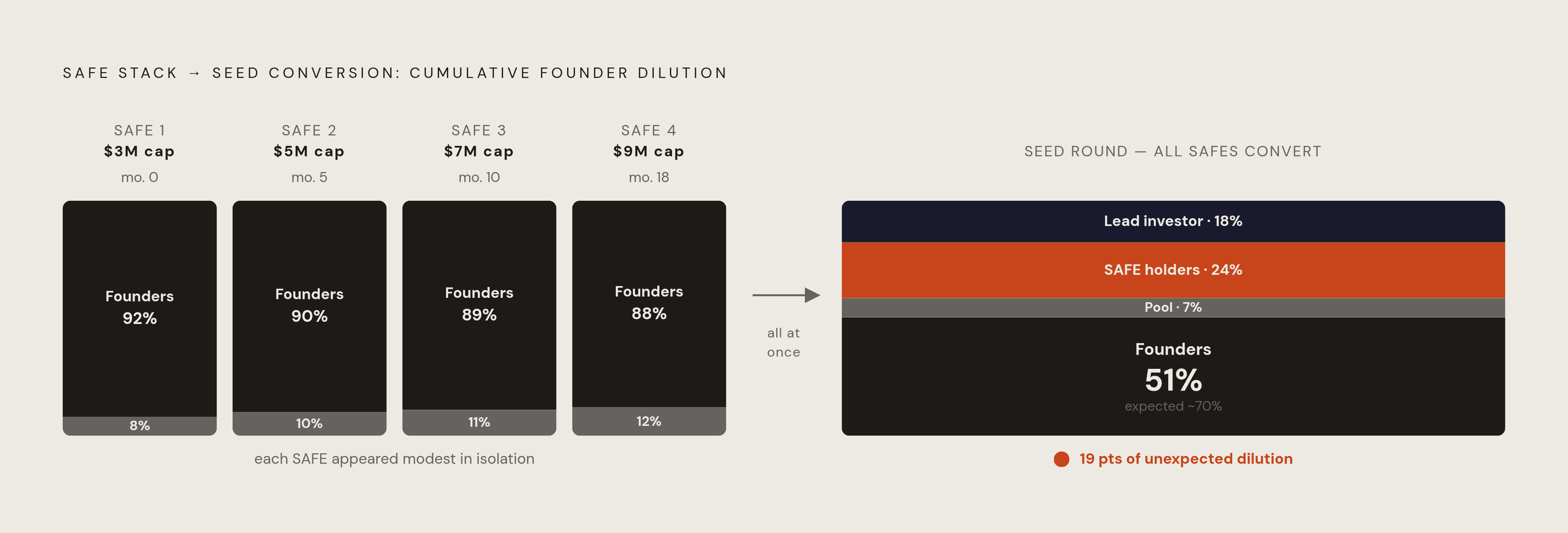
The most common structural problem founders bring into a seed round is a stack of SAFEs raised over time without ever modeling how they convert together. Each one felt, at the moment it was signed, like a quick and simple way to extend the runway. Lined up and converted at once, they become a governance and dilution surprise that an investor will spot within minutes of opening the cap table.
Most seed rounds today raise through SAFEs, and the post-money SAFE has become the dominant version of the instrument. A post-money SAFE gives the investor a predictable ownership percentage calculated against a defined post-money cap, which makes the instrument easier for founders to understand at the moment of signing. That same clarity raises the stakes of the arithmetic once several SAFEs are stacked on top of each other, because each one locks in its own slice of the future cap table independent of the others. A founder who raises four SAFEs over 18 months, each at a different valuation cap, will often discover only at the priced seed round that those four instruments convert separately and collectively claim a larger share of the post-money table than anyone involved expected. SAFE holders can end up absorbing a disproportionate share of the company for a relatively small amount of total capital raised, leaving less room than planned for the new lead investor and for the founders themselves. The discipline that prevents this is straightforward in concept, even if founders skip it under the pressure of closing a bridge quickly: model every SAFE before it's signed, negotiate the cap with the same seriousness given to the dollar amount, and run a full conversion scenario before adding any new instrument to the stack.
The five red flags investors find in seed-stage cap tables during diligence
Investors doing diligence on a seed cap table are scanning for a short, well-known list of structural problems, and any single one of them can slow down or sink a term sheet.
Dead equity from a departed co-founder is the first and often the most damaging. If someone who left the company early still holds a significant stake, investors read that as a governance failure waiting to happen: a large shareholder who contributes nothing going forward but retains the power to complicate decisions later. The structural fix is standard four-year vesting with a one-year cliff from day one, so unearned equity never fully vests if someone leaves early. Where the damage has already happened, the practical remedy is a negotiated buyback before the next round closes.
Founders owning too little equity going into the round is the second flag. Investors expect the founding team to hold a combined stake large enough to keep them motivated through years of hard work, and a healthy benchmark at seed is a substantial majority of the company, with founders still holding roughly a third or more by the time Series A happens. Founders who have already diluted heavily before a priced seed round, whether through an oversized friends-and-family give-away, generous advisor grants, or an uncontrolled SAFE stack, arrive at the negotiating table with less leverage and send a signal that earlier decisions weren't managed carefully.
Excessive advisor equity is the third. Advisors should receive a small slice each, with total advisor equity kept well below 5% of the fully diluted cap table. When investors find advisors holding outsize individual stakes, or an advisor pool that has grown past reasonable bounds, the conclusion they draw is that the founders either didn't know how to negotiate equity or were buying credibility they couldn't earn on their own. Every advisor grant should sit behind a signed Advisor Agreement, and undocumented advisor equity is a diligence problem on its own, regardless of how small the grant was.
Missing or incomplete founder vesting is the fourth. Investors are wary of founder equity that was never subject to vesting or was documented poorly, because a founder who leaves still owns a major stake while contributing nothing to the work ahead, leaving the remaining team to carry more weight for the same upside. If founder stock was issued subject to vesting, founders need to confirm whether an 83(b) election was required and whether it was filed within the mandatory 30-day window. A missing or undocumented 83(b) election creates a tax problem that appears during diligence and is far easier to fix early than to untangle once investors are deep into the process.
Undocumented equity promises and cap table discrepancies round out the list. The failure here is rarely one dramatic legal mistake. It's usually a pile of small gaps: a cap table that doesn't match the underlying legal paperwork, founder stock that was promised but never formally issued, missing IP assignment agreements, or advisor arrangements that were never signed. Each gap on its own creates a question mark, and a cap table with several of them signals that the company hasn't been run with much operational discipline. Stripe's cap table guide notes that a startup should update its cap table anytime its ownership structure changes, and keeping that habit is what prevents the retroactive reconciliation that trips up diligence later.
Option pool size and timing as a hidden negotiation inside the round
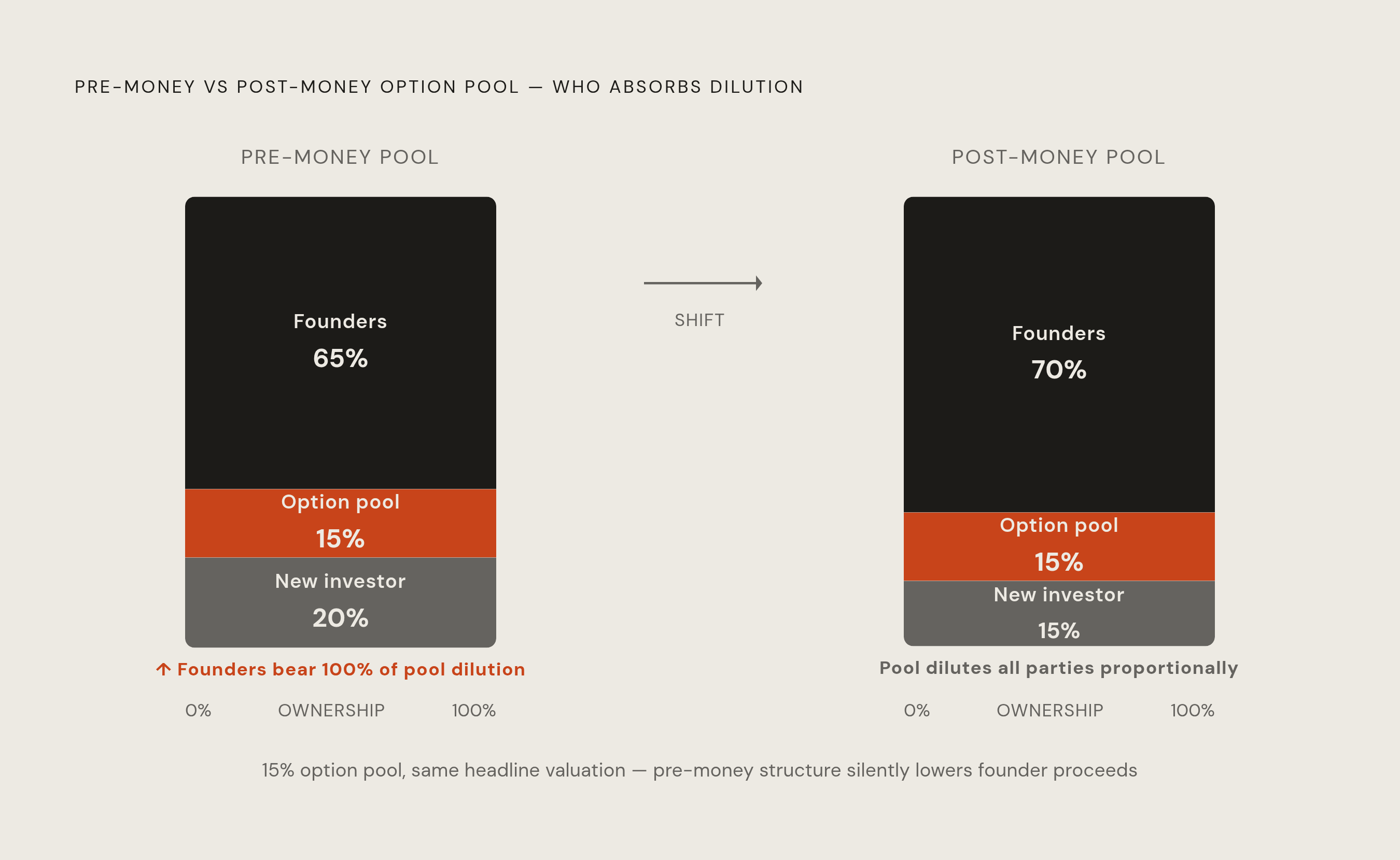
The option pool looks like a simple hiring tool, but inside a term sheet it functions as a lever that can quietly shift dilution onto founders without ever touching the headline valuation. Founders who confuse a pre-money option pool with a post-money option pool can give away equity without realizing it, on top of whatever dilution they already agreed to on paper.
Investors often require the option pool to be created or expanded before their investment is calculated, an approach known as the pre-money option pool. Under that structure, the dilution from the pool lands entirely on founders and existing shareholders. A term sheet that advertises a headline pre-money valuation but also requires a 15% post-money option pool carved out before that valuation is set effectively lowers the real value founders are getting for their equity. This is often called the option pool shuffle, and it's worth founders recognizing the term the first time they see it in a term sheet, because it changes what the valuation actually means in practice. Founders with enough negotiating leverage can push for a post-money pool instead, where the new investor shares in the dilution from the pool alongside the founders. Most institutional rounds still default to the pre-money structure, so winning that point takes real leverage, not just a polite ask.
The practical counter is to negotiate the pool size against an actual, short-term hiring plan instead of accepting whatever number the investor proposes as standard. Option pools at seed typically make up a meaningful share of the fully diluted share count, and there's a reasonable starting point for most early-stage teams, but the right number depends on who the company actually plans to hire before the next round, not on an industry average built to pad the investor's effective ownership.
The dilution trajectory from seed through Series A
Investors reading a seed cap table are running the same table forward to Series A and beyond, and a company that has already diluted its founders heavily before the seed round even closes raises a real question: will the ownership structure still motivate the founders and attract institutional capital two years from now?
Seed rounds dilute existing shareholders by a meaningful amount, and Series A rounds add a further round of dilution in a similar range. These effects compound rather than reset with each round, so the decisions founders make at pre-seed and seed directly shape how much of the company they still hold by Series A. Founders typically retain roughly 36% of their company after Series A closes, and investors frequently point to a threshold above half as the benchmark a founding team should clear going into that round, to keep both motivation and leadership continuity intact. A team that arrives at Series A already below that threshold invites a harder question from investors about whether the decisions made back at seed were managed with any discipline.
There's a related argument about runway that cuts against the instinct to minimize dilution at every turn. Underfunding a seed round to protect short-term ownership percentages often forces a bridge round later, and bridge rounds tend to be more dilutive than raising the right amount from the start would have been. Eighteen months of runway should be treated as the floor, with 24 to 30 months the more realistic target in the current market. The goal is survival and leverage at the next raise, not the lowest dilution number on paper today. A related warning sign is the party round, where a founder collects many small checks but no investor commits as a real lead. Series A investors read the absence of a lead as a sign that nobody was willing to put real conviction behind the company, and that signal matters on its own, independent of how much dilution the round actually caused.
The practical steps founders can take to clean up a cap table before starting a raise
Most of the problems that worry investors about a seed-stage cap table can be fixed before a raise ever starts. The fix has to happen before diligence begins, because once questions start coming up mid-process, every open item slows things down and reads as disorganization.
Start by reconciling the cap table against the actual legal paperwork. Every equity grant, every SAFE, and every convertible note on the table should be backed by a signed, executed document, since gaps between what the spreadsheet says and what the legal record shows are the most common reason diligence drags on. Confirm that any 83(b) elections that were required were actually filed, and that the filing can be documented. If any are missing, get a startup attorney involved before approaching investors.
Next, model every SAFE conversion before the raise begins. Run the full dilution scenario, converting every outstanding SAFE at its own cap against the seed valuation being targeted, so the fully diluted post-money picture is known in advance of the negotiation. If that math shows SAFE holders absorbing a disproportionate share of the post-money table, deal with it directly, either by talking to existing SAFE holders or by adjusting the structure of the new raise.
Address any dead equity sitting with a departed co-founder before outreach starts. If a former co-founder's stake is large enough to concern investors, negotiate a buyback or restructuring ahead of time rather than walking into a first meeting with the problem still open.
Audit the advisor pool and put every grant on paper. Confirm each advisor's equity is within a reasonable range, that a signed Advisor Agreement backs it, and that the total advisor pool won't raise eyebrows when an investor adds it up. Any informal or unsigned advisor arrangement should be formalized or closed out before diligence starts.
Finally, build a forward-looking model of the fully diluted cap table as it will look right after the seed round closes, including SAFE conversions, the option pool, and the new investor's shares, and check founder ownership against the benchmark trajectory toward Series A. That same model is the right tool to bring into the option pool negotiation: a specific, short-term hiring plan that justifies a particular pool size carries far more weight than accepting whatever default an investor proposes.