Use of Proceeds Slide Framing for Seed Rounds
Seed investors now read the proceeds slide as proof of operational thinking, not accounting.

More money is moving through seed-stage venture capital, but the number of deals that get funded keeps shrinking. Each check a seed investor writes carries more weight than it used to, so the firm behind it needs a sharper reason to believe before signing. A founder's use of proceeds slide, once a filler page that absorbed whatever didn't fit earlier in the deck, now has to do independent work: it has to show that the capital being requested has already been thought through at the level of an operator, not an optimist. CRV's guidance on seed decks describes the strongest ones as a single argument a partner can follow in one pass, and a proceeds slide that merely lists spending categories breaks that argument. The slide's job has changed from absorbing leftover space to answering a direct question: what does this money produce, and when will the investor see it.
What investors read in the proceeds slide
An investor looking at a proceeds slide is not auditing a budget. The slide is a test of whether the founder thinks operationally, and at the seed stage, where traction data is necessarily thin, it is one of the few places that test can actually run. CRV states that it reads decks looking for founders who understand their problem from lived experience rather than from a template, and the proceeds slide is where that understanding either shows itself or fails to. If a slide names categories of spend without naming what each category is supposed to produce, it reads as a financial plan. A slide that ties each dollar to a dated outcome reads as a commitment, and investors are looking for the commitment because it tells them what failure would look like and how soon they would recognize it. By the time a partner reaches the proceeds slide, the raise amount is no longer a mystery: CRV's guidance puts that number on the cover slide, stated alongside the round's stage. What remains unanswered at that point in the deck is what the number buys, and that is the question the proceeds slide exists to close.
The milestone contract structure: what the slide must contain and why each element earns its place
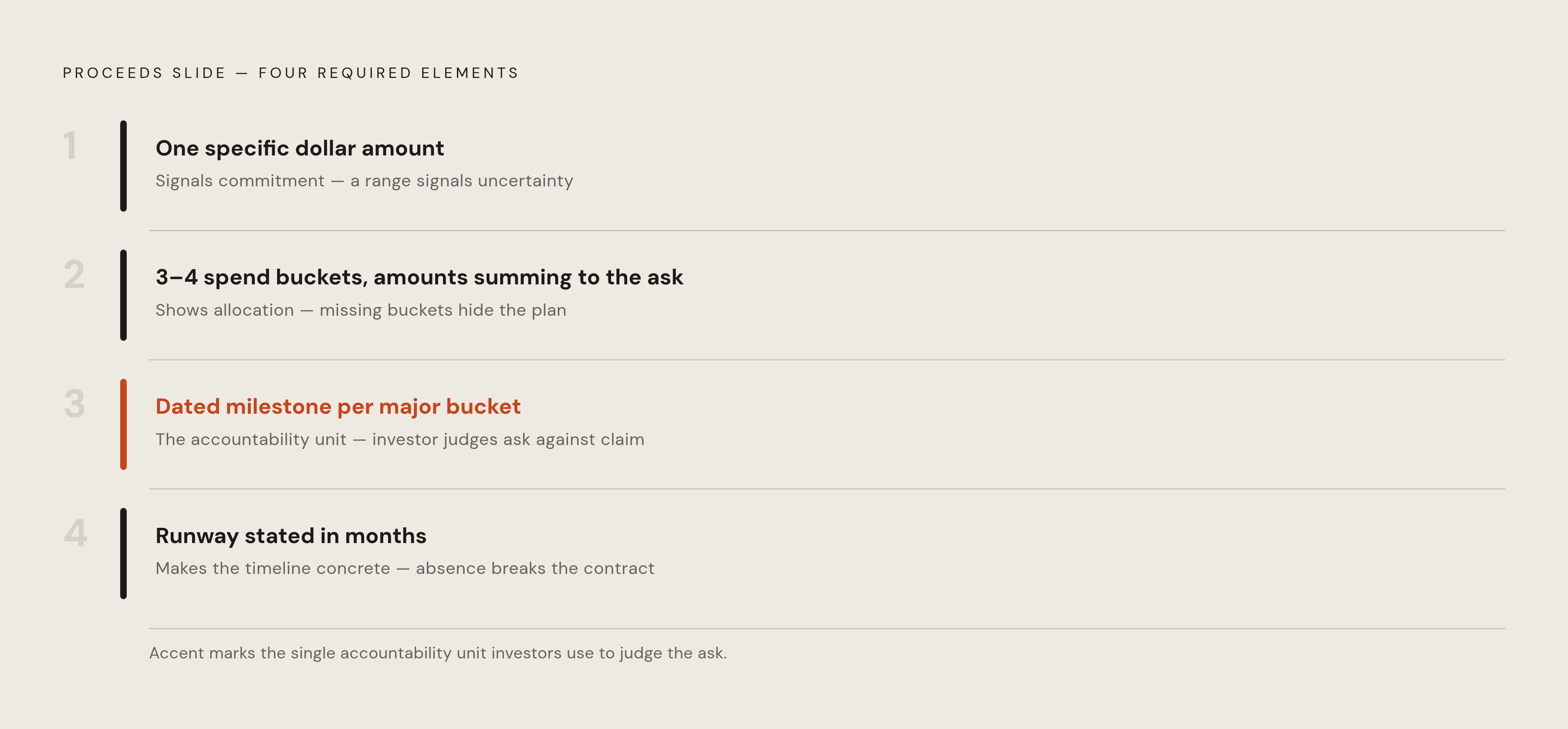
A proceeds slide that functions as a milestone contract rests on four components, and each one is load-bearing: take any single one away and the commitment the slide is supposed to make falls apart.
The first is one specific number, not a range. A range signals that the founder hasn't yet settled on what the company actually needs, and that uncertainty undercuts the operational discipline the rest of the slide is trying to demonstrate. Specificity on the ask is established earlier, on the cover slide, where CRV's guidance places the raise amount and stage. If a range gets reintroduced on the proceeds slide, it undoes that work before the investor even gets to the spending logic.
The second is three to four spend buckets with dollar amounts attached that sum to the ask. Naming categories like engineering, sales, and product is the baseline. Attaching a dollar figure to each one shows the founder has actually sized the hires and initiatives behind the label.
The third is a dated milestone tied to each major bucket. The milestone functions as the unit of accountability on the slide: it tells the investor what to expect and by when, and it establishes what the founder will be measured against when the Series A conversation eventually happens. This raise gets us to a specific metric by a specific month. Stated that way, an investor can judge whether the size of the ask actually matches the milestone being claimed.
The fourth is runway, stated explicitly in months. Runway should never be left for the investor to infer from the raise amount and an assumed burn rate. It needs to be stated directly, because runway determines how much time the milestone actually has to be hit, and whether there's enough buffer left over to run a fundraising process before the company runs out of cash.
Connecting spending allocations to the Series A bar the seed round is supposed to clear
The strongest proceeds slides are built in reverse: starting from the Series A threshold the company needs to clear and working backward to what the seed round must buy to get there, rather than starting from the current burn rate and projecting forward. Series A in the current cycle carries a recognizable bar, specific expectations around ARR, growth rate, and unit economics, and the entire purpose of a seed round is to buy the time and the capability needed to clear that bar. The proceeds slide should say that logic outright, not leave it implied.
Each spend bucket on the slide should map to a specific capability that advances the company toward that threshold. Engineering hires should compress the product roadmap. Sales hires should validate a repeatable go-to-market motion. Marketing spend should prove out a payback period investors can underwrite. None of these allocations are generic headcount; each one is a specific bet on what closes the gap between where the company is and what Series A investors will expect to see.
This backward-from-Series-A logic also answers the pressure founders feel to raise large, loosely structured rounds at high valuations. Staged fundraising discipline exists because investors have grown wary of oversized seed rounds that fund open-ended exploration rather than a defined set of milestones. A proceeds slide that ties each tranche of spending to a specific de-risking milestone is the single-round version of that same discipline, compressed into one slide instead of spread across multiple closings. Founders who skip this step and raise at an inflated post-money valuation on a vague plan often end up with a cap table full of investors who need a markup at the next round rather than partners who can open doors when the company needs them. The proceeds slide is the first place that outcome can be prevented, because it forces the founder to say, in specific terms, what de-risking actually looks like before the money is spent.
Efficiency is not optional in the current fundraising environment. Spend allocations that compound, headcount that builds a proprietary capability rather than headcount that just keeps the lights on, read as disciplined. Allocations that look like growth pursued without regard for cost are disqualifying on sight. For AI-native companies, this standard has an added layer: the spending plan has to map to defensibility, whether that's a data advantage, model differentiation, or a proprietary workflow, and not to growth alone. A plan that states "we use AI" without connecting that spend to a moat is a signal experienced investors catch immediately, and it works against the founder.
What funded seed decks show on this slide
The proceeds slides that appear in decks which actually closed share a common trait: specificity at the level of named hires and named metrics, not categories and rough percentages. CRV's own framework points to Qortex's seed deck, which raised $10 million, as an example of a broader structural discipline worth following, specifically its separation of a distinct product-answer slide from the product slide itself. The lesson generalizes beyond that one slide pairing: each argument in the deck gets its own slide, and nothing appears that fails to move the argument forward. A proceeds slide that tries to do double duty as both a budget summary and a milestone commitment violates that same discipline.
Decks are not static documents, and the strongest founders treat every investor meeting as a source of free diagnostic feedback. An objection like "the milestone is too aggressive" or "the runway is too thin" is information, and founders who revise the proceeds slide after each meeting converge on a stronger version of the contract with every iteration. That iterative process is how a proceeds slide goes from a reasonable first draft to one that survives partner-level scrutiny.
The weak version of this slide is easy to spot because it's so common. Three categories, rough percentages assigned to each, an 18-month runway stated with no milestone attached to any of it. An investor reading that slide gets a budget, not a commitment, and carries every unresolved question about the plan straight into the meeting. CRV notes that a strong traction slide can decide the meeting on its own. The proceeds slide is the forward-looking half of that same argument: traction proves what the company has already accomplished, and proceeds proves what the new capital will accomplish next. Together, the two slides give the investor the complete case they need to say yes.
AI-driven investor screening and proceeds slide precision
If a proceeds slide lacks specificity, it risks never reaching a human reader. Investors are already using tools that automatically parse incoming pitch decks, extracting business model details, founder backgrounds, and traction metrics to score and triage which decks advance to a partner's desk. A vague proceeds slide, one that doesn't surface a clear milestone or a coherent spend logic, scores poorly at that first automated pass before a partner ever opens the file.
The screening layer reads for the same signals a sharp partner reads for: specificity, coherence between the ask and the milestone attached to it, and consistency between what the traction slide claims and what the proceeds slide commits to next. That convergence changes what a founder is actually writing for. The proceeds slide now has two audiences, the automated system that screens it first and the partner who reads it second, and the milestone contract structure happens to serve both at once. Structured, specific, milestone-anchored language is exactly the kind of signal that pattern-matching screening tools are built to surface as credible. The discipline the slide requires for a human partner is the same discipline it needs to clear the automated filter.
The same shift that raised the bar on the investor side has also narrowed the gap on the founder side. Tools that surface investor targeting intelligence, track outreach pipelines, and automate parts of the fundraising process now let founders identify the right investor list by stage, sector, and check size with a precision that used to belong only to firms with institutional research teams behind them. That targeting matters as much as the slide itself: a well-built milestone contract delivered to the wrong investor still produces a pass.
The three mistakes founders make on this slide that signal operational immaturity to investors
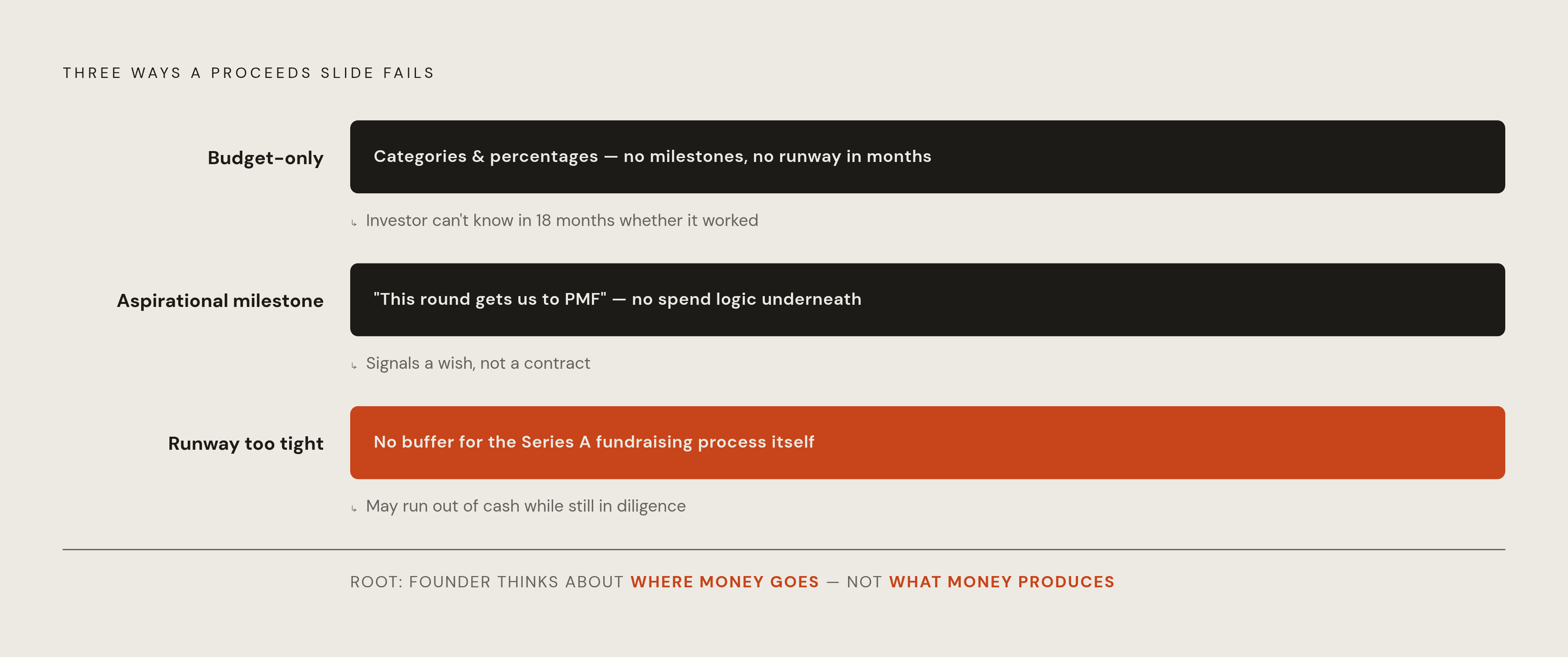
Most proceeds slides fail because the slide breaks the milestone contract in one of three specific ways, and each failure signals a different kind of operational immaturity to the investor reading it.
The first is the budget-only slide: three categories, approximate percentages, no milestones, no runway stated in months. This is the most common failure, and it tells the investor how the money will be spent without ever saying what that spending is supposed to produce. The unspoken objection sitting in the investor's mind is simple: how will they know in 18 months whether this worked? A budget-only slide leaves that question open. A milestone contract closes it.
The second is the aspirational milestone, a goal stated with no spend logic underneath it, phrases like "this round gets us to product-market fit" or "this round establishes our brand." That isn't a contract, it's a wish, because neither the founder nor the investor could point to a specific outcome and agree, later, on whether it was actually hit. The fix is to state a milestone specific enough that both sides would reach the same verdict on it independently.
The third is runway sized too tightly against the milestone date, with no buffer built in for the Series A process itself. Raising a round takes time even after a company hits its milestone, and a slide that assumes the next check arrives the moment the metric is reached is asking the company to run out of cash while still in diligence. The fix is conservative runway sizing: build in buffer beyond the milestone date to cover the fundraising process that has to happen after the milestone is met.
All three mistakes trace back to the same root habit. The founder is thinking about where the money goes rather than what the money is supposed to produce, and the milestone contract framing exists specifically to force that inversion.