Narrative Arc Differences Between Seed and Series A Decks
Seed investors bet on potential, but Series A investors need proof the model already works.

A founder pulls up the old seed deck, changes the revenue line, swaps in a new logo slide, and halfway through the edit realizes the whole document no longer holds together. That moment of starting over happens more often than most founders expect, and it points to the real mistake: treating the Series A deck as the seed deck with updated numbers. The two documents fail for the same reason when this happens, because investors are not just reading the numbers on the page. They are reading how the founder tells the story as a stand-in for how that founder will run a company at scale. A deck built to answer seed questions will raise flags the moment it lands in a Series A meeting, because seed investors and Series A investors are asking for different things and weighing different risks. Getting this wrong carries real weight: when a founder misreads what stage of evidence is expected, institutional investors take it as a sign the founder lacks the strategic clarity needed to run the next phase of the company.
What each investor is actually trying to evaluate, and why those are different cognitive tasks
Seed investors size up potential. Series A investors underwrite a system. Those are two different jobs, and that difference is why identical evidence can land well in one room and fall flat in the other. At seed, the founding team is frequently the strongest piece of information an investor has to go on, since the business itself is too early to judge on its own. What matters is whether the team can learn fast and adjust, not what the product or revenue line looks like today. Seed investors therefore work off proxy signals: how clearly the founders can state the idea, how coherent the business model sounds, whether the team seems built to figure things out under pressure.
By Series A, the question has moved. It is no longer whether the business could work. It is whether the business already works, what the data proves about that, and what the company looks like once serious capital gets put behind it. Institutional investors at this stage run formal diligence: they ask for the data room, they build their own model of the unit economics, and the deck needs to survive that level of scrutiny rather than just make a good first impression. Proxy signals that carried weight at seed lose their power here, replaced by consistency signals: repeatability, efficiency, retention, and whether the story being told in the deck matches the operating reality that the metrics actually describe.
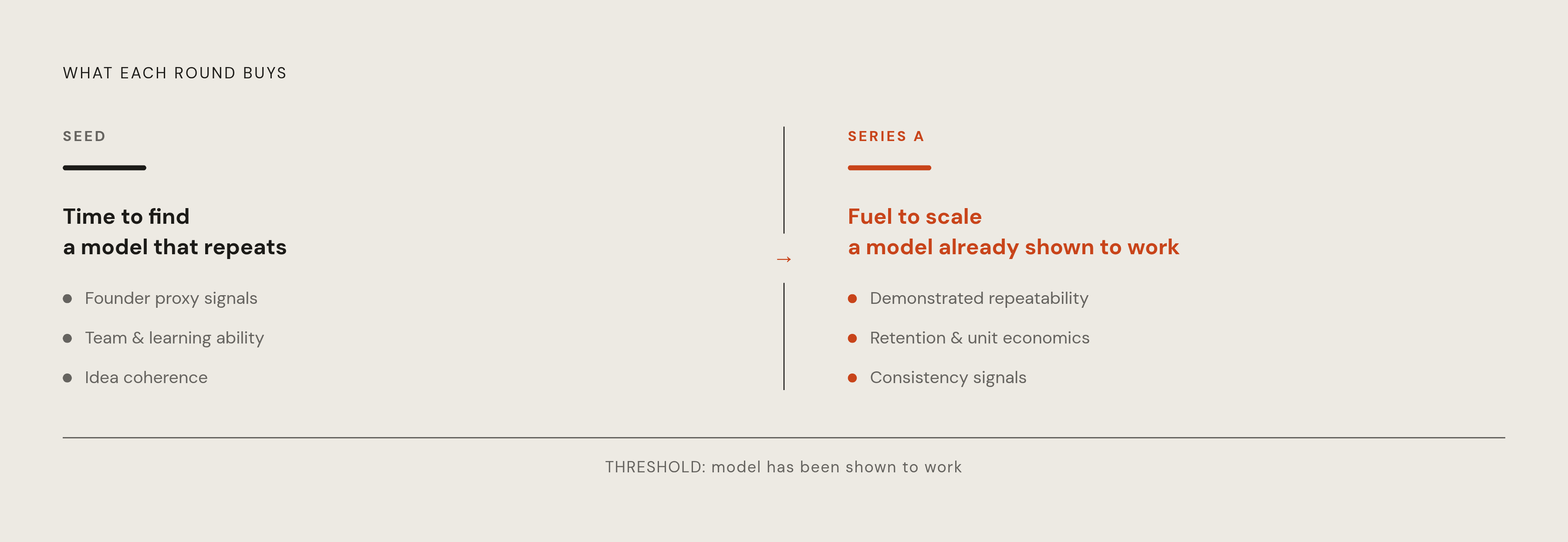
The clearest way to hold the distinction is through what each round is buying. A seed round buys time to find a model that repeats. A Series A buys fuel to scale a model that has already been shown to work. Each deck is making a different purchase argument, and a founder who doesn't register that difference will keep pitching the wrong purchase to the room in front of them.
What Must Stay Constant Across Both Decks
Three things need to hold steady across every round a company raises: the mission, meaning why the company exists; the core differentiation, meaning how it's positioned to win; and the founding insight, the piece of market truth the founders saw before anyone else did. These are the spine of the story, and they should read the same at Series A as they did at seed, even as everything built around them changes.
When a Series A deck introduces a new differentiation claim that never showed up at seed, investors don't read it as growth. They read it as a sign that the earlier story might not have been true, and they start wondering which version of the company they're actually looking at. The instinct many founders have, to "mature" the pitch by adding fresh claims, tends to work against them: it signals that the original thesis wasn't solid enough to carry the company this far on its own.
Consider a founder whose seed deck claimed, "we understand small business owners better than anyone." At Series A, that same claim should still be on the page, but now it's backed by customer interviews, retention data broken out by segment, and usage patterns that show the understanding paying off in practice. The insight itself doesn't move. What changes is how much proof sits behind it.
How the Opening Slide Logic Inverts
A seed deck earns the investor's attention by laying out a problem worth solving. A Series A deck earns it by showing that the machine built to solve that problem is already running.
Seed decks tend to open on a problem narrative, the kind of story that convinces an investor the founder has spotted something real in the market. Series A decks more often flip that order: traction comes first, and the problem gets revisited afterward as context for why that traction matters. The problem slide doesn't disappear, it just changes job. Instead of opening the pitch, it now explains why the numbers the investor just saw are impressive.
The Series A opening slide should carry one undeniable proof point, whether that's monthly recurring revenue, a growth rate, or a customer count, strong enough on its own to earn attention for everything that follows. Series A decks lean more heavily on numbers throughout, because the goal is to build confidence that this company can keep growing, and burying the traction in the middle of the deck works against that goal directly. Investors expect to see revenue and growth evidence from the first slide, and a deck that makes them wait for it reads as unprepared for the room it's in.
That structural choice reflects a question of trust sequencing. At Series A, investors need to believe in what the company has already done before they'll believe in what it plans to do with new money. Reversing that order, asking for belief in the plan before proving the track record, is the seed-stage approach appearing in the wrong meeting.
How the Traction Section Expands at Series A
At seed, traction backs up the argument. At Series A, traction is the argument, and the section has to grow structurally to hold that weight. At seed, if the hard numbers are thin, qualitative signals can fill the space: customer testimonials, the size of a waitlist, early signs that people want the product. "Product potential" is an acceptable stand-in for proven demand at that stage, because the business hasn't had time to generate much else.
Series A removes that cushion. The traction section stops being a single slide and becomes a multi-slide centerpiece covering revenue alongside growth rate, a working business model with real margin data, customer acquisition that's demonstrably profitable with unit economics attached, and, for companies selling to enterprise customers, sales cycle length and average contract value. A deck that collapses all of this into one slide of vague totals is not doing the job. A TechCrunch teardown of a $5.4 million Series A deck showed exactly this failure: the company put its revenue on a single case-studies slide as unexplained lump sums, and reviewers came away unable to tell how many customers the company had or how quickly revenue was growing. That gap might pass unnoticed at seed. At Series A, it damages the pitch.
Cohort analysis does something a single growth chart cannot. It shows whether customers brought on in later periods retain as well as the earliest customers did, which is the clearest available signal of product-market fit. A growth chart drawn from gross revenue can hide churn, and cohort data exposes that churn before an investor has to find it independently in the data room.
Metrics that never needed to appear in a seed deck now belong at the center of the traction section: customer acquisition cost, lifetime value, the ratio of lifetime value to acquisition cost, and net revenue retention. These need to come from actual operating history rather than projections, because by Series A, investors expect numbers that describe what already happened, not what the founder hopes will happen next. Net revenue retention above a healthy baseline tells an investor that existing customers are spending more over time, which is a stronger signal than simple retention of the customers a company already has. Gross retention alone no longer impresses anyone at this stage, it's the floor, not the differentiator. Burn multiple, the ratio of capital spent to new recurring revenue generated, has become a central question as well, since it tells an investor whether growth is coming cheaply or expensively.
Two categories of company need to read this traction section differently. AI-native companies get benchmarked against a different standard than traditional SaaS businesses, particularly around growth rate and margin profile: AI-native startups commonly run lower gross margins than a classic software company would, and some hypergrowth companies still clear investor bars when their burn efficiency is strong enough to offset that margin gap. A founder building an AI-native company should benchmark against AI-native norms specifically and label the company that way in the deck, rather than inviting a comparison against SaaS margin expectations that don't apply. Deep tech and biotech companies face the opposite adjustment: the key Series A metric isn't revenue at all, it's technical de-risking. The traction section for these companies should show progress against scientific or engineering milestones, patents filed, or results from clinical trials, since that's the evidence that actually tells the story of de-risked progress at this stage.
Go-to-Market: From Hypothesis to Proof
The go-to-market slide doesn't just need new content between seed and Series A; it needs to do a different job. At seed, the go-to-market slide is a hypothesis: a list of channels worth testing and a guess at how customers will find the product, which makes sense for a business still searching for what works. At Series A, the slide has to show that a motion for acquiring customers already exists and already repeats.
Investors at this stage want to see go-to-market execution that's proven out, along with where the company intends to put more capital to work. The slide needs to answer "what is already working, and why are we doubling down on it with this money," not "what might we try next." A slide that lists channels like brand partnerships or content marketing without attaching cost data and conversion rates reads as a seed-stage slide no matter what round the company is technically raising. The absence of acquisition cost numbers is the signal that gives it away.
This is also where the logic of capital deployment lives in the deck. The GTM slide at Series A has to make clear that capital, not product quality, not product-market fit, not organizational capability, is the actual constraint on further growth. Capital does not repair broken unit economics. It only makes whatever already exists, good or bad, run faster.
How the Team Slide Reverses Its Weight
Most founders assume the team slide barely needs to change between rounds. It undergoes one of the sharpest reversals in the whole deck. At seed, the team slide answers why these particular founders are the right people to take on this problem. At Series A, it has to answer a different question: can these founders build and lead an organization. Those are separate questions.
At seed, the signal that matters is founder-market fit: proof that the founders have spent enough time inside this problem to see what an outsider would miss. At Series A, that signal gets replaced by organizational capability. Investors want evidence that the founders have hired well, filled the skill gaps the business actually has, and built a company that can execute beyond what the founders alone could do.
A common failure at this stage is a team slide full of recognizable logos from past employers that says nothing about why this particular team fits this particular market. Every hire and every organizational decision on that slide should reinforce one thesis: that this team can scale this specific business. Investors want to see operators who will execute sitting in the organization, with advisors offering opinions only from the board. The org chart implied by the slide needs to look like the org chart of a company that's already scaling, because that's the proxy investors are using for whether the founders can run what the new capital is about to build.
Why the Seed-to-Series A Gap Has Widened
The whole transition has gotten harder because the bar has moved up by a full stage. Seed rounds now need to show the kind of traction that used to be reserved for Series A, and pre-seed rounds carry the expectations that seed used to carry. A deck that worked to open a seed conversation two or three years ago would likely struggle to do the same job today.
When capital gets tighter, diligence gets heavier. The looser "trust the founder" approach that characterized earlier fundraising cycles has given way to systematic checking of every material claim sitting in the deck. Bridge rounds add their own burden: a founder using a bridge to extend runway ahead of a Series A needs to address directly, inside the deck, why the bridge was necessary and what's changed since. A bridge that goes unexplained reads to investors as a sign that the original story didn't hold.
The practical implication is that rebuilding the deck isn't a task to squeeze in before a meeting gets booked; it's a decision that should happen whenever the underlying evidence shifts, whether that's a new cohort proving out retention, a GTM channel turning repeatable, or an organization reaching a shape that can actually scale. The deck should track the business as it changes rather than the fundraising calendar.