LP Cycle Pressure as a Deployment Signal Founders Can Actually Read
Fund age, successor funds, and recent first checks reveal which VCs can invest.
Fund lifecycle timing is as important as thesis fit when identifying VCs that are actually writing checks. LP pressure creates readable deployment signals through investment deadlines, reserve needs, and demands for cash returns. Founders can distinguish active investors from exploratory meeting-takers by combining fund vintage, successor fund announcements, and recent first checks, then using partner behavior to confirm sourcing activity.
Why LP pressure on funds creates a timing advantage for founders who can read it
The meeting went well, the partner understood the business, and the conversation suggested a genuine sector match. Then the process quietly stalled. Founders who build their target lists around thesis fit and check size can interpret that silence as a change of conviction. Yet the constraint often sits above the partner, in the fund’s obligations to its limited partners. Interest in a company does not establish that the fund has either the authority or the available capital to invest.
Deployment deadlines determine when new investments can be made, reserve demands constrain what capital remains available, and distribution expectations shape the time allowed for a return. A founder cannot read all of those terms from outside the fund. Their effects, however, become visible through fund age, fundraising announcements, portfolio additions, and sourcing behavior. This helps founders judge whether an interested investor can act and which promising conversations have a chance of leading to a check.
How fund investment periods and LP mandates actually control deal velocity
A fund’s investment period is a contractual boundary in its Limited Partnership Agreement. The investment window is typically three to five years from fund close. Once that window closes, a GP generally cannot write a first check to a new company, regardless of enthusiasm. The fund instead moves into harvest mode. Partners may continue taking meetings and publishing on social media even when the vehicle is no longer authorized to lead a new round.
The return clock imposes a separate constraint within that investment window. LPs expect meaningful returns within a defined multi-year horizon, so a later investment has less time to produce the required outcome. That raises the return bar for a new company. It can accelerate a decision when the opportunity meets that bar, or stop the process when it does not.
Portfolio construction rules also limit what the GP can do. Sector concentration limits and stage allocation guardrails can leave a partner interested in a company but unable to invest because the relevant allocation is already full. Reserves create another boundary around remaining capital. Money retained for follow-on investments in existing holdings is not the same as money available for a first check. A fund can consequently have capital left while offering little practical opportunity to a new founder.
Quarterly LP reporting cycles add shorter decision checkpoints to these longer constraints. VCs batch investment decisions ahead of reporting deadlines, which helps explain why the same fund can close one deal in two weeks and take three months on another. The calendar affects the pace of an otherwise viable process. It does not remove restrictions on investment authority or portfolio allocation.
Why 2026 is an unusually pressured moment for a large cohort of funds
The concentration of 2021-vintage funds reaching their fifth year makes lifecycle pressure especially legible in 2026. These funds are at just 0.08x DPI five years into their life. Paper markups have not translated into substantial cash returned to LPs. GPs managing those unrealized portfolios are also trying to raise successor funds in a contracting LP market. For founders, that combination makes the distinction between a firm’s public activity and a particular vehicle’s deployment capacity especially important.
The vintage concentration puts a large cohort near the same contractual inflection point. With typical investment periods running three to five years, a 2021 vehicle is at or near the end of that window in 2026. Its partners may still be visible and responsive. Their attention, however, may be directed toward existing investments and the next fund. A familiar firm name alone does not show that the firm has capital it can put into new companies.
Funds within their deployment sweet spot face structural pressure to move, while funds beyond it face restrictions on doing so. Both can look active from the outside. The founder’s targeting decision turns on identifying which vehicle is relevant and where it sits in its lifecycle. In this environment, recent fundraising and recent first-check activity help distinguish deployment pressure from pressure to manage and realize an existing portfolio.
How to date a fund and what its age tells you about available capital
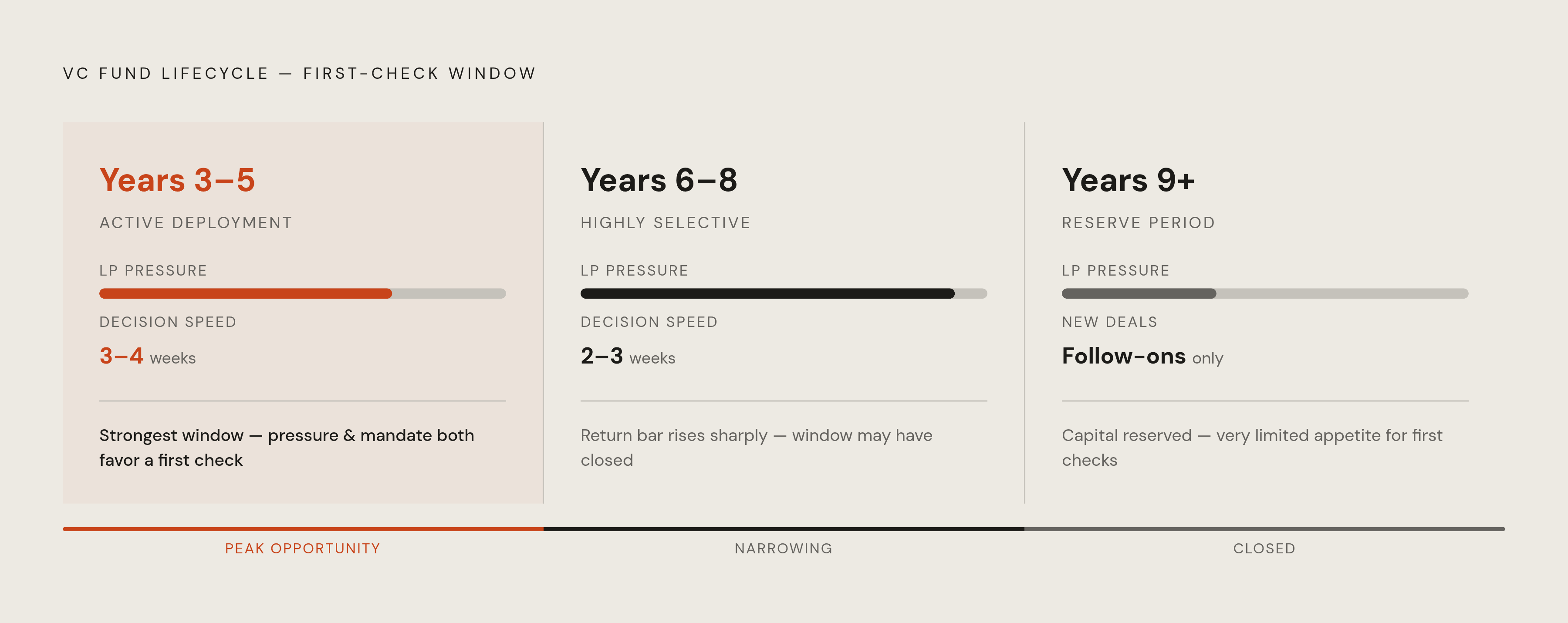
Vintage year is the most reliable starting filter for that distinction. A fund’s age indicates whether it is likely to be actively deploying, making highly selective investments, or concentrating on follow-ons. A firm’s older vehicle and its newly announced successor can present very different opportunities to the same founder.
Years three to five are the strongest general window for active deployment, with high LP pressure and decisions taking three to four weeks. Both the GP and the LP have reasons to want the capital put to work. Founders seeking a first check can start with funds in this period. The actual investment-period boundary still governs whether the fund can act, and sector or stage allocations can restrict an otherwise suitable vehicle.
Years six to eight bring very high LP pressure, highly selective investing, and decisions taking two to three weeks where new investments remain possible. Speed is not the same as openness. The return bar rises sharply, and the typical investment window may already have closed. These funds call for a close check of whether they still have authority to make a new investment. By year nine and beyond, pressure is mixed and remaining capital is generally reserves, with mostly follow-ons and very limited appetite for new deals.
A fund that led headline rounds in 2022 may have committed sixty to seventy percent of its capital in years two and three. What remains in 2026 may be earmarked for companies it already owns. For a new founder, the relevant distinction is between unspent capital and capital available for new portfolio additions.
Fund-close information is public in almost every case through press releases, PitchBook, and SEC Form D filings. These provide the starting material for dating vehicles before building a target list. In this workflow, Crunchbase helps founders find portfolio activity, while fund-level closes need to be checked elsewhere. The tools answer different questions and should not be treated as interchangeable.
Firms typically begin raising the next fund while the prior vehicle is still active, so a 2021 or 2022 fund without an announced successor is approaching or may already have passed its investment-period end. Absence alone is not a complete capital assessment. Combined with fund age, however, it weakens the case for assuming fresh deployment capacity. The next step is to look for behavior that supports or contradicts that initial reading.
How can founders tell which VCs are actively writing first checks?
Recent new portfolio additions are the most direct behavioral complement to fund age. A fund’s website or Crunchbase can show whether new companies have appeared in the last six months. Follow-on activity demonstrates support for existing holdings but does not establish openness to a first check.
New fund announcements give founders another sign to check, as long as they look closely at the vehicle’s stage. Index Ventures announced three fresh vehicles across stages in 2026: a seed fund, a venture fund, and a growth fund. Kleiner Perkins announced new funds in March 2026, which included KP Select IV, a growth vehicle, and KP22, a $1 billion early-stage vehicle. The raise signals that prior deployment supported a return to LPs, but neither example establishes current availability or suitability for a particular founder.
Partner communications help distinguish active sourcing from portfolio management. Event appearances, podcasts, and writing about “what we are looking for” indicate an effort to attract new opportunities. Published work about emerging sectors the fund wants to enter adds specificity to that signal. Partners who are active on social media with founders and early-stage companies add to that evidence. These activities are most useful when they align with recent first checks.
Replies to cold outreach in under two weeks indicate active sourcing, while slow or absent responses can point in the other direction. One unanswered message gives only part of the picture. Job postings for investment associates or analysts provide another signal because sourcing hires indicate a commitment to finding investments. Taken together, these behaviors help separate a fund that is seeking new companies from one that is simply maintaining a visible presence.
A partner who has gone quiet on content may be managing existing positions. That interpretation becomes more useful when it accompanies an aging vehicle, no successor announcement, and few recent portfolio additions. Signals need context to be useful. Fund age establishes the structural possibility of deployment, while behavior shows whether sourcing is occurring now. The strongest assessment comes from agreement between those two forms of evidence.
How timing outreach to fund lifecycle stage changes the conversion math
The practical sequence is to build the target list from vintage year, confirm deployment through behavior, and then map warm introduction paths. That order protects scarce relationship capital. Beginning with available introductions can produce a list of accessible partners whose funds cannot make a first investment. Thesis and check-size fit remain necessary, but they are applied to a field of investors capable of acting.
Warm introductions remain the highest-conversion access path at every lifecycle stage. They cannot restore a fund’s investment authority. The strongest introduction to a follow-on-only vehicle can still end in a polite pass, while an introduction to an actively deploying fund reaches a different decision context. Lifecycle timing helps founders allocate effort to conversations according to their prospects of progressing.
Pitching four to six weeks before quarter-end can tap into the pressure to act before LP reporting deadlines. This works on top of the lifecycle advantage. It does not turn reserves into first-check capital or reopen an expired investment period. For a fund already authorized and motivated to invest, however, the reporting calendar can help explain when a conversation is more likely to move toward a decision.
The research becomes more useful when it shapes the pipeline continuously. Founders can keep track of fund ages, successor announcements, portfolio addition velocity, and LP type. Press releases, filings, PitchBook, and Crunchbase supply different parts of that picture. Tools built for fundraising earn their place when they use those signals to show where a fund is in its lifecycle now, alongside the contacts they store. A spreadsheet of names and introductions does not by itself distinguish available first-check capital from an aging reserve pool.
The same founder, deck, and thesis fit can produce sharply different response rates and decision speeds depending on the fund’s lifecycle moment. The practical choice is to direct outreach toward funds whose authority, capital, and sourcing behavior align with the raise. Thesis fit gets a founder into the room.