Managing Investor Pipeline Across a 6–10 Week Raise Sprint
How to organize an investor pipeline so stalls surface before they become silent passes.
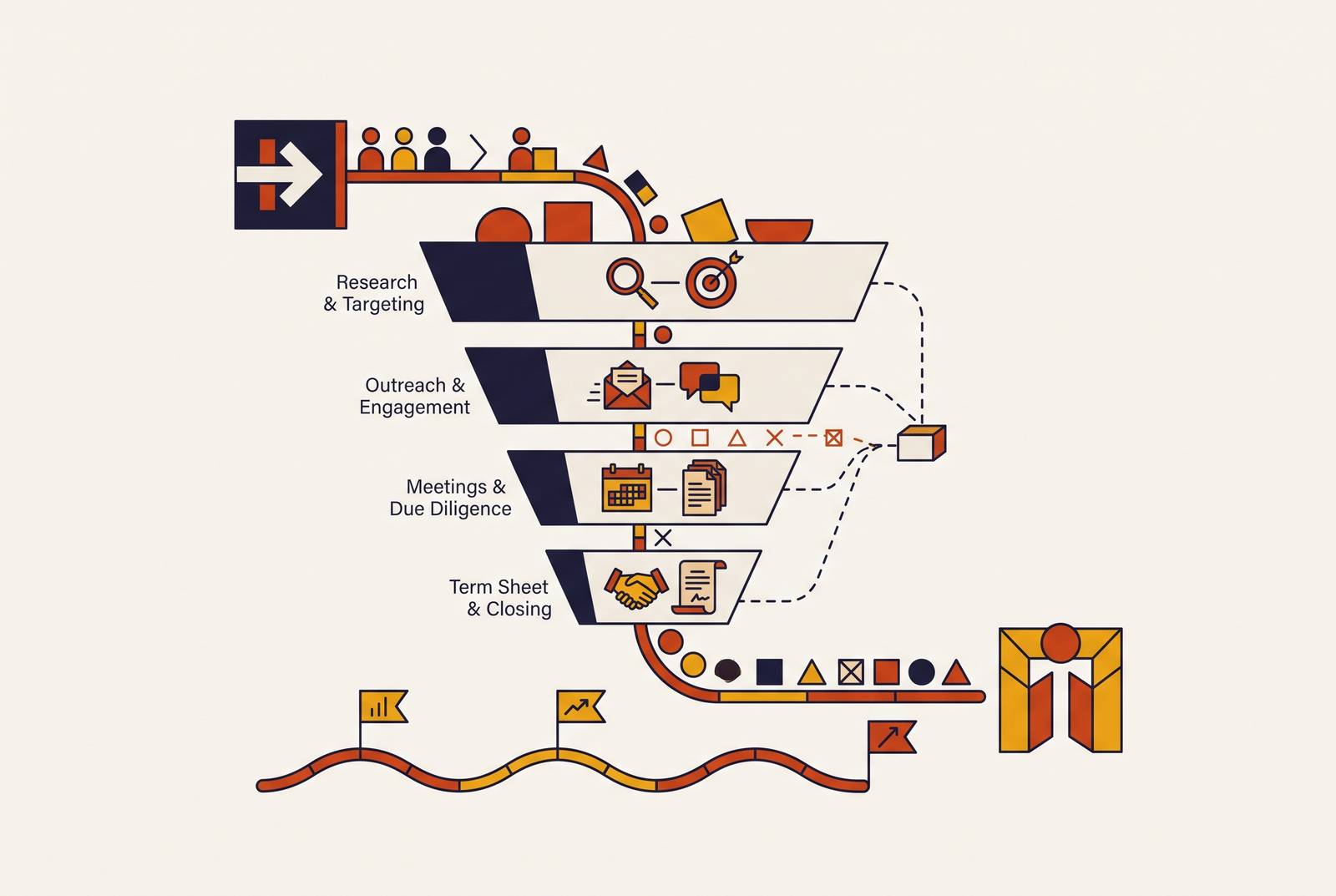
Picture week six of a raise: forty conversations logged as "in progress," a calendar full of recurring check-ins, and no lead investor. The founder in this position usually reaches for the wrong diagnosis. The deck gets rewritten. The narrative gets tightened. The pitch gets rehearsed again. None of that addresses what actually happened, because the deck was probably fine and the business was probably real. What failed was the system for moving investors through stages, tracking where momentum was forming, and knowing when to push a conversation, let it sit, or cut it loose. A sprint that drags past 10 weeks without a lead is almost always a pipeline problem rather than a market problem, since the same market closed rounds for founders who ran a tighter process. The backdrop raises the cost of getting this wrong: seed-to-Series A conversion rates have fallen to single digits, and nearly half of all seed financings in 2025 were structured as bridge rounds, so a failed sprint doesn't just cost time, it often produces a bridge that functions as a dead end rather than a path forward.
The funnel math behind how many investors the sprint needs
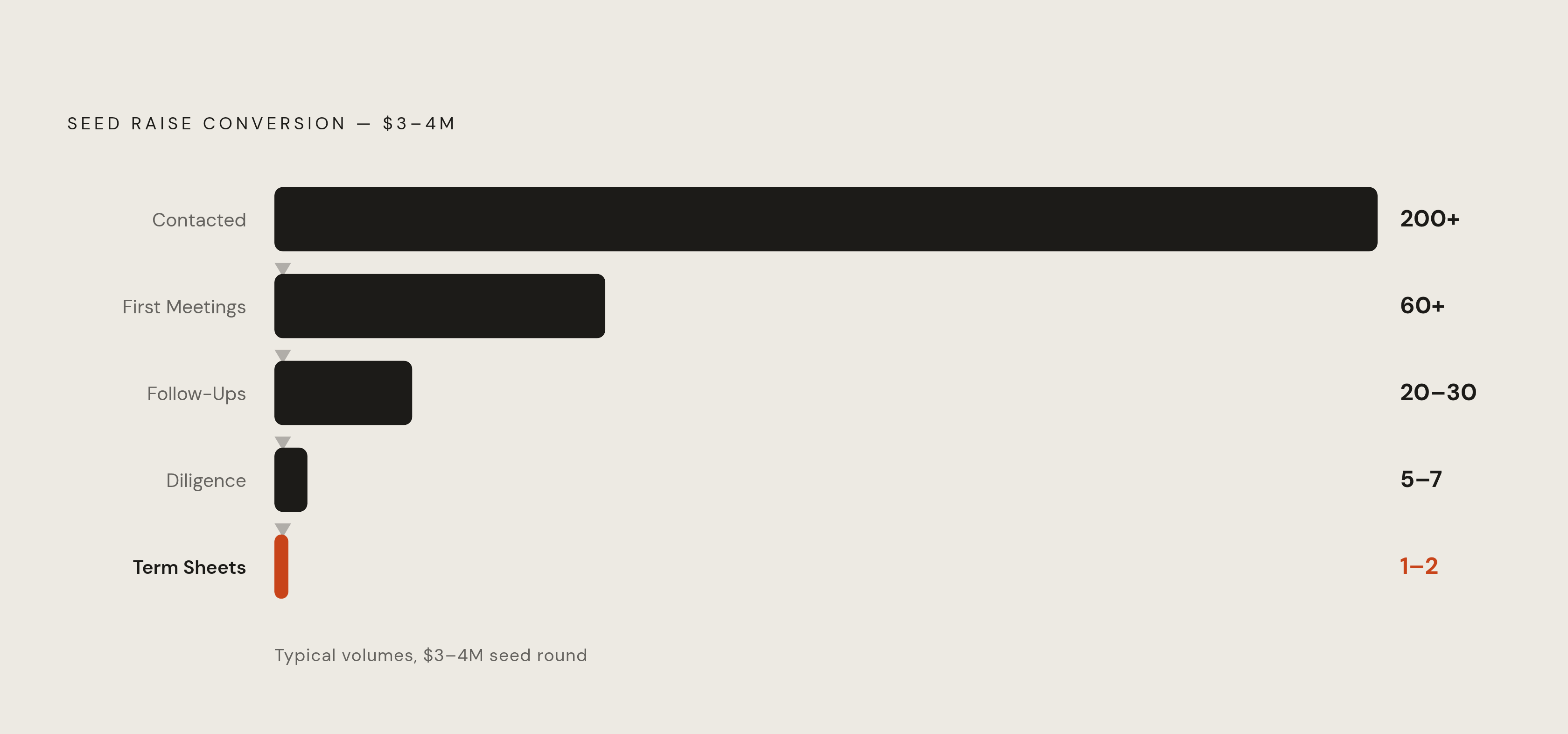
A raise behaves like a sales funnel with conversion rates at each stage, and founders who skip the math tend to under-source the top of it, then wonder why no term sheet options exist by week eight. Closing a $3-4M seed round typically requires contacting 200+ investors, running 60+ first meetings, moving 20-30 of those into follow-ups, and advancing only 5-7 into diligence, a process that produces just 1-2 viable term sheets at the end. Those numbers look discouraging until they're read correctly: they're not a mandate to blast 200 cold emails on day one. They're a mandate to build the prioritized list of the right 200 before the sprint starts, so the funnel runs on qualified inputs instead of raw volume. Investor-market fit carries as much weight as product-market fit. Tight targeting of 40-80 names per round raises hit rates meaningfully, and the 200-contact funnel only works once those contacts are pre-qualified by stage, sector, check size, and strategic fit.
Warm introductions change this math directly, because they move investors through the top of the funnel faster and at a higher conversion rate than cold outreach can manage in a compressed window. Portfolio-founder referrals rank among the highest-conversion intro paths available to a founder running a sprint: connecting with founders already backed by a target fund, at industry events or through shared communities, and asking for an introduction once that relationship is genuine. A founder should map not just the funds worth reaching but the founders already inside those funds' portfolios, and start building those relationships before the sprint clock starts. A founder who treats warm-intro mapping as something to figure out in week one of the sprint has already built a slower funnel than one who mapped it in advance.
Building the pipeline stage map before the first meeting goes out
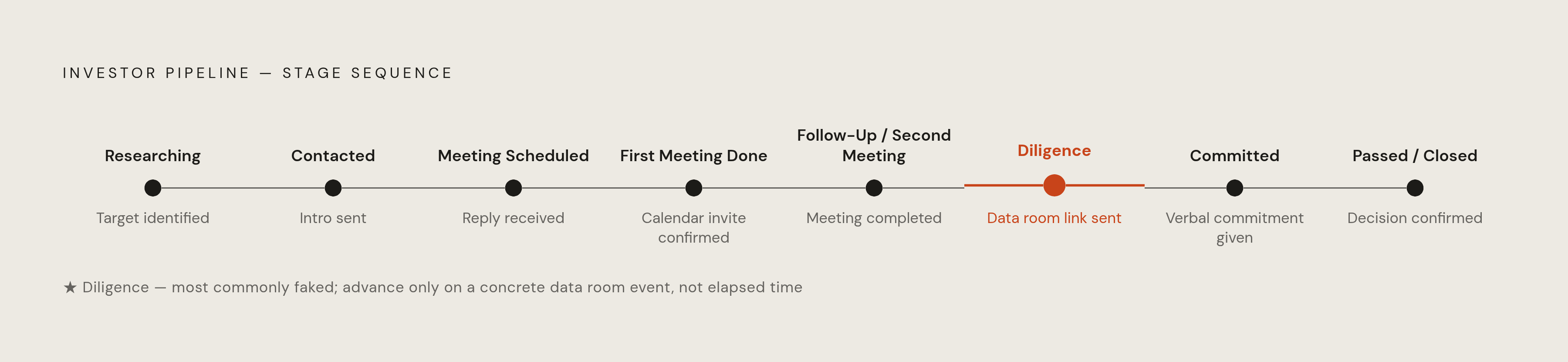
A contact list is not a pipeline. A pipeline requires stages, and without them a founder has no way to see where momentum exists, where it has stalled, or where a conversation has quietly died without anyone calling it. The stage map that reflects how investor decisions actually move runs: Researching, Contacted, Meeting Scheduled, First Meeting Done, Follow-Up or Second Meeting, Diligence, Committed, Passed or Closed. The value of this structure depends entirely on how strictly each transition is defined. Each stage change needs a specific trigger, not time elapsed but a concrete event: a reply received, a meeting confirmed, a data room link sent, a verbal commitment given.
The discipline here is not cosmetic. A founder who moves an investor into "Follow-Up" because a week has passed since the first meeting is hiding a stall behind a stage label, while a founder who only makes that move once a second meeting is confirmed has captured real signal. The gap between those two founders, several weeks into a sprint, is the gap between a pipeline that tells the truth and one that flatters the person reading it.
Stage alone doesn't capture engagement, so the pipeline needs to track behavioral signals alongside it: deck opens and re-opens, especially after a week of silence, data room access and time spent on specific sections, response latency to follow-ups, and whether an investor has proactively asked for a reference or an introduction to a co-investor. An investor sitting in "Diligence" who hasn't opened the data room in ten days has not stayed in diligence. They have quietly passed and simply haven't said so, and catching that early lets the founder redirect energy toward conversations that are actually live rather than waiting on one that's already over. This signal tracking only works if it's centralized. When two co-founders each manage separate threads with the same investor, the signals they're collecting don't add up to a clearer picture, they contradict each other, and the pipeline becomes less reliable the more people touch it without a shared system.
The weekly cadence that keeps the sprint moving rather than drifting
A stage map provides structure, not motion. Without a weekly operating rhythm, a sprint defaults to reactive mode: the founder responds to whoever reaches out instead of driving the process, and the compressed window closes before the pipeline has been worked with any intention. The weekly cadence does three things at once. It surfaces stalls before they turn into silent passes, it schedules follow-up while a thread is still warm, and it forces a weekly decision about where the founder's time goes in the week ahead.
One rule does most of the work of preventing drift: any investor sitting in "Contacted" for more than seven days gets a follow-up scheduled immediately, built into the weekly review rather than left for whenever time allows. The review itself should answer a small set of fixed questions every week: who advanced and why, who stalled and whether that's recoverable, who should be cut to free up energy for higher-conviction conversations, and what the pipeline as a whole says about whether the raise is on track to close in the time remaining.
This is where push, pause, and cut become real decisions instead of gut calls. Pushing means an investor has shown a concrete trigger, a confirmed second meeting, a data room request, a reference ask, and earns a prioritized follow-up this week. Pausing means the signal is ambiguous enough that forcing a response would cost more goodwill than it's worth, so the founder waits for a natural touchpoint rather than manufacturing one. Cutting means the signal has gone cold by a defined standard, and most founders delay this cut or never make it, even though cutting early and cleanly is a sprint discipline rather than a failure.
The standard for cutting is specific: two unreturned follow-ups after a first meeting, an explicit "not right now" that hasn't been followed by any re-engagement, or a first meeting that ended without any request for more information or a next step. Not cutting has a real cost: time keeps going into dead threads while live opportunities in earlier stages don't get the attention that would move them forward. Cutting is not the same as burning a bridge. A clear, polite close, something like "I understand the timing doesn't work, I'll circle back after our next milestone," preserves the relationship and removes the conversation from the active pipeline without damage.
The specific failure mode of treating pipeline management as the work
The pipeline is a support function for the raise, and founders who spend two hours a day updating stages and color-coding a tracker are generating the feeling of progress without any of its substance. This is a real risk precisely because the discipline described above is genuinely necessary. The tell is simple to spot: the pipeline looks increasingly organized as the weeks go by, while the number of investors who have actually advanced toward a term sheet stays flat. A clean tracker is not evidence of a working sprint.
The actual work the pipeline exists to protect time for is the investor conversations themselves, the follow-up materials that address specific concerns raised in a first meeting, and the reference calls and relationship-building that build conviction outside formal pitch meetings.
The highest-leverage use of pipeline data isn't updating it, it's reading it to make a decision that changes what happens next. If first meetings are converting to follow-ups at a low rate across a specific segment, generalist funds for example, that pattern is a signal to re-examine the pitch framing or to shift outreach priority toward sector-focused funds where conversion is running higher. A pipeline that never produces an uncomfortable finding worth acting on isn't being read closely enough.
Sprint mechanics under a Demo Day timeline
A Demo Day compresses the general sprint logic into a window measured in days rather than weeks, and it rewards only the founders who built their pipeline before the event rather than after it. Y Combinator now runs four batches a year, each with 250-300 startups, each culminating in a Demo Day pitch of roughly sixty seconds delivered to approximately 1,500 invited investors, and the fundraising window that opens immediately afterward closes fast. The 48 to 72 hours following Demo Day are the most consequential stretch of the entire process. Top companies receive a concentrated burst of investor attention, and the ability to triage inbound interest, respond quickly to the highest-signal inquiries, and get first meetings scheduled before that attention cools depends entirely on pipeline infrastructure that was built before Demo Day happened.
Founders accepted into a batch should build a target list of 40-60 funds prioritized by check size and stage focus, with at least two warm intros lined up before the batch dinners even start. Most skip this step, and most pay for it when the raise stretches into the following quarter instead of closing on schedule. Emmett Shear's post-Demo Day guidance from his own YC experience captures the discipline required once the window opens: "(1) Don't fundraise forever. Get back to work as fast as you can. (2) Set weekly goals. Everyone should buy into it and hit them as a team."
Timing within the YC calendar also shapes how the pipeline needs to be planned. The Summer batch creates a specific trap: its September Demo Day lands inside vacation season for a meaningful share of LP-side capital. A post-Demo Day raise for a Summer batch, S26, realistically closes in October or November rather than September, so founders who build their cash position around a September close are likely to come up short. The pipeline response to this is straightforward: Summer batch founders need to build a longer active-management window into their sprint plan, with follow-up cadences that account for slower investor response in the first two to three weeks after Demo Day.
Investor conviction signals a well-run pipeline reveals before a term sheet arrives
The behavioral signals already sitting in the pipeline make conviction visible weeks before any formal offer arrives. High-conviction signals look specific: an investor who goes quiet for a week and then re-engages with a pointed follow-up question rather than a generic check-in, one who proactively introduces the founder to a portfolio company for diligence purposes, or one who asks to schedule a second partner meeting without being prompted.
Low-conviction signals are easy to mistake for progress because they look like engagement on the surface. An investor who takes every scheduled meeting but never asks for the data room, who answers emails promptly but never moves the conversation toward any kind of commitment decision, or who repeats some version of "we love this, we just need to see one more thing" across several weeks running, is producing activity without advancing anything. The investor who has quietly passed without saying so shows a recognizable pattern: response latency doubles, data room activity drops to zero, and follow-up questions stop arriving. The pipeline tells that story before the investor ever does.
Reading these signals accurately changes a specific, high-stakes decision: which investor to ask for a term sheet first, and how to use that term sheet to accelerate every conversation behind it. A term sheet from a credible lead investor doesn't just validate the round, it changes the pipeline dynamics for everyone else in it, converting an indefinite "we're interested" into a decision with an actual deadline attached. Founders who skip this reading often ask the wrong investor first, someone who sounded enthusiastic in conversation but whose behavioral signals were thin, and end up with a soft term sheet that creates no urgency for the rest of the list.
The six weeks before the sprint that determine whether the system works
None of this architecture can be built once the sprint is already underway. The founders who run clean 6-10 week raises assembled their infrastructure in the six weeks before the first investor meeting, not during the sprint itself. That means the target list of qualified names, segmented by stage, sector, and check size, needs to exist before outreach starts. It means the warm-intro map, built from portfolio founders and shared communities, needs relationships already in motion rather than cold asks sent the week the sprint opens. It means the stage map and the engagement-tracking system need to be set up and agreed on across co-founders before the first email goes out, so that signals compound instead of contradicting each other from day one. And it means the weekly cadence, the four standing questions, the seven-day follow-up rule, and the criteria for cutting a conversation, need to be in place as habits before there's any pipeline to apply them to. A sprint is the visible part of a process that has to start well before the clock does, and the six weeks beforehand are where the system gets built that makes the following six to ten actually work.