How YC and Techstars Founders Close Rounds Faster With AI-Native Pipeline Tools
AI tools help accelerator founders run parallel fundraising processes and close rounds faster.
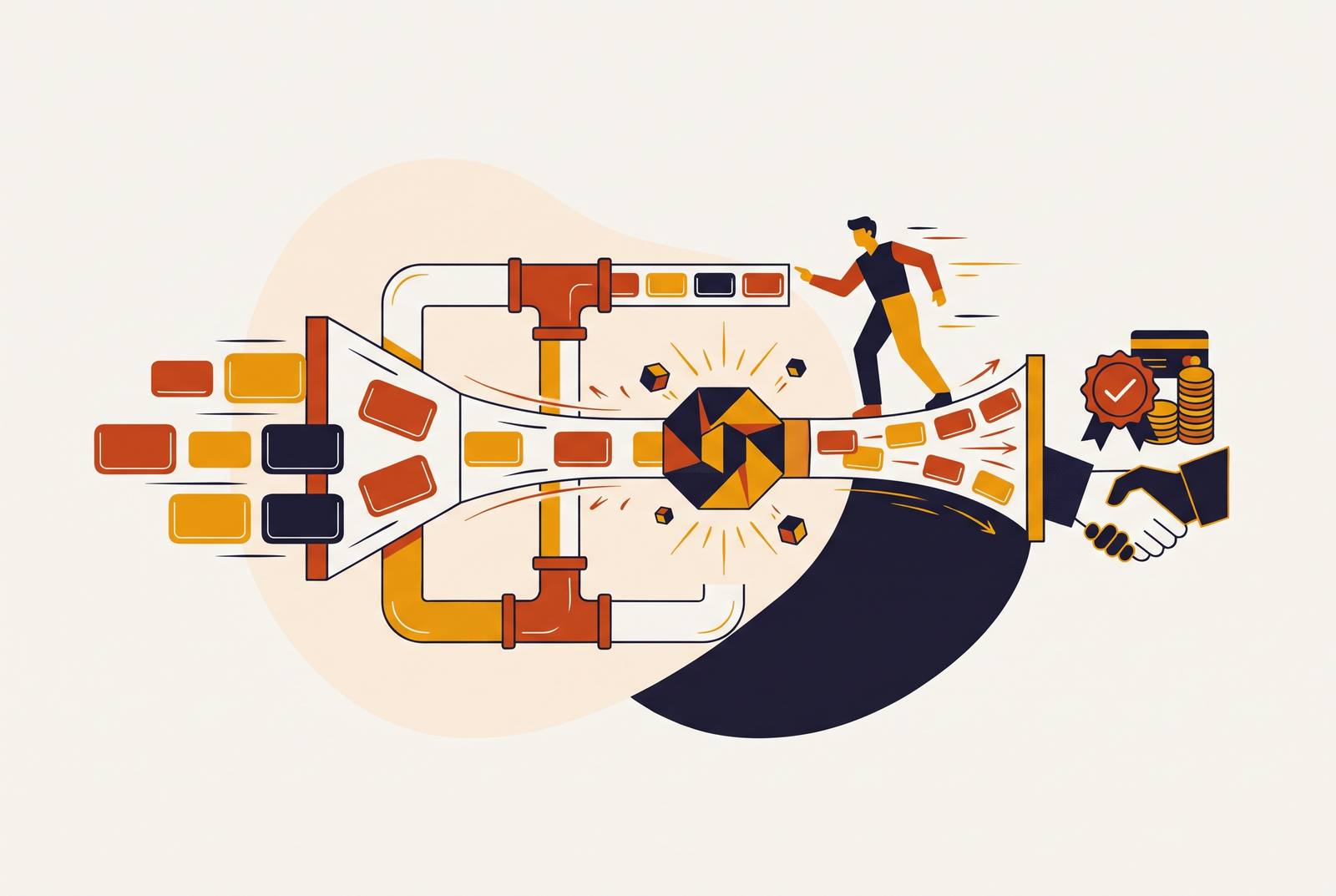
YC and Techstars founders close rounds faster when they treat post-Demo Day fundraising as an operational system. That system brings together choosing the right investors, holding meetings in parallel, following through promptly, and improving the pitch along the way. AI-native pipeline tools provide the infrastructure to run it at speed, accelerating a fundable company’s raise.
Why the 2026 fundraising environment punishes slow, unstructured raises
The 2026 venture market has bifurcated. Headline valuations are rising while conversion from seed to Series A has fallen, leaving AI megadeal outliers in a different position from most founders seeking follow-on capital. A higher valuation at the top of the market does not imply an easier raise for everyone else. For the majority, the competitive question is how to turn qualified investor interest into a decision before momentum dissipates.
The bridge round reflects this change in expectations. Roughly 38% of seed-funded startups now raise one before reaching a priced Series A, making the bridge a planned milestone. Series A investors increasingly want proof of product-market fit, a repeatable go-to-market motion, and meaningful ARR. A clean deck and a warm introduction are insufficient. Because founders must establish that operating evidence while raising capital, a slow, disorganized process competes with the work needed to clear the next funding threshold.
What YC and Techstars actually give founders — and where the accelerator's work ends
Y Combinator and Techstars provide capital, credibility, and a concentrated window of investor attention. Their structures nevertheless create different fundraising dynamics. Techstars’ current standard deal includes $200,000 through an uncapped MFN SAFE and a separate $20,000 through a post-money Convertible Equity Agreement (CEA) for 5% common stock. Founders need to understand those terms before the follow-on raise, as they prepare to explain the financing they already have.
Techstars has backed founders since 2006, producing numerous unicorns and a network that keeps opening doors for years. Techstars AI Health Baltimore and the Techstars Anywhere Accelerator both list final deadlines of November 18, 2026, and start dates of March 8, 2027. Yet the program schedule is not the fundraising schedule. Techstars Demo Day does not compress a round the way YC does, and the hours immediately afterward are when deals start moving.
YC’s W26 batch shows how much traction companies had when they began raising funds. Fourteen companies had $1M+ ARR when they entered Demo Day, three times more than the previous batch three months earlier. The distinction is operating progress, not presentation polish. Those companies had used the batch to build evidence that investors could examine, rather than merely a deck that investors could admire. The concentration of attention rewards readiness to discuss that evidence.
Neither accelerator supplies the founder’s complete follow-on fundraising process. Founders still have to handle investor targeting and parallel outreach and improve their pitch across dozens of meetings. Access is only the beginning of the work. A network can open a conversation, but it does not organize every subsequent meeting, diligence request, and decision. Demo Day therefore starts an execution window whose value depends on the operating layer the founder has built around it.
How do founders keep investor momentum going after Demo Day?
The fastest-closing founders treat the two to four weeks after Demo Day as a structured sprint. They block 25–40 investor meetings across two weeks, rather than waiting for each conversation to resolve before starting another. Before every requested meeting, they send a detailed memo. They also set a soft close date two to three weeks out, giving the parallel process a shared time horizon without presenting that date as a guaranteed outcome.
This cadence gives each part of the sprint a purpose. In the hours immediately after Demo Day, founders who are ready turn interest into scheduled conversations. Before each call, the memo establishes the substance for discussion. After each call, founders log surprise questions and update the deck and data room as their understanding improves. Across the two-week meeting block, those revisions make the pitch materially stronger by meeting fifteen than it was at meeting one.
AI also puts pressure on investors to come prepared. Systems can watch Demo Day, score companies against a fund’s mandate, and rank its strongest prospects by the end of the first session. So founders may meet investors who have already been briefed. The conversation can move quickly beyond the company’s basic description toward the model, assumptions, and evidence behind it. A process that captures questions and improves answers becomes more useful as investor preparation becomes more systematic.
Relationships remain a serious counterargument to any process-led account of fundraising. Warm introductions still play a large part in who gets a term sheet, and software cannot make people trust each other on demand. But access and execution are not competing explanations. Pipeline discipline converts warm introductions into meetings faster, while well-targeted cold outreach can be more effective than unstructured warm outreach to investors whose mandates do not fit.
Founders are coordinating meetings, distributing materials, interpreting interest, answering diligence questions, and revising their case at the same time. Each conversation can change the next one. Keeping those changes connected requires more than a record of investor names and a column marked interested. The sprint creates a coordination problem that becomes harder precisely when the raise is gaining momentum.
Why generic CRMs and spreadsheets break down at Demo Day velocity
A venture raise does not follow the same path as a sales pipeline. Its stages include pre-seed contact, first meeting, partner meeting, term sheet, and close, with each stage representing a different funding decision. Generic sales CRMs have to be adapted to track those stages. A spreadsheet can record the labels, but the labels alone do not connect outreach, deck engagement, diligence access, and meeting follow-through.
For this process, the useful record extends beyond contact details. It includes investor fit, introduction or outreach status, current fundraising stage, meeting status, memo delivery, deck engagement, diligence activity, and questions that remain unanswered. A founder needs to distinguish an investor who has merely received the deck from one who has reached a partner meeting. Without that distinction, a long contact list can hide how few investors are in the active pipeline.
The surrounding tools also have to serve the same process. Investor discovery, relationship mapping, pitch sharing with analytics, outreach automation, and diligence management are interconnected workflows. A tool built for one does not automatically serve the others. For example, deck analytics can identify a useful follow-up opportunity, but that information still has to inform the outreach process.
Commercial terms introduce another form of fit. A flat monthly subscription can be started and stopped around a three-week Demo Day window, while an annual stakeholder-tiered contract does not match that short operating horizon. The decisive criteria remain fundraising stages, connected information, and support for parallel execution. At Demo Day velocity, purpose-built tooling is basic infrastructure.
The core tools in a 2026 AI-native fundraising stack for accelerator founders
The most effective stacks combine three to four purpose-built tools covering investor discovery and targeting, pitch sharing and analytics, a data room, and pipeline management with outreach automation. These are distinct jobs, even when one product covers more than one. A discovery platform does not replace diligence management, and a well-designed deck does not reveal which investors are engaging with it. The stack works when its parts support the same raise.
Investor discovery establishes who belongs in the process. Useful targeting looks at what is in an investor’s portfolio, their check sizes, how often they invest, and their thesis signals, rather than treating every investor as equally likely to be a fit. PitchBook serves institutional-grade research needs at a price point designed for institutional teams, whose purchasing needs differ from those of early-stage founders running a three-month raise. For an accelerator founder, access to relevant investor intelligence has to be weighed against the duration and budget of the raise.
Pitch sharing adds evidence of attention to that targeting. An investor who reopens the deck two days later and spends time on the financial model presents a different follow-up opportunity from one who spends only a few seconds with it. The former warrants follow-up that afternoon. This signal gives the founder a more concrete basis for prioritizing outreach than the fact that a deck was sent. Papermark offers dynamic watermarking, transparent pricing, and full data control for teams that want it.
The data room serves a different purpose from deck analytics. It supports diligence, while pitch engagement helps founders understand the attention they get before and between conversations. Both belong in the same operational picture. When investor questions reveal gaps in the presentation or supporting material, founders update the deck and data room so different versions of the case do not stay scattered across the process. The objective is coherent evidence as conversations become more detailed.
Purpose-built fundraising CRMs track first meeting, partner meeting, term sheet, and close, and integrate with outreach automation so founders can run parallel processes without manual status updates. This is the coordination layer of the stack. Its value comes from keeping meeting progress and follow-through connected while many investors are moving at different speeds. Automation supports that coordination rather than making the investment decision for either side.
Pitch construction remains a separate capability. InvestorReady.AI helps pressure-test the substance of the case, including the model, assumptions, and narrative, which is different from designing slides. A presentation can look complete even when the reasoning behind it is weak. This distinction becomes especially important when investors arrive already briefed and use the meeting to test the company’s claims. Tools that sharpen the case and tools that distribute it solve different problems, so neither should be mistaken for the other.
Why operating an AI-native fundraising stack is itself a signal investors read
The way founders run a raise provides evidence of how they organize demanding work. Running a raise well means being prepared, responding quickly, learning, and following through, all on a tight schedule. The software is not the signal in isolation, because buying a tool proves little about execution. The signal is the founder’s ability to use it to coordinate a process and improve the quality of each conversation.
This distinction also explains why embedded AI is more consequential than an occasional chat-based answer. Intelligence within targeting, outreach, and diligence workflows supports work that must recur throughout the raise. That shift remains in its early innings. Founders who use an agentic fundraising stack are trying a new way to run a raise, but using it alone does not prove that they have a good company. The useful test is whether the system improves preparation and execution.
Capital concentration places a clear limit on the argument. Investors are putting money into fewer companies that lead their categories, so even well-targeted outreach cannot save a company that lacks a credible investment case. Tools compress the interval between having a fundable company and closing its round, while reducing the risk that strong operating evidence is poorly presented or inconsistently followed through.
Founders who can analyze portfolios, check sizes, investment frequency, and thesis signals approach conversations with more of the context institutional investors use. Their questions and targeting become more precise. Meanwhile, AI helped make the W26 traction discussed earlier possible by cutting the build cycle for a working product from six months to six weeks. Operational use of AI can strengthen both what founders bring to Demo Day and how they pursue funding afterward.
The lesson for a founder approaching Demo Day is to systematize the raise around a company worth funding. No stack guarantees a term sheet or better terms. The distinction between top-decile fundraising outcomes and the median is not simply access to more introductions, but the ability to convert a concentrated opportunity into a disciplined close.