Why Partner-Level Deal Attribution Data Is the Only Reliable Way to Pick Your Contact at a Top-Tier Firm
Deal records show which partner owns your category, and who can reach them.

Partner-level deal attribution data is the only reliable way to choose whom to approach at a top-tier VC firm because it shows who sponsored investments like the founder’s company. AI-powered investor targeting and thesis decoding should therefore match founders to individual partners based on attributable deals, recent activity, and portfolio composition. That evidence determines both the contact to pursue and the introduction most likely to reach them.
Why targeting a VC firm by name is structurally broken
A firm name does not identify the person who will sponsor a deal, defend it at the partner meeting, and commit time after the investment. The firm is an administrative wrapper around individual conviction. The firm’s reputation cannot take the place of someone willing to champion the company.
Authority also differs among people at the same address. A partner sponsors a deal, a GP approves it, and a principal runs it to close but cannot approve it alone. Partners also sit on several boards and help raise the next fund, so a prospective investment competes for their attention as well as capital. Promotion depends less on tenure than on attribution to deals the partnership funded. Their investment records are therefore readable evidence of where they have committed professional standing.
At Benchmark, every GP has an equal share of ownership. Equal ownership does not make the partners interchangeable. The opportunity still depends on the specific person receiving an introduction for internal advocacy, regardless of the brand that drew the founder to the firm.
How partners develop category ownership inside a firm
Under the “prepared mind” model, partners develop sector theses over months or years rather than forming conviction only when a pitch arrives. By the time a founder approaches them, some have already studied the problem deeply. Others have not built that prior conviction. That prior conviction makes category ownership a distinct feature of the partnership.
That preparation leaves evidence in investment activity. A partner actively building a position in a category will have a recent, dense record of relevant deals, while one winding down a thesis will not. An adjacent exit adds another signal. A partner who recently exited a company addressing a related problem has domain liquidity and may be looking for the next generation of that technology. Patterns in founder backgrounds can also reveal a thesis that favors technical teams from particular companies or backgrounds.
PLG companies need partners familiar with product adoption, activation, retention, and self-serve conversion, whereas sales-led B2B companies need experience with long procurement and buying-committee cycles. Those may be different people at the same firm. Trae Stephens, for example, focuses on defense at Founders Fund. A defense or hard-tech founder who bypasses Stephens may reach someone else in the partnership without finding someone who has conviction in that category.
How do you find the right VC partner to pitch? Start with deal attribution data
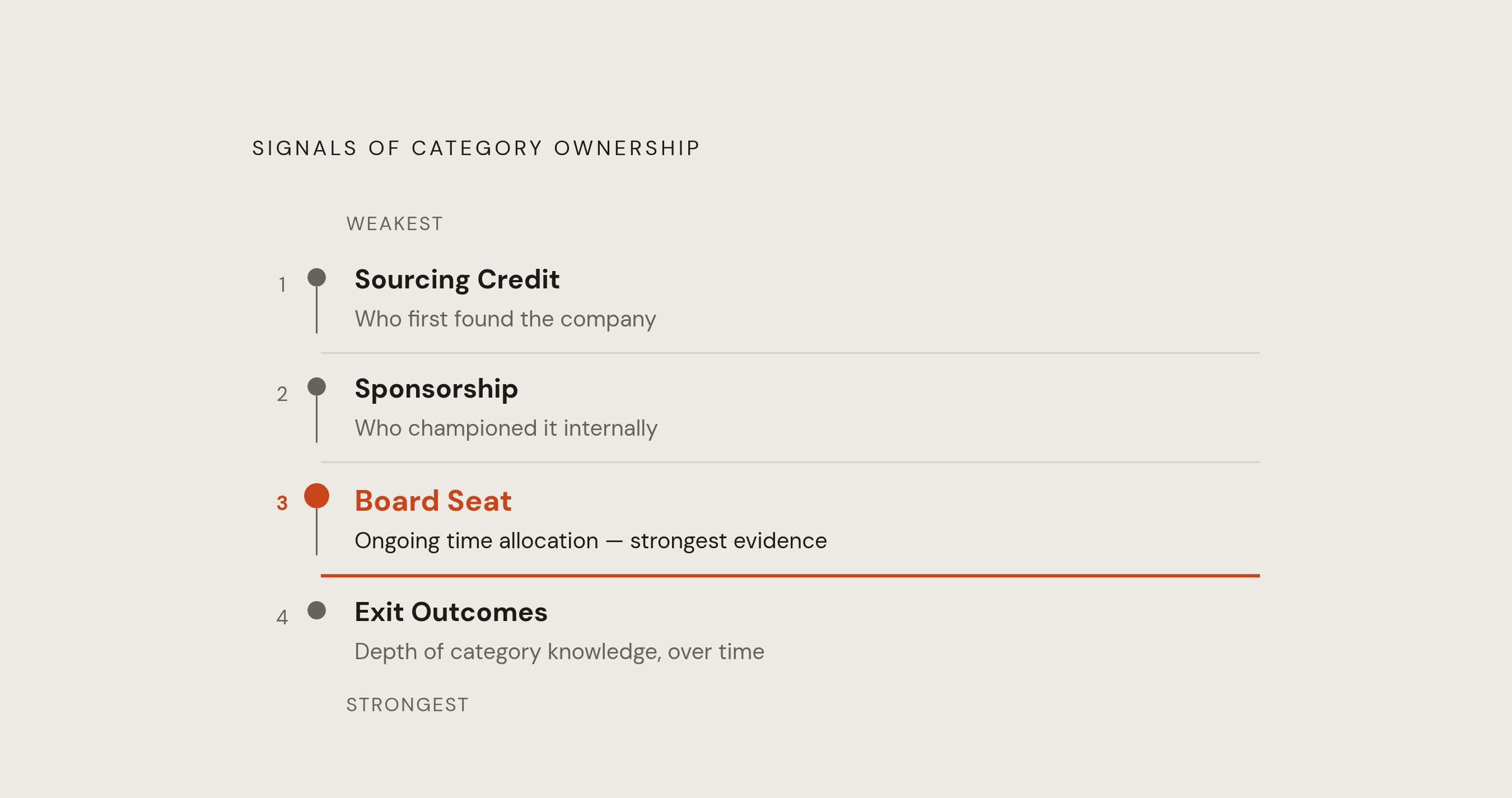
Deal attribution data is the documented record of which partner sourced, sponsored, and took a board seat in comparable investments. It connects a person to an investment decision. Unlike a stated preference, that record shows where conviction resulted in action, making it the public signal that reveals who actually owns a category within a firm.
Sourcing credit identifies the partner who first found the company and points to proactive thesis development. Sponsorship identifies who championed the investment internally. A board seat is the strongest evidence of ongoing category ownership because it represents continuing time allocation after the check. Exit outcomes also show how well a partner knows a category, especially when they have multiple attributable exits in it.
A firm may list enterprise software as a focus even though only one of five partners has closed deals there in the past three years. The other four provide only nominal coverage.
Attribution also remains useful when a firm is new. Vanessa Larco, formerly of NEA, and Mercedes Bent, formerly of Lightspeed, launched Premise VC to invest in pre-seed and seed AI-native technical founders. Their prior deal records precede the new firm’s record. Those investments give founders a basis for assessing each partner’s specific sub-thesis rather than treating a shared focus on AI-native companies as sufficient fit.
Why the firm-level alternative — logo targeting — fails in practice
Top-tier investors review substantial inbound volume, and contacting the wrong person does not reliably produce a redirect to the right one. A pass from one partner tends to close the door at that firm for the round. The founder can lose a viable opportunity before reaching the person most likely to understand it.
That loss changes the fundraising funnel. Most seed and Series A raises take many conversations with investors before they close, so contacting the wrong partners uses up chances in a process that already takes much work. The apparent breadth of the pipeline says little about how many contacts have both relevant conviction and the authority to advance a deal.
Firm reputation is also a static guide to a moving target. A firm may have invested heavily in a category two funds ago while the partner responsible has since rotated into another sector. Website biographies, category tags, and static investor lists do not capture that rotation. Recent attributable investments show what the partner has actually closed, rather than tying them to a category they have since left.
The correction is to identify the current category owner and then find a warm introduction to that specific person. That changes the task from securing access to a recognizable firm to securing a credible path to the relevant decision-maker.
How knowing the right partner changes the warm intro you need
The highest-leverage variable is not the firm approached but who introduces the founder to which partner. A connection to the firm is insufficient information. The connector needs a strong relationship with the individual whose deal record establishes fit.
The connector’s relationship with that partner outweighs the founder’s relationship with the connector. A founder may know someone well even though that person has little access to the investor the founder wants to reach. A connector the founder knows less well may have a stronger relationship with that investor. Attribution makes that comparison possible because it supplies the precise destination against which each introduction path can be assessed.
For founders, the operational implication is to map portfolio founders, angels, and mutual connections against the identified partner. Without that destination, introduction research defaults to guessing which relationship inside the firm will be useful. With it, the request can follow the strongest available connection.
Affinity’s deal sourcing research documents that the most efficient firms generate introductions from only a small fraction of emails sent. The same logic suggests that founders can get more from asking for specific introductions than from sending more emails. Warm introductions also close deals significantly faster than cold outreach because the relationship conveys real signal to the relevant decision-maker. Partner identification therefore affects both access and the time required to turn that access into a financing conversation.
Building a targeted pipeline from attribution data rather than from firm lists
The practical application is a refined pipeline of partner-level targets. Each record needs the partner’s name and tier, attributable investments in the relevant category, the strongest introduction path, and the recency of the evidence. These fields serve different purposes. Tier establishes decision authority, deal history establishes fit, and relationship mapping establishes the route into the conversation. Recency distinguishes active deployment from a thesis last expressed two or more funds ago.
The research starts with comparable investments and narrows to the people responsible for them. Recent board seats and exits in the specific segment are more informative than a broad sector label. Portfolio composition tells founders more about the partner’s thesis. The resulting target is not merely someone associated with a relevant firm, but someone whose decisions explain why the company belongs in their pipeline.
Content signals extend that investment record. A partner’s podcasts, blog posts, and social commentary can reveal active thesis-building before the next deal closes, when a static deal database necessarily lags. The distinction preserves a useful separation between what a partner is exploring and what they have already funded.
AI-driven investor matching makes this research tractable by scoring thesis fit, recent deal activity, and portfolio composition at the partner level. Founders need pipeline tooling when they can no longer track follow-ups, introduction paths, and round momentum across dozens of targets by hand. The added complexity comes from retaining partner-specific context throughout the raise.
The one case where cold outreach to an unknown partner can work — and why it still proves the rule
Cold outreach can convert at seed when a founder has exceptional, verifiable traction. Demonstrably strong growth can signal category fit clearly enough for a company to reach the right investor without a referral. In that situation, the company’s data performs part of the identification work that attribution research would otherwise perform.
The condition is unusually demanding, however. It applies to a small minority of seed-stage founders. Real traction is not necessarily exceptional traction. A strategy that depends on metrics strong enough to overcome uncertainty about the recipient is therefore not reproducible for most founders preparing a raise.
A strong traction email sent to a partner whose thesis does not cover the category can still receive a pass or a redirect, losing time. A possible redirect is not a dependable routing strategy. Attribution reduces the mismatch before the email is sent rather than relying on the strength of the company’s numbers to correct it afterward.
The cold-outreach case is also weakest at Series A and later, where top-tier firms are most selective. At those stages, a firm’s reputation can make founders wrongly assume that any partner can give them a way in. The exception therefore changes the need for a referral under specific conditions while preserving the value of knowing which partner to approach.
Using the partner relationship after the round closes
The partner who champions the investment becomes the founder’s primary internal advocate for follow-on capital, reserve deployment, and board support. Contact selection therefore shapes more than the probability of closing. It establishes the ongoing capital relationship. A partner’s category experience and commitment matter both when they first weigh the pitch and when the company needs help between rounds.
That relationship also provides information for the next raise. A founder who understands the partner’s evolving conviction can time and frame a Series A or B around active deployment appetite. The information flows in both directions. The company’s outcome becomes part of the partner’s attributable record, giving both parties a stake in how the relationship develops.
Founder trust and attributable portfolio outcomes influence a partner’s internal standing. References from portfolio leaders supported through difficult periods are therefore consequential, as are the investment results themselves. For founders, the practical implication is to use updates and communication strategically. Regular updates, tracked metrics, and consistent communication with the cap table keep the relationship active between rounds and build the trust that makes reserve deployment and Series referrals more likely.
The deal record that helps a founder choose a partner later includes their own company, giving them a shared record of decisions and outcomes. The partner selected at the start is the person with whom that record compounds for the life of the relationship.