How AI-Native Fundraising CRMs Handle Pre-Seed and Seed Workflows That Generic Tools Cannot
A fundraising pipeline CRM built specifically for early-stage founders should track investor fit, introduction paths, engagement and meeting feedback around the stages of a raise. AI-native fundraising CRMs handle these workflows through their underlying data model. For pre-seed founders with fewer than roughly 75 investors, a Notion template or free CRM can still be sufficient.
Why the volume and complexity of a seed raise breaks generic CRM logic
A warm introduction goes cold because the follow-up gets buried. Elsewhere in the same raise, an investor stops responding before the founder has logged the last conversation. Both can happen on a small team with a tool that works. Both emerge when more relationships need attention than founder memory can reliably support. Each investor brings a distinct introduction path, thesis, decision timeline and set of partner dynamics, so tracking a name and a next-contact date leaves much of the work unresolved.
The complexity grows with the relationship count. Spreadsheets and free CRMs can support the first handful of conversations because founders can supply the missing context themselves. As the pipeline expands, the absence of engagement signals, stage-appropriate reminders and investor-specific context becomes a daily operational drag. Generic sales CRMs such as HubSpot, Salesforce and Pipedrive are organized around recurring transactional pipelines. A venture raise is instead a finite, non-recurring sprint in which the relationship history determines what should happen next.
How fundraising pipeline stages differ structurally from sales pipeline stages
A fundraising pipeline moves through target, intro requested, first meeting, diligence, term sheet and closed. Those labels describe more than progress toward a transaction. They track whether access exists, whether an investor has begun evaluating the company and whether conviction is developing within a time-bounded round. Sales pipelines emphasize deal value and close probability across a repeating cycle. Fundraising requires relationship warmth and introduction-chain status to shape the process itself.
Renaming sales stages does not supply that logic. An “intro requested” stage still needs the context of the introduction chain, while diligence needs investor engagement to inform the next follow-up. In a generic CRM, those requirements become custom fields, separate integrations for data rooms and deck tracking, and stitched-together reminder logic. The contact record fragments as more of the relevant activity sits elsewhere. Because the process evolves during the raise, maintaining those connections becomes recurring work.
The five workflow gaps that generic CRMs cannot close without becoming a different product
The first gap is investor fit scoring. A generic sales contact does not natively represent investor thesis, stage history, check size range, sector focus or portfolio overlap. Outreach deserves a place in the pipeline when those inputs indicate investor fit. Without them, founders fall back on static directory searches that produce names without a strong basis for prioritization. The consequence is low-probability first calls that consume time without advancing the round.
The second gap is warm-introduction path mapping. Warm introductions materially outperform cold outreach in venture, but manually tracing paths across Gmail, LinkedIn, co-founders and advisors does not scale past a handful of relationships. Relationship-focused CRMs differ substantially on this point. Affinity makes network overlap mapping its core differentiator, while Attio’s less mature relationship intelligence does not automatically surface those overlaps. With the latter, founders still perform the introduction-mapping work themselves.
The third gap is engagement-triggered follow-up logic. In a raise, a deck open, data room view or investor update read can be a more useful prompt than the passage of a fixed interval. A calendar reminder cannot distinguish those conditions by itself. Without engagement signals, founders may interrupt a cold relationship and miss an investor who has started looking at the company again. The missing capability is not merely a reminder, but a connection between investor activity and the next action.
The fourth gap is content signal and thesis matching. Investors show where they plan to put money through blog posts, podcast appearances, LinkedIn commentary and portfolio announcements. Matching that activity against a founder’s company requires discovery to change as investors publish and deploy. A static contact database cannot do that on its own. Without this feedback, the target list remains anchored to directory information.
The fifth gap is in the help founders get from meeting intelligence and round coaching. Founders can repeat the same pitch mistakes across dozens of investor conversations without a structured feedback loop. In B2B sales, manager coaching and deal reviews provide an established mechanism for that work. Founders often have no equivalent during a raise. Call intelligence supports preparation around an investor’s thesis and decision pattern, while round coaching turns conversations into structured feedback instead of leaving first meetings as the only calibration mechanism.
Where generic CRMs break down in practice — the limits of customization
Customization becomes too much to maintain even when the system still works. As a pipeline moves from a handful of investors to scores or hundreds, another workflow requirement means another field, integration or manual fix. The founder must keep those additions in step with changes to the process. That work competes directly with live investor conversations.
The resulting leakage is easy to miss. A calendar-based reminder does not reflect renewed investor engagement, and a conversation that has not been logged leaves the next follow-up without its context. Adding another field can create a place for information, but it does not supply the signal or the logic needed to use it. A generic CRM can therefore contain an extensive investor record while still requiring the founder to reconstruct what deserves attention each day.
This is not a general argument against customization. Custom fields and stages can support a smaller process whose missing connections remain manageable. The constraint appears when the founder must continually reconcile investor data, engagement, introduction paths and meeting feedback across separate systems. That work takes the most effort just as the growing raise calls for faster decisions that take more of each relationship into account.
What AI-native fundraising CRMs are actually architected to do differently
The architectural difference begins with the investor object. A fundraising-native data model has thesis metadata, stage history, check size ranges and portfolio overlap built in, where a generic contact would need extra labels. Fit scoring and thesis matching can then use those inputs directly. The pipeline also follows the progression of a raise. Its stages have follow-up logic tied to how a raise moves from one stage to the next, so they do more than rename sales stages.
Engagement feeds back into that same process. Deck views, content publishing and portfolio announcements become inputs to prioritization, reducing the need for founders to reconcile activity with a static target list. Meeting intelligence then connects the conversation itself to the wider round. The platform captures what happened in a call and surfaces structured feedback on pitch narrative and investor calibration. These functions belong to one fundraising workflow rather than operating as unrelated additions to a contact database.
The distinction is therefore more specific than AI-assisted administration. An outreach assistant can help draft a message without understanding whether the investor fits the round or whether the relationship is ready for follow-up. A fundraising-native architecture links those questions through investor data and stage logic. That is the relevant basis for comparison. The presence of an AI feature alone does not establish that a CRM supports the five workflows.
What CRM should a founder use to track seed-round investors and conversations?
For pre-seed founders tracking fewer than roughly 75 investors, a Notion template or free CRM can provide a functional pipeline at no cost. Enterprise-grade relationship tooling is difficult to justify at that volume. The founder may still be able to track introduction paths and what was said in each conversation by hand without taking too much time away from the raise. This can be the best fit for the founder, even beyond the short term. Pipeline complexity, rather than the appeal of automation, should determine when the setup changes.
Attio offers a customizable, modern CRM with a usable free tier and paid plans, but founders still need to map warm introductions manually. Folk suits founders who need help with outreach, with LinkedIn enrichment, drafting and follow-up sequences, a low monthly price per user on Standard and a single-seat free plan. It has no AI-driven thesis matching or round coaching. Affinity is better suited to a large extended network where relationship intelligence can justify its pricing, although it was originally designed for VC firms.
The calculus changes as a seed round reaches 75 to 150 active investor relationships. Without engagement signals, thesis matching and stage-native follow-up, the raise starts to slow down as well as take more work. The crossover depends on operational demands. An AI-native fundraising platform becomes cost-justified when fit scoring, engagement-triggered follow-up and meeting intelligence would each prevent at least one high-value relationship from going cold. A founder with fewer contacts but little network access faces a different constraint from one managing a large, active introduction graph.
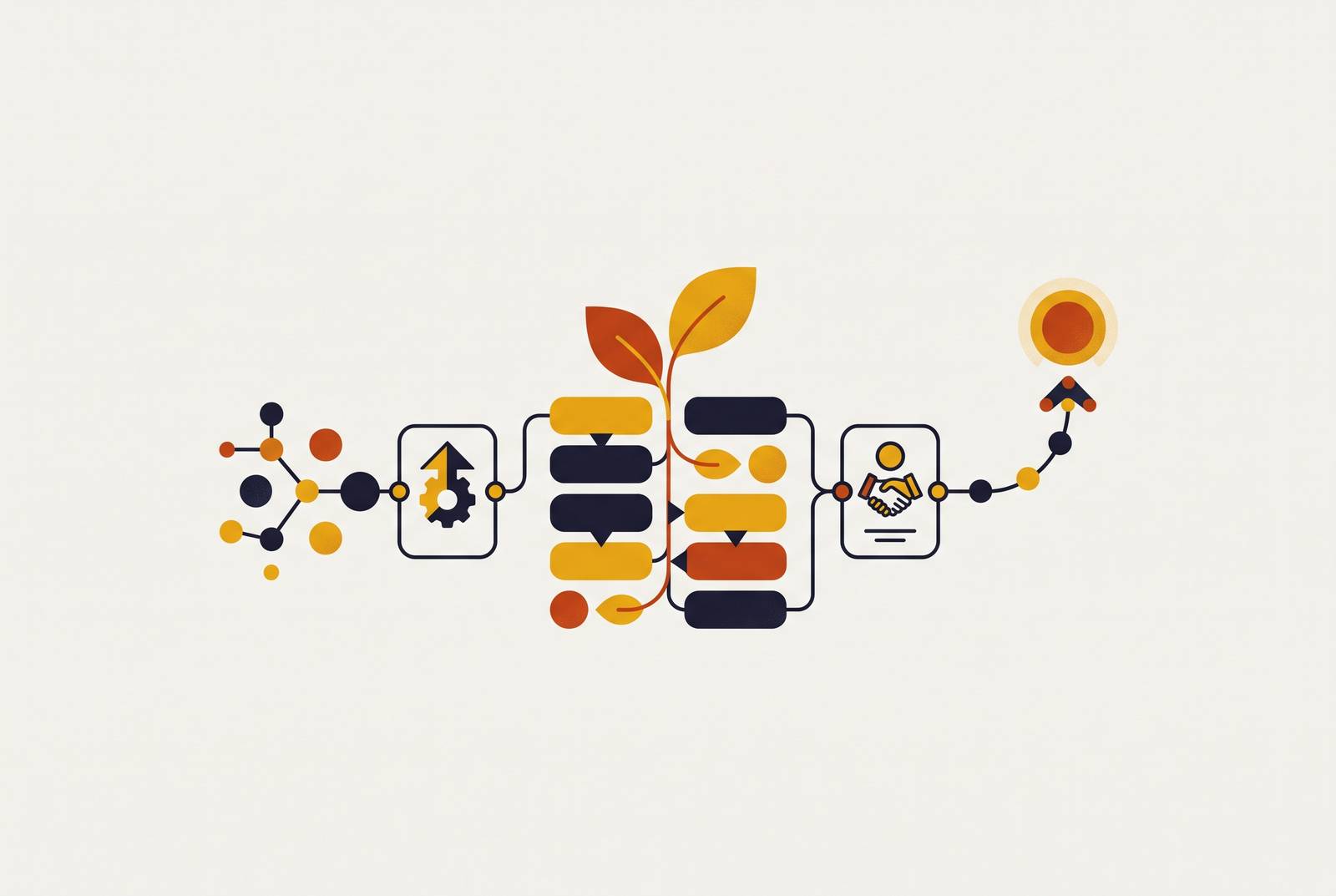
The workflow the AI-native stack enables end to end, from target list to close
Discovery begins with a target list that changes as investor signals change. AI fit scoring and content tracking rank potential lead investors by how well their thesis aligns, their stage history, their check size and where they have put money recently. Access comes next. Warm-introduction mapping finds paths through Gmail, LinkedIn, co-founders and advisors and ranks them by how strong the connections are.
Once introductions begin, the pipeline follows the actual raise. Each conversation progresses through the relevant fundraising stages, while investor activity informs follow-up priority. A deck view or data room visit can prompt a follow-up with an engaged investor before the calendar reminder for that contact comes due. Preparation then draws on call intelligence to surface thesis language, typical questions and prior portfolio decisions before the first meeting.
After meetings, round coaching supplies the iteration loop. It captures what worked and what did not across calls, feeding structured feedback into pitch narrative and round strategy. That feedback is part of the same process that tracks relationships through diligence, term sheet and close. The founder can repeat these steps even though investor decisions are still uncertain. Reproducing it in a generic CRM requires the founder to keep supplying the links between discovery, access, engagement and learning.
The objection worth taking seriously — when AI targeting still cannot open the door
Perfect targeting does not guarantee a meeting. A founder at true pre-seed with a thin network may need warm introductions far more than a better-ranked database. An engine that identifies fifty perfectly aligned investors offers limited practical value if none will meet without a mutual connection. This is the strongest objection because it separates two genuinely different problems. Knowing whom to approach does not establish a route to them.
Warm-introduction mapping addresses that constraint only within the existing network. It can reveal hidden paths through co-founders, advisors or other connections, but it cannot create relationships that do not exist. Better data does not remove that boundary. The platform narrows the gap between a founder’s network and the investors that network can reach. Founders still need to build their networks as part of fundraising, even with fit scoring.
Consequently, AI-native fundraising CRMs deliver their greatest value when there is enough of a network for introduction mapping to use. That is typically the case by seed stage, including for first-time founders coming out of accelerators such as Y Combinator, Techstars, ERA, Alchemist, a16z Speedrun or Goodwater Capital. The tooling decision turns on whether the founder needs to build relationships first or operate an existing relationship network with greater precision.