Building a Tiered Investor Target List From Scratch
A step-by-step method for ranking 30–80 investors by fit.

Building a Tiered Investor Target List From Scratch. Typical raise at this stage ranges from $250K–$1.5M, with a median of roughly $500K and a post-money valuation of $5M–$10M. Dilution typically runs 10–20%, with time to close spanning 1–3 months. Typical raise at this stage ranges from $1.5M–$6M, with a median of roughly $3M and a post-money valuation of $10M–$25M. More specifically, Crunchbase/Carta data show median seed rounds were $4 million in Q4 2025 with post-money valuations averaging $24 million. Dilution typically runs 15–25%, with time to close spanning 2–4 months. Typical raise at this stage is $7–15M in the US and €8–15M in Europe, raised 6–18 months after seed. Investor types include tier-1 VCs such as a16z, Sequoia, Accel and equivalents, with a median pre-money valuation of roughly $49.3M overall, though AI Series A pre-money valuations run significantly higher. The total list size should span 30–80 names across all three tiers, selected against the qualifying criteria rather than pulled from a generic VC database. Tier 1, the A-list, consists of 8–10 investors who are the highest-fit, highest-conviction targets. They match all five qualifying criteria precisely. Two of three Series A deals in 2026 involve investors who already knew the founder for 6–9+ months before the round opened, and the cold-start round is dying.
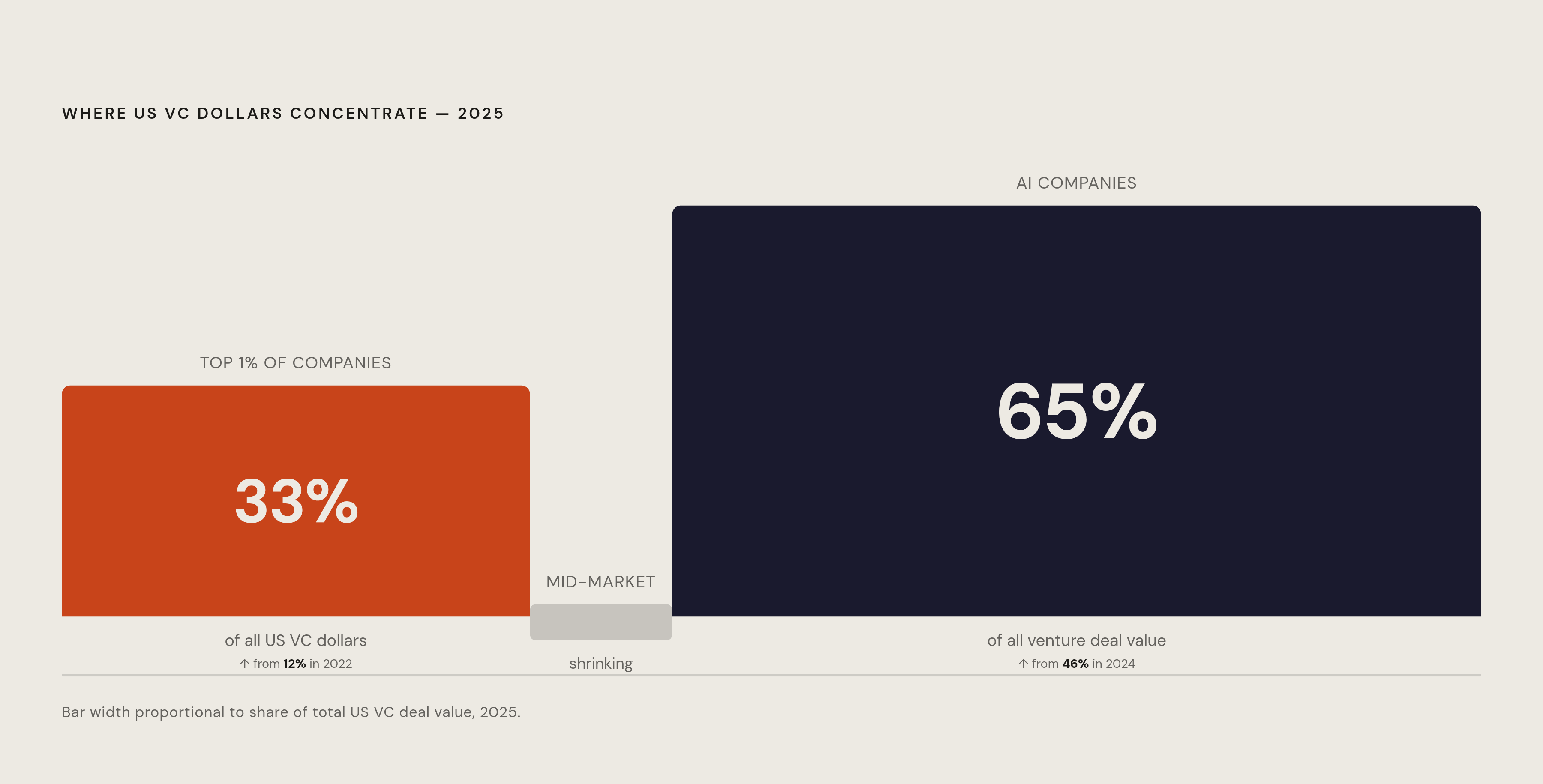
A tiered investor target list is a matching exercise: stage, sector, and traction profile checked against investors who are actively writing checks at that exact intersection, ranked by fit rather than by name recognition. AI companies alone captured 65% of all venture deal value in 2025, up from 46% the year before, and the top 1% of companies by valuation absorbed 33% of all US VC dollars in 2025, nearly triple the 12% share they held in 2022.
That barbell shape, heavy at the top, heavy at the earliest stage, thin in the middle, means the founder raising an ordinary-sized round is competing for a narrower slice of investor attention than the headline totals suggest. Investors are seeing more deal flow, not less, and they are pattern-matching faster as a result. A list of 200 VCs pulled from a database loses to a list of 40 built against real qualifying criteria, and it is not close. Volume reads as desperation to a partner whose fund closed in the last 12 to 18 months and is now under deployment pressure. Precision reads as a founder who did the work of understanding who they are actually talking to.
The stage you are at determines everything about who belongs on your list
Stage is not a label to slap on a pitch deck. It sets the investor class, the check size, the valuation band, and the traction bar a founder has to clear before a given VC can even say yes.
At pre-seed, the numbers are tight and the instruments are small. The investor class here is angels, accelerators such as Y Combinator, Techstars, 500 Global, and Antler, and pre-seed micro-funds like Hustle Fund, Forum Ventures, and Hawthorne. US founders raised $10.4 billion across pre-seed instruments in 2025, but the number of individual instruments fell 13% year over year, which tells you the same thing the barbell data tells you at the macro level: fewer checks, each one bigger, going to founders who look ready rather than merely promising.
Seed looks different again. The roster expands to dedicated seed funds like Floodgate, First Round, and Initialized, multi-stage early firms such as Felicis, seed programs run out of larger platforms (Sequoia Arc, a16z Seed, Lightspeed's Launch program), and strategic angels operating through AngelList syndicates. Seed funding in North America totaled $20.4 billion in 2025, down 9% from the year before: fewer checks, each one bigger. At this stage investors want an MVP with early signs of product-market fit, some go-to-market motion already underway, and a narrative that holds together.
Series A is where the filter tightens hard, and this is the stage most founders misjudge. Only about 20% of seeded companies ever raise a Series A, which makes the round a filtering event rather than a natural next step in a founder's story. It also takes longer to get there than it used to: the median time from seed to Series A is 616 days, roughly 20 months. The traction bar has moved: $1M+ ARR is the new baseline, growing 2 to 3x year over year, with a GTM motion that is codified and repeatable rather than improvised.
The criteria framework that qualifies an investor before they go on your list
Stage fit comes first: does this investor write checks at your stage, and does their fund size actually support it. Sector fit follows, and it has to be a pattern, not a coincidence: look for a run of portfolio companies in your category or a thesis the firm has stated publicly that names your space.
Geographic fit gets overlooked constantly, and that is a mistake. US investors reward growth velocity and a blitzscaling story, while European investors heading into 2026 increasingly want capital efficiency, a defined regulatory path under frameworks like MiCA or GDPR-2, and a credible route to EBITDA positivity. The same deck, unmodified, does not work in both markets. A founder who sends it anyway is telling a sophisticated reader that they have not done their homework on who they are pitching. For AI companies specifically, seed-stage AI startups are closing at a 42% valuation premium over non-AI peers, and that premium changes not just who is hunting for the round but the terms they are willing to offer.
A firm can match every other criterion on paper and still be unable to write the check, because the fund it raised from is past its investment window or the firm itself is out raising its next vehicle from LPs https://altss.com/blog/top-5-venture-capital-trends-to-watch-in-2025. Run a portfolio conflict check first: if the investor already backs a direct competitor, most will pass outright, and the ones willing to engage anyway will rarely lead. Then target the partner, not the firm. Qualifying the firm is not the same as qualifying the person, and the specific partner whose sector focus and portfolio pattern actually match your company is who the pitch needs to reach. Pitching the wrong partner at the right firm still counts as a miss. An investor's fund size should be roughly 20x your target raise (a $10M fund is not writing a $5M check).
The purpose of each of the three tiers
The three-tier structure exists to manage sequencing and risk. It is not a vanity ranking of the most famous names a founder can attach to a data room.
The instinct is to pitch them first, since they are the dream outcome. Resist that instinct. A no from this tier stings in a way that shapes momentum for the rest of the raise, so protect these names until the pitch has been tested and sharpened elsewhere.
Tier 2 covers strong fits with one gap: an investor newer to the sector than ideal, a check size slightly off, or a relationship that is warm but not yet hot. This is where the primary outreach wave belongs, run only after the pitch has been stress-tested on Tier 3.
Investor intelligence sources worth using
A standard database can tell a founder who invested in what historically. That is where its usefulness ends. It cannot say whether that investor is deploying right now, the firm's thesis has quietly shifted since its last fund closed, or the founder's own network already holds a warm path to the one partner who matters.
For deal-level history and fund status, PitchBook remains the standard reference, a private market intelligence platform covering deal data from pre-seed through buyout, founded in Seattle in 2007 and acquired by Morningstar in 2016, with fund vintage and check-size detail specific enough to cut real time off determining whether a firm is currently active. Crunchbase serves a similar function at broader scale, useful for filtering by industry, stage, geography, and portfolio history, and it has added AI-powered search and investor recommendation features through 2025 and into 2026. Tracxn has broadened its US and European coverage over the same window, adding thesis and stage tags granular enough to surface sector-specific investors who do not show up prominently in the bigger, more generalist databases.
A second category of tool handles fundraising workflow directly rather than research: tracking investors, running dashboards, and coordinating investor updates, with expanded database functionality and workflow automation rolled out through 2025 and 2026. Affinity pulls relationship data out of emails, calendars, and meetings, then layers AI on top to surface the warmest path to a given decision-maker, and that matters more now that 85% of VC firms use AI to automate daily tasks: the tools an investor's own firm runs on shape how that investor expects to be approached. Rings AI, which added warm-intro network mapping in 2024 and native CRM sync in 2025, earns its keep specifically by surfacing connection paths that would not otherwise be obvious.
A newer category, the AI-native fundraising platform built for founders rather than institutional deal teams, folds research, pipeline tracking, and outreach into one workflow instead of forcing a founder to stitch together a database, a CRM, and a tracking sheet by hand. The sensible approach borrows from each category rather than picking one: PitchBook or Crunchbase for deal history and fund status, relationship-mapping tools for warm-path identification, AI-native platforms to pull it all into one working pipeline. Harmonic offers AI-powered investor matching, analyzing a company profile and suggesting investors based on sector, stage, and portfolio fit.
Finding the warm path into each tier, and the reasons cold outreach rarely clears the bar
Warm introductions convert at meaningfully higher rates than cold outreach, and the gap runs wide enough that cold email, as a primary channel, wastes the limited outreach window a founder has for Tier 1 and Tier 2 names. This is a matter of substance, not etiquette: it reflects how relationships actually form ahead of a round. The cold-start round, where a founder emails a partner they have never spoken to and closes a check off that single message, is dying as a viable path, and it is dying fastest for the tiers that matter most.
There is a clear order to how a warm path gets built, and skipping it does not save time so much as spend it somewhere worse. Portfolio founders already backed by the target investor make the strongest introduction, since they have sat through that partner's diligence process and their endorsement carries weight a founder cannot manufacture alone. Co-investors from a prior round rank second, followed by mutual angels or advisors who know both sides. Direct LinkedIn outreach is the bottom, a distant last resort reserved for Tier 1 and Tier 2 names specifically. It is not useless everywhere: cold outreach can still work further down a list where the bar for engagement sits lower. For the names a founder can least afford to burn, though, it remains the weakest tool available.
Finding these paths takes systematic research. Relationship-mapping tools like Affinity and Rings AI exist precisely because they surface shared connections methodically rather than relying on memory. Treated with the same rigor as the qualifying criteria themselves, warm-path mapping is what turns a target list from a wish list into an actual sequence of moves.
Signals that an investor is actively deploying, and signals that they are not
Chasing a firm in that position burns time inside a fundraising window that is already compressed, and it ranks among the more avoidable mistakes a founder can make once the rest of the list is built correctly.
A handful of signals point toward active deployment. A recent fund close, announced within the last 12 to 18 months, usually means the fund sits fresh and under real pressure to deploy.
The warning signs run the other way. A portfolio that has drifted sharply away from the founder's own sector over time rounds out the list, and any one of these three should slow a founder down before they spend outreach effort on that name.
None of this is guesswork a founder has to run on instinct anymore. AI adoption inside venture firms is accelerating fast, with 82% of firms now using AI for deal-sourcing research. The investors on the other side of the inbox run faster, more automated pattern-matching on every deal that lands. That cuts both ways. It raises the cost of a poorly targeted approach, since a mismatched pitch gets filtered out faster than it used to, but it also means a genuinely well-matched founder, one who has done the stage work, the criteria work, and the warm-path work described above, is easier for the right investor to recognize as what they have been looking for. A firm that matches all five criteria on paper but is past-vintage or in LP fundraising mode cannot lead your round, and targeting them wastes your compressed outreach window. Look for new portfolio company announcements at your stage in the past 6 months. A last announced deal that is 18+ months old at your stage is a warning sign. A fund vintage more than 5–6 years old with no new fund announced is another warning sign. AI companies captured 65% of all venture deal value in 2025 https://qubit.capital/blog/ai-startup-fundraising-trends. AI companies captured 46% of all venture deal value in 2024 https://qubit.capital/blog/ai-startup-fundraising-trends. 33% of all US VC dollars went to the top 1% of companies by valuation in 2025 https://qubit.capital/blog/ai-startup-fundraising-trends. 12% of all US VC dollars went to the top 1% of companies by valuation in 2022 https://qubit.capital/blog/ai-startup-fundraising-trends. OpenAI raised $40 billion in a mega-round https://qubit.capital/blog/ai-startup-fundraising-trends. Anthropic raised $30 billion in a mega-round https://qubit.capital/blog/ai-startup-fundraising-trends.