Automated Investor Follow-Up Reminders Built Into Fundraising CRMs
Automated reminders keep investor relationships warm when conversations stall between touchpoints.

A fundraising pipeline CRM built for early-stage founders keeps investor relationships moving with stages for each round, automated follow-up reminders, and engagement signals. Its purpose is to preserve the cadence between conversations without requiring the founder to remember every next action. After Demo Day, that means working warm contacts first, responding to renewed interest, and sustaining follow-up across weeks.
Why most raises stall between conversations, not in them
A founder raising a Seed or Series A is managing dozens of investor relationships at once. One investor needs a deck, another is considering a partner meeting, and another has asked to reconnect in Q2. Each conversation has a different next action and an implicit deadline. The gaps are where momentum most often breaks. An enthusiastic first call can become a cold contact when the next message arrives too late or never arrives at all.
Most founders begin with a spreadsheet or Notion doc because the first handful of conversations is manageable. A partner asks for a deck that was already sent, a reminder for later gets buried, and high-conviction investors go quiet without a nudge when they need one. The information may still be somewhere in the system. What is missing is a reliable mechanism that brings it back to the founder when action is due.
This is cognitive overload. A good pitch cannot make up for a process that relies on the founder to remember every promise and how long it has been between messages. Even a founder who is good at relationships needs a system that can preserve the context and timing those relationships require.
What a fundraising pipeline actually looks like at volume
A venture round moves through first contact, first meeting, partner meeting, diligence, term sheet, and close. Each transition calls for a different follow-up, from sending initial materials to supporting diligence or advancing a decision. The cadence changes with the stage as well. A pipeline must therefore track both where a relationship stands and what needs to happen next.
Across a full raise, those transitions overlap. A founder can be arranging first meetings while other investors review materials and others move toward a term sheet. Updates, nudges at the right time, and momentum signals must keep coming for weeks, even as new conversations enter the pipeline. A strong meeting is only one touchpoint. The operational work lies in connecting it to the next one without neglecting relationships elsewhere in the process.
Once a pipeline has roughly 20 active relationships, the limits of a spreadsheet add work every day. It does not have the engagement signals, permissioned data room access, and connected update workflows needed to handle all that activity in one place. The founder must also piece together what investors have done, what previous messages said, and what still needs to be done across separate tools. That workload is solvable, but it requires a system designed for the structure of a raise.
What separates a fundraising CRM from a sales CRM
A sales CRM and a fundraising CRM can look alike because both keep contacts in order and track progress. Their underlying workflows differ, however. Generic stages such as “Lead,” “Opportunity,” and “Closed” do not describe the progression from an investor introduction through a partner meeting, diligence, and a term sheet. Stages built for fundraising give a more accurate record of that progress. They also give follow-up reminders the context needed to distinguish one next action from another.
HubSpot and other sales CRMs require heavy customization to run a raise. Investor-specific workflows, including data rooms, updates, and deck tracking, sit in a separate stack that must be stitched together. That separation creates opportunities for fragmented contact records and missed follow-ups. The distinction is not simply convenience or terminology. A tool that knows an investor opened a deck update three times supports a different decision from one that records only that an email was sent.
Angel Match illustrates how relationship state can update without manual logging. When a founder emails an investor, the lead moves from “Leads” to “Contacted.” When the investor replies, it moves to “Responded,” and the founder receives a notification in the Angel Match Inbox. This automation keeps the stage aligned with the exchange. It illustrates one component of a fundraising workflow, rather than establishing that every tool in the category provides every engagement or reminder capability.
How automated follow-up reminders actually work inside a fundraising CRM
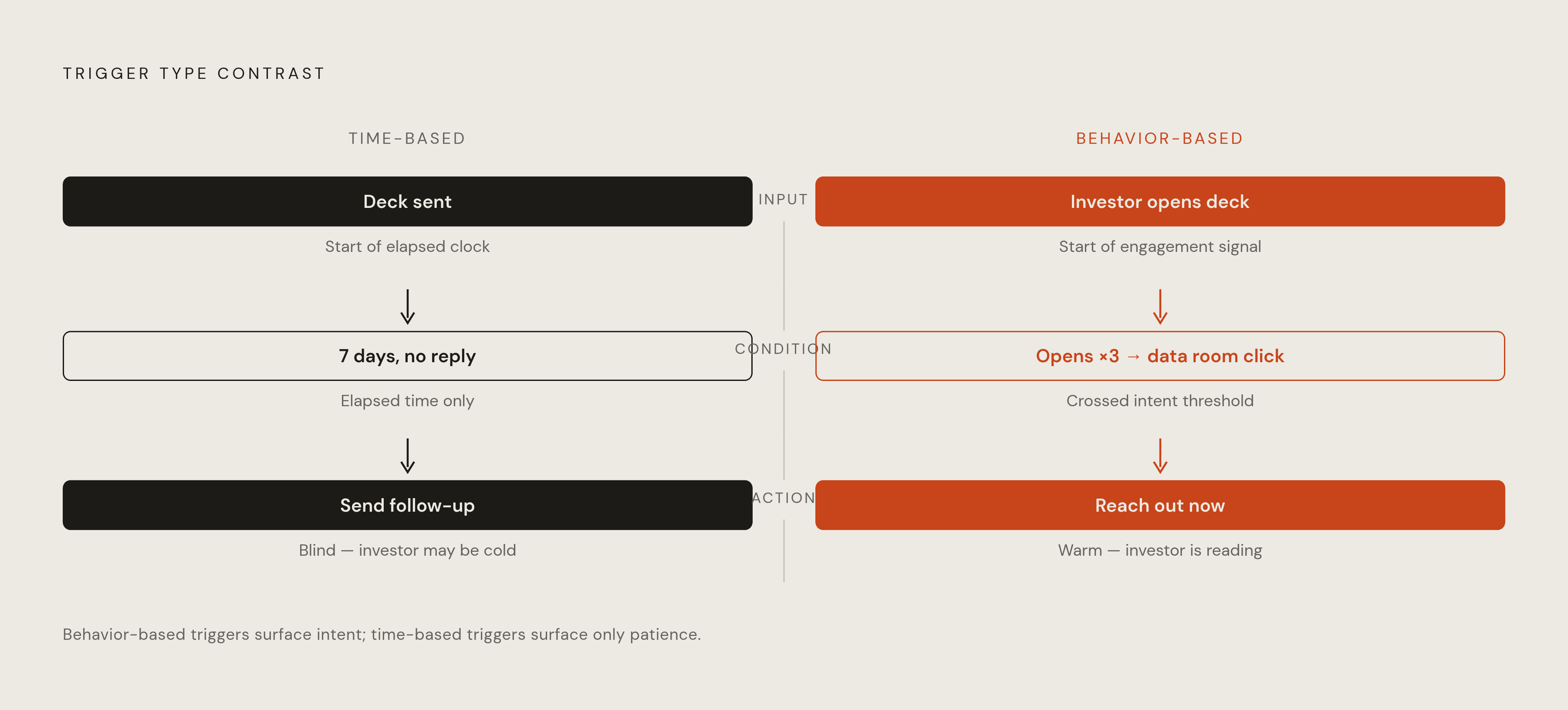
Automated reminders operate through two distinct forms of trigger logic, which are time-based and behavior-based. A time-based trigger queues a reminder after a defined interval following an event, such as a meeting or deck send. For example, the system can prompt a follow-up seven days after materials were sent with no reply. This is the baseline protection against forgetting. It makes elapsed time visible even when nothing new has happened in the relationship.
Behavior-based triggers respond when an investor takes action. In more sophisticated systems, repeated deck views, data room visits, or link clicks can cross a threshold that surfaces an investor for attention the next morning. An investor who opens a deck update three times and clicks through to metrics then becomes a prioritized next action. The founder does not have to discover that activity manually. The reminder connects a change in engagement to an opportunity to follow up.
These trigger types work best together. Time-based reminders help keep contacts from being forgotten, while behavior-based reminders flag conversations that now need more attention. Automatic stage movement also keeps replies from leaving the pipeline record stale. Filters by last contact date, follow-up status, and engagement level make the resulting queue usable. A founder can open the CRM in the morning and see which three investors need attention, rather than reconstructing the day’s priorities from messages and notes.
The engagement signal layer that makes reminders strategic rather than administrative
An alert that says a follow-up is due provides timing but little guidance about the conversation itself. Engagement signals add that missing context. Deck-level analytics can show which slides received attention, whether the deck was shared internally, and how often an investor returned to the financials. Those observations are more specific than an email open. They help distinguish a contact who merely received materials from one actively examining them.
That distinction should change the follow-up. Investor A, who viewed the deck once and never returned, should not receive the same treatment as Investor B, who reviewed it three times and clicked through to the data room. The reminder system can surface that difference automatically, allowing the founder to prioritize the second relationship and tailor the next message to its context. These are indicators of intent. Their value lies in directing attention without requiring the founder to infer warmth entirely from memory.
Investor updates also give signals about the relationship through opens, link clicks, and offers of help. Systems that use those signals to tag highly engaged investors can support a tiered follow-up cadence. The pace then reflects actual interaction rather than the founder’s general impression of who seemed enthusiastic. At 50 investor conversations, that distinction becomes operationally significant. The morning queue can identify warm relationships while the founder concentrates on what each conversation needs.
Where automated reminders break down and how to avoid the failure mode
Automation can make follow-up worse when it produces generic, undifferentiated messages at scale. Investors already get automated outreach from many sources. Another message without context can look like part of a mass-blast rather than a targeted, conviction-driven raise. A delayed personal note may be better than that.
The remedy is to automate timing and context while leaving the founder responsible for the actual follow-up. A reminder should surface the right moment and the information needed to write one personalized sentence from the conversation. Automation configured around volume substitutes repetition for depth. Automation configured around relationship quality removes tracking overhead so that the founder can spend more attention on each exchange.
Scope also changes the decision. For a first raise under roughly $1M with a small contact list, a well-structured lightweight tool or Notion template may be adequate. Warm introductions still have the highest conversion rate, so founders should weigh relationship mapping and warm-intro enrichment more heavily than generic pipeline features. Benchmark’s Everett Randle has described sourcing through “meaningful and deep relationships with entrepreneurs” that begin well before a formal process. Automated systems should support relationships built over months.
Demo Day as the highest-stakes test case for automated follow-up discipline
Demo Day compresses the follow-up problem into a burst of warm attention with a short half-life. Investors take meetings, customers say “email me,” and partners offer introductions, leaving the founder with multiple kinds of next action at once. Each contact can be valuable, but each requires follow-through. The first few days are the highest-leverage window. Under that load, a system is more likely to break down if it cannot tell stages apart, keep context, and bring up reminders.
YC’s Winter 2026 Demo Day took place on March 24, 2026, with a large cohort presenting and pitch videos posted shortly after each founder presented. The operating response is a structured four-week process. Founders should block a substantial slate of investor meetings over the following two weeks while running outreach in parallel. The first follow-up is a short note thanking the investor, restating the round, and linking to materials with one personalized sentence. Reminders make that task visible across the interested contact list, rather than only for the investors the founder remembers most clearly.
The daily cadence then shifts from initial acknowledgment to prioritization. Each morning, the CRM’s last-contact dates, follow-up status, and engagement signals should show the founder what is due and who has shown renewed interest. Before starting another outreach campaign, founders should follow up with the warm contacts they already have. A short weekly investor update sustains that cadence across the process while supporting accountability and relationship-building. Automated update workflows help keep the note from being missed, even for contacts who may be part of the next raise.
How to evaluate whether a fundraising CRM's reminder system is built for a venture raise
A founder choosing a fundraising CRM should check whether its stages, triggers, and engagement data work together in one workflow. Fundraising-native stages should cover first contact, partner meeting, diligence, term sheet, and close without heavy customization. Both time-based and behavior-based reminders should be present. A timer alone is insufficient for prioritizing renewed interest. Deck analytics, data room view tracking, and investor update open rates should feed the reminder queue.
The contact record is the next practical test. Relevant fields include pipeline stage, last contact date, follow-up status, engagement level, notes, and task ownership. Co-founders, advisors, and operators need shared visibility into those records so that relationship status does not depend on one person’s private view. Team access becomes especially important in a Series A process. The CRM should also continue into investor relations after close, because term sheet day begins another phase of relationship work.
Angel Match has a CRM built for early-stage founders, with reply-triggered stage movement and advanced filters by last sent date, outreach count, reply status, and notes. Its pipeline management is built for founders managing cold outreach at volume. Buyers should still check the full reminder and engagement criteria separately from those features. The appropriate choice depends on scale and stage, from a lightweight tool for the earliest conversations to engagement signals, automated reminders, and AI-driven prioritization for a full Seed or Series A process.