Why Demo Day Buzz Dies in Your Inbox and How to Revive It Before Investors Go Cold
A four-week sprint turns Demo Day interest into real meetings.

Post-Demo Day fundraising pipeline discipline means treating investor interest as a timed operational process. For accelerator founders, the practical answer is a four-week sprint with qualified targets, explicit next actions, scheduled follow-ups, and weekly investor updates. Demo Day buzz dies in the inbox when no system converts attention into meetings, diligence, and decisions.
Why Demo Day is a fundraising launch, not a fundraising close
A sixty-second pitch opens a fundraising conversation. It does not close one. Demo Day is a sales and marketing launch whose concrete output should be a packed calendar of qualified investor meetings for the following two weeks. YC founder accounts describe the pitch as the opening move and the meetings afterward as the real raise.
A room full of interested investors produces warm leads, and treating those leads as a finished round leaves the decisive work undone. YC data shows that roughly 40% of batch companies raise within four weeks. The first month is a consequential window. Founders enter it with attention they have already earned, but that attention does not remain available indefinitely.
How investor interest decays after the room clears
Investor attention compresses immediately after Demo Day because a fund partner can give meaningful consideration to only a small fraction of the presenting companies. The rest begin to blur together. Meanwhile, the deals investors believe in most move toward oversubscription and locked leads, so investors who wait for inbound the following week fall behind. This is a timing problem on both sides of the table. Investors are sorting opportunities while founders are trying to preserve their place in that ranking.
For founders, the same timing problem occurs when routine tasks slip. A deck request goes unanswered for three days, a reminder to reconnect in Q2 disappears into a spreadsheet, or two high-conviction investors go quiet without a timely follow-up. These failures can happen even when the relationship is good. They occur when the next step depends on someone remembering a conversation or deciding that the moment feels right.
Interest is an option. An investor can mean it while still needing diligence, talks with partners, and a reason to decide within a set time. Without a process connecting those steps, the initial enthusiasm has nowhere to go.
What the post-Demo Day window actually looks like as an operational sprint
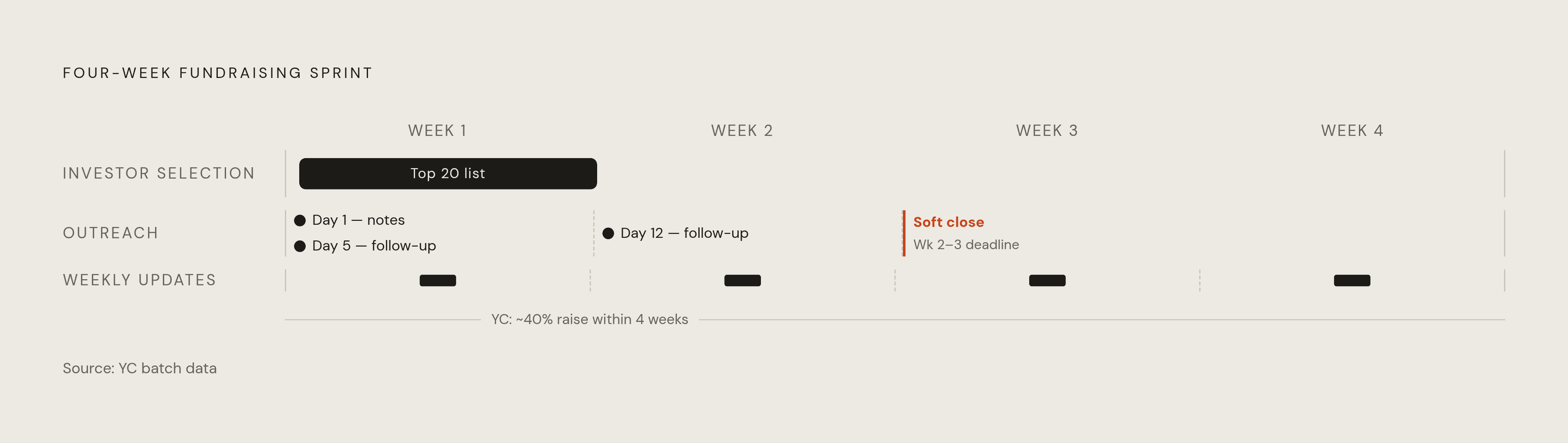
The operational response is to define the four weeks after Demo Day as a sprint with a close date, parallel tracks, and explicit milestones. YC founders describe setting aside time for 25–40 investor meetings across the following two weeks, sending a detailed memo before every call, and setting a soft close date two to three weeks out. The date gives investors a decision point. Rather than leaving the opportunity open indefinitely, it renews the urgency that the event created.
Parallel work is essential to that structure. Founders should prioritize two to three potential lead investors while continuing to advance the full pipeline, because waiting for a lead before engaging everyone else sacrifices time and leverage. The round itself also needs a specific purpose, expressed through the amount being raised, the milestone it funds, and the months required to reach it. That connects the financing decision to an operating plan.
The preparation must precede the sprint. The target list, follow-up email template, and data room should be ready before Demo Day ends, so founders can spend the first hours after the event using them. A prepared template supports speed without requiring identical messages. From there, the sprint has three distinct operational layers, which are investor selection, outreach execution, and structured updates between meetings.
Building and prioritizing the investor pipeline before the first follow-up goes out
Founders should first build a “Top 20” target list before Demo Day, qualified by specific partner, thesis fit, check size, and portfolio overlap. A fund name alone is insufficient. A direct competitor in the portfolio removes a target from the list, while complementary portfolio companies can provide a reason for a conversation. The list should also extend beyond Demo Day attendees, who represent only a subset of the active check writers at a given stage.
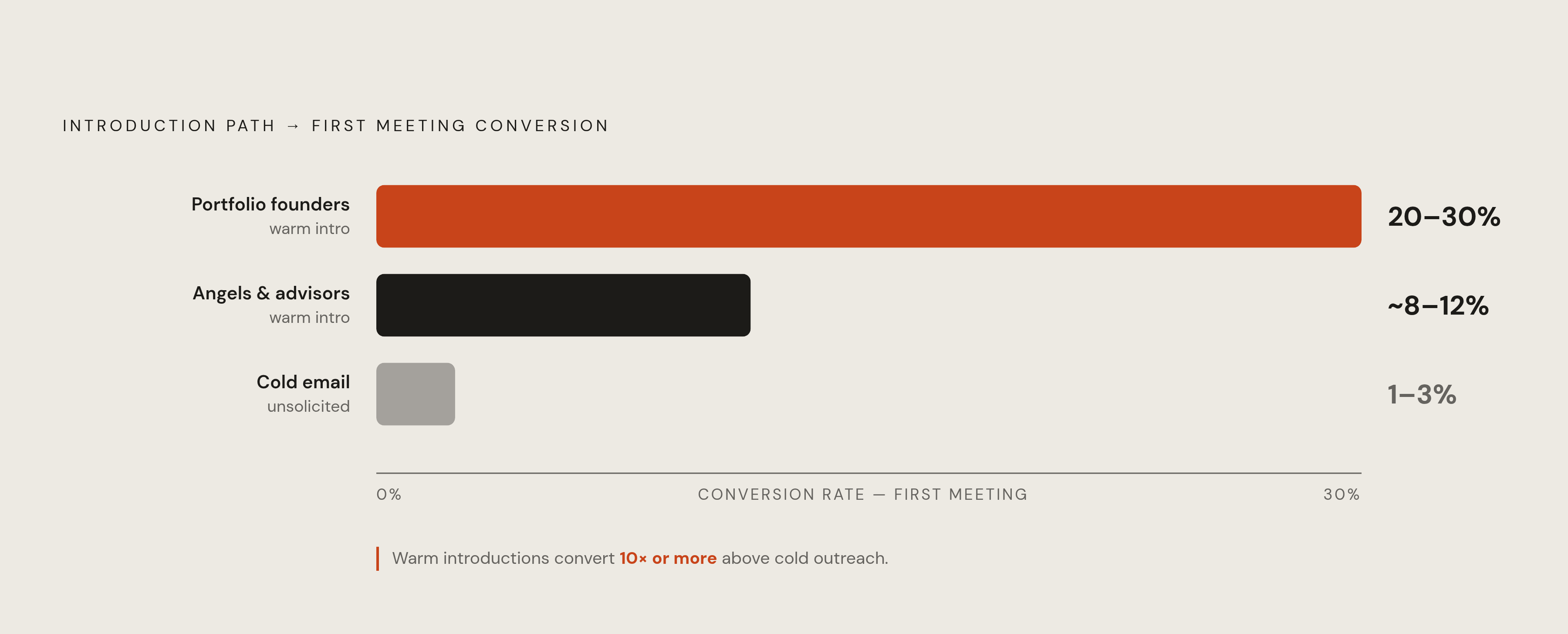
Warm introductions convert to first meetings at 20–30%, while cold email converts at a small fraction of that rate. Introductions from portfolio founders are most likely to lead to first meetings, followed by those from angels and advisors, with cold email at the bottom. The route changes the outreach priority. A list ordered only by investor name or fund prominence misses the practical question of how a qualified conversation will begin.
Founders should aim to send most outreach through warm introduction paths and use cold email for the rest. Mapping relationships through Gmail and LinkedIn networks can show paths that research by hand misses, so founders can find a way in. The pipeline also has value beyond the current round, so every pass should be archived. An investor who declines now may become a relevant lead for the next raise.
Running the outreach cadence so no warm lead goes cold
In the first days after Demo Day, founders should send a short, personalized note to every investor who showed interest, referencing a specific moment from the conversation, restating the round, and linking to the data room. One sentence should come from the actual exchange. That detail distinguishes a managed follow-up from a broadcast without requiring a completely new message for every recipient. Before each booked call, the detailed memo gives the investor the material needed for a substantive discussion.
The advice is to send two follow-ups, spaced roughly five and twelve days apart. These are planned touches. Outreach volume should remain high enough to sustain a competitive round, but sending more messages than the founder can track simply moves the bottleneck into follow-up. The relevant constraint is the ability to keep every active conversation actionable.
The CRM should move investors through explicit stages, namely Target, Intro Requested, First Meeting Booked, First Meeting Done, Due Diligence, Term Sheet, and Closed. Each investor needs exactly one clear next action. A usable record should bring together the qualification information, introduction path, current stage, next action, and follow-up timing, so the founder can distinguish a promising name from a conversation that is actually advancing. The next action makes the record operational.
When a lead investor is willing to set terms, founders should communicate that development to other interested parties immediately. This is a concrete urgency signal. Even a well-run outreach cadence, however, leaves intervals between meetings and diligence steps. A weekly investor update keeps founders in touch during that time.
Keeping the pipeline warm between meetings with structured investor updates
Founders should send it on the same day each cycle, at the same frequency, as part of the same process that schedules partner meetings and maintains the diligence checklist. Consistency builds a record of reliable execution. Sporadic updates, by contrast, make communication another variable the investor has to interpret. Sending updates on a fixed schedule keeps the founder in view without another meeting.
The update also provides information about the pipeline. Opens, replies, and follow-up questions indicate which investors are paying attention before a term sheet arrives. Those signals help distinguish continued engagement from a conversation that has stopped moving, while progress shared between meetings reduces the amount of catching up required in the next call. Investors who remain informed are better placed to move quickly when a decision is needed.
Each update should include a specific request, such as an introduction to a particular firm, an answer to a question, or a reference check. The request gives interested investors a concrete way to participate before committing capital. It also connects the update to the next step in the raise.
Where AI tooling fits into the post-Demo Day sprint
The research and tracking behind this process create a substantial workload for a founder without a large team. At the pace the post-Demo Day window demands, that repetitive work needs automation if outreach is to remain both fast and precise. The pressure is not limited to founders. Some funds already use automated sourcing engines to score and rank batch companies before the pitches end. The investors who move fastest may come to the first conversation with a shortlist and their screening work already done.
Founders need tools that let them do the same kind of research. AI tools can support investor discovery through stage, sector, geography, check size, and thesis fit, then map relationships to identify warm introduction paths. They can also track the pipeline, prompt follow-ups, surface next actions, and analyze pitch performance from call recordings. These functions support different parts of the same process. Their value is in reducing the research and administrative load that would otherwise compete with investor meetings.
Deck analytics add another signal between direct exchanges. Tools that show who viewed a deck, which slides received attention, and whether it was shared internally can reveal engagement before an email reply arrives. The signals still require interpretation. Their purpose is to inform pipeline decisions. Likewise, research-based personalization is more useful than increasing template count or send volume, because investor fit must be established before a message is drafted.
Consolidating discovery, relationship mapping, pipeline management, and round coaching reduces the fragmented work of separate searches, network research, and spreadsheet tracking. It does not replace founder judgment. The founder still decides which investors fit the company’s vision, builds the relationship in the meeting, and earns the conviction needed to close a lead. The tools can make disciplined execution possible at speed, but they cannot make an improvised process disciplined by themselves.
What separates founders who close in four weeks from those who don't
Fast closes depend on what happens after the applause. The distinguishing feature is not simply an impressive pitch, but a process that keeps qualified investors moving toward a decision while the founder maintains alternatives in parallel. When founders leave the pipeline unmanaged, they lose that time to outreach that reacts to events, long silences, and unclear next steps. Founders can see the difference when they know what each active investor needs next and go beyond remembering who sounded keen.
The practical change is to make fundraising a scheduled operating responsibility rather than a series of conversations revisited when time permits. That means committing to the sprint before Demo Day ends and using research and tracking tools to protect time for the discussions only the founder can conduct. Qualified investor attention is the scarce resource. A founder cannot turn every interested investor into a check, but can prevent earned attention from expiring because a request, reminder, or decision was left unmanaged.